Category Archives: #screenwriting

What do your characters want?

EVERY character has a goal and a need.

Each of the major characters in your story world has a goal for their life. A want. A desire.

From a junkie who wants to score, to a politician who wants to be president.

Even minor characters have goals, too.

And whenever a character, major or minor, comes into contact with your hero, those goals should clash.

This is conflict.

John Truby in his incredible book ANATOMY OF STORY describes a threefold opposition.

Your ‘hero’ or ‘protagonist’ has a moral flaw, right? And that moral flaw is preventing her from achieving her goal, right?

It’s only when she realizes her need that she has the inner knowledge and strength to achieve her goal, (or realize the goal she was chasing wasn’t important after all).

But that’s the climax: the moral / psychological revelation that causes new moral action and completes her change, her character arc.

To bring our hero to the point that drives her to have a moral or psychological revelation she must be attacked from all three corners of the ring – each opponent attacking her fatal flaw in a different way, from a different perspective.

For example in my screenplay about a vigilante who becomes addicted to killing pedophiles after his 7 year old daughter is raped and left for dead, he faces moral opposition from his wife who believes in trusting the legal system. He faces moral opposition from his (now teenage) daughter who believes in psychiatric help and rehabilitation for men convicted of sex crimes. Finally he faces moral opposition from a violent cop, representing the force of authority.

Yet each of these characters must have their goals and needs too and must always be working towards those goals.

We always want something – and so do our characters if we are to make them real – a life goal, a story goal and a scene goal.

For example in my screenplay the teenage daughter’s life goal is to pass her A levels so she can study Psychology at university and go onto help men like the one who hurt her. That’s her journey.

But her story goal is to stop her dad from killing on her behalf.

Yet a scene goal may be simply to make eggs for breakfast.

Even making those eggs, when she runs into her father in the kitchen, those story goals come into direct conflict. Even if it’s unspoken, it’s there in the tension. It’s there in the subtext.

Story goals cause conflict.

So, let’s do the groundwork, guys.

What do your characters want? What are their goals? In the scene, in their life, and in the story.

Let’s build a solid foundation for our screenplays.

Let’s know what our characters want.

vonnegut quote

Click here for John Truby’s definition of a psychological and a moral need.
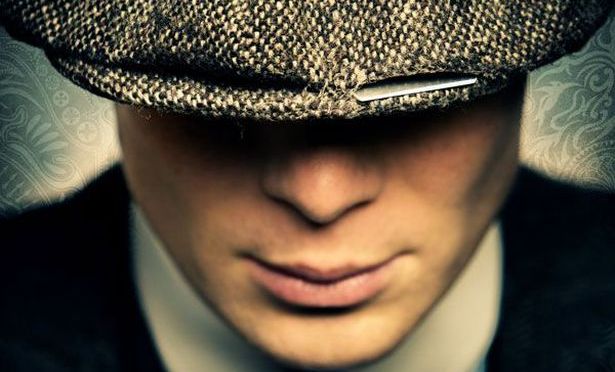


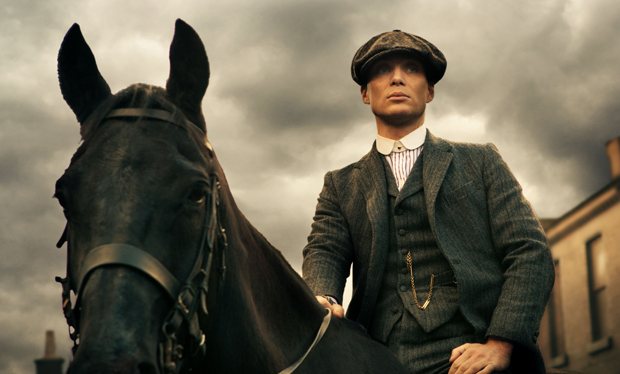
10 Extra Facts about Peaky Blinders

Here are some extra posts exploring the opening 10 mins of Steven Knight’s superb historical crime series Peaky Blinders.

1.The Rise of a King

2. 12 scenes – dialogue or action?

3.A Personal Story in a Political Context.

4. What do Dexter and Peaky Blinders have in common?

5.  Five Facts About Scene Length in your TV Drama.

6. What characters do we meet in the opening ten minutes?

7. Transcending the Genre

8. How long is Your Hero on Screen For?

9. One thing about Women.

10. Three Facts about Scene Length

Peaky Blinders Opening 10 minutes: Scene 5.

I’m just putting the finishing touches to this series of posts exploring the opening ten minutes of Peaky Blinders.

I realized that the Opening 10 minutes has 12 scenes, and I had analyzed every scene except scene 5.

So, here it is:

This is a 15 second transition scene, 1 shot, as we follow Thomas across a busy street and enter a house. On his short journey three more men say ‘Good Morning Mr. Shelby’ and ‘doff’ their caps in respect.

We also get the final opening credit:

Screen Shot 2015-11-29 at 1.43.54 PM.png

In my next email I’ll be putting these Peaky Blinders posts in order so we can really analyze how Steven Knight and his team constructed the all important opening 10 minutes.

Ciao for now!

Mark.

Peaky Blinders Opening 10 Minutes.

In the opening 10 minutes of Steven Knight’s historical crime drama there are 12 scenes.

I have explored each scene in 12 posts.

Below is a link to each post:

Scene 1. Do Your Tits Still Have Milk?

Scene 2. The Man with No Name.

Scene 3. Meeting Thomas

Scene 4. Opening Credits.

Scene 5. Transition. Beginning of Episode .

Scene 6. Meeting youngest brother Finn.

Scene 7. Meeting younger brother John.

Scene 8. Meeting oldest brother Arthur.

Scene 9. Revealing the Antagonist (part 1.)

Scene 10. Setting the Political Context.

Scene 11. Revealing the Antagonist (part 2.)

Scene 12. The King in his Castle.

There are many interesting things to learn.

Firstly, there are only two dialogue driven scenes – scene 8 – a fight for personal power and scene 10 – a cry for political power.

So what do these two scenes reveal? That this is a story about POWER. Personal and Political.

Secondly, the main antagonist is revealed through visuals only – NO dialogue.

Thirdly, at TEN MINUTES EXACTLY we come face-to-face with Thomas Shelby, center screen, as he enters his castle – aptly named The Garrison Tavern.

As you’ll see this is a tightly crafted opening ten minutes.

Please feel free to comment, or drop me an email.

Mark.

peaky-blinders-5277bdad6dba4

Click here SCENE 1.


A Sneaky Peak at Peaky Blinders extra – Transcending the Genre.

We’re studying the opening 10 minutes of Steven Knight’s historical crime drama Peaky Blinders.

In scene 9, when we’re first introduced to the series main antagonist Chief Inspector Campbell (check this post) there is ONE interesting thing Steven Knight subtly sneaks in.

This is a cops and robbers story.

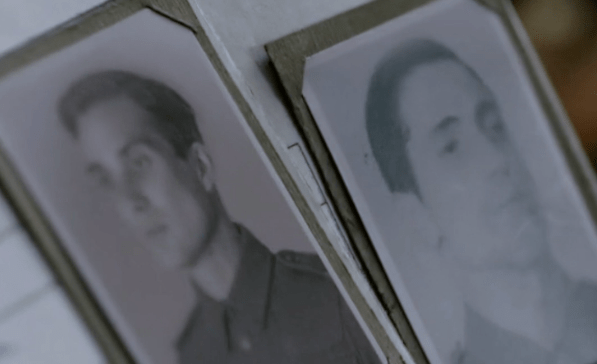
Yet we see on Thomas Shelby’s file the words Honoured for Gallantry.

Screen Shot 2015-04-26 at 12.26.27 PM

Our main antagonist – Chief Inspector Campbell – is hunting not just a gangster, a racketeer and armed robber but a war hero.

In his Detective Crime Thriller audio class John Truby calls this sub-genre Criminal as Hero.

But where a writer twists a genre in a new and original way, John Truby calls this transcending the genre. In fact Truby says this is a ‘must’ in order to write an original screenplay.

This is where Peaky Blinders is successful – it transcends the genre.

Our story is not a simple cops and robbers story but a battle between a Police Chief and a War Hero.

Or, to take it one step further, between The King and his subject.

Read this post to see how Thomas Shelby’s story is The Rise of a King.

1 THING about WOMEN in the opening 10 minutes of PEAKY BLINDERS.

The opening ten minutes of Steven Knight’s Peaky Blinders is filled with men.

  1. Thomas and his brothers – his Peaky Blinders clan.

2. Freddie Thorne, a communist agitator, Thomas’s brother in arms and his brother-in-law to be.

3. Chief Inspector Campbell.

Who is missing?

Dominant Shelby family matriarch Aunt Polly.

What is Steven Knight saying? Is this an intentional statement about post WW1 England being a ‘man’s world’ ?

There is a huge, female-size hole in the opening ten minutes.

Except, of course, the opening scene, where we see a teenage Chinese immigrant hand a baby over to another barely teenage girl and ask her “Do your tits still have milk?”

But how long will we have to wait for razor-tongued, ferocious family boss Aunt Polly to blaze onto our screen?

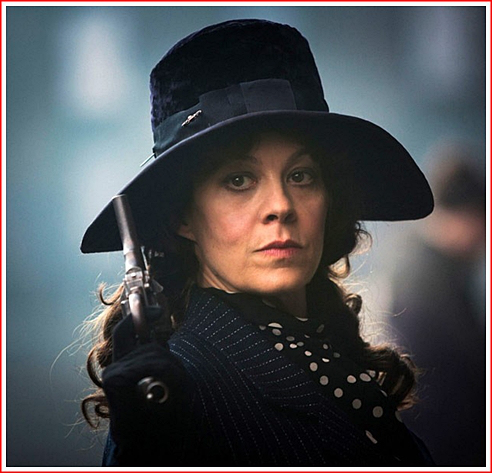
Aunt Polly

A Sneaky Peak at Peaky Blinders: the Personal and the Political.

In the opening ten minutes of Steven Knight’s historical crime drama Peaky Blinders only 2 scenes are dialogue driven.

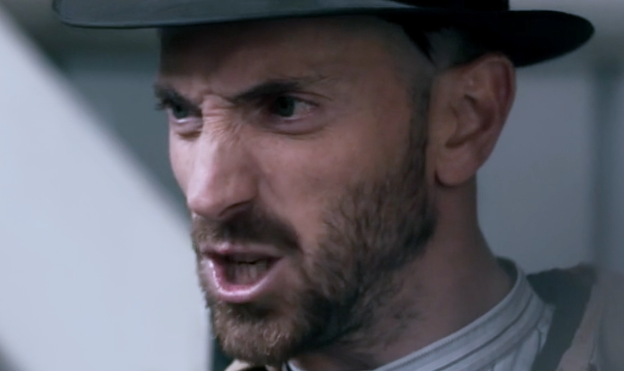
i. Freddie’s rallying socialist cry to the workers.

Iddo Goldberg as Freddie Thorne

ii. Thomas’ fight for power with his older brother.

Arthur blustery

Do these two scenes agree with each other in theme or disagree?

They represent ideological opposites.

Freddie is a ‘communist’. He believes in the power of the workers. He believes in the collective power of the working class. His ideology and influence over the workers of Birmingham, a major industrial city, was a threat to the political elite.

Wikipedia describes communism as:

In political and social sciences, communism (from Latin communis – common, universal) is a social, political, and economic ideology and movement whose ultimate goal is the establishment of the communist society, which is a socioeconomic order structured upon the common ownership of the means of production and the absence of social classes, money and the state.

However, Thomas is on a rise to power. He wants to be, as Freddie says to Thomas’ s sister, “King of Small Heath.” Thomas is a capitalist. Wikipedia describes the capitalist system:

In this system, there are two major social classes: the working class – who must work to survive, and who make up a majority of society – and the capitalist class – a minority who derive profit from employing the proletariat.

The conflict between these two political systems is Thomas Shelby’s story – his rise to power – from working class to capitalist class – from beggar to King.

It’s no mistake by Steven Knight that the two longest dialogue driven scenes in the opening ten minutes are both a struggle for power. One a struggle for communal, collective power. The other a struggle for personal, private power.

The two scenes represent capitalism versus communism.

The scenes are a war of ideas, a conflict of ideologies.

Summing up then, what ONE important thematic technique does Steven Knight employ in his opening ten minutes?

He does what Shakespeare taught us to do in dramas such as Hamlet, Coriolanus and King Lear.

He sets a personal story in a political context.

Screen Shot 2015-07-26 at 5.11.03 PM

3 important facts about scene length in Peaky Blinders.

1. The longest scene is the opening credits (1.35) which shows through action both the story world and status of series protagonist Thomas Shelby.

2. Chief Inspector Campbell (the series main antagonist) has 2 scenes  – a total of 1.16 – roughly 10% of screen time.

3. In contrast Thomas (protagonist) dominates the opening 10 minutes with approximately 75% of screen time.

In the next post we’ll study how Steven Knight grabs us and pulls us in with his opening scene.

Click here for the next sneaky peak at Peaky Blinders.

3 Facts about Action & Dialogue in Peaky Blinders.

1. In the opening 10 minutes of Steven Knight’s Peaky Blinders only 2 scenes are driven by dialogue:

i) Scene 8 – Arthur and Thomas’s power struggle. (1.28)

ii) Scene 10 – Freddie’s political battle cry. (1.21)

N.B Not including the Opening Credits, these are the two longest scenes in the opening 10 minutes.

2. C.I Campbell’s scenes (the series antagonist) have NO dialogue. They are visual only.

3. In total there are approximately 3 minutes of dialogue.

So, this means that the opening 10 minutes of Peaky Blinders is:

30% dialogue. 70% action.

Iddo Goldberg as Freddie Thorne

Peaky Blinders Opening 10: Scene 12 (Final Scene)

We’ve been exploring the opening ten minutes of Steven Knight’s brilliant historical crime drama Peaky Blinders, and we’re onto the final scene.

We’ll look briefly at what happens in this scene.

Then, we’ll examine what elements the writer, director and editor have included to present the most effective opening ten minutes in the grasp of their collective talents.

So, onto the scene.

The scene is 4 shots and lasts 20 seconds.

It starts at 09.40.

SHOT 1.

EXT. INDUSTRIAL BACKSTREET, BIRMINGHAM – DAY

Thomas Shelby, small in the frame of the huge street, walks towards us for 6 seconds.

screen-shot-2015-08-03-at-3-13-02-pm

SHOT 2.

SAME STREET – CONTINUED.

Switch POV as we watch Thomas approach a pub from behind.

Screen Shot 2015-08-03 at 3.13.25 PM

In the top corner of the frame we make out part of the sign: The Garrison Tavern.

Three people stand at the entrance: two WOMEN and an OLD MAN.

Seeing Thomas the Old Man cowers and bows.

Shot length: 6 seconds.

SHOT 3.

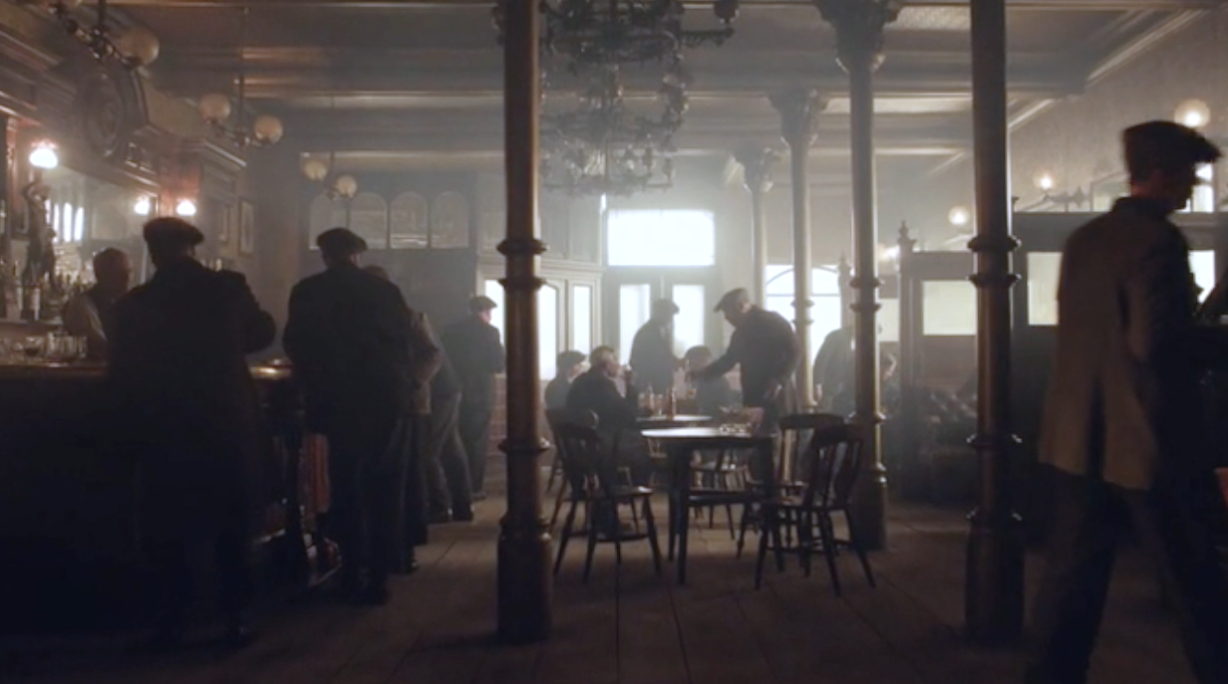
INT. THE GARRISON TAVERN – DAY.

Screen Shot 2015-08-03 at 3.13.43 PMWe watch men being men in a pub.

Shot length: 6 seconds.

CUT TO:

SHOT 4.

INT. THE GARRISON TAVERN – DAY.

The doors open, like an old Western saloon, as –

Thomas enters.

Screen Shot 2015-08-03 at 3.29.04 PM

That’s the final shot – BANG ON 10 minutes Thomas Shelby, center frame.

Shot length: 2 seconds.

Total scene length: 20 seconds.

For extra posts on the opening ten minutes of Peaky Blinders click here.