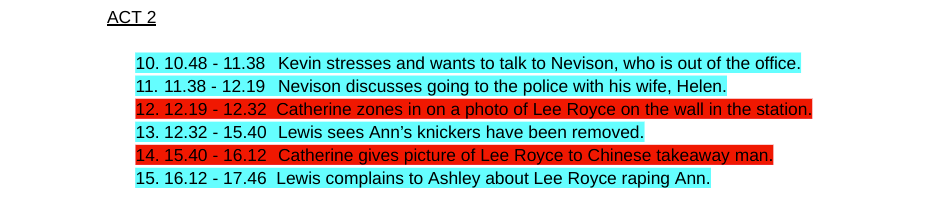
Having analysed Happy Valley season 1 episode by episode, act by act, I decided to write my TV pilot in 5 act structure.
I am using the same colour code as I used in my HV analysis, with an extra colour as I am working with two protagonists (my first time attempting this).
I am certainly not expecting a perfect result from this first attempt at a TV pilot but hopefully something which I can continue to work on when the MA has finished and something which I can submit with an element of confidence that it will pass.
Here is the way I have colour coded the first act, inspired by my analysis of the structure of Happy Valley.
What about you? Are you colour-coding your outlines?
Warning – contains spoilers, crude language, and sexual references.
Introduction
Having watched four of Sorkin’s films over three days: A Few Good Men, Moneyball, Steve Jobs, and Molly’s Game, I learned that Sorkin has a style which is not immediately apparent. That he writes snappy, humorous dialogue is undisputed. However, the underlying idiosyncratic skill he has as writer, is evident in the parody of himself in 30 Rock when Sorkin states: ‘Listen, Lady (a gender I write extremely well if the story calls for it )… ’ (0.44)
Sorkin portrays conflicting attributes to his characters. Perhaps this is why his screenplays are so successful. Yet there is a hidden elixir in his writing to be shared.
All four films have a plot which we are aware of, on the surface. However, the writer asks us to look more closely, and dig a little deeper to a play within a play. Underneath the plot, is the theme, the message Sorkin wants us to think about, go away with, learn from – the elixir of our viewing journey. This theme is not immediately apparent. I believe if we are to learn from Sorkin, and share the elixir he presents to us, we must discover the treasure that lies between the lines, below the surface, the subtext. Maybe it is there we will find Sorkin’s true value as a writer; the reason for his success, and why he may have been the catalyst for a cultural shift in favor of the way in which screenwriters are perceived.
In order to search for the elixir to share, I watched Molly’s Game first, followed by Moneyball. When I realised both shared a father-daughter theme I was eager to watch Steve Jobs, thinking to myself that it must deviate from the theme. There is no way Steve Jobs can be a father-daughter story in the way Molly’s Game and Moneyball is. It’s Steve Jobs. It’s about Apple. So, I watched it and learned… guess what? It’s a father-daughter story! I wonder how much screen time is dedicated to Job’s relationship with his daughter and his personal life goal of being a good father, in comparison with his work goal of selling 1 million computers in 90 days.
I have noticed that in all four films the theme is parental love and specifically, father-daughter (in A Few Good Men: father figure – daughter.) The plots have their own trajectories. Yet I believe the message Sorkin wants us to take from each of these stories – the theme – is the value and importance of parenthood. The plots are simply wallpaper in which to tell the real story – which is the theme. Let’s face it, what’s more important? Selling a million computers or having a good relationship with your daughter? As Phoebe Waller-Bridge says to Daniel Craig: “The mission’s not the real story, the relationships are.” (Spitting Image S2 E03). Let’s look at the four films one by one.
1. A FEW GOOD MEN (1992) directed by Rob Reiner, screenplay by Aaron Sorkin.
The first thing we should notice about this story is the oxymoron between title and poster image. One of the ‘few good men’ in the image is a not a man, but a woman. Notice how both men look us in the eye. The woman looks somewhere else -a visual metaphor, perhaps. In the film, Lieutenant Commander Joanne Galloway (Demi Moore) is subjected to sexual harassmentfrom both her younger protege Daniel Kaffee (Tom Cruise) and her superior officer Colonel Jessup (Jack Nicholson).
Galloway, the only female in this story world, acts as mentor to Kaffee, inspiring him to take his work seriously and fight for justice for the two young men accused of murder. Kaffee is hired by the Navy for his reputation for plea bargains. Galloway wants Kaffee, rather than enter a plea bargain, to search for the truth and fight for justice. In John Yorke’s vernacular, by the denouement, Kaffee has assimilated Galloway’s quality of truth-seeking. What is the truth that lies behind the lines of Sorkin’s writing? And can we handle it?
First, when Galloway briefs Kaffee on the court case he ‘jokes’ that he’s “sexually aroused”. Next, Jessup is in the Officer’s Mess with Kaffee, Kendrick, Markinson, other lawyers and Joanne Galloway. As well as having the opportunity to be a father-figure / mentor / role model to Tom Cruise’s character – Kaffee, Jessup also has the opportunity to be a role model to Galloway – a mentor or father-figure to a young, brilliant, smart female officer. Tragically, he bypasses this opportunity in favor of bravado, machismo and sexist banter in front of a group of men. Jessup chooses not to serve and protect but to humiliate the female officer under his command with crude, salacious, offensive language:
JESSUP
(to Kaffee)
There is, believe me gentlemen, nothing sexier on earth
than a woman you have to salute in the morning…
Promote ‘em all I say, cause this is true:
If you haven’t gotten a blow job from a superior
officer, well, you’re just letting the best in life pass you by.
Sorkin achieves two things with this dialogue. Firstly, he highlights the issue of sexual harassment women are subjected to in the workplace, in this case, by state actors (US military personal). Secondly, he evokes our disgust and creates enmity between the audience and the story’s main antagonist.
2. MONEYBALL (2011) directed by Bennett Miller, screenplay by Steven Zaillian & Aaron Sorkin
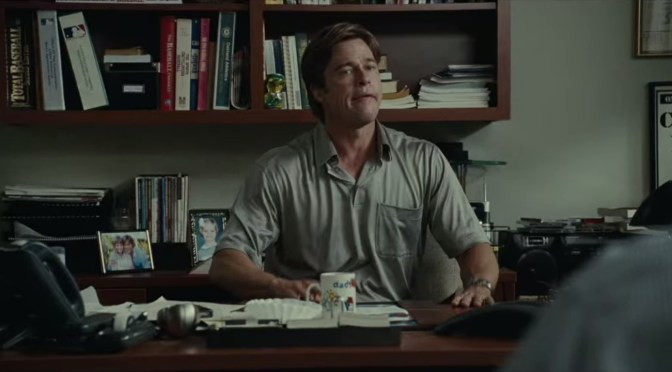
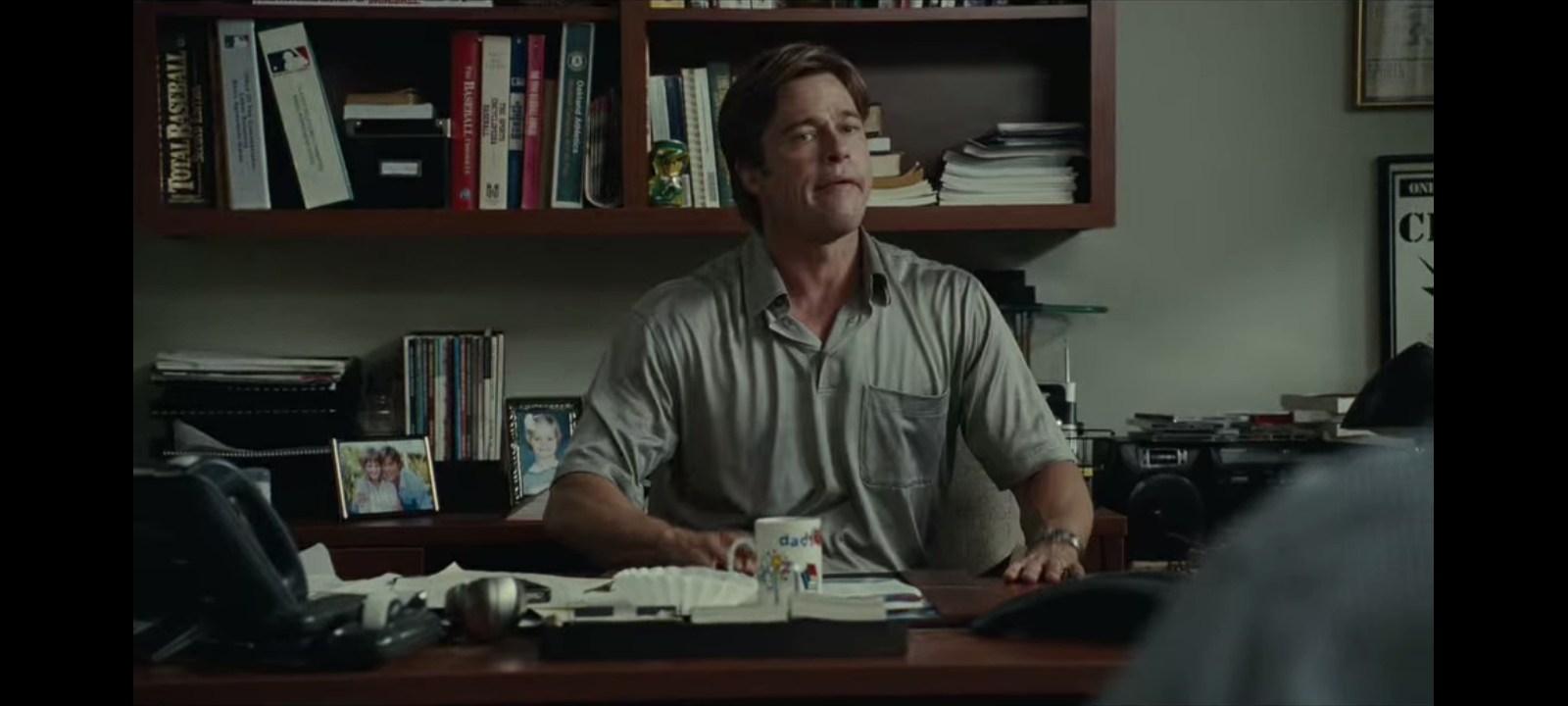
Moneyball is ostensibly about Billy Beane (Brad Pitt) GM of a baseball team, and about his relationship with a young economist, Pete (Jonah Hill), who creates a winning team based on statistics. However, let me draw your attention to the scene, on p128 in the screenplay, where Billy and Pete are in Billy’s office, and Billy is frantically calling teams trying to do deals on players. At one point it’s a wide shot, and Billy (Brad Pitt) kicks back in his chair, and spins around so he’s side on, and the scene goes still and quiet, as Billy thinks and waits for a phone call. This space and time with nothing happening allows us, the viewer, to take in the details mise en scène. And what do we see?
Three photos: two of his daughter, one of him and his daughter, and a mug – obviously a gift from his daughter – which says ‘Daddy.’ This happens again, and the actor, writer, director, gives us time to assimilate the details. This scene portrays the theme: father-daughter parental love.NB – a word of warning – only the dialogue is in the script. There is no action stating “Billy kicks back revealing photos of his daughter and a mug with the word ‘Daddy’ on.” This leads me to believe the screenplay is a transcript. When we write screenplays, we are writing what is on screen. We describe the whole screen / scene. If something is on screen, it should be in the screenplay, right? If not, we would just have a close up of Brad Pitt, thinking! But Brad turns away from the camera and kicks back, doing nothing, saying nothing, giving us space and time to assimilate the important information intended – relating to the theme. I suggest the only reason this scene exists is for us to witness Billy’s office, to see the photos he has of his daughter, to see the mug on his desk saying ‘Daddy.’ The trade deals, the baseball, the phone calls are plot. The photos, the mug saying ‘Daddy’ are theme.
Earlier in the story, Billy and his colleague visit an injured player Scott Hatterberg (Chris Pratt) to offer him a contract. It’s late. Here’s an excerpt from the screenplay:
HATTEBERG’s YOUNG DAUGHTER comes down the staircase in her pajamas, having just woken up in the middle of the night.
BILLY
Hello.
HATTEBERG’S DAUGHTER
Hi.
SCOTT
That’s our youngest daughter.
BILLY
Great.
SCOTT
Do you have kids?
BILLY doesn’t like to share personal lives with the players, but he covers well–
BILLY
–yeah, I have a daughter.
Brad Pitt, aware of the utmost importance of this line as it relates to the theme, basically shrugs off the question before getting back to business. Next we witness Billy in a guitar shop with his daughter, Casey (Kerris Dorsey). She sings a song. Billy brings his hand to cover his face in total shock. He cannot believe how beautiful his daughter is. Tears fill his eyes. Later, when Billy’s team are about to break the record of 20 wins in a row, he’s driving away from the stadium because he can’t bear the pressure. He receives a phone call from his daughter. Casey advises her father to turn around and head back to the stadium. Billy listens to his daughter and turns around.
Then, just after Billy has been offered a contract with the Boston Red Sox as the ‘highest paid GM in the history of sport’, the screenplay states:
EXT. FREEWAY – DAY
BILLY’s driving along and listening to the continued DRONE of talk radio criticism. BILLY keeps listening a moment, then reaches in the glove box and pulls out a CD marked “Dad’s Mix”.
BILLY slips it in the CD player.
The sound of the radio immediately snaps off and the momentary silence is soon broken by CASEY’s VOICE–
CASEY (V.O)
Hey, Dad. I picked these songs out just for you.
And then the first track on the CD comes on…
And BILLY smiles.
We know that for the whole movie, with all the buying and selling of players and talk of baseball, Billy has been thinking about his daughter.
3. MOLLY’S GAME (2017) written and directed by Aaron Sorkin (in his directorial debut).
Molly’s Game frequently flips back to Molly’s childhood.
In this scene (p61) Sorkin has us witness Molly (Jessica Chastain) at home as a teenager with her emotionally abusive psychologist father (Kevin Costner):
The FATHER looks at MOLLY then throws his fork down on his plate with a frightening clang.
FATHER
Don’t disrespect me like that at the table.
GIRL
I wasn’t disrespecting you, I was disrespecting Freud and it’s a kitchen table, it’s not the Tomb of the Unknown Soldier.
FATHER
And I’m a professional psychologist, not a quack.
GIRL
I never said (you were a)–
FATHER (over)
Yeah you did and don’t do it again and don’t ever use that language again.
GIRL
Okay, ignore my teachers, watch my language and respect the kitchen table. What else do I need to do before I’m allowed to disagree with you?
FATHER
Make your own money so you can live in your own house and eat your own food.
Later, Molly’s agent, Lois (Joey Brookes) makes a flippant comment which causes Molly’s regression, evoking this painful childhood memory.
LOIS
Millions or nothing. Go big or go home and
go live with your mother. For the rest of your life.
Sorkin writes:
This is excruciating for MOLLY…
In Act 3, Molly is visited by her father in New York, in a redemption scene. Her father admits that his anger was misdirected. He was angry at Molly because when she was 5 years old she had seen him in a car with another woman. Molly can’t remember this, but her father does. He held this shame – expressing itself as anger towards Molly – throughout her childhood and teenage years, alienating him from his daughter until this moment.
What is tragically ironic about Costner’s character is the fact that he is a psychologist and psychotherapist. He is trained to see defence mechanisms of the psyche, such as transference, misdirected anger etc. in others, yet he did not recognise it in himself until years later. This irony is played out in the final scene between father and daughter when he tells Molly he’s going to give her three years of therapy in three minutes. He gives her three minutes of therapy yet it took him many years to admit his own flaw to his daughter, the reason for his estrangement from her. It was this ‘moral self-revelation’ (Truby) which brought him back to her. Realizing his need he was able to achieve his want – to be in relationship with his daughter. Costner’s character has a strong character arc. We are able to forgive her father as Molly does. Again, the plot is the poker games, the FBI, the court case. This father-daughter subplot relates to, what I believe is, the story’s main theme: parental love.
4. STEVE JOBS (2015) directed by Danny Boyle and written by Aaron Sorkin.
Ostensibly the main plot of Steve Jobs is Apple and the launch of the iMac (Job’s work goal), yet his relationship with his daughter and his character growth as a father runs alongside the main plot as another main plot – a personal life goal. So Jobs has two goals: a work life goal and a personal life goal.1. In the next paragraph I will explore gender balance in screen time in Steve Jobs.
In conclusion, I believe Sorkin’s value lies between the lines, underneath the main plot, and is related to theme. Furthermore, in my opinion criticism for gender bias towards Sorkin in his stories is unfair. In fact, when I watched the four films I had no idea of this criticism and I was shocked to discover it because after watching the four films I was impressed by Sorkin’s clear stance as an advocate for women’s rights.
Beneath the main plot of A Few Good Men, Sorkin was raising an issue in women’s rights which is still causing problems, even today. Thirty years later, we still face the same issues. Even today here in the UK we read of police officers colluding with a convicted rapist and murderer with sexist comments in a misogynistic whatsapp group and The Guardian has reported on sexual harassment in the UK armed forces. Janet Hills, Chairperson of the Metropolitan Black Police Associationhas been speaking out recently regarding her call for zero tolerance on “sexist police banter.” Recently, the British TV and Film has followed the US #metoo movement / cancel culture (Noel Clarke), making it fiercely clear that misogynistic behaviour, in word or deed, will not be tolerated.
Doesn’t Sorkin’s raising of these issues raise an eyebrow to anyone excoriating him with negative gender bias criticism? In fact, if Sorkin is responsible for the cultural shift in the way the world perceives screenwriters, perhaps it’s fair to say that is a consequence of the way his films illuminate gender bias issues notwithstanding the strong female characters he creates.
My advice to anyone wishing to imitate Sorkin’s writing style is to look beyond the dialogue to discover what is happening between the lines, on the screen, relating to theme, to invest thought and time in reflecting issues relating to women’s rights, to create conflicting characters, consider male characters with personal goals, to think about character arcs in all of the main characters and finally, to write female characters “extremely well when the story calls for it.”
SPOILER ALERT. Please do not read if you have not seen Happy Valley Season 1.
We explore this episode in 5 acts.
Please note – Happy Valley is a trilogy: 3 seasons with 1 main overarching story.
In this post we will look at the various story threads, and how writer Sally Wainwright weaves them together.
We can observe four story threads:
The main story which runs through the three seasons is about Catherine and her grandson Ryan and his relationship with his father – trilogy antagonist Tommy Lee Royce. I have called this the ‘A’ story (trilogy).
Next, there is the season story: the kidnapping of Ann Gallagher by Kevin, Ashley, Lewis and Tommy Lee Royce. Let’s call this the ‘A’ story (season).
We can see immediately how the two A stories – season and trilogy – intertwine around the character of Tommy Lee Royce (the trilogy’s main antagonist).
Thirdly, we have Catherine’s extended family: her sister Clare, her ex-husband Richard and her son Daniel. Let’s call this the ‘B’ story.
Fourthly, we have the theme of drugs, police procedure, and corruption. Let’s call this the ‘C’ story.
The different story threads are colour coded.
Let’s look at Act 1.
So, here we can see the episode opens with the C story, followed by opening credits.
It is interesting to note there is no B story.
Immediately following the credits we are into the season A story – the kidnapping.
Next, we are nudged into the A story for the trilogy – Catherine (protag) V Tommy Lee Royce (antag).
The next two scenes introduce Catherine’s day to day of busting small time drugs gangs so represent the C story.
The act finishes focusing on the A story (season) of kidnapping with season victim Ann whimpering, bound and gagged, to carry us into Act 2.
Now let’s check Act 2. Again, no B story.
Here we can see that Act 2 focuses only on the two A stories, expertly interweaving the season story and trilogy story.
The act again finishes with Ann (season victim) and her ordeal, propelling us into Act 3.
Act 3 finally gives us some insight into Catherine’s personal life.
In fact, Act 3 blends all 4 storylines.
This central act opens with a scene introducing Daniel, Catherine’s son, inviting her and her sister Clare to dinner (paid off in Act 4 Scene 32.)
The next scene, 17, interweaves the C story, drugs and corruption, with the B story and the A story (trilogy).
The next 4 scenes, 19-22, focus on the season A story.
Scene 23, which we might call the midpoint of the episode, points to the A story of the trilogy.
Again, the act ends by focusing on Ann and her ordeal.
Act 4 steers away from the A story for the trilogy (Catherine / Ryan / Tommy Lee Royce) and opens with a 4 minute scene which references drugs and corruption, the C story.
The next scene, 27, foreshadows Kirsty’s death.
Scenes 28 / 29 focus on the A story (season).
The central scene of Act 4 brings us back to the C story: drugs and corruption.
Scenes 31/32 revolve around Catherine’s son, ex-husband and grandson – B story.
Act 4 ends with us focusing again on the A story for the season (33/34).
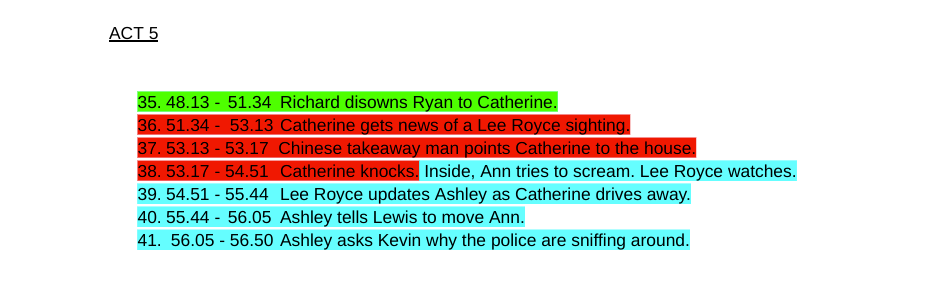
Act 5 opens with B story, with a powerful moral conflict between Catherine and Richard discussing the consequences on their family of dealing with bringing up a child who was born to their (deceased) daughter as the consequence of a rape.
The rest of this final act is equally split between A story (season) and A story (trilogy) – expertly separated by one scene, 38, which glues both stories together and brings protagonist and antagonist (almost) face to face.
Catherine has yet to meet her trilogy antagonist, but here, we the viewer – in privileged superior position – know that only a wall separates her from direct confrontation with her arch enemy Tommy Lee Royce. Dramatic irony at its finest.
The final 3 scenes draw us back into the A story for the season to propel us into the next episode.
Do you agree with this analysis? Please let me know your thoughts.
I missed a week I think, thinking, well, should I bother with this weekly reflective blog, because apparently we’re not being graded on it. But, the truth is, I had grown into a habit of doing it on Sunday nights before tackling the next week’s inbox of tasks. And I miss it. Besides which, it is actually useful to organize my thoughts, progress, or lack thereof.
The war in Ukraine has taken up my attention and I’ve been finding it increasingly difficult to focus on my short screenplay. I did, though, manage to get a step outline done this week, as well as weaving in an unexpected pixar-style animation into my script, which took me by surprise, which I’m enjoying writing, exploring the internal workings of the urinary system. (If I hear another ‘are you taking the piss’ joke I may just throw my laptop at you.)
My task this week is to get a first draft of the screenplay down. I’ve applied for an extension for my portfolio submission date, so I’ve got an extra two weeks, thankfully. This at least allows me to make up for some of the time I lost due to being glued to The Guardian’s Ukraine invasion live stream 24/7.
An important decision I have to make is what kind of law is my female half of the romcom studying. The story serves as a metaphor for female empowerment. The key will be to subtly hint at the theme rather than spelling it out and bashing my readers over the head with the European Convention on Human Rights.
So week 4 was 1:1 tutorials. I was privileged to pitch my 15 minute short film Piano to the course leader.
I had already decided to rewrite my female character as a law student without being an escort. The story itself is already a metaphor for consent. Nuff said.
I pitched it as a romantic comedy, even though in my short, as in Notting Hill, rather than the two central characters sharing equal screen, time narrative weight seemed to favor the boy.
So it was suggested to perhaps pitch it as a personal drama with a comedic tone. That way I won’t have to worry about giving the two central characters equal screen time, but can focus on the learning curve of the male character – learning his lesson at the feet of the woman he loves – following his journey.
I checked the defining qualities of the personal inner drama genre as per Philip Parker‘s breakdown and decided that my story fits.
The reading this week was Alternative Screenwriting, one of the chapters is called ‘Working against Genre.’
So, my task this week is to pitch this story as a personal inner drama with elements of the rom com, and, importantly, to be specific about which elements of each genre.
And then, record and upload it for grading.
After that, my task will be to ensure the want and need of my hero is in place. Not only that, but to ensure that the climax happens like this:
The Hero has a moral revelation of his ‘need’. The revelation causes him to take new moral action. As a result of this change my hero is able to achieve his goal.
So, my second task this week is to ensure my hero’s outward physical goal and inner need is set in stone in my mind.
So, it’s week 2, and, to be honest, I’m struggling so far this term. The assignment is to write another short film, and present a video pitch, due in week 5, together with premise, treatment, and reflective essay at the end of term.
So what’s my problem? It’s not like I don’t have ideas. I have a lot. The two I am considering for this project are a romantic comedy and a rite of passage crime drama. I can’t decide which to pursue. I’ve written a premise for both, a treatment for both, and a step outline for both, but I’m still undecided.
The romantic comedy gives me more enjoyment. It’s fun and full of light. The rite of passage crime drama is dark. No light. If I’m to write this story I need to find a way of allowing the light in. If I go with the romantic comedy I need to figure out how to squeeze it into the rules of the genre.
As for genre, we have been pointed to Philip Parker and The Art and Science of Screenwriting, which is next on my buy-list. Initial readings of the rules of the three ‘romance’ genres seems to slot my story into comedy, as opposed to romantic drama or romantic tragedy (in this case art doesn’t imitate life).
Of the romantic comedy, our genre reading states this:
“The aim of the plot is to provide as many comedic moments as possible between the two central protagonists and their environment or other characters.“
But my question is this: comedic to whom?
Interviewed about his play The Comedians playwright Richard Griffiths paraphrases Mark Twain when he says the source of all comedy is pain. Just because we are laughing, it doesn’t mean the character finds what’s happening funny. Don’t we often laugh at people schadenfreude style? Not laughing with them, but rather at them? At least, that is how it seems to work in Soap Operas.
Which gives me a task, to take a romantic comedy and see if I am laughing with the characters, or at them? What is your screenwriting task this week?
So, week 12 has been and gone and this is the last blog post of the term. Pat on the back to myself for writing a reflective blog post every week so far. Actually, I think I’ve found a kind of pattern.
Each week, as the required reading list comes through, I decide to read those first. Secondly, I get on with the creative task for that week, ready to submit for feedback. Finally, I jump on the peer feedback thread to read and feedback on the creative work of my peers.
This structure seems to be working. Am I attacking the working week in order of importance? I don’t think so. I get the required readings out of the way so I can focus on my creative work freely, without worrying that there’s some academic text I need to get back to and comment on. And I get my creative work out of the way so I am free to feedback on peer work without my own creative agenda hanging over my head, like a pigeon on a ledge.
We might say, therefore, that the importance of the tasks is in reverse order. I mean sure, my creative work is the most important, which is the centrepiece of my week. Next, peer feedback is super important because, to my peers, that is their creative work, the most important part of their work that week. And if it’s important to them, it should be important to me, right? So where does that leave the required readings? Third place? Last but not least? It depends on the required reading.
One of the most valuable readings for me came late in the term and was an optional task on Vince Gilligan and the Breaking Bad writers room. The task pointed to this article in The Guardian which is an extract from Difficult Men, a book by Brett Martin, which, despite the title, is a post-feminist exploration of American television in the third golden age, from The Sopranos to The Wire, Dexter, Mad Men et al. It covers not only how the role of television has grown into what it is today – ever hungry for streaming content – but also how the role of the writer has changed and continues to change, even here in the UK as we enter, according to the BBC report today, a new golden age of television right here, right now.
And that’s not a cue for a High School Musical song.
This week’s lecture, The History of Screenwriting focused on how screenwriting has developed and gave two examples from screenplays written in the 1950’s – On the Waterfront (1954 – dir. Elia Kazan, screenplay Budd Schulberg) and Sunset Boulevard (1950 – dir. Billy Wilder, screenplay Charles Brackett, Billy Wilder, D.M Marshman). Finnegan noted “There are noticeable differences in terms of their formatting, despite only being made four years apart.” – At the Crossing: Changing Perceptions, Technologies and Screenplay Functions in Contemporary Cinema (Finnegan, J. 2017).
Furthermore, we were asked to read the scenario of Le Voyage Dans La Lune (directed and written by Georges Méliès) and instructed to “Think about the logistics of film production in this period, and how the documentation reflects this. Compare this scenario to the documentation used by practitioners today. How has the shift in production practices affected our approaches to the craft of writing for the screen?”
I noted that some of the scene headings used only nouns and others used verbs. Where verbs were used, this gave instruction to the crew and actors what would happen on set through improvisation. Where nouns, the function of the scene heading was to describe the set. Indeed, Melies would have taken the word scenario from its Latin meaning, meaning “that which is represented on stage.” In this sense, the scene headings serve the same function as modern format of screenplays i.e the NIGHT / DAY and INT / EXT simply serve to give instruction to the technical crew and logistics personnel on a film project for planning purposes. Finnegan notes “The scenario was, as the name suggests, a brief description given to the minimal crew of the time, but also a marketing tool used to attract audiences.” These readings certainly wet my appetite for further study in the history of the screenplay.
Finally, creative work was to develop the treatment for our short film and give peer feedback. My intention through feedback was to encourage and to steer my peers towards knowledge I have recently enjoyed gaining through reading John Yorke’s Into the Woods. By referring to Yorke’s work in feedback I was able to cement ideas I am attempting to assimilate and apply to my own work.
This week involved posting a synopsis for a short film. I posted Isaac. I have been working on this concept in a novel and feature film with a female lead. However, I posted it in short film format with a male lead. It tells the story of a young Eritrean footballer who, after being press-ganged into joining the Tigrayan conflict, is lured into a trafficking ring and who winds up in the UK, exploited, and his human rights violated. I have been torn between writing it as a male or female lead. However, for the short I’ve opted for a male lead because, whereas trafficking usually revolves around women’s rights, I want to highlight the fact that men are trafficked and exploited as well. While in Bahrain I heard the story of young African men being trafficked there with dreams of playing professional soccer, but on arrival, after having had their passports stolen from them they are then coerced into cheap labour.
I also decided to embark on an optional project to study the work of Aaron Sorkin. When I began I had no idea what I would find. I intended studying his dialogue techniques. However, after viewing four films, A Few Good Men, Moneyball, Molly’s Game and Steve Jobs I realized there is more going on than just the quick-fire dialogue he is famous for. I discovered that below the text there are themes regarding gender issues and family relationships, particularly father-daughter. My research led me to an MA thesis from Stockholm University which focuses on gender studies in Hollywood films. Perhaps this study as relating to Aaron Sorkin is something I may pick up on again later in the course. Regardless, I learned a great deal about Sorkin and how he goes about sharing his worldview through his writing.
Week 1 has been both daunting and exciting. Both course leader John Finnegan and module tutor Mat Owen are friendly, inspirational and offer reassurance.
The required academic reading text by Steven Maras, Auteur Theory, is not only daunting due to its academic approach (academia v art) but also seems to be pulling me away from the reason I took the course, that is, to write screenplays and develop my craft in writing screenplays, as well as collaborate with others in writing screenplays.
The Maras text seems to be ostensibly about authorship. I wonder if the underlying cause that this text attracts so much polemic is a question of money, rather than what it presents itself as, that is a discussion on who is the true author of a film and whether screenwriters are artists who can claim authorship.
I was drawn by the visual on the course module syllabus – a still of Gary Oldman as Herman J. Mankiewicz – to watch Mank, dir. David Fincher based on a screenplay by the director’s late father Jack Fincher.
To a backdrop of pre-WW2 American politics, it explores the relationship between Mankiewicz and Orson Welles during the writing of Citizen Kane, for which Mankiewicz had to fight for screen credit. It also explores the fraught relationship of the screenwriter with Luis B. Mayer of Metro-Goldwyn-Mayer.
Although the Maras text presents itself as a conflict of theories (auteurism v anti-auteurism / conception and execution v separation of conception and execution, I do wonder if its value today is due to its monetary value rather than its artistic / literary value. Hollywood is big business, worth in the region of $150 billion per year.
I am aware from reading screenwriting articles and speaking to screenwriters of the process each screenwriter has to endure in order to ensure, in an industry which employs a multi-writer system, the writer is paid his dues. For this entertainment lawyers are employed and scripts are scrutinized with a fine tooth comb for each word set on each age, to ascertain what each writer should be paid. Consequently, Maras text has more than artistic value. Am I right in thinking its pro-auteur stance may have a negative effect on earnings of the screenwriter. Is this why Maras states ‘Few issues provoke as much emotion in screenwriting theory as the auteur discourse.’
The text Writing the Short Film by Patricia Cooper is providing much food for thought regarding sound and is forcing me to rethink my short film concept. I am looking forward to writing the 1 page outline of Isaac in Week 2.