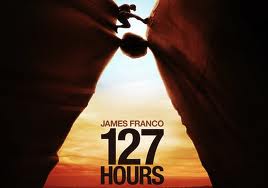
SPOILER ALERT – watch the movie before reading this post.
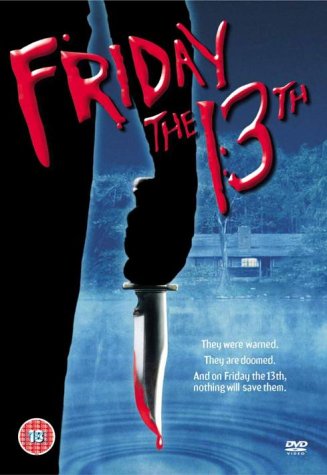
What most impresses me about 127 Hours is, although it’s an intensely visual film, the dialogue is deep with subtext. Take the Friday 13th joke in the opening sequence. Aron is out exploring on the Grand Canyon, and sees two girls, obviously lost. He bounds down the canyon and offers his assistance. We know he’s charming and likeable, but his face is covered by a dust mask, and he’s wearing a cap and shades. He looks scary – like Jason.
“Sorry about the Friday 13th thing,” he wisecracks.
Joke, right? Throw-away line, simple. Actually it’s very cleverly foreshadowing the fact that this family wilderness drama is going to suddenly twist genre in the final act to a gruesome slasher movie as Aron slashes off his own arm to free himself from the rock. It’s horrific to watch, terrifying and extremely bloody. The pain is excruciating. In this throw-away ‘joke’ the film makers are actually apologizing to us, the viewer, for the excruciating horror they’re about to endure.
Genius!
Also, look at the line when Aron makes a joke about the insects crawling beneath him waiting for him to defecate. Although a simple joke, coupled together with the bird circling above, which feeds on insects, this seemingly irrelevant line is pointing to the film’s theme – that all living creatures are interdependent, that our world is interdependent, that no man is an island – that we, as people, as human beings, depend on each other.
This is the lesson Aron must learn, in Truby terms the ‘moral and psychological revelation’ he must have in order to change and become a better human being. This is his character arc: if Aron hadn’t been so selfish, if he’d have answered his mom’s calls, and told her where he was going, he wouldn’t be in this nightmare. He wouldn’t be suffering alone between a rock and a hard place.
Aron goes through an intense furnace of change – a terrifying, horrific experience.
It’s his – and therefore our – Friday the 13th.
How about your script? Have you foreshadowed the climax with a seemingly throw-away line?
The opening lines in 127 Hours (screenplay by Danny Boyle and Simon Beaufoy) are an answerphone message from Aron’s sister:
“Hey, Sonia here…again… I know you’re probably gonna be away this weekend, but listen… just think about what we’re gonna play, ‘cause we have to decide if we need to practice, it will be fun, anyway…oh…and, please call Mom, ‘cause, you know, she worries…”
These lines refer to 5 things:
1. Character Arc.
Why doesn’t Aron answer the phone? We see he’s super-busy preparing his trip, grabbing the bits and pieces he needs. And we all know how annoying phone calls are when we’re trying to get stuff done. But this preoccupation with himself shows us he is more focused on his own needs than his sister’s. The fact that Sonia emphasizes again tells us this isn’t the first time she’s called. And so Aron’s character flaw is illuminated – the flaw that will not only cause his extreme suffering but will also cause him to grow and change.
2. Foreshadowing.
‘Think about what we’re gonna play’ foreshadows a line of dialogue at the Act 2 Turning Point paid off when Aron apologizes to his sister for not being able to play the piano at her wedding. This apology tells us something way deeper and more important: that he has lost the battle. He is defeated. Michael Hague calls this the All is Lost moment. Blake Synder the Visit to Death.
3. Theme.
Sonia reminds Aron to call Mom as ‘she worries’. Later Aron realizes that if he hadn’t have been so selfish, if he had returned his mom’s calls, he would’ve told her where he was going and he would’ve been rescued. Major theme: interconnectedness + familial love.
So these opening lines not only foreshadow the Act 2 Turning Point before Aron’s do or die drive to survive, but they immediately point us to both theme and character arc.
SPOILER alert – please watch the movie before reading the rest of this post.
4. Endearing us to the Hero.
One of my favorite lines of dialogue comes where Aron meets the two lost female hikers. Aron rocks down the hill, superhero to the rescue, to help them with their map-reading. Realizing his mask is high on his face and he must look pretty scary, Aron jokes something about looking like Jason from Friday the 13th. Not only is this funny, and, as Michael Hague tells us in Screenwriting for Hollywood, funny alwaysendears us to a hero, but it’s oozing subtext. Which brings us to –
5. Subtext.
Aron’s lines hiding a much deeper and far more sinister meaning. Check out his line:
Sorry about the Friday 13th thing. I’m only a psychopath on weekdays.
We don’t read much into it on first viewing. But actually it’s preparing us for – or foreshadows – the sudden Act 3 genre twist from family adventure drama to slasher/horror.
‘I’m not usually a psychopath,’ he’s saying (my paraphrase) ‘but stick around and later you can watch me hack my own arm off, Saw style.’
127 Hours runs at 90 minutes and adheres to perfect 3 Act Structure:
Act 1: 15 minutes.
Act 2a : 30 minutes.
Midpoint
Act 2b: 30 minutes.
Act 3: 15 minutes
NB: The Midpoint or Point of No Return happens at 45 minutes – exactly half way through the movie.
Each act break + plot point is not only marked with a Turning Point but is also marked with the end of a musical sequence.
Watch the film carefully paying attention to what happens at these exact times.
So, what happens at each Turning Point?
SPOILER ALERT – watch the movie before you read this analysis!
Act 1 begins by foreshadowing the moral revelation the hero will have in the climax – Aron’s selfishness – as he refuses to answer his mum’s phone calls or tell his work mate where he’s going. Next we’re shown an excited young man off on an adventure. He’s a daredevil. When he spectacularly falls from his mountain bike he simply smiles, snaps a pic of himself and he’s ‘back on the saddle’ foreshadowing his tenacity and resilience displayed in extremis in the Climax.
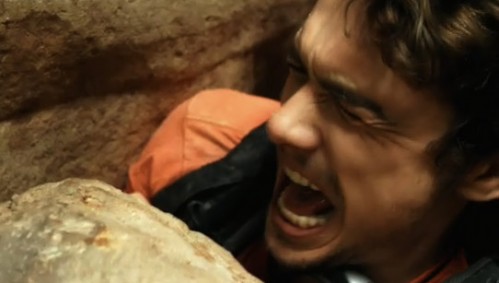
After exactly 15 minutes, Aron falls: the film’s inciting incident. He’s trapped by the rock. Danny Boyle inserts the film’s title 127 Hours here, telling us the movie, the real story, starts now. Like any Act 2 this is the new world, the upset Status quo which must be re-balanced.
So Act 2 begins at 15 minutes.
Then, 15 minutes into Act 2 (30 minutes into the movie) we have Plot Point 1 which points us towards the film’s major Theme.
So what happens here? Well, we see Aron as a small boy sitting on the Grand Canyon in his father’s loving embrace as they both stare out at the rising sun. (Theme: interconnectedness + familial love).
Between 30 minutes and the midpoint at 45 minutes we witness Aron beginning to make his video diary. He addresses his mom and dad – we hear his mother’s voice saying ‘call me – lots of love’ (Theme reinstated: connectedness + familial love).
The Midpoint or Point of No Return comes at exactly 45 minutes: Aron takes his pocket knife and tries to cut his arm – foreshadowing the Climax. Why is this the Point of No Return? Because Aron is considering another option, if all else fails.
And we’re into the second part of Act 2 which we’ll call Act 2b.
Immediately after the Midpoint we’re back with the video camera and treated to the hilarious spoof radio show and Aron’s self-examination. This is a superb blend of comedy and tragedy. He reveals the fact he’s always seen himself as a ‘big fucking hard American superhero’ who can do everything ‘on his own’. This is writing of the highest quality; the hero’s moral / psychological revelation that his ‘supreme selfishness’ – his character flaw – has led him to this place of captivity and isolation, later to become a place of extreme suffering, is delivered with a ‘spoon full of sugar’ as this self-revelation is presented to us by the writers gift-wrapped in brilliant dialogue as Aron attacks his own flaws with scathingly funny self-deprecating humor.
Then, 15 minutes after the Midpoint at Plot Point 2 Aron rams the blade into his arm. Danny Boyle takes us visually inside his arm and we see the blade ‘close to the bone.’ An idiom often used when remarks cut close to the truth. And the truth Aron has just revealed to us? He has been living life selfishly. In fact, he apologizes to his mom and dad into the camera for being ‘unappreciative.’
After another 15 minutes, at around the 75th minute of the movie – leading towards the End of Act 2 Turning Point Aron apologizes to his sister that he won’t be able to play piano at her wedding. Another apology. This dialogue tells us he has accepted his fate and that fate is death. Michael Hague calls this the ‘All is Lost’ moment. Blake Snyder the ‘Visit to Death’.
Then, still at the 75th minute mark, we enter ACT 3 as Aron makes one last ‘do or die’ drive to set himself free, and, as a mirror to the Midpoint – BANG! – he rams the blade back into his arm and drags us, screaming and terrified, feeling every nerve of his tortuous pain, into the bloody, horrific Climax.
The next 15 minutes are the Resolution as Aron is rescued. Here Aron’s learning curve – his character arc – is clear as the ‘big hard fucking superhero’ who can do ‘everything on his own’ screams for help from strangers – a changed man.
127 Hours sticks to perfect 3 Act Structure as taught by Michael Hague and also adheres to John Truby’s teachings on Moral and Psychological Revelations in his book Anatomy of Story.