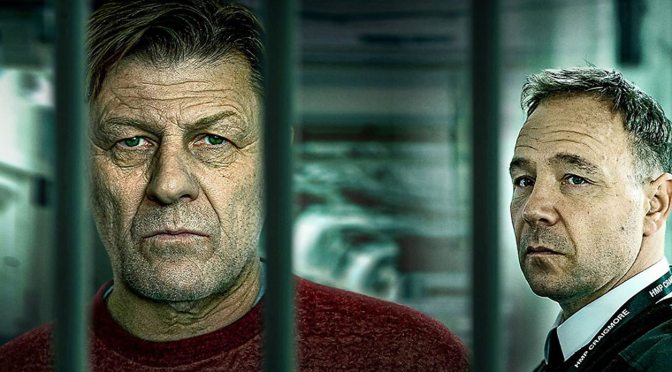
I asked chatgpt how does Jimmy McGovern structure episode 1 of Time. This was the response.
In Episode 1 of Time, Jimmy McGovern skillfully structures the episode to immerse viewers in the harsh, tense environment of a British prison while introducing the complex inner lives of the main characters. McGovern, known for his gritty, character-driven storytelling, uses a dual narrative approach to introduce the two main characters, Mark Cobden (played by Sean Bean) and Eric McNally (played by Stephen Graham), and to establish the emotional stakes that drive the story forward.
Establishing Characters and Context: The episode opens with Mark, a former teacher, who is sentenced to four years for causing a fatal car accident. The narrative dives directly into his vulnerability and isolation as he enters prison, giving viewers a raw look at the fear and guilt he feels. In parallel, we meet Eric, a seasoned prison officer, whose moral integrity and deep care for the inmates contrasts sharply with the brutality of the prison environment.
Conflict and High Stakes: McGovern quickly escalates tension by throwing Mark into confrontations with fellow inmates, exposing the brutal reality of prison life. He also creates immediate tension for Eric, who is forced into a moral dilemma when a gang threatens his family. This dual conflict (Mark’s survival and Eric’s integrity) drives the episode’s structure, balancing empathy and suspense.
Developing Themes of Guilt and Redemption: Throughout the episode, McGovern interweaves themes of guilt, redemption, and justice, exploring these through the contrasting lives of Mark and Eric. Flashbacks and dialogue subtly reveal Mark’s remorse, highlighting his emotional journey, while Eric’s ethical struggles reveal his vulnerability, adding depth to the narrative.
By ending the episode on cliffhangers for both characters, McGovern effectively hooks viewers, leaving them invested in the fate of these two men whose lives are irrevocably intertwined within the brutal confines of prison.
Warning – contains spoilers, crude language, and sexual references.
Introduction
Having watched four of Sorkin’s films over three days: A Few Good Men, Moneyball, Steve Jobs, and Molly’s Game, I learned that Sorkin has a style which is not immediately apparent. That he writes snappy, humorous dialogue is undisputed. However, the underlying idiosyncratic skill he has as writer, is evident in the parody of himself in 30 Rock when Sorkin states: ‘Listen, Lady (a gender I write extremely well if the story calls for it )… ’ (0.44)
Sorkin portrays conflicting attributes to his characters. Perhaps this is why his screenplays are so successful. Yet there is a hidden elixir in his writing to be shared.
All four films have a plot which we are aware of, on the surface. However, the writer asks us to look more closely, and dig a little deeper to a play within a play. Underneath the plot, is the theme, the message Sorkin wants us to think about, go away with, learn from – the elixir of our viewing journey. This theme is not immediately apparent. I believe if we are to learn from Sorkin, and share the elixir he presents to us, we must discover the treasure that lies between the lines, below the surface, the subtext. Maybe it is there we will find Sorkin’s true value as a writer; the reason for his success, and why he may have been the catalyst for a cultural shift in favor of the way in which screenwriters are perceived.
In order to search for the elixir to share, I watched Molly’s Game first, followed by Moneyball. When I realised both shared a father-daughter theme I was eager to watch Steve Jobs, thinking to myself that it must deviate from the theme. There is no way Steve Jobs can be a father-daughter story in the way Molly’s Game and Moneyball is. It’s Steve Jobs. It’s about Apple. So, I watched it and learned… guess what? It’s a father-daughter story! I wonder how much screen time is dedicated to Job’s relationship with his daughter and his personal life goal of being a good father, in comparison with his work goal of selling 1 million computers in 90 days.
I have noticed that in all four films the theme is parental love and specifically, father-daughter (in A Few Good Men: father figure – daughter.) The plots have their own trajectories. Yet I believe the message Sorkin wants us to take from each of these stories – the theme – is the value and importance of parenthood. The plots are simply wallpaper in which to tell the real story – which is the theme. Let’s face it, what’s more important? Selling a million computers or having a good relationship with your daughter? As Phoebe Waller-Bridge says to Daniel Craig: “The mission’s not the real story, the relationships are.” (Spitting Image S2 E03). Let’s look at the four films one by one.
1. A FEW GOOD MEN (1992) directed by Rob Reiner, screenplay by Aaron Sorkin.
The first thing we should notice about this story is the oxymoron between title and poster image. One of the ‘few good men’ in the image is a not a man, but a woman. Notice how both men look us in the eye. The woman looks somewhere else -a visual metaphor, perhaps. In the film, Lieutenant Commander Joanne Galloway (Demi Moore) is subjected to sexual harassmentfrom both her younger protege Daniel Kaffee (Tom Cruise) and her superior officer Colonel Jessup (Jack Nicholson).
Galloway, the only female in this story world, acts as mentor to Kaffee, inspiring him to take his work seriously and fight for justice for the two young men accused of murder. Kaffee is hired by the Navy for his reputation for plea bargains. Galloway wants Kaffee, rather than enter a plea bargain, to search for the truth and fight for justice. In John Yorke’s vernacular, by the denouement, Kaffee has assimilated Galloway’s quality of truth-seeking. What is the truth that lies behind the lines of Sorkin’s writing? And can we handle it?
First, when Galloway briefs Kaffee on the court case he ‘jokes’ that he’s “sexually aroused”. Next, Jessup is in the Officer’s Mess with Kaffee, Kendrick, Markinson, other lawyers and Joanne Galloway. As well as having the opportunity to be a father-figure / mentor / role model to Tom Cruise’s character – Kaffee, Jessup also has the opportunity to be a role model to Galloway – a mentor or father-figure to a young, brilliant, smart female officer. Tragically, he bypasses this opportunity in favor of bravado, machismo and sexist banter in front of a group of men. Jessup chooses not to serve and protect but to humiliate the female officer under his command with crude, salacious, offensive language:
JESSUP
(to Kaffee)
There is, believe me gentlemen, nothing sexier on earth
than a woman you have to salute in the morning…
Promote ‘em all I say, cause this is true:
If you haven’t gotten a blow job from a superior
officer, well, you’re just letting the best in life pass you by.
Sorkin achieves two things with this dialogue. Firstly, he highlights the issue of sexual harassment women are subjected to in the workplace, in this case, by state actors (US military personal). Secondly, he evokes our disgust and creates enmity between the audience and the story’s main antagonist.
2. MONEYBALL (2011) directed by Bennett Miller, screenplay by Steven Zaillian & Aaron Sorkin
Moneyball is ostensibly about Billy Beane (Brad Pitt) GM of a baseball team, and about his relationship with a young economist, Pete (Jonah Hill), who creates a winning team based on statistics. However, let me draw your attention to the scene, on p128 in the screenplay, where Billy and Pete are in Billy’s office, and Billy is frantically calling teams trying to do deals on players. At one point it’s a wide shot, and Billy (Brad Pitt) kicks back in his chair, and spins around so he’s side on, and the scene goes still and quiet, as Billy thinks and waits for a phone call. This space and time with nothing happening allows us, the viewer, to take in the details mise en scène. And what do we see?
Three photos: two of his daughter, one of him and his daughter, and a mug – obviously a gift from his daughter – which says ‘Daddy.’ This happens again, and the actor, writer, director, gives us time to assimilate the details. This scene portrays the theme: father-daughter parental love.NB – a word of warning – only the dialogue is in the script. There is no action stating “Billy kicks back revealing photos of his daughter and a mug with the word ‘Daddy’ on.” This leads me to believe the screenplay is a transcript. When we write screenplays, we are writing what is on screen. We describe the whole screen / scene. If something is on screen, it should be in the screenplay, right? If not, we would just have a close up of Brad Pitt, thinking! But Brad turns away from the camera and kicks back, doing nothing, saying nothing, giving us space and time to assimilate the important information intended – relating to the theme. I suggest the only reason this scene exists is for us to witness Billy’s office, to see the photos he has of his daughter, to see the mug on his desk saying ‘Daddy.’ The trade deals, the baseball, the phone calls are plot. The photos, the mug saying ‘Daddy’ are theme.
Earlier in the story, Billy and his colleague visit an injured player Scott Hatterberg (Chris Pratt) to offer him a contract. It’s late. Here’s an excerpt from the screenplay:
HATTEBERG’s YOUNG DAUGHTER comes down the staircase in her pajamas, having just woken up in the middle of the night.
BILLY
Hello.
HATTEBERG’S DAUGHTER
Hi.
SCOTT
That’s our youngest daughter.
BILLY
Great.
SCOTT
Do you have kids?
BILLY doesn’t like to share personal lives with the players, but he covers well–
BILLY
–yeah, I have a daughter.
Brad Pitt, aware of the utmost importance of this line as it relates to the theme, basically shrugs off the question before getting back to business. Next we witness Billy in a guitar shop with his daughter, Casey (Kerris Dorsey). She sings a song. Billy brings his hand to cover his face in total shock. He cannot believe how beautiful his daughter is. Tears fill his eyes. Later, when Billy’s team are about to break the record of 20 wins in a row, he’s driving away from the stadium because he can’t bear the pressure. He receives a phone call from his daughter. Casey advises her father to turn around and head back to the stadium. Billy listens to his daughter and turns around.
Then, just after Billy has been offered a contract with the Boston Red Sox as the ‘highest paid GM in the history of sport’, the screenplay states:
EXT. FREEWAY – DAY
BILLY’s driving along and listening to the continued DRONE of talk radio criticism. BILLY keeps listening a moment, then reaches in the glove box and pulls out a CD marked “Dad’s Mix”.
BILLY slips it in the CD player.
The sound of the radio immediately snaps off and the momentary silence is soon broken by CASEY’s VOICE–
CASEY (V.O)
Hey, Dad. I picked these songs out just for you.
And then the first track on the CD comes on…
And BILLY smiles.
We know that for the whole movie, with all the buying and selling of players and talk of baseball, Billy has been thinking about his daughter.
3. MOLLY’S GAME (2017) written and directed by Aaron Sorkin (in his directorial debut).
Molly’s Game frequently flips back to Molly’s childhood.
In this scene (p61) Sorkin has us witness Molly (Jessica Chastain) at home as a teenager with her emotionally abusive psychologist father (Kevin Costner):
The FATHER looks at MOLLY then throws his fork down on his plate with a frightening clang.
FATHER
Don’t disrespect me like that at the table.
GIRL
I wasn’t disrespecting you, I was disrespecting Freud and it’s a kitchen table, it’s not the Tomb of the Unknown Soldier.
FATHER
And I’m a professional psychologist, not a quack.
GIRL
I never said (you were a)–
FATHER (over)
Yeah you did and don’t do it again and don’t ever use that language again.
GIRL
Okay, ignore my teachers, watch my language and respect the kitchen table. What else do I need to do before I’m allowed to disagree with you?
FATHER
Make your own money so you can live in your own house and eat your own food.
Later, Molly’s agent, Lois (Joey Brookes) makes a flippant comment which causes Molly’s regression, evoking this painful childhood memory.
LOIS
Millions or nothing. Go big or go home and
go live with your mother. For the rest of your life.
Sorkin writes:
This is excruciating for MOLLY…
In Act 3, Molly is visited by her father in New York, in a redemption scene. Her father admits that his anger was misdirected. He was angry at Molly because when she was 5 years old she had seen him in a car with another woman. Molly can’t remember this, but her father does. He held this shame – expressing itself as anger towards Molly – throughout her childhood and teenage years, alienating him from his daughter until this moment.
What is tragically ironic about Costner’s character is the fact that he is a psychologist and psychotherapist. He is trained to see defence mechanisms of the psyche, such as transference, misdirected anger etc. in others, yet he did not recognise it in himself until years later. This irony is played out in the final scene between father and daughter when he tells Molly he’s going to give her three years of therapy in three minutes. He gives her three minutes of therapy yet it took him many years to admit his own flaw to his daughter, the reason for his estrangement from her. It was this ‘moral self-revelation’ (Truby) which brought him back to her. Realizing his need he was able to achieve his want – to be in relationship with his daughter. Costner’s character has a strong character arc. We are able to forgive her father as Molly does. Again, the plot is the poker games, the FBI, the court case. This father-daughter subplot relates to, what I believe is, the story’s main theme: parental love.
4. STEVE JOBS (2015) directed by Danny Boyle and written by Aaron Sorkin.
Ostensibly the main plot of Steve Jobs is Apple and the launch of the iMac (Job’s work goal), yet his relationship with his daughter and his character growth as a father runs alongside the main plot as another main plot – a personal life goal. So Jobs has two goals: a work life goal and a personal life goal.1. In the next paragraph I will explore gender balance in screen time in Steve Jobs.
In conclusion, I believe Sorkin’s value lies between the lines, underneath the main plot, and is related to theme. Furthermore, in my opinion criticism for gender bias towards Sorkin in his stories is unfair. In fact, when I watched the four films I had no idea of this criticism and I was shocked to discover it because after watching the four films I was impressed by Sorkin’s clear stance as an advocate for women’s rights.
Beneath the main plot of A Few Good Men, Sorkin was raising an issue in women’s rights which is still causing problems, even today. Thirty years later, we still face the same issues. Even today here in the UK we read of police officers colluding with a convicted rapist and murderer with sexist comments in a misogynistic whatsapp group and The Guardian has reported on sexual harassment in the UK armed forces. Janet Hills, Chairperson of the Metropolitan Black Police Associationhas been speaking out recently regarding her call for zero tolerance on “sexist police banter.” Recently, the British TV and Film has followed the US #metoo movement / cancel culture (Noel Clarke), making it fiercely clear that misogynistic behaviour, in word or deed, will not be tolerated.
Doesn’t Sorkin’s raising of these issues raise an eyebrow to anyone excoriating him with negative gender bias criticism? In fact, if Sorkin is responsible for the cultural shift in the way the world perceives screenwriters, perhaps it’s fair to say that is a consequence of the way his films illuminate gender bias issues notwithstanding the strong female characters he creates.
My advice to anyone wishing to imitate Sorkin’s writing style is to look beyond the dialogue to discover what is happening between the lines, on the screen, relating to theme, to invest thought and time in reflecting issues relating to women’s rights, to create conflicting characters, consider male characters with personal goals, to think about character arcs in all of the main characters and finally, to write female characters “extremely well when the story calls for it.”
Action: Catherine is compassionate, skilled and professional.
Dialogue: Catherine is witty, with a dark sense of humour and has a complicated family life, which we learn about in detail.
Scene 2 is opening credits.
Scene 3:
Dialogue: we learn that Weatherill is the accountant and that Nevison, his boss is from a poor background.
Scene 4:
Dialogue: we learn that Richard is a journalist, and that Tommy Lee Royce (series antagonist) has been released from prison.
Scene 5:
Dialogue: Ryan has been aggressive and using unacceptable language at school.
Scene 6:
Dialogue: we learn from Clare that Lee Royce has been released. This is the second time we have heard this, so it must be important.
Scene 7:
Dialogue: Kevin is jealous of Nevison. He is falling apart. Feels undervalued.
Jenny is positive and reassuring, even in the midst of severe illness.
Scene 8:
Dialogue: Normal family friction. Nevison reveals he does value Kevin as he at least is thinking about his pay rise.
Scene 9:
Dialogue: Richard and Catherine have a good relationship as friends.
Scene 10:
Action: Richard and Catherine still fancy each other.
Scene 11:
Dialogue: Jenny positive, Kevin negative and self-pitying.
Action: Jenny needs help being put to bed and so is physically dependent on Kevin.
Scene 12:
Action: Writer Sally Wainwright is a fan of Sylvia Plath.
Scene 13:
Dialogue: Ashley Cowgill presents himself as generous and considerate. Kevin is jealous and self-pitying.
Scene 14:
Catherine is concerned about the whereabouts of Tommy Lee Royce.
Scene 15:
Action: Cowgill is a cannabis dealer to scale.
Dialogue: Cowgill is passive / aggressive and a bully.
Scene 16:
Dialogue: Kevin Weatherill is cowardly, deceitful and manipulative.
Scene 17:
Dialogue: The ‘other’ man working for Cowgill has been in jail for 8 years, and is therefore the man Catherine is worried about, Tommy Lee Royce. NB we don’t yet know what Lee Royce has done. (We find out in scene 24 / 25).
Lewis, Cowgill’s other worker, doesn’t like Lee Royce.
Scene 18:
Dialogue: Catherine is tired and impatient with her grandchild, Ryan. She is taking her worry over Tommy Lee Royce out on Ryan, his son – projecting her anxiety onto him.
Scene 19:
Action: We are reminded that Kevin is a father with a daughter.
Scene 20:
Dialogue: Kevin is self-deceiving as he believes he has the power to negotiate over his kidnapping arrangement fee.
Scene 21:
Action: Catherine is active, fearless, professional and strong.
Scene 22:
Dialogue: Catherine wittily makes fun of her own challenges in the job – but not regarding Lee Royce.
Scene 23:
Dialogue: Nevison is generous and kindhearted.
Scene 24 / 25
Dialogue and Action: Catherine is broken over her daughter’s ordeal of sexual violence and subsequent suicide. Through this scene of emotional turbulence exposition and backstory about her daughter Becky and Tommy Lee Royce’s crime and character are expertly revealed.
Scene 26:
Dialogue: Catherine desires intimacy with Richard.
Scene 27:
Dialogue: Catherine hates Lee Royce
Scene 28:
Action: Kevin cannot sleep.
Scene 29:
Dialogue: Kevin is nervous and scared.
Scene 30:
Action: Ashley seems cool and focused / Kevin is aggressive and careless.
Dialogue: Ashley sounds anxious.
Scene 31:
Action: Ann is fervent, youthful and life-loving.
Scene 32 / 33 as 31.
Sceen 34:
Lewis and Lee Royce are in conflict.
Scene 35:
Action: Kevin is experiencing inner conflict between doing what is right and fear of the consequences.
Scene 36:
Action: Catherine is busy at work.
Scene 37:
Action: Catherine is quick-thinking / Kevin is impulsive and irrational.
Scene 38:
Action: Lee Royce is brutal, misogynistic and violent / Lewis is naive.
Dialogue: Lee Royce is brutal, misogynistic and violent.
Scene 39:
Dialogue: Kevin is naive.
Scene 40:
Action: Lee Royce is a narcissist (signified by his adjusting his hair in the rear view mirror immediately after having been violent to Ann).
Dialogue: Lee Royce is vulgar, misogynistic and violent / Lewis is inexperienced, thoughtless and naive.
Scene 41:
Dialogue: Catherine is chatty, convivial.
Scene 42:
Action: Catherine is fearless.
Scene 43:
Action: Catherine is intensely angry.
Scene 44:
Action: Nevison is terrified.
Dialogue: Kevin is nervous.
Scene 45:
Dialogue: Lee Royce is heartless, cruel, and sadistic.
Scene 46:
Dialogue: Nevison loves his daughter.
Dialogue: Kevin is duplicitous.
Scene 47:
Action: Catherine is smart, resourceful, investigatively skillful.
This article is also available to watch on Youtube
We’ve been looking at techniques for responding to questions.
In the last post we looked at two examples from Mammoth Screen’s The Serpent by Richard Warlow. Let’s look at some more examples from the same script. This is episode 1, available from BBC Writers Room.
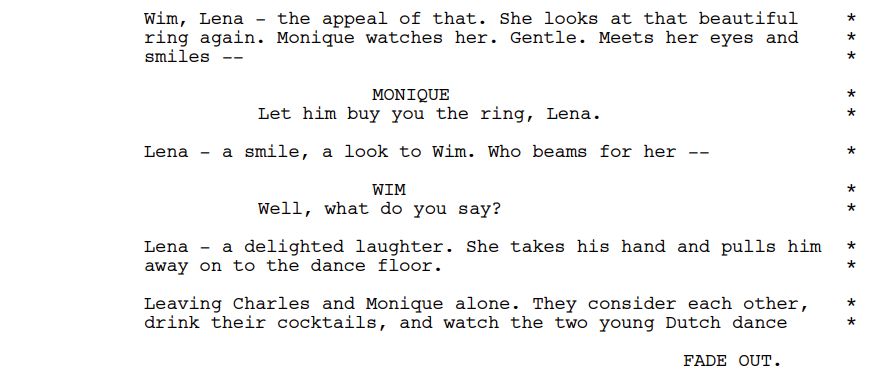
In this scene, Charles and Monique are trying to sell the sapphire / diamond ring to Wim and Lena.
When Monique asks Charles ‘they don’t have to decide now’ it is not a real question. Of course Charles wants them to decide now, but, he’s willing to play the long game. It’s a lot of money.
How does Charles reply? Of course not. But he’s lying. Of course he wants them to decide now. So what technique is this? We might say Charles is responding to Monique’s question by saying what Wim and Lena want to hear.
Let’s look at another question, a bit later in the same scene.
This time Monique pushes for a sale, telling Lena to let Wim buy her the ring. Lena smiles at Wim. Wim ‘beams for her’ and asks Lena: Well, what do you say? Lena responds not with words but with action, laughing and pulling him to the dance floor.
Let’s look at another scenario.
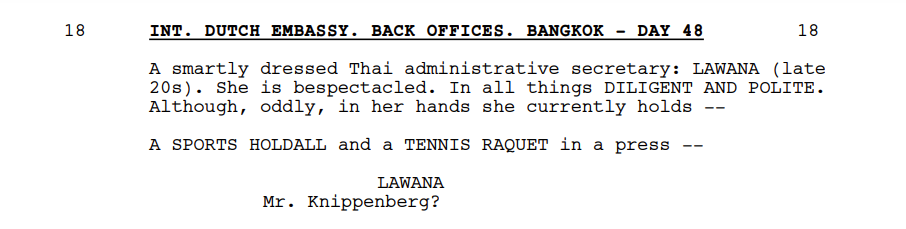
At the Dutch embassy, Lawana, the Thai administrative secretary, asks Herman to clarify that he is who she is expecting: Mr. Kippenberg?
Herman swears in Dutch before responding with a question: how long ago did the others leave?
Lawana – perhaps she doesn’t want to say. So Herman answers his own question.
To conclude, three more techniques writer Robert Marlow uses when responding to questions:
In this post we’ll explore how theme emerges from dialogue, thematic subtext from text.
Into the scene:
JEM
There’s people I can’t let you walk
away from.
DOUG
What? Who?
JEM
Come on!
A beat. Doug realizes.
DOUG
Are you serious, Jimmy?
She’s not my kid….
(beat)
Cut it out. All you give a fuck
about is coke and Xbox and now
you’re trying to play it off you
care about Shyne, come on now!
JEM
You know what your fucking problem
is?
DOUG
What?
JEM
You think you’re better than
people.
DOUG
Uh-huh.
JEM
Mister fucking clean, mister
fucking goddamn high and mighty,
right?
DOUG
Yeh, I’m better than all these
people, you’re right. I’m better
than anybody in this fucking
project.
JEM
Yeah, that’s what you think, but
you grew up right here. Same rules
that I did.
DOUG
OK. What else?
Beat.
JEM
Who the fuck’s the father?
DOUG
I know I’m not the father.
JEM
You were the one fucking her.
DOUG
Yeh, and I wasn’t the only one, brother, OK?
She knew I knew I’m not the father
and I have enough respect for her
not to ask her. OK? Because I don’t
think she knows. Alright? Now I
don’t wanna shatter your illusions
here, partner, but there aren’t
enough free clinics here in
Mattapan to find out who the father
of that kid is…
Beat.
DOUG (cont’d)
And I don’t know who the fuck you
think you are, either. You aren’t
letting me or not letting me do
shit. Alright? Here’s a little
fucking cheat sheet for you. Its
never gonna be me and you and your
sister and Shyne fucking playing
house up there. Alright? You got
it? Get that in your fucking head!
I’m tired of your one way fucking
bullshit. If you wanna see me
again, come down and visit me in
Florida.
So, what’s going on here in the way of exposition? What are we being exposed to thematically?
Later, at the end of the scene, we find out that Jem’s family took Doug in when his dad went to prison. Doug obviously started to fuck Krista, Jem’s sister – who isn’t mentioned by name here. Krista got pregnant, had a daughter, and from this we learn that she doesn’t know who the father is. Next, Doug, in quite an eloquent way, basically tells Jem his sister was a slut:
…there aren’t enough free clinics here in Mattapan to find out who the father of that kid is.
But this section of the scene is working subtextually on two more levels – interconnected by theme.
1. Krista & Shyne.
Krista’s motherly love for her daughter Shyne is the reason she later sacrifices her brother and Doug, giving them up to the FBI.
2. Doug’s mother.
When Doug asks his dad, on a visit to prison, why he didn’t look for his mother when she walked out on them, Doug’s dad says ‘because there was ‘nothing to find.’
He infers because Doug’s mother was no different to all the other single parent girls he sees on the projects ‘fucking around’ – was no different, in fact, to Krista.
So, underlying this section of dialogue, ostensibly conflict between Doug and Jem about the identity of Shyne’s father, is one of The Town’s major themes: parenthood and its absence.
The Town boasts an incredibly in-depth story world with complex back-stories and subplots. As Doug, the protagonist, says, “There’s a lot going on here.”
As this scene reveals information regarding three separate subplots I’m going to split it into three parts.
First, the back-story & subplot regarding the character The Florist which happens in the first few lines of the scene.
So, let’s study the dialogue from two perspectives:
First, what information is revealed?
Secondly, what information is concealed?
Let’s start at the beginning of the scene.
Doug approaches Jem not knowing what this meeting is about. He thinks it’s about the apartment.
However, Jem tells him he’s bought some information from The Florist about a potential robbery and now he has to do the heist and pay up.
But Doug tells Jem he’s not interested.
Let’s read the dialogue:
DOUG
Something wrong with the apartment?
JEM
No. The Florist.
DOUG
The Florist what?
JEM
Came through.
DOUG
Oh, Jesus Christ.
JEM
It’s large, Dougie. It’s large.
DOUG
We’re smoked. Punt it.
JEM
Who else is gonna buy it?
DOUG
You should have thought about that
before you fucking kept breaking
the guy out for forty dimes after
every job.
JEM
There’s an expectation rate.
DOUG
I’ll correct his expectation.
JEM
Oh, you will?
DOUG
Yeh.
Let’s look at the lines more closely.
From this we can see that Jem is paying The Florist after every job, even though The Florist doesn’t do any of the ‘heavy lifting.’
The heists are done by Doug, Jem and the other two men in the gang.
The Florist, Doug infers, gets a cut of every job they do.
But that’s just the way it is to Jem. But not to Doug. Doug is changing things.
In fact, Doug’s line:
I’ll correct his expectation.
is actually foreshadowing.
But look at Jem’s line:
You will?
When we watch the scene in action, Renner delivers this line with sarcasm.
Jem doesn’t believe Doug has the power, will, or ability to ‘correct his expectation.’
From these two words, from the way the line is delivered, we might think that Jem fears The Florist.
We learn later that Jem would rather die than go back to prison, when he says, in one of the best lines of the movie:
I can’t do any more time, Dougie. So if we get jammed up, we’re holding court on the streets.
In a previous post we noticed how Jem is actually scared of expressing himself emotionally. We learned how Jem and Doug love each other ‘like brothers’ and actually Jem is terrified of losing ‘Dougie.’ Jem’s a tough cookie with a soft centre; capable of extreme violence and incapable of expressing brotherly love – except perhaps through a play-fight – yet Doug reads between his lines.
Jeremy Renner manages to play this tough guy with immense vulnerability. It’s easy to see why he was nominated for an Academy Award for this role and why he’s become such an in-demand film actor.
OK, so back to our scene.
We’ve learned what the writers have revealed regarding The Florist.
Now, what is being concealed?
Firstly, there is a deep back-story regarding Doug and The Florist, concerning both Doug’s father and his mother.
Although we never meet her, Doug’s absent mother is a vital character in this story.
We learn from Doug’s dad that his mother was ‘no different’ than the other single parent 20 year olds he sees on the streets.
Doug’s father worked for The Florist, and, we learn, was a victim of his brutal violence.
So, these few lines of dialogue are hiding deep layers of back stories and subplots – yet the writers’ touch on them is as light as a feather.
How heavy is your dialogue?
David Mamet says people speak to conceal, not reveal.
How much are your characters revealing and concealing?
You can also read a studio version of the screenplay here.
NB. this script is different from the final cut that made the movie – but that’s another study.
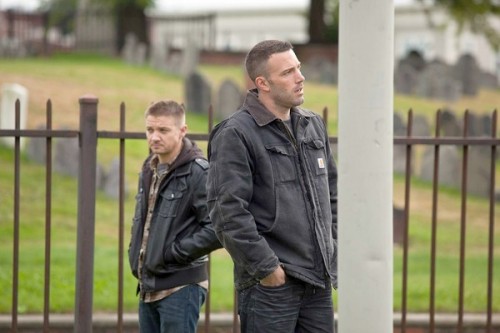
The first aspect of the scene I’d like to look at is the power play between Doug (Ben Affleck) and Jem (Jeremy Renner).
(Analysis in brackets and in bold).
EXT. PROJECTS – PARKING LOT/CEMETERY – DAY
Jem waits for Doug by the ancient cemetery near the projects. Doug approaches him.
DOUG
Something wrong with the apartment?
(So, from Doug’s question we know that Doug doesn’t know why Jem has arranged the meeting. Jem has called Doug, and Doug doesn’t yet know why. So, we might say that at the beginning of the scene Jem holds the power. )
JEM
No. The Florist.
DOUG
The Florist what?
JEM
Came through.
DOUG
Oh, Jesus Christ.
(If you’ve yet to see the film The Florist is The Town’s ‘godfather’ gangster, played by Pete Postlethwaite, a fearsome Northern Irishman, whose ability to cut flowers symbolizes his trademark ability and pleasure to ‘cut your fucking balls off.’ A lovely rose he is not. Doug obviously doesn’t want to do the job, whatever it is. Power with Doug.)
JEM
It’s large, Dougie. It’s large.
(Jem tries to tempt Doug with money. But Doug has enough money. Jem’s bait doesn’t work. The power is still with Doug.)
DOUG
We’re smoked. Punt it.
(‘We’re smoked’ means Doug knows the FBI are watching them. Power: Doug.)
JEM
Who else is gonna buy it?
DOUG
You should have thought about that before you fucking kept breaking the guy out for forty dimes after every job.
JEM
There’s an expectation rate.
DOUG
I’ll correct his expectation.
JEM
Oh, you will?
(No one makes demands or disobeys The Florist. Jem tries to intimidate Doug. It doesn’t work. Power : Doug. It’s a one way fight so far.)
DOUG
Pick up an extra guy or go with three guys or… fucking be smart and boot it.
JEM
Oh so you’re not going?
DOUG
No.
JEM
Why is that?
DOUG
Because we got a ton of fucking heat on us for one thing.
JEM
We’ll put a move on them, right? We’ve done it a hundred fucking times before.
DOUG
You know what, forget it. Do what you wanna do. I’m done.
(Read a separate post on the difference between the studio script and the dialogue in this scene here.)
JEM
What?
DOUG
I’m done.
JEM
You’re done?
DOUG
What does it sound like?
JEM
What’s that.. what’s that mean?
DOUG
What the fuck do you think it means?
JEM
What does that mean you’re done? It sounds like a bunch of fucking bullshit.
(Why the confusion? Doug doesn’t want to do the job. More than that, he wants out completely. Why isn’t Jem just letting it go? And why is Doug even entertaining him? Why not just tell him to fuck off? If he’s done, he’s done. There must be more to it. There must be more to this relationship. Something deeper. Doug seems to be struggling to hold onto his power. OK, he’s holding his corner, but why take the questioning? In a previous scene with the Feds Doug runs rings around them with their questioning. What’s going on? The power balance is shifting. Power: shared.)
DOUG
Let me put it to you this way, I’m putting this whole fucking town in my rear view.
(OK, so there we have it. Doug states his outward goal – a reflection of the visual we get earlier of Doug watching the plane in the sky as he waits for his girl outside the cafe. Power, back with Doug.)
JEM
There’s people I can’t let you walk away from.
DOUG
What? Who?
(Confusion again. What is Jem talking about? Power unbalanced again.)
JEM
Come on!
(Doug realizes Jem is talking about his (Jem’s) sister, Krista and her young daughter, Shyne. So, finally, we get to what this meeting is really about – the subtext rises, and it’s not work, but family. Jem grabs the power.)
DOUG
Are you serious, Jimmy? She’s not my kid….
(beat)
Cut it out. All you give a fuck about is coke and Xbox and now you’re trying to play it off you care about Shyne, come on now!
(Doug ridicules him. Assassinates his character. Coke and Xbox. Doug uses humor to disparage him, snatching the power back easily.)
JEM
You know what your fucking problem is?
(Come on, Jem, fight back.)
DOUG
What?
JEM
You think you’re better than people.
DOUG
Uh-huh.
JEM
Mister fucking clean, mister fucking goddamn high and mighty, right?
(Some info on Doug. He’s clean. He was an addict. He goes to AA / NA meetings. We know that. But is Jem right? Does Doug think he’s better than the other people on the ‘projects’? Remember his back-story, he was drafted as a pro hockey player, got into trouble for fighting other guys on his team, and lost his opportunity. Jem is really pressing Doug’s buttons here. In Truby terms, this could be Doug’s moral flaw. Does he think he’s ‘better’ than other people? Or does he simply believe he’s capable of a better life than the one he’s living, the one he’s been born into? Who’s holding the power here? I would say it’s definitely not Doug, but possibly shared, because we’re not sure if Doug’s ‘uh-hu’ and his agreeing with and repeating what Jem accuses him of is him being truthful, or him being sarcastic. Therefore – Power: shared.)
DOUG
Yeh, I’m better than all these people, you’re right. I’m better than anybody in this fucking project.
JEM
Yeah, that’s what you think, but you grew up right here. Same rules that I did.
DOUG
OK. What else?
Beat.
(Doug’s three little words here are very interesting. Doug now knows why Jem has called this meeting. He’s given him an earful about the job with The Florist, and he’s accused him of being self-righteous, proud, of seeing himself as ‘high and mighty.’ But Doug knows that’s not all. He knows this is all leading somewhere. When you watch the scene you’ll see a change of pace here. There’s a beat change. It’s as though Doug admits defeat, but really, to Doug, defending himself from Jem’s childish accusations just isn’t a battle worth fighting. Doug’s tired of the bullshit now. He’s had enough. He asks the direct question: What else?)
JEM
Who the fuck’s the father?
(OK. Now we know what this is all about. Finally. His niece, his sister’s beautiful little girl – Shyne. Power: Jem)
DOUG
I know I’m not the father.
JEM
You were the one fucking her.
DOUG
Yeh, and I wasn’t the only one, brother, OK? She knew I knew I’m not the father and I have enough respect for her not to ask her. OK? ‘Cause I don’t think she knows. Alright? Now I don’t wanna shatter your illusions here, partner, but there aren’t enough free clinics here in Mattapan to find out who the father of that kid is…
(Doug snatches the power back easily again. Watch the acting here. Affleck’s doing all the talking, but you can feel Renner about to explode. He represses his rage, but it’s rising to the surface. Doug doesn’t back down. He’s got the power, and he goes in for the kill).
DOUG
And I don’t know who the fuck you think you are, either. You aren’t letting me or not letting me do shit. Alright?
(Exactly! Why does Jem feel he can ‘let Doug or not let Doug’ do anything? And why was Doug letting him act like his boss? Now we know, Doug doesn’t let anyone tell him what he can or can’t do. He lays down the law. Power: Doug).
DOUG
Here’s a little fucking cheat sheet for you. It’s never gonna be me and you and your sister and Shyne fucking playing house up there. Alright? You got it? Get that in your fucking head! I’m tired of your one way fucking bullshit. If you wanna see me again, come down and visit me in Florida.
(Jem’s lost this argument, this verbal argument, so he attacks with all he’s got left, his physical toughness. Affleck’s tough, too. But Jem pulls a pistol, and cracks Doug on the head with it. Physical power: Jem. Emotional power: Doug.)
Doug recovers.
He sits up, panting.
JEM
In the 302 the Feds have me dropping Brendan right here. But I got him back on Tibbetts… shot him right in the chest. I remember he looked at me…and, I don’t know who was more fucking surprised he wasn’t dead – him or me. We just fucking stood there a second waiting for some shit to happen, I don’t know what, but…then he started running. Fucking guy ran a 100 yards with a bullet in his heart…The fucking guy should have run track, y’know what I’m saying?
(So Jem has called this meeting exactly where he killed ‘Brendan’ whoever Brendan is.)
Jem laughs.
DOUG
I didn’t ask you to do that.
JEM
Yeh, well, you didn’t have to, Dougie, come on. They told me Brendan Leahey was coming down here to roll up on you with a glock 21 so I came over here, and I put him in the fucking ground. Did nine years for it. Now, you don’t gotta thank me, but you’re not walking away.
(Jem wrenches the emotional power from Doug. Jem had saved his life. And what, now he was leaving town? Leaving him, and his sister, and his niece? Doug knows Jem isn’t capable of being open emotionally, and that all this tough talk about ‘not letting him walk away’ is just a cover up for the pain he feels. Power: Doug).
DOUG
I’m grateful for everything you’ve done for me. Your family took me in when my father went away. (Exposition at the height of tension. Jem’s family kind of ‘adopted’ Doug when his dad went to prison). You’re like a brother to me. (Doug, without saying the words directly, tells Jem that he loves him). But I’m leaving. (Outward goal stated again.) You gonna shoot me? Go ahead. But you’re gonna have to shoot me in the back.
(Of course, Jem doesn’t. He has lost this conflict and he knows it. Doug gets up, holding all the power, and walks away.)
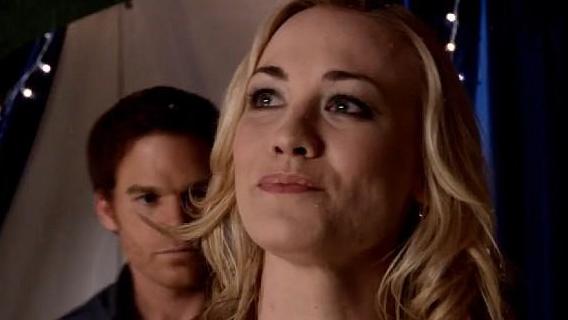
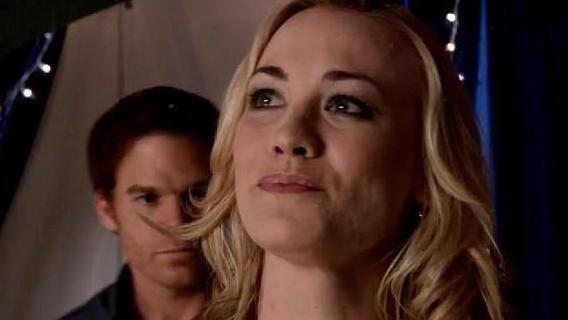
We’re studying the explosive climax from DEXTER Season 7 Episode 7 – ‘Chemistry’.
This post will look at the way the writers use the technique of answering questions with questions and how questions form part of the power play between characters.
Dexter, angry that Hannah’s latest victim died in his apartment, asks Hannah how she killed him.
DEXTER
How did you do it?
HANNAH
Is it really important?
DEXTER
Is life in prison important?
Hannah bats Dexter’s question away. But Dexter counters with force.
3 questions in a row.
Note the way the number of syllables increase: 5, 7, 8. As the tension increases, so do the number of syllables.
Now this is really interesting: when Hannah finally answers, she tells the truth.
HANNAH
I’m never going to prison.
Price liked to chew on his pens.
The last one had a little something on it…completely undetectable.
Another section of the script where Dexter responds to a question with a question is the break between Beat 2 and Beat 3.
Hannah attempts to make Dexter aware they have a ‘spiritual connection’, to draw him in:
HANNAH
I could feel you watching me while I was being interrogated.
You saw the whole thing didn’t you?
But Dexter refuses to go with her, still needing more information before he commits to this spiritual partnership, to this bond Hannah is convinced they share. Dexter responds to her question with a completely unrelated question – a question that pierces deep:
DEXTER
Is it true about your husband?
Did you kill him because you didn’t want a family?
Hannah answers this question, telling the truth. It’s as though she knows what Dexter needs, and she’s willing to make herself vulnerable to him, to allow herself to be known. She’ll do anything to draw him in to her world, even tell him the truth.
HANNAH
It was the opposite.
I wanted a family and he didn’t.
He threatened to leave me unless I got an abortion.
Hannah also answers Dexter’s next question directly:
DEXTER
What happened to the baby?
HANNAH
It was a miscarriage.
Sometimes life subtracts, sometimes it adds…
So what do we see here? Hannah answers truthfully when she believes doing so will draw Dexter towards her.
And when Dexter refuses to be drawn in, refuses to give up power, he bats the question away with a question of his own.
Questions are part of the power play between characters.
Hannah’s next and final question is a rhetorical one, which she answers herself, not giving Dexter the chance to bat it away, she answers for him in order to draw him in to their spiritual bond:
HANNAH
Do you see what just happened? We were looking out for each other…









 screenwrite.org