This article is also available to watch on Youtube
We’ve been looking at techniques for responding to questions.
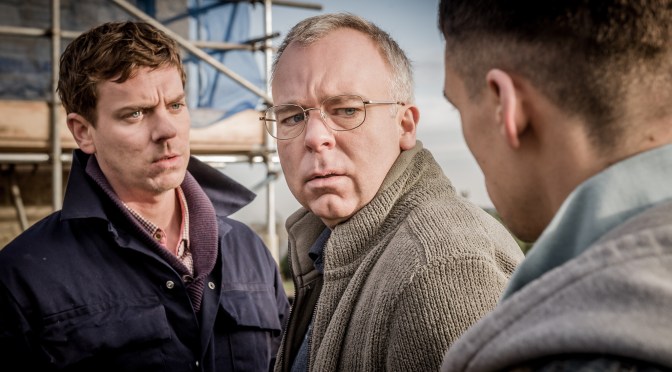
In the last post we looked at two examples from Mammoth Screen’s The Serpent by Richard Warlow. Let’s look at some more examples from the same script. This is episode 1, available from BBC Writers Room.
In this scene, Charles and Monique are trying to sell the sapphire / diamond ring to Wim and Lena.
When Monique asks Charles ‘they don’t have to decide now’ it is not a real question. Of course Charles wants them to decide now, but, he’s willing to play the long game. It’s a lot of money.
How does Charles reply? Of course not. But he’s lying. Of course he wants them to decide now. So what technique is this? We might say Charles is responding to Monique’s question by saying what Wim and Lena want to hear.
Let’s look at another question, a bit later in the same scene.
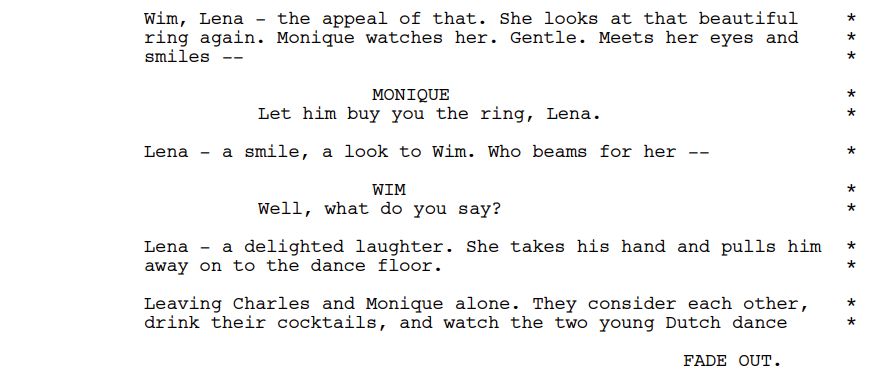
This time Monique pushes for a sale, telling Lena to let Wim buy her the ring. Lena smiles at Wim. Wim ‘beams for her’ and asks Lena: Well, what do you say? Lena responds not with words but with action, laughing and pulling him to the dance floor.
Let’s look at another scenario.
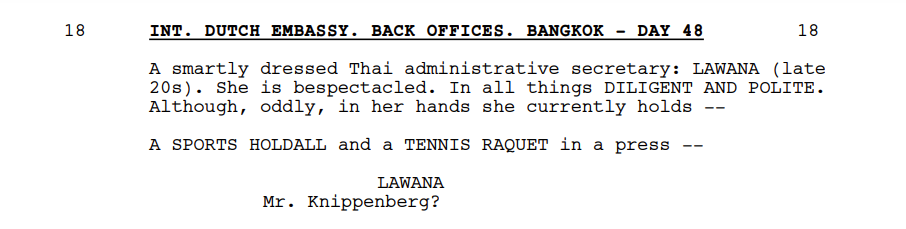
At the Dutch embassy, Lawana, the Thai administrative secretary, asks Herman to clarify that he is who she is expecting: Mr. Kippenberg?
Herman swears in Dutch before responding with a question: how long ago did the others leave?
Lawana – perhaps she doesn’t want to say. So Herman answers his own question.
To conclude, three more techniques writer Robert Marlow uses when responding to questions:
This week involved posting a synopsis for a short film. I posted Isaac. I have been working on this concept in a novel and feature film with a female lead. However, I posted it in short film format with a male lead. It tells the story of a young Eritrean footballer who, after being press-ganged into joining the Tigrayan conflict, is lured into a trafficking ring and who winds up in the UK, exploited, and his human rights violated. I have been torn between writing it as a male or female lead. However, for the short I’ve opted for a male lead because, whereas trafficking usually revolves around women’s rights, I want to highlight the fact that men are trafficked and exploited as well. While in Bahrain I heard the story of young African men being trafficked there with dreams of playing professional soccer, but on arrival, after having had their passports stolen from them they are then coerced into cheap labour.
I also decided to embark on an optional project to study the work of Aaron Sorkin. When I began I had no idea what I would find. I intended studying his dialogue techniques. However, after viewing four films, A Few Good Men, Moneyball, Molly’s Game and Steve Jobs I realized there is more going on than just the quick-fire dialogue he is famous for. I discovered that below the text there are themes regarding gender issues and family relationships, particularly father-daughter. My research led me to an MA thesis from Stockholm University which focuses on gender studies in Hollywood films. Perhaps this study as relating to Aaron Sorkin is something I may pick up on again later in the course. Regardless, I learned a great deal about Sorkin and how he goes about sharing his worldview through his writing.
In the opening ten minutes of Steven Knight’s historical crime drama Peaky Blinders only 2 scenes are dialogue driven.
i. Freddie’s rallying socialist cry to the workers.
ii. Thomas’ fight for power with his older brother.
Do these two scenes agree with each other in theme or disagree?
They represent ideological opposites.
Freddie is a ‘communist’. He believes in the power of the workers. He believes in the collective power of the working class. His ideology and influence over the workers of Birmingham, a major industrial city, was a threat to the political elite.
Wikipedia describes communism as:
In political and social sciences, communism (from Latincommunis – common, universal) is a social, political, and economic ideology and movement whose ultimate goal is the establishment of the communist society, which is a socioeconomic order structured upon the common ownership of the means of production and the absence of social classes, money and the state.
However, Thomas is on a rise to power. He wants to be, as Freddie says to Thomas’ s sister, “King of Small Heath.” Thomas is a capitalist. Wikipedia describes the capitalist system:
In this system, there are two major social classes: the working class – who must work to survive, and who make up a majority of society – and the capitalist class – a minority who derive profit from employing the proletariat.
The conflict between these two political systems is Thomas Shelby’s story – his rise to power – from working class to capitalist class – from beggar to King.
It’s no mistake by Steven Knight that the two longest dialogue driven scenes in the opening ten minutes are both a struggle for power. One a struggle for communal, collective power. The other a struggle for personal, private power.
The two scenes represent capitalism versus communism.
The scenes are a war of ideas, a conflict of ideologies.
Summing up then, what ONE important thematic technique does Steven Knight employ in his opening ten minutes?
He does what Shakespeare taught us to do in dramas such as Hamlet, Coriolanus and King Lear.
We’ve been exploring the opening ten minutes of Steven Knight’s brilliant historical crime drama Peaky Blinders, and we’re onto the final scene.
We’ll look briefly at what happens in this scene.
Then, we’ll examine what elements the writer, director and editor have included to present the most effective opening ten minutes in the grasp of their collective talents.
So, onto the scene.
The scene is 4 shots and lasts 20 seconds.
It starts at 09.40.
SHOT 1.
EXT. INDUSTRIAL BACKSTREET, BIRMINGHAM – DAY
Thomas Shelby, small in the frame of the huge street, walks towards us for 6 seconds.
SHOT 2.
SAME STREET – CONTINUED.
Switch POV as we watch Thomas approach a pub from behind.
In the top corner of the frame we make out part of the sign: The Garrison Tavern.
Three people stand at the entrance: two WOMEN and an OLD MAN.
Seeing Thomas the Old Man cowers and bows.
Shot length: 6 seconds.
SHOT 3.
INT. THE GARRISON TAVERN – DAY.
We watch men being men in a pub.
Shot length: 6 seconds.
CUT TO:
SHOT 4.
INT. THE GARRISON TAVERN – DAY.
The doors open, like an old Western saloon, as –
Thomas enters.
That’s the final shot – BANG ON 10 minutes – Thomas Shelby, center frame.
Shot length: 2 seconds.
Total scene length: 20 seconds.
For extra posts on the opening ten minutes of Peaky Blinders click here.
We’re studying the opening ten minutes of Steven Knight’s Peaky Blinders.
We’re 8 minutes in: Scene 10.
In this scene Freddie Thorne rouses workers to strike. Here’s a transcript.
Freddie speaks from the stairs, looking down on a sea of workers:
FREDDIE
Comrades, we are here today to take a vote on strike action. But before we have a show of hands for that, let’s have a show of hands from all of those who fought in France. All those who stood side by side with your comrades and watched your comrades fall. Raise your hands. The blood shed on Flanders fields. The sweat of your brows. Who reaps the rewards? Is it you? Is it your wives? Who then? Do they stand among us? Or do they sit at home, comfortable, with a full belly, while you scrape to find enough to put food on your children’s feet? And what is the reward they offer you for your sacrifices made? A fucking cut in your wages. That is your reward. Raise a hand all those who want to strike.
So, Freddie unleashes a passionate call to strike, delivered with relish by actor Iddo Goldberg.
But what’s it all about?
Flanders Fields was a major ‘Western Front’ in World War 1 and the grave of many soldiers. It became the subject of a famous poem In Flanders Fields.
Wiki says:
Between 1915 and 1917 there were several major offensives along this front. Among the most costly of these was the Battle of the Somme with more than a million casualties.
The first season of Peaky Blinders is set in 1918, one year after the October Revolution in Russia, commonly referred to as Red October, the October Uprising or the Bolshevik Revolution.
It was an armed insurrection to overthrow an autocratic government and gain state power.
During this time, urban workers began to organize into councils (Russian ‘soviets’).
Is Freddie trying to organize workers not only to strike – but to rise up, take control from the government and give the power back to the people?
Who reaps the rewards? Is it you? Is it your wives? Who then? Do they stand among us? Or do they sit at home, comfortable, with a full belly, while you scrape to find enough to put food on your children’s feet?
According to Wiki it was the October Uprising that
initiated the establishment of the world’s first self-proclaimed socialist state.
Also –
Bolsheviks became the Communist Party.
And –
Founded by Vladimir Lenin and Alexander Bogdanov, the Bolsheviks considered themselves the leaders of the revolutionary working class of Russia.
Does Freddie Thorne consider himself leader of the revolutionary working class of Great Britain?
And how how does this connect to Thomas Shelby and his criminal gang The Peaky Blinders?
In the penultimate scene of the opening 10 minutes Steven Knight takes us back to our main Antagonist, and we discover Freddie Thorne is on his wanted list as well.
We’re studying the opening ten minutes of Peaky Blinders.
We’re on scene 11.
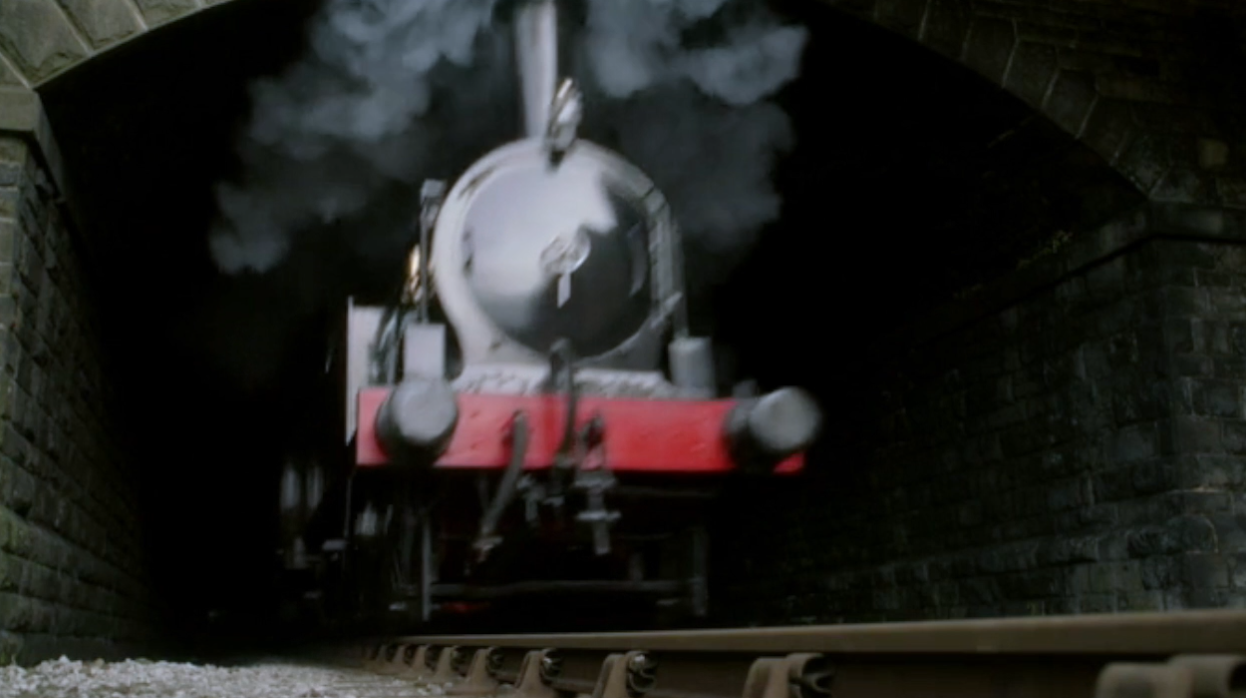
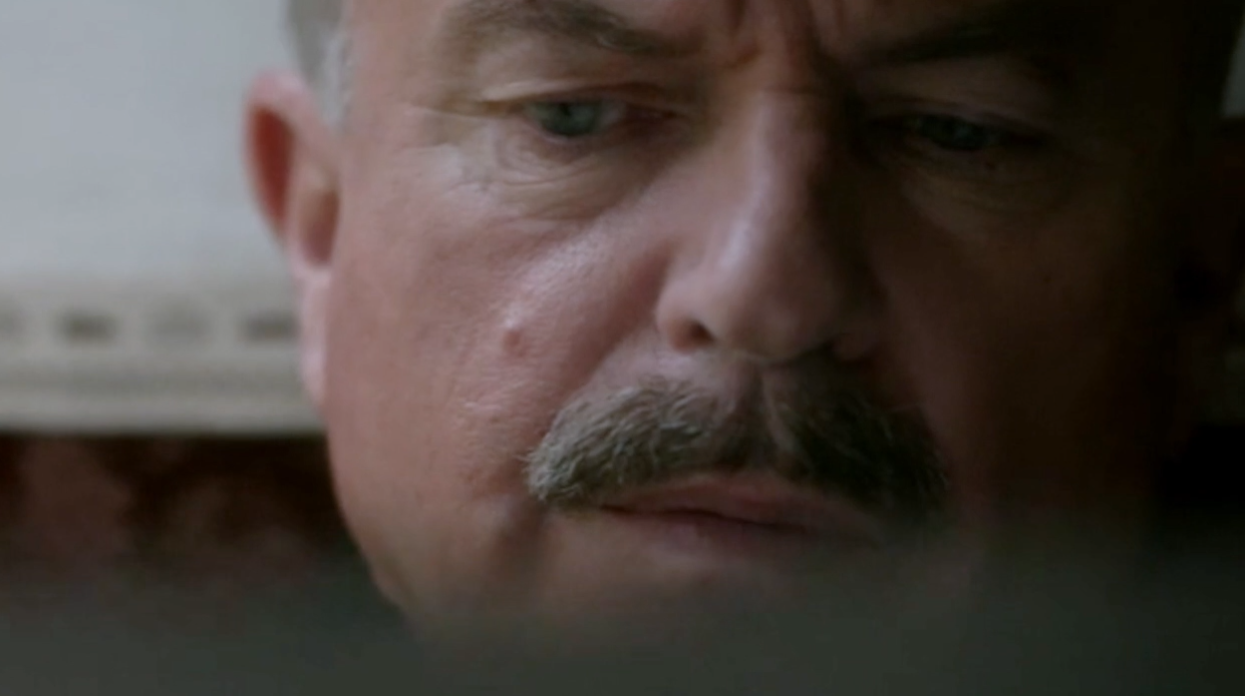
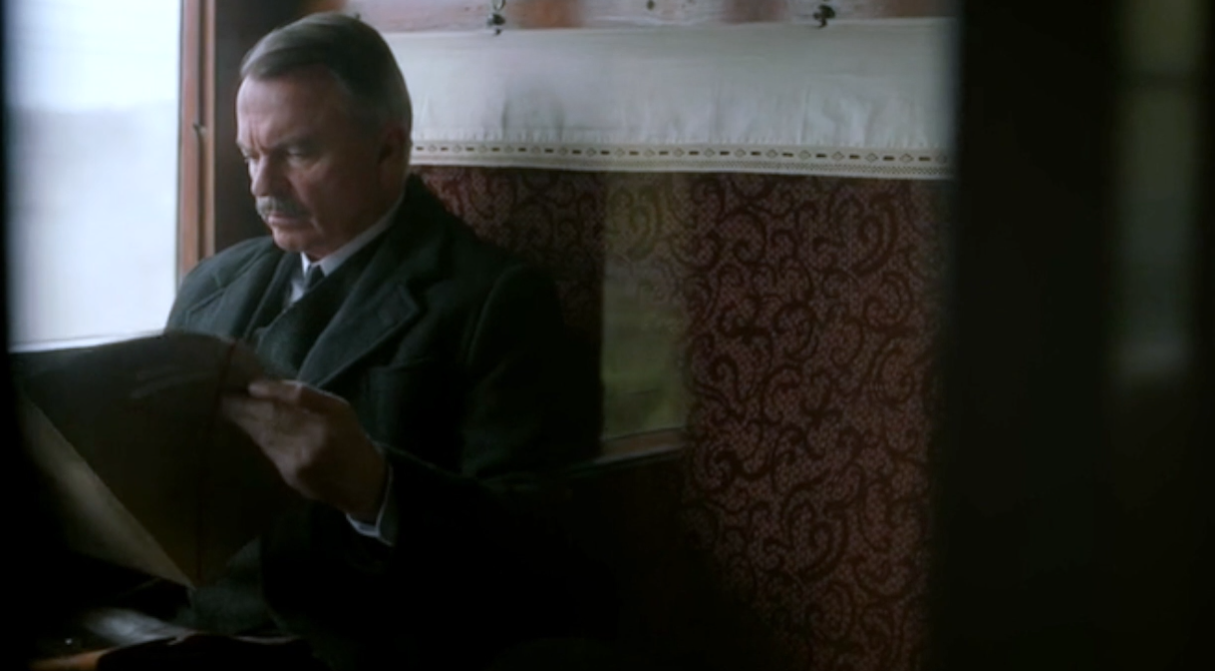
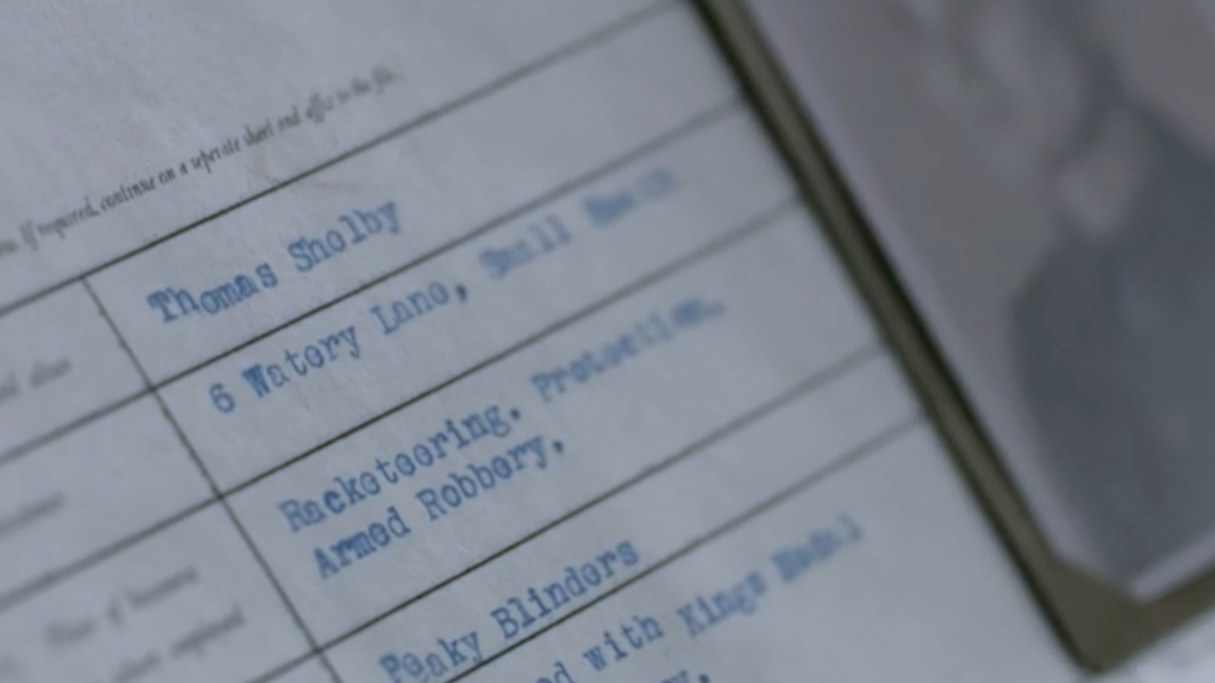
We’re back on the train with C.I Campbell as he studies his ‘Top Secret’ files.
This scene lasts 01.21.
As before in C.I. Campbell’s introductory scene – it’s all visual.
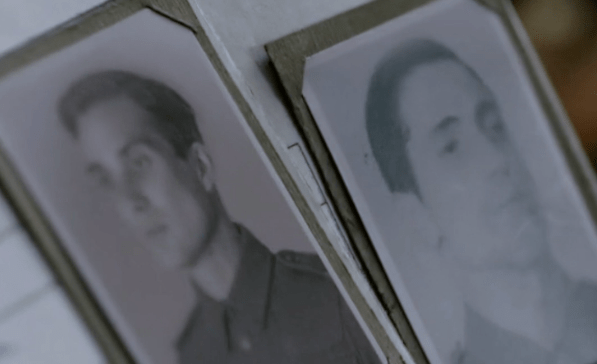
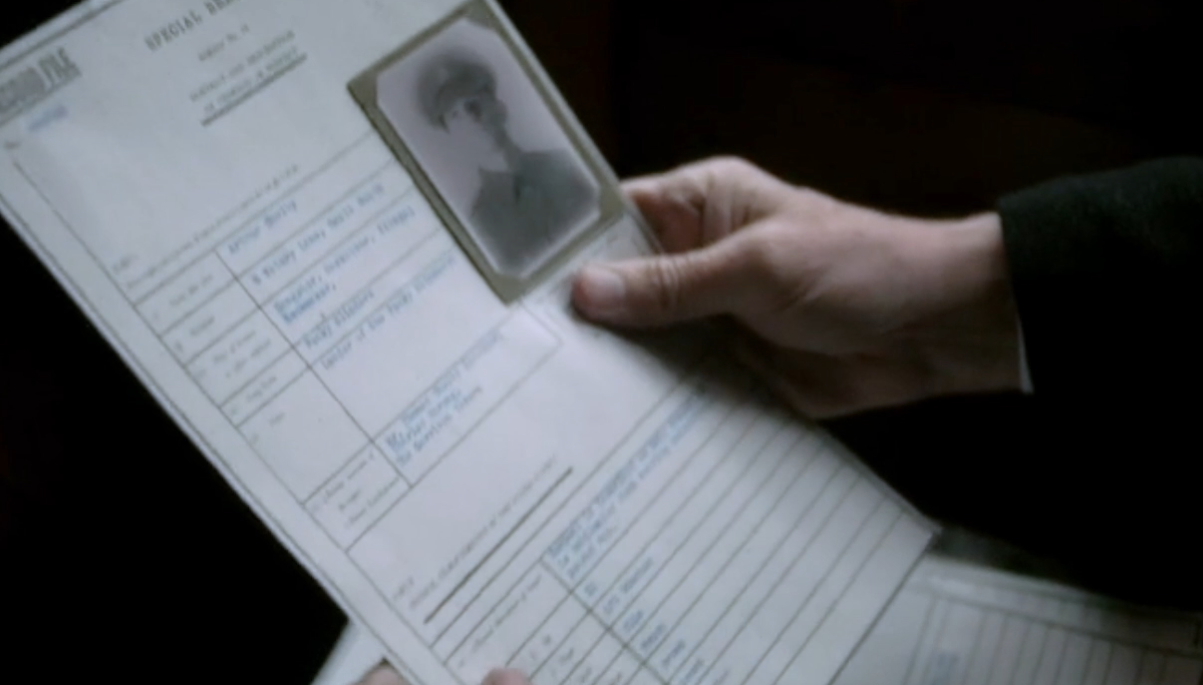
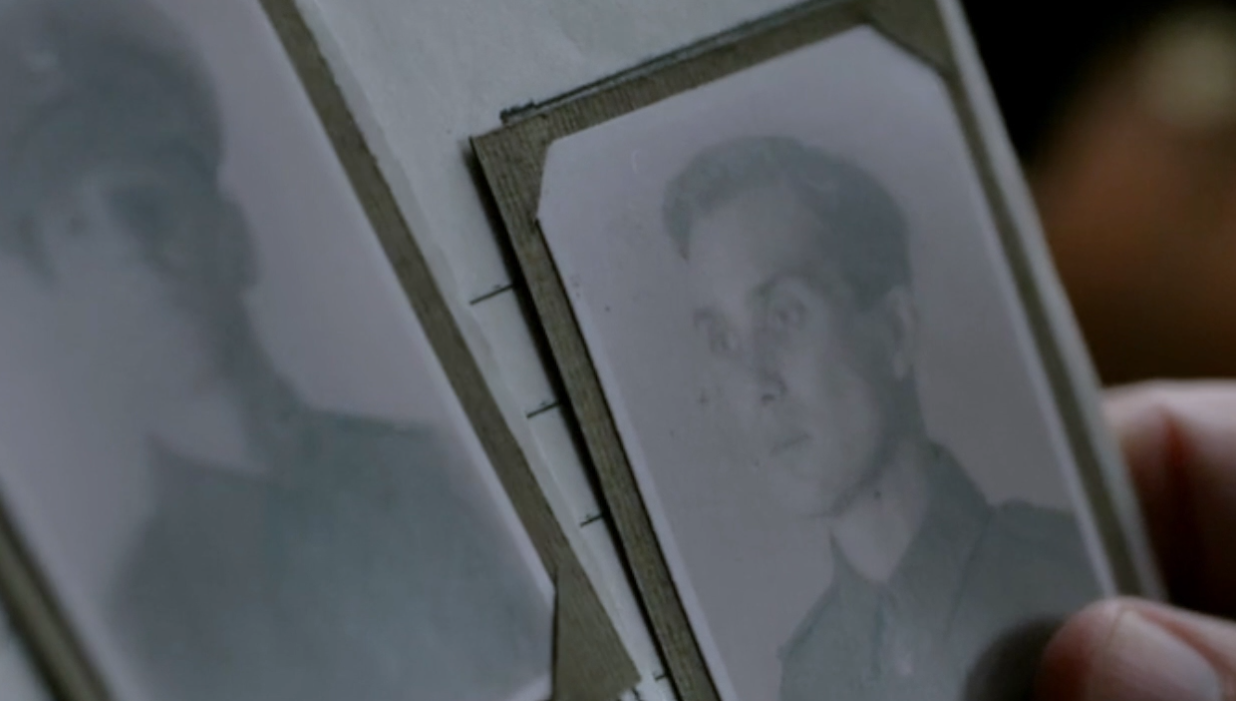
The opening shot is of an image of a man in military uniform.
It’s the man we’ve just been watching rouse his workers to strike in the previous scene.
Campbell turns the page, revealing his name: Freddie Thorne.
Next, we’re close on:
Special Branch consider Freddie a “Communist Agitator” and a “Bolshevik.”
Next, C.I. Campbell holds up Thomas’s photo, so the two are side by side. Comrades, brothers in arms, but also this photo symbolizes one of the series grand themes, and one of societies greatest battles of ideas – communism versus capitalism.
Finally, the Chief Inspector holds his files tightly, takes a deep breath, and closes his eyes, as if relaxing before the battle. The calm before the storm?
Summing up then, what do we learn from this scene?
1. Freddie is on C.I. Campbell’s ‘Top Secret’ target list.
2. Freddie is considered a political threat – a communist agitator.
2. As C.I. Campbell holds the images of Thomas and Freddie side by side it hints at a grand theme: Capitalism versus Communism.
Click here for the final scene in the opening 10 minutes, and see how, at exactly 10 minutes, the writer and director places our hero, Thomas Shelby, centre screen.
This is the first in a series of posts studying subtext.
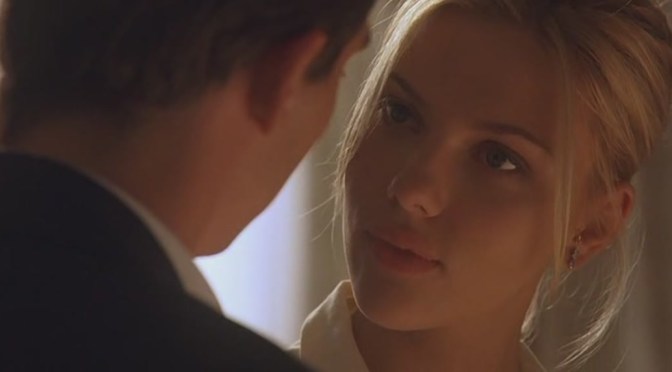
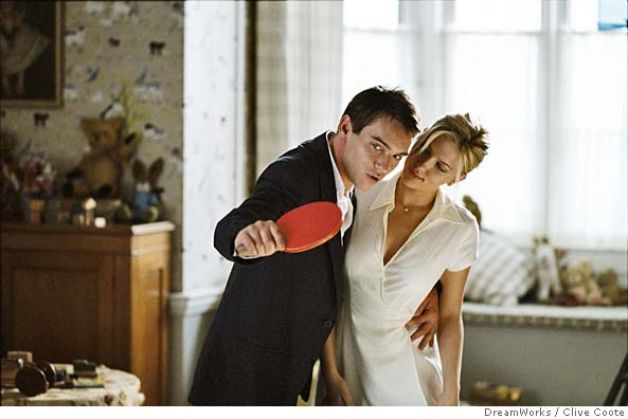
This electrifying scene – between Jonathan Rhys Meyers and Scarlett Johansson in Woody Allen’s Match Point (nominated for an Academy Award for Best Original Screenplay) – sizzles with sexual tension through subtext.
Watch the scene:
Here’s the dialogue:
NOLA
So, who’s my next victim? You?
CHRIS
I haven’t played table tennis in quite a while.
NOLA
Would you like to play for a thousand pounds a game?
CHRIS
What did I walk in to?
Chris plays and smashes the ball violently to win the point.
NOLA
(surprised at his aggression)
What did I walk in to?
Chris moves to Nola’s end of the table.
CHRIS.
It’s like this.
He goes to help her.
May I?
NOLA
Please.
Chris puts his arm around her and pulls her close.
CHRIS
You have to lean in and hit through the ball.
NOLA
I was doing just fine until you showed up.
CHRIS
Ah…story of my life.
So tell me…what’s a beautiful young American ping-pong player
doing mingling among the British upper class?
NOLA
Did anyone ever tell you you play a very aggressive game?
CHRIS
Did anyone ever tell you you have very sensual lips?
NOLA
Extremely aggressive.
CHRIS
I’m naturally competitive. Is it off-putting?
NOLA
I’ll have to think about that for a while.
Tom enters (played by Matthew Goode).
TOM
Ah! There you are. I wanted to introduce you to Chris Wilton.
Chris Wilton this is Nola Rice, my fiance.
NOLA
The tennis pro.
They shake hands.
CHRIS
My pleasure.
NOLA
(to Tom, but eyes fixed on Chris)
He was trying to have his way with me over the table.
TOM
(laughing)
Oh really? Well you’d better watch out for this one.
He’s made a living out of hustling.
NOLA
(to Chris)
I’ll be ready for you next time.
So, let’s study it line by line:
NOLA
So, who’s my next victim? You?
This is brilliant foreshadowing by Woody Allen. If you haven’t seen the film yet, I won’t spoil it for you.
CHRIS
I haven’t played table tennis in quite a while.
NOLA
Would you like to play for a thousand pounds a game?
CHRIS
What did I walk in to?
Chris plays and smashes the ball violently to win the point.
NOLA
What did I walk in to?
Chris moves to Nola’s end of the table.
CHRIS.
It’s like this.
He goes to help her with her posture.
May I?
NOLA
Please.
Chris puts his arm around her and pulls her close.
CHRIS
You have to lean in and hit through the ball.
NOLA
I was doing just fine until you showed up.
Nola isn’t just talking about the table tennis game. She’s talking about the game of life. Nola is a hustler, an out-of-work actress using her beauty to work her way up in society. She was doing fine. But now Chris has walked in to her life…
CHRIS
Ah…story of my life.
So tell me…what’s a beautiful young American ping-pong player
doing mingling among the British upper class?
NOLA
Did anyone ever tell you you play a very aggressive game?
This aggressive game, again, is not just about the ping-pong. More superb foreshadowing by Woody Allen, pointing towards the climax.
CHRIS
Did anyone ever tell you you have very sensual lips?
NOLA
Extremely aggressive.
By using the adverb of intensity ‘extremely’ Woody Allen pushes the foreshadowing at us even harder.It’s a warning. There is ‘extreme aggression’ to come.
CHRIS
I’m naturally competitive. Is it off-putting?
NOLA
I’ll have to think about that for a while.
Tom enters (played by Matthew Goode).
TOM
Ah! There you are. I wanted to introduce you to Chris Wilton.
Chris Wilton this is Nola Rice, my fiance.
NOLA
The tennis pro.
Chris and Nola shake hands.
CHRIS
My pleasure.
NOLA
(to Tom, but eyes fixed on Chris)
He was trying to have his way with me over the table.
I love this line. Throughout the scene the body language subtext has been electric sexual tension. Until now its been unspoken. We’ve seen it. We’ve watched it. We’ve felt it. But Nola speaks it. It’s no longer subtext. The subtext has come to the surface. It’s the truth. But heedless Tom, lacking all awareness of the sexual chemistry that we’ve just witnessed between Chris and Nola, laughs it off.
TOM
(laughing)
Oh really? Well you’d better watch out for this one.
He’s made a living out of hustling.
NOLA
(to Chris)
I’ll be ready for you next time.
This ingeniously crafted line works on two levels.
i. She’ll be ready next time he wants to ‘take her’.
ii. It foreshadows the climax when being ready for him has life or death stakes.
Summing up then, this scene is a superb example of subtext working to both foreshadow and to create sexual tension.
We also experience sexual tension ‘subtext’ through the actors’ physical interaction and body language.
What a pleasure to see these two actors working together to create so much sexual tension with such a clever script.
I’ll finish with 3 questions:
1. What tension is your dialogue creating?
2. What is your dialogue/subtext foreshadowing?
3. Does your dialogue give room to the actors to allow them to create tension in their physical space?
We’re studying the opening ten minutes of Steven Knight’s historical crime drama Peaky Blinders.
In the previous post we saw how this scene introduces the main antagonist – Chief Inspector Campbell – and the main plot, visually, with no dialogue, in 39 seconds.
But what does this scene reveal regarding character?
Let’s take the three characters referenced in this scene one by one, in order of appearance.
What 3 characteristics do we learn about each of them?
Chief Inspector Campbell
1. He is “a thinker”.
2. He is determined.
3. He is fiercely focused.
Arthur
1. He is ex-military.
2. He’s a gangster, a racketeer, and a bookmaker.
3. Police consider him “leader” of the Peaky Blinders.
Thomas
1. He is ex-military.
2. He is an armed robber i.e. a violent criminal.
3. He was ‘honored for gallantry’ and therefore a war hero.
So, a great deal revealed in this short scene with no dialogue.
Stay tuned for the next sneaky peak at Peaky Blinders!
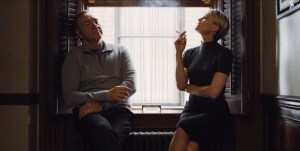
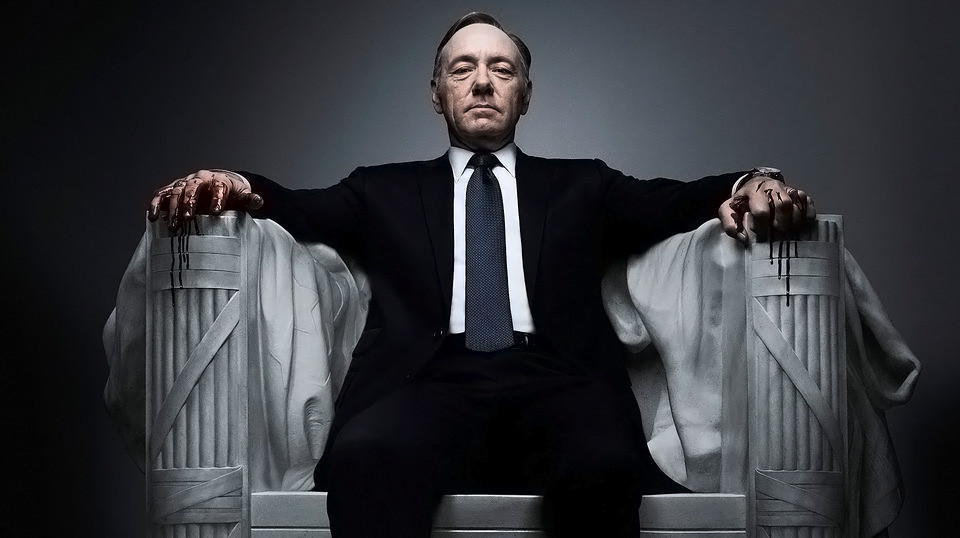
Everyone is doing something. Take Frank and Clare Underwood in House of Cards. They don’t just sit and talk. They share a cigarette. Their ‘secret’ habit. In a later season Frank takes up a new hobby of painting his little soldiers. What secret habits or little hobbies do your characters have?
2. Desire.
Everyone wants something. We want something in life and we want something now. What do your characters want?
a) In any specific moment.
b) In a specific scene.
c) In this story.
2. Power Play.
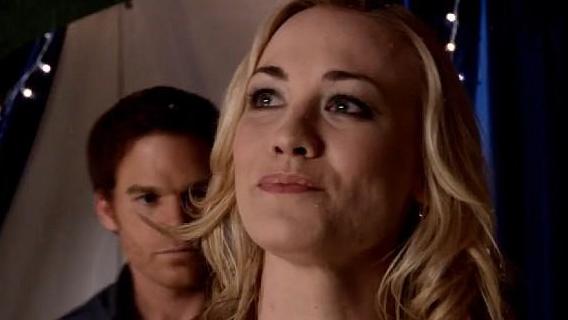
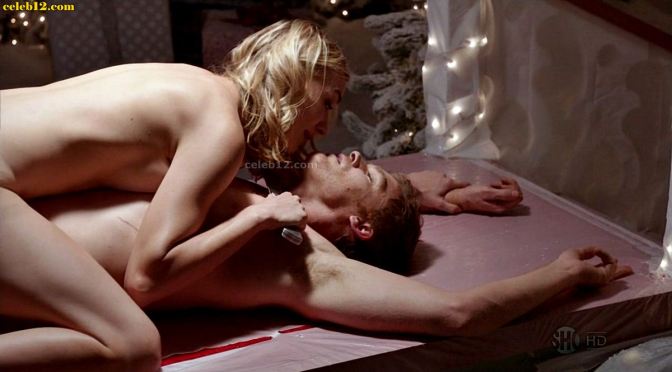
In this scene between Hannah and Dexter there is a constant battle for power.
Mamet believes we speak to conceal ourselves, not reveal ourselves.
In her book To Be a PlaywrightJanet Nepris says it’s when characters can no longer keep inside what they truly feel that we reach the highest point of drama in a scene.
Until that point we speak to conceal the truth.
We conceal our secrets. We conceal our true desire.
Check out this post exploring how Woody Allen uses subtext to foreshadow the violent climax in the clever, Oscar nominated Match Point.
So, four things to remember as we work on our scenes: action, desire, power play and subtext.
In Scene 6 Thomas enters the Shelby house and has a quick interchange with Finn, his youngest brother.
In the screenplay Steven Knight describes this short, 30 second scene in detail:
Thomas breezes through a hallway decorated with brass and fancy floral crockery. The Shelby home is compact, a typical terrace, but we might notice a surfeit of brass and flowery ornamentation around the place. The Shelbys are cash rich but without conventional good taste. The home is decorated like a gypsy caravan, or a boatman’s barge with lots of roses, elephants and castles.
We might glance a photograph of three brothers in military uniform, smiling (this is Arthur, Tommy, and John – all in Warwickshire Yeomanry uniform, with a freshly dug trench behind them).
Thomas tosses his coat aside and passes through a small kitchen, where a young boy (FINN, 10, Thomas’s youngest brother) is smoking a cigarette into the flames of a coal fire. A rabbit roasts on a spit. Finn hides the cigarette and calls out as Thomas passes…
FINN
Arthur’s mad as hell.
THOMAS
What does a ten year old know about hell?
FINN
I’m eleven Sunday.
Let’s have a quick look at how much of this is realized on screen.
The first paragraph –
Thomas breezes through a hallway decorated with brass and fancy floral crockery.
– is on screen.
However the first thing we notice when Thomas enters is a crucifix on the wall, illuminated by a shaft of sunlight as Thomas opens and closes the front door. This is perhaps a nod to the Shelby’s Irish – Catholic heritage. Aunt Polly is described as “half Romany, half catholic” and the city of Birmingham in the UK in 1919 had “a large Irish Catholic” community. (Sources: Telegraph/Guardian).
From Steven Knight’s description we do notice on screen –
flowery ornamentation around the place.
– and the home is
decorated like a gypsy caravan.
It’s interesting to note Thomas is referred to several times as being a “gypsy.”
However, the rabbit on the spit, the action of tossing the coat, and specifically the photo of the three brothers in uniform are all absent from the screen.
(Note to self – not everything you write will make it on to the screen – even if you’re at the top of your game!)
So, to answer our two questions:
1. What is revealed in this scene regarding plot?
Nothing per se. However the line of dialogue from Finn prepares us for familial conflict between Thomas and Arthur – itself revealing one of the series’ major themes – the rise of a king – and this theme is itself revealed in plot – the various actions Thomas takes in order to achieve his ambitions.
And why is Arthur ‘mad as hell’ ? Because, as we soon find out, Thomas has been treading on Arthur’s toes. There’s a battle for leadership going on. A battle for kingship. Who is the King of the Shelby clan? Who is The King of Small Heath ? Is it older brother Arthur, or his younger, smarter, brother Thomas?
2. What is revealed in the scene regarding character?
Firstly, through Thomas’s action – a playful bash on Finn’s head with his cap (on screen not in the script – actor’s choice?) – and by his tone of voice – we see that Thomas is friendly to Finn.
He could curse and swear at him for smoking, but he doesn’t.
Thomas is revealed in this scene as friendly,gentle and playful – a stark contrast to the fear and reverence he evokes out on the streets.
Secondly, through dialogue, Knight cleverly and with subtlety reveals that Thomas has experienced ‘hell.’
Thomas asks what Finn, a ten year old, can possibly know about hell.
“Hell” here refers to the horrific war Thomas has just returned from – the blood, the bombs, the death, the injured and dying men screaming – portrayed to us later in his vivid nightmares.
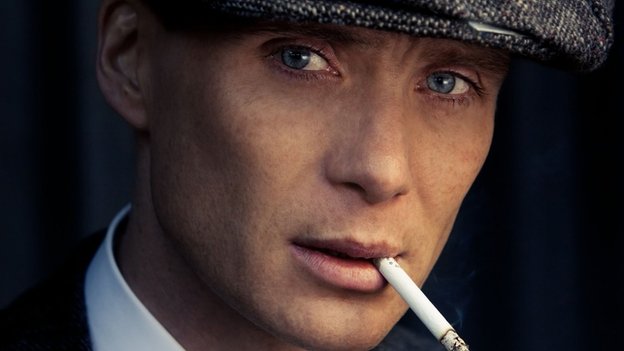
Tommy Shelby is a paradoxical character: ruthless, yet with an almost angelic aura; youthful, but with the air of one who has already seen it all.
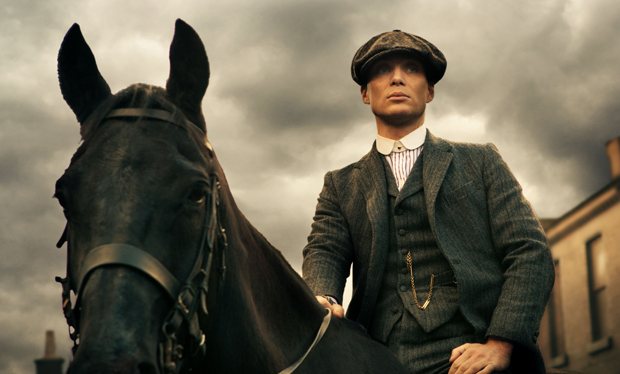
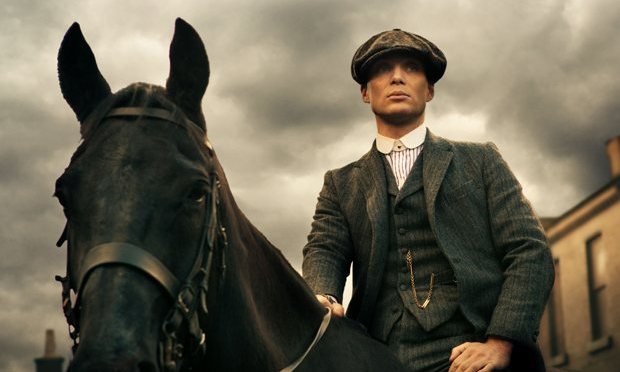
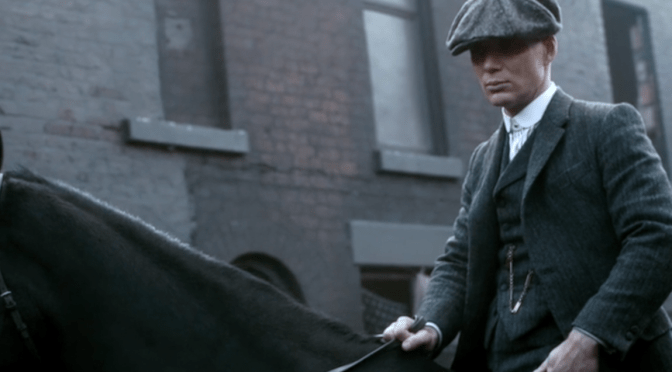
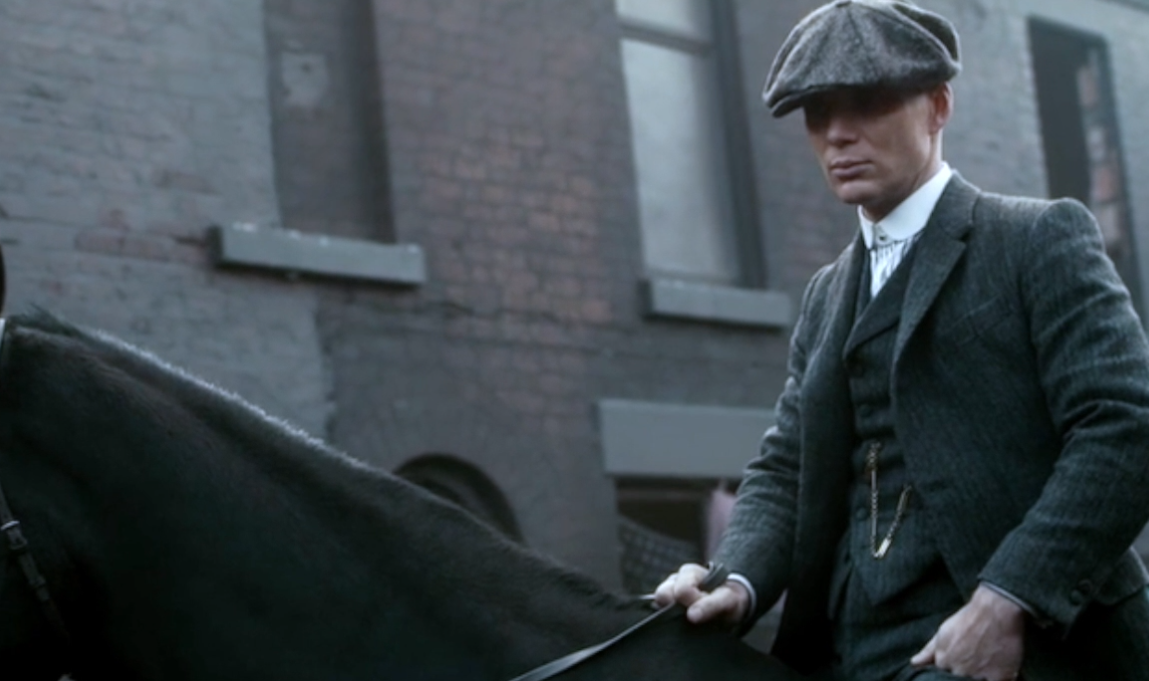
In the opening ten minutes, as Thomas Shelby rides majestically through the backstreets of Birmingham on a beautiful black horse, dressed immaculately in three piece suit, polished black shoes and a gold watch chain – it’s a stark contrast with the dirt and grime of the laborers and beggars around him.
As beggars, the preacher, and even policemen bow and tip their hats we see Thomas is revered by all.
Refusing to tip his hat in return to the police, Thomas is making a strong statement. He doesn’t see himself as subordinate to the police. And if he’s not subordinate, he must be above them. Above the law.
But in the UK only The King or Queen is above the law.
In the United Kingdom the Crown has never been able to be prosecuted or proceeded against in either criminal or civil cases.
This theme of Thomas as King runs through the series.
In scene 13, as communist leader Freddie Thorn examines the razor blades sown into Thomas’s cap, he says:
The crown of a prince. Soon to be king, I’d say.
Later, Freddie says to his girlfriend, Ada, Thomas Shelby’s sister:
Oh my Ada. The only princess of the royal family of the Kingdom of Small Heath.
But Freddie isn’t the only one to recognize Thomas as King.
When Thomas’s wealthy, aristocratic horse trainer visits him in the backstreets of Birmingham, she says:
I mentioned your name and it was like being led to a king.
But Thomas, when he leans down to drop a coin into the bowl of a line of begging soldiers, blinded in the war, he shows he shares status with them.
We might say Thomas is both king and beggar – a favorite theme of Shakespeare:
Your fat king and your lean beggar are but variable service – two dishes but to one table.
– Hamlet.
Also, Thomas leaning down to drop a coin in the bowl of the soldiers might be compared to King Henry V when he humbles himself to sit with his ordinary soldiers just before battle.
John Truby, in his review of another rise of a king story, House of Cards, says:
The struggle for power is one of the prime human motivations.
I asked multi-produced screenwriter Mark Sanderson aka @scriptcat this question:
What’s the most important thing you show in the opening ten pages?
This was his reply:
First ten eh? Get right into the action! Definitely something with the character, who he or she is just from one thing they do or how they act — we know instantly… and their dilemma — and the important characters on the journey. Maybe open with a memorable image – definitely all set up stuff — fewer words the better and more images. Cut into the story in progress – definitely.
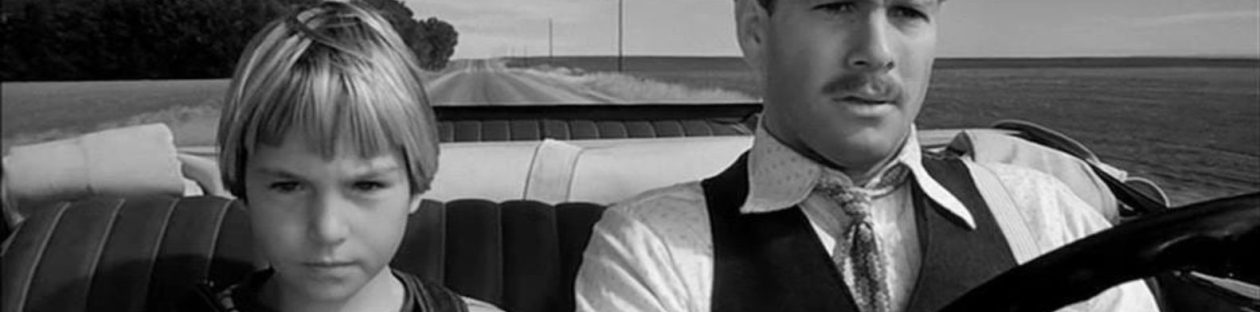
I always remember the opening scenes (first minute & a half) of COOL HAND LUKE – says it all about his character for sure.
Hell, I’m just trying to please my producer! But he loved my opening scene in my first draft. The location, atmosphere, character in action doing something specific and “in character” that tells us some of her back story, the antagonist comes into scene and stops her, and we’re off to the races!
As I explore the opening 10 minutes of Peaky Blinders it’s clear that Steven Knight shows Thomas Shelby’ character visually, through action, in 3 ways.
1. How he acts.
2. How he reacts.
3. How others react to him.
By his actions we learn he is generous and humble.
By his reactions we learn he does not bow down to authority.
By others’ reactions to him we learn he is feared and revered, by both the common people and the police.
How are you showing character in your opening ten pages?
A symbol of mystery and intrigue, power, independence, sexual allure and a strong sense of self.
2. Jimmy Jesus – an Afro-Caribbean street preacher – glances up and nods a greeting.
This is from the script. However, on screen he doesn’t nod a greeting, he fully removeshis hat from his head – showing both social distance and reverence (more on this later).
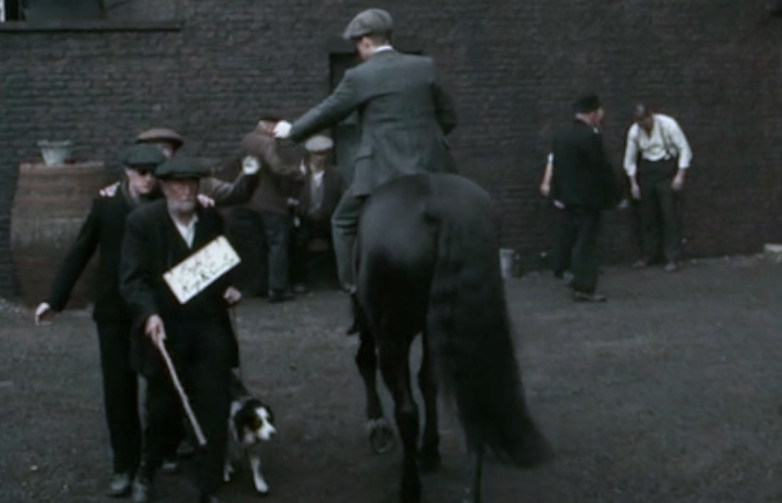
3. Thomas slows to allow a line of men to cross the road. (These are men blinded in the war, now begging for pennies.) Thomas leans down in the saddle to drop a coin into their bowl.
Interesting phrase Steven Knight uses here – leans down. He could have just written ‘he drops a coin in their bowl.’ But he doesn’t. He says he leans down. When Thomas leans down he is equating himself with these beggars, showing humility.
So why show humility to a group of men who were blinded in the war and now begging ‘for pennies’? Does Thomas share an affinity with the beggars?
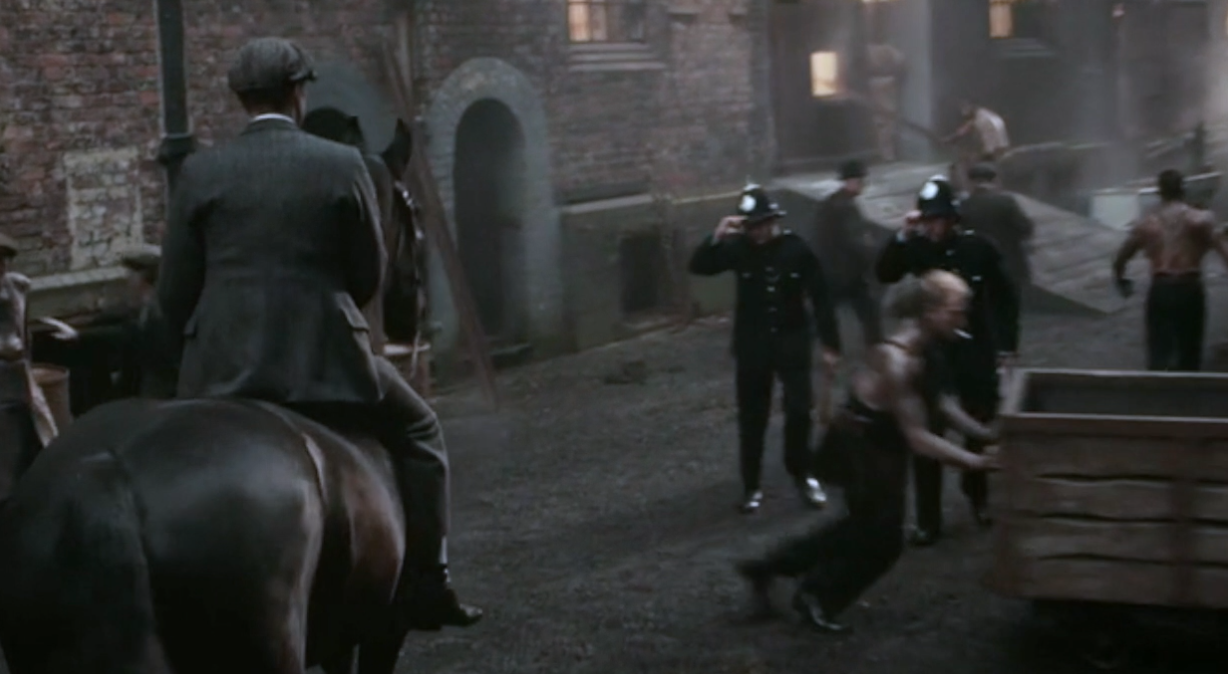
4. Two policemen see Thomas. They both look nervous and touch their caps. Thomas ignores them and urges his horse on.
This action of touching your hat is called a hat tip.
In Western societies of the 19th and early 20th centuries, a hat tip was a common non-verbal greeting between friends or acquaintances. Typically, two men would lift or tip their hats to each other.
But Thomas doesn’t lift or tip his hat. This is not to each other.
Wiki continues:
Where the ritual was used to emphasize social distance the subordinate was obliged to make the more elaborate gesture, for example fully removing his hat while the superior merely touched his.
Who fully removes his hat? Jimmy Jesus – the street preacher. Jimmy’s full removal of his hat shows social distance. As well as showing reverence he is admitting to Thomas that he is his subordinate. Jimmy’s preaching echoes this social distance:
God does not care if you live in a slum or in a mansion.
Back to the policemen then. Not only does Thomas not tip his hat to them, he doesn’t even respond. Steven Knight makes a point of this:
Thomas ignores them.
So why do the police look nervous? And why do they tip their hats? Isn’t Thomas Shelby a criminal? Why are the police tipping their hats to him? The fact that Thomas doesn’t tip his hat reveals a lot. Wikipedia says:
The subordinate was obliged to make the more elaborate gesture…
But Thomas doesn’t even touch his hat, let alone make a more ‘elaborate gesture.’ He doesn’t make any gesture. As Steven Knight states:
He ignores them.
So Thomas doesn’t see himself as subordinate to the police. And if he’s not subordinate, he must consider himself as above them. Does Thomas consider himself above the police? Above the law?
But isn’t this pride?
Summing up then, in addition to the power, independence and sexual allure symbolized by the black horse, which 3 characteristics of Thomas Shelby are we shown through action?
I suggest respect, humility and pride.
Will his pride be his downfall?
This visual, opening credits scene ends around 3.57 and we get the title credit:
We linger in this for 3 seconds then, at exactly 4 minutes, we cut to:
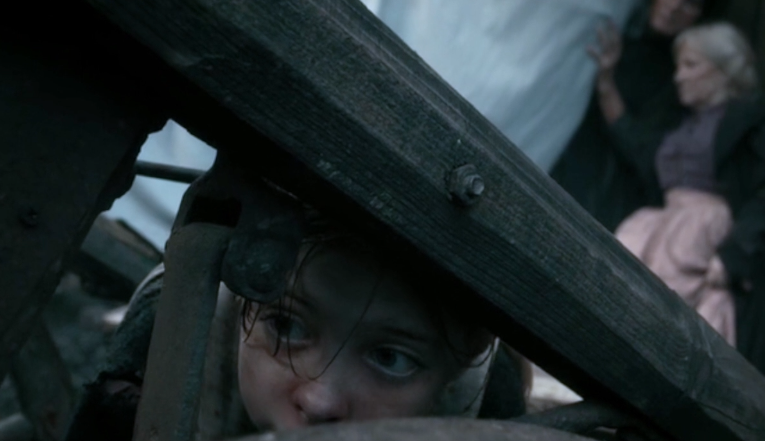
Thomas Shelby rides through the street and comes to a standstill.
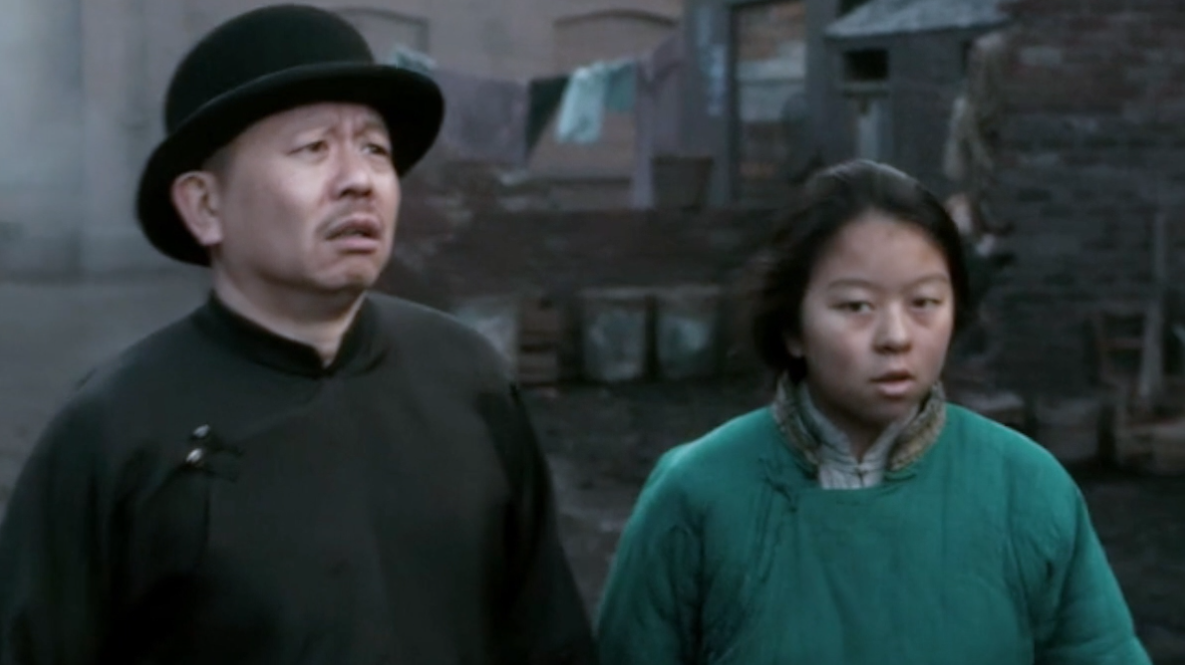
The Chinese Man and Girl from scene 1 come running and stop in front of him.
CHINESE MAN
Sir, this is her.
This is the first time we hear Thomas speak.
A shadow blinds us to his eyes by the peak of his cap.
But we hear his deep, warm voice.
THOMAS
The girl who tells fortunes?
He takes money from his pocket and gives it to the Man.
He accepts it.
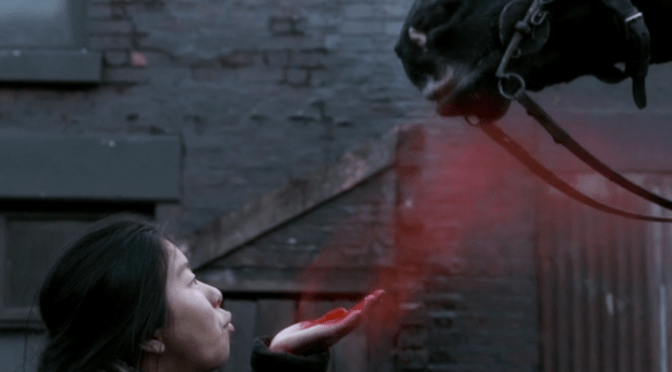
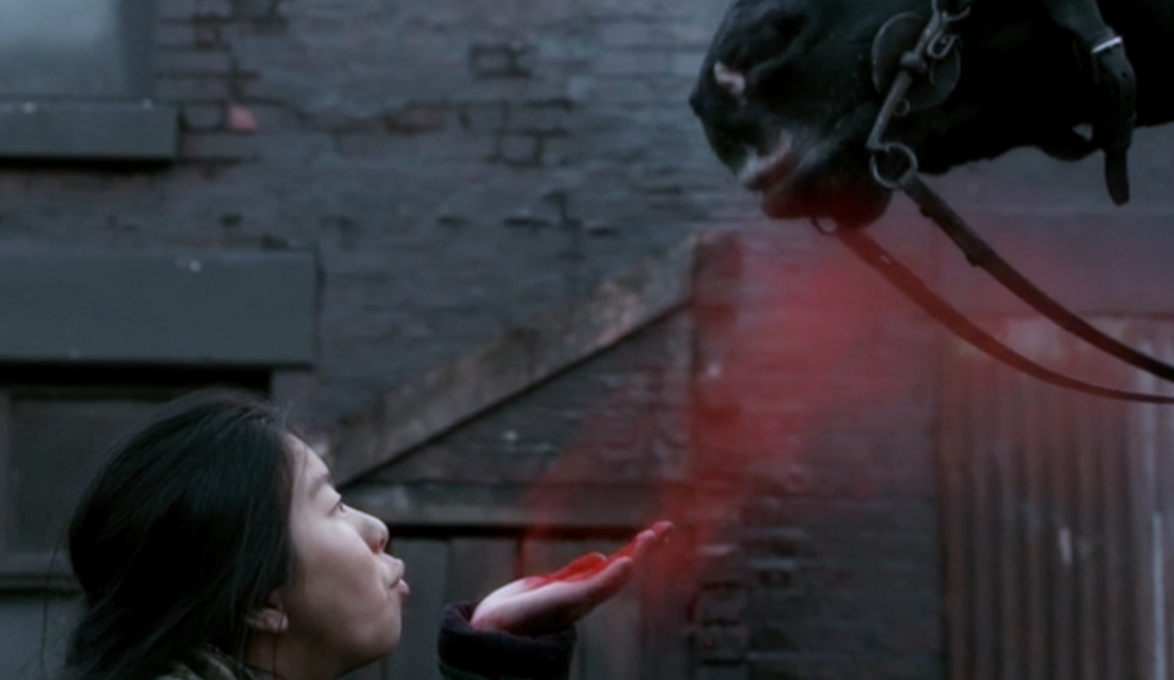
Then, the Girl takes out a small, red, Chinese purse and tips out a handful of red dust.
The director cuts to different villagers watching from their hiding places: grown women, young boys.
We also get our first CLOSE UP of Thomas, almost revealing his eyes, but not quite.
Then, the Chinese Girl blows the red dust into the horse’s nostrils.
Cut to three young boys peeking out from their hiding place. One Boy speaks.
BOY
They’re doing a magic spell to make him win a race.
Then, the Chinese Man and Girl both bow, and, holding hands, turn and run away.
Thomas speaks, loudly, to all of the hiding villagers.
THOMAS
The horse’s name is Monahon Boy. Kempton, 3 o’clock, Monday. You ladies have a bet yourself but don’t tell anyone else.
Thomas rides off.
The women and children come back out to the streets.
Theme music kicks in. And we get a title insert:
End of scene.
So, how is Thomas Shelby’s character revealed in this scene through action?
1. When the women and children run to hide we see that Thomas is feared.
2. When the Chinese Man calls him ‘Sir’ he seems to be revered. When the Man and Girl bow as they leave we could also say that Thomas is revered (but this of course could also be fear.)
3. We see that Thomas is well dressed: a three piece suit, a waist coat and a gold watch chain. Wealth, or at least the appearance of wealth.
4. When he pays the Chinese Girl we learn that Thomas is not a tyrant, but generous, paying for her service rather than forcing it for free.
5. Thomas gives the locals a racing ‘tip’ – telling them that the horse will win.
But is this generosity or a scam and therefore revealing an unscrupulous man?
We’re not yet sure.
To sum up then, this scene reveals 5 characteristics of Thomas Shelby:
We’re analyzing the opening 10 minutes of Steven Knight’s crime drama Peaky Blinders.
How does Steven Knight grab our attention in the first few moments and draw us in?
Let’s study the action and dialogue:
Scene 1.
EXT. BUSY MARKET – DAY.
A CHINESE MAN runs through a busy market, followed by a teenage GIRL carrying a baby.
CHINESE MAN
Hurry up, or they will kill us all.
The Man and Girl reach another GIRL. Girl 1 hands the baby to Girl 2 (who looks about 12).
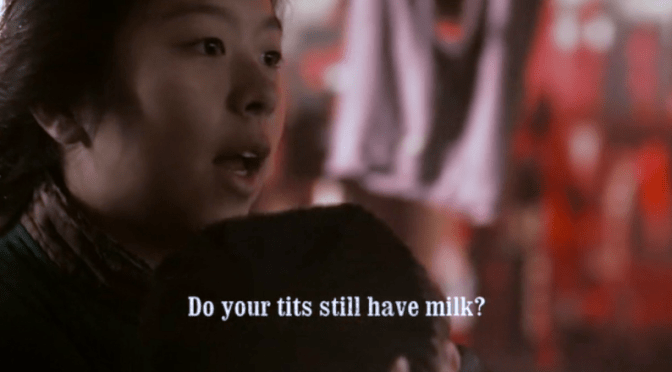
The next line is both shocking and funny.
Do your tits still have milk?
Girl 2 nods. Girl 1 hands her the baby.
(What?!! This 12 year old girl has milk in her breasts? She has had a baby?)
The Chinese Man looks desperate and worried at an OLD CHINESE MAN.
OLD CHINESE MAN
Where are you going?
CHINESE MAN
They have asked for her.
Zoom in close to the anxious Old Chinese Man’s face.
So, how does Steven Knight grab us and draw us in in his opening moments?
1. He creates intrigue. Who are they? And why have they asked for a girl?
2. He shocks us.
3. He delivers an unexpected, funny, unusual line of dialogue.
And bang! We’re in.
That’s the opening 18 second scene of Peaky Blinders.
But what are Chinese nationals doing in Birmingham in 1918? It’s a little known fact that during WW1 more than 140,000 Chinese ‘volunteers’ were recruited by the British government.
The Chinese thread continues with Thomas Shelby’s opium trafficking storyline in season 5.
The Chinese Labour Corps中国劳工旅; traditional Chinese: 中國勞工旅; pinyin: Zhōngguó láogōng lǚ) was a force of workers recruited by the British government in the First World War to free troops for front line duty by performing support work and manual labour.
In the opening 10 minutes of Peaky Blinders, do the 12 scenes contain action, dialogue or both?
Let’s go.
Scene 1.
A Chinese man runs to find a girl, saying “Hurry, or they will kill us all.”
Scene length: 18 seconds.
Action and dialogue – but mostly action.
Scene 2.
Thomas rides a horse through the streets. People run to hide.
Scene length: 1 minute.
Action only.
Scene 3.
The Chinese Girl does the ‘powder trick’ on the horse.
Scene length: 1.05
Action and dialogue – but mostly action. Only 4 lines of dialogue in 1.05 minutes of screen time.
Scene 4.
Thomas rides through town.
Scene length: 1.35
Action and dialogue – but mostly action – only one line of dialogue in 1.35 of screen time.
Scene 5.
Thomas walks across a normal busy street and enters a house.
Scene length: 17 seconds.
Action only.
Scene 6.
Inside, youngest brother Finn warns Thomas that Arthur is angry.
Scene length: 30 seconds.
Action and dialogue.
Scene 7.
Thomas enters and walks through the gambling den and speaks to his younger brother John.
Scene length: 52 seconds.
Action and dialogue.
Scene 8.
Thomas and Arthur have a fiery duologue.
Scene length: 1.28
Dialogue.
(There is basic action: the pouring of a glass of whiskey signifies Arthur’s drinking but mostly this is a dialogue-driven scene displaying the power-struggle between the two oldest Shelby brothers . We’ll study this scene in detail later).
Scene 9.
Introduction to series antagonist C.I Campbell on a moving train studying files on Arthur and Thomas Shelby as well as a document about a ‘munitions robbery.’
Scene length: 54 seconds.
Action only.
Scene 10.
Introduction to ‘communist’ Freddie Thorne.
Scene length: 1.21
Dialogue – a political speech by Freddie rallying workers to strike.
Scene 11.
C.I Campbell studies a file on Freddie Thorne.
Scene length: 22 seconds.
Action only.
Scene 12.
Thomas walks along a street towards a local pub.
Action only.
Summing up then, in the opening 10 minutes, we might notice that out of 12 scenes only 2 scenes are driven by dialogue.
There are 12 scenes in the opening ten minutes of Peaky Blinders.
But which characters do we meet?
Are they the protagonist, antagonist, main characters, minor characters or extras?
Scene 1. A Chinese man and a Chinese girl. (Extras).
Scene 2. Thomas. (Protagonist)
Scene 3. Thomas + the Chinese Girl and Chinese Man. (Protagonist + Supporting).
Scene 4. Thomas. (Protagonist)
Scene 5. Thomas. (Protagonist)
Scene 6. Thomas + youngest brother Finn. (Protagonist + Supporting)
Scene 7. Thomas + younger brother John. (Protagonist + Supporting)
Scene 8. Thomas + older brother Arthur. (Protagonist + Main)
Scene 9. C.I Campbell alone. (Main Antagonist)
Scene 10. Freddie Thorne + workers. (Main + Extras)
Scene 11. C.I Campbell alone. (Main Antagonist)
Scene 12. Thomas. (Protagonist)
So, an interesting opening with the Chinese characters considering this is Birmingham 1919.
So, considering the Chinese characters are extras in the opening 10 minutes we actually meet the Protagonist, the Antagonist, 2 main characters and 2 supporting characters.
The Protagonist is Thomas Shelby.
The Antagonist is Chief Inspector Campbell.
The 2 main characters are communist agitator Freddie Thorne and Thomas’ oldest brother Arthur Shelby.
The 2 supporting characters are Thomas’ 2 younger brothers John and Finn.
Here they are in order or appearance: (notice we meet the 4 Shelby brothers first.)
Mark Sanderson aka @scripcat has had 7 films produced and has written 27 feature screenplays.
I asked him:
Dude, what’s your secret?! What’s the single most important factor you keep in mind when writing your screenplays?
This was his awesome reply:
I think there are many important factors that I keep in mind before I ever go down the pathway of taking an idea to a story and eventually a fully realized spec screenplay. After graduating film school it used to be if I could sell the script or not — that’s a fool’s endeavor trying to play the Hollywood spec, big budget screenplay sale game and trying to figure out if they will buy my genre or not. Chasing a big sale will deliver nothing but frustration and grief.
In addition, it will take years of bouncing the script around town and it may never sell. You’ll need to be working a job to pay your bills during this time and it gets difficult to hang on with the hopes to sell every spec that you create. The reality is that just because you write it doesn’t mean anyone will “love it.” You need to write from your heart and it will show in the work.
My buddy is writing a romantic comedy and it’s not a personal story so he’s obviously trying to make it as commercial as possible to sell it to Hollywood and play in the “big leagues.” And now I read that the romantic comedy is dead in Hollywood. The genre has not done well lately and they are not making them anymore so I ask him, “Why are you writing this movie genre?” Is the spec going to be a writing sample or is it something you actually think you can sell to the studios as an un-produced writer? I believe it’s the second reason so he’s chasing an illusive ghost and in my opinion not utilizing his limited writing time properly.
I told him he should be writing a spec that is near and dear to his heart as he’s not going to be able to compete with known writers with a script that is a long shot at best. It’s a high concept commercial Hollywood script that will not sell because of the genre. Sure, it may get him meetings…but why waste time on a script that has limited potential? Write something personal and from the heart and it will showcase your writing ability.
Try writing what you care about and that will come through in the screenplay. Your passion will shine through and attract interest in quality work. Back when I was first pursuing my career, I did this with my original script I’ll Remember April and it placed in the top 20 of all Nicholl Fellowship entries that year and later went on to be optioned, purchased and produced and distributed globally.
I don’t write specs much anymore as my jobs are screenplay assignment work. I just had my seventh film produced and I try to please my boss the producer who is paying me so he can hire me again. It’s the nature of building a career to write films that get produced and to build a great working relationship with producers. Those writers who have lofty ideals about writing something that will compete with top screenwriters who already have credits and relationships with studios and producers — it’s a big dream and a big risk of time. Carve out your own unique brand and sell them on “you.”
I don’t think there is only one important factor, but many. I think to myself before I start: “Is my idea commercial and can it translate to the most people possible so a producer/director will see the potential and want to make it?” I recently consulted on a project for a screenwriter who asked for my honest opinion on his script. He recently had been getting a lot of rejections by producers with it and told me, “They just don’t get it.” I shook my head in silence. Maybe when four different producers “just don’t get it” — it could be that the screenwriter just didn’t get it. Repetitive notes from different sources must be considered. I told him that his movie was not big enough or commercial enough to go into 4,000 screens on opening weekend.
That’s the reality of the business. It’s actually a smaller film, maybe indie art house film or a something for TV, but he is aiming for the top of the mountain. And that’s okay, but that comes with a lot of risk, just like writing a spec that can only be produced for $150 million and being an unknown writer with no attachments on the project. Seriously?
Write a kick-ass script that can be produced for about $1.5 million and IT COULD ACTUALLY GET MADE! Find an actor who loves it and will tell you to attach them while you find the money. Go out and do it and make it happen. Stop trying to chase the brass ring of Hollywood studio films and constantly coming up short and rejected. Ah, but who wants a small film, right? We all want the summer blockbuster with the “A-list” career, the home in the hills and the millions in the bank.
Sure, I wanted the same just out of film school and then after about six or seven years of getting knocked around and brutalized, I realized just how fucking hard it was to reach the “A-List.” I have close friends on the “A-list.” They suffer the same trials and tribulations like everyone else just at a bigger level. Hell, since I was a kid I just wanted to just make a living anyway from what I loved to do — making movies. My dream has been realized over a dozen times with getting paid for assignment jobs and one spec sale. Seven of those dozen scripts were produced and made it to little and big screens around the world. I’m living my dream.
So, there are many factors that I ask myself before writing a spec screenplay:
WHY AM I WRITING THIS PARTICULAR STORY?
IS IT FOR ME? MY PASSION PROJECT?
IS IT FOR THEM? AM I CHASING A BIG SALE?
IS IT TO SHOWCASE MY ABILITY AS A TALENTED WRITER?
IS IT TO ACTUALLY PRODUCE MYSELF OR DIRECT?
OR IS IT BECAUSE I AM DRIVEN AND MUST TELL THIS STORY?
Honestly consider why you are screenwriting and why you are writing your particular story. How you write it is as important as what you write. Keep the faith and filling your blank pages.
Mark Sanderson (aka @scriptcat) is a veteran of the screenwriting game with over fifteen years of experience and has worked with Academy Award® winning producers, veteran directors, and Academy Award®, Emmy® and Golden Globe® acting nominees. Mark’s indie and TV films have been distributed globally and have opened and premiered at major festivals. His seventh produced film “Sara’s Choice” is in post production and stars Franchesca Eastwood. Check out his popular screenwriting blog MY BLANK PAGE and look for his new book “A Screenwriter’s Journey to Success” coming in November on Amazon.
‘Twin Peaks: The Entire Mystery‘ is now out on Blu-ray DVD (including deleted David Bowie scenes.) To celebrate its release yesterday, I’m very excited to welcome UK film maker & screenwriter Zennis to my blogwith his superb article.
WARNING: Some minor spoilers may affect your enjoyment of Twin Peaks.
Prior to its debut airing on 8 April, 1990, Television had never before known anything remotely like the show that co-creator David Lynch chose to set in the northwest logging town of Twin Peaks. Nearly quarter of a century on, Television hasn’t known anything like it since.
The inhabitants of Twin Peaks are rarely what they seem. For the most part they are, in themselves, manifestations of the secrecy that engulfs them like the town’s surrounding forest, itself darkly cloaking their illicit desires and fantasies played out in the local bordello, ‘One-eyed Jacks’ – reached only by a murky water crossing, as if to symbolize the elusive ‘truth’ lurking deep beneath the surface of all that is visible.
Washed up on the shore of this truth, the most mysterious Twin Peaks resident appears in the opening minutes: a beauty queen ‘filled with secrets’ and delivered to us plastic-wrapped (as opposed to the tight-sweater wrapping usually preferred by Lynch for his female twin-peakers).
Thus the series is furnished with its first and most compelling dramatic question: Exactly who – or what – killed Laura Palmer? Indeed it is this burning unknown that must be made known by the show’s seeker-protagonist detective, Dale Cooper, an FBI Special Agent with powers of perception to rival Sherlock Holmes. Simply put, ‘Cooper is able to sees things that other people can’t,’ according to one of the series episode directors, Lesli Linka Glatter.
Naturally our detective has his very own Doctor Watson sidekick – here in the form of the local Sheriff and all-round-stand-up guy, Harry Truman – but Cooper seems more ably aided (although as often hindered) by his three muses, all of whom are as intriguing as each other in the secrets stakes. If ever there were riddles truly wrapped in mysteries inside enigmas, they are these young women conceived inside Lynch’s Jungian mind.
Firstly, there is Audrey Horne (played by the circumflex-eyebrowed Sherilyn Fenn), who can knot a cherry stalk with her tongue and scare off a smörgåsbord of her wealthy father’s business partners with a one-minute performance of feigned grief for her brutally murdered friend – quickly prompting the audience to ponder on the deeper cause of such provocative behavior by this saddle-shoed minx.
As for the chemistry we feel instantly bubbling beneath the surface between Agent Cooper and Audrey (at their first meeting, she serves his breakfast table in her tight-form cardigan, prompting him to ask if the grapefruits are freshly squeezed), Glatter states: ‘Audrey knows what she wants and how to get it … There was definitely a kind of unspoken sensuality there.’
Later, when she turns up naked between Cooper’s sheets, he declines her offer, stating: “Secrets are dangerous things, Audrey”. But exactly what is Audrey’s mysterious secret?
According to Fenn it’s her virginity. For despite all indicators to the contrary it is intact: ‘She absolutely hasn’t been with anybody,’ Fenn has said of her character in interview. ‘She acts like she has. She wants to. That is her secret.’
Indeed, when Cooper asks Audrey how old she is at their very first meeting she stares him straight in the eye when replying, “eighteen”. Clearly no more blind than we are to the ‘old enough’ subtext here, Cooper replies without blinking, “I’ll see you later Audrey,” then exits with his heroic code of conduct established.
Of Fenn’s character, David Lynch, hints at what may be rooted in Audrey’s psyche: ‘Uh, well, she has trouble at home,’ whilst Glatter plumbs these depths further, commenting on Audrey’s decision to turn detective herself: ‘Audrey wants to know all the secrets. Because of her lack of relationship with her father, she lives in that darker world. If she has the secret she has the power.’
And then there is Agent Cooper’s second muse, Shelly Johnson (played by Mädchen Amick), a bad-boy magnet who does for her waitress uniform what Barbarella did for, well, every costume she ever wore, and who clearly knows how to do more than just pour a damn fine cup of coffee because she quickly teams up with Laura Palmer’s former boyfriend, Bobby Briggs, to shoot Shelly’s husband, Leo, who has a penchant for abusive behavior and an abundance of plastic sheeting in his unfinished house…
Summing up Shelley, episode director Tim Hunter says, ‘Mudchen’s character always knows what’s going on. She’s very manipulative in a very subtle way.’
Finally comes Cooper’s third muse in the form of Donna Hayward (played by Lara Flynn Boyle), the butter-wouldn’t-melt-in-my-mouth Miss goodie-two-shoes, set up early on when a policeman enters her class during morning registration. We effectively see the rest of the scene as if through Donna’s empathic eyes: first as she looks at the policeman whispering in her teacher’s ear, then at another female student screaming as she runs past the window outside, and then to an empty chair that we immediately understand to be Laura Palmer’s.
Donna shares this establishing ‘non-dit’ moment by exchanging a look with Laura’s former secret lover, James Hurley, and then clasping her hand to her heart, mumbling Laura’s name before breaking down in tears. When the teacher tells the class there will shortly be an announcement from the principal, the scene’s end is punctuated by James’ pencil snapping in his hand. This is a sequence with all the power of an iceberg, revealing only its shining tip yet making us feel much, much more. Hemingway would be proud.
So here we are, not half way into the first episode and we could already be forgiven for wondering of Donna: surely nobody can be this sensitive and good in Twin Peaks? Indeed, only a few hours after this unspoken announcement of her best friend’s death, Donna promptly falls into the arms of the grieving James.
In narrative terms, if the ellipsis is about the gap (or the parts of the story withheld from us by the story-teller), then it is effectively about secrets – and Agent Cooper’s muses are nothing if not bundles of secrets; each one a key-keeper to doors that loath to be unlocked; each a majestic vessel positively brimming with the unknown.
If you haven’t watched Twin Peaks yet then you’re not just missing out on one of the best TV shows ever, you’re also missing out on one of the best examples of storytelling, fullstop.
Formerly a Hollywood-based product placement specialist, in addition to all the major studios Zennis has worked closely with the producer partners of Tom Cruise, Steven Spielberg, and Michael Bay. Currently evolving from film marketer into film-maker, he is now on the last furlong of his Master’s at Newport Film School. Of his first award-winning short, ‘Drink?’, BBC programming chief, Sian Thomas, said: “This winning film had impact and style from the outset … It was targeted and hard hitting.” More recently, after 50,000+ online film viewings and giant screenings across the UK, the judging panel of the British Big Voice Festival (headed by Lord David Puttnam) awarded its 2012 Silver Prize to the first-cut of his most recent short, ‘Shine’. His film-making is now focused on a pilot adapted from the novel he has been writing for more moons than he can remember. All other things Zen can be found on his website at Ze-Hub.com
I think the problem with the moral vision in Harry Brown is that the writer – Gary Young – has Harry compare the Troubles in Northern Ireland with social unrest on the council estates of England.
Harry states that those fighting in Northern Ireland were fighting for ‘a cause’, whereas the youth hurling petrol bombs at riot police on London’s council estates were doing it for ‘entertainment.’
I don’t believe lower class social unrest is ‘entertainment’ at all, but that this anger comes from deep-seated resentment at the rich, ruling classes and at capitalism. I agree with this statement:
“…self-destructive or antisocial behavior is a response to circumstances and not a moral failing.”
– from this article on the Open Democracy website about capitalism and drug legalization.
When you finish your precious screenplay you’re eager to receive feedback and this can be a vulnerable time for you and the script. This is why you never want to give out your script for a read before it’s ready—only when you’re confident it’s the best draft you can possibly write and you feel that you’re “written out.” Feedback is an important part of any screenwriter’s growth on their journey, but make sure you don’t set your expectations too high and then become disappointed when you don’t receive the praise you expected. I think Hemingway said it best:
All you need to do is write truly and not care what the fate of it is.
I think too many aspiring screenwriters write new scripts and suffer under their self-imposed pressure of having to sell it. What are the odds? Astronomical. The safer bet is writing a new script for the sake of telling a story that you need to tell and making sure it’s the best example of your ability. Many times something does not sell but garners you meetings and eventually screenwriting assignment jobs—the bread and butter of working writers.
Many new screenwriters don’t take feedback well or don’t know how to execute the notes that are given. As they say, “everyone has an opinion” and that’s true, but you need to be able to filter the good feedback from the bad and be open enough to use the good notes and push your screenplay closer to a better draft.
When you’re finally working at a professional level, you’ll need to be a team player and not a diva when it comes to feedback. Screenwriting is all about the execution of the script and as you continue to write new material you will need to execute your ideas on a professional level. This is necessary to compete in a very crowded and competitive marketplace.
Be careful when open yourself up to feedback and set your expectations too high. We all have expectations after we complete a script. You know the creative high that you felt during writing and now you might be coming off that high as you turn in your draft and await feedback. Did you get notes and they are not exactly what you expected? Were you disappointed they didn’t appreciate the work enough — or maybe didn’t understand it enough? Maybe they felt your execution was off? Perhaps you become down on yourself as the insecure voices scream in your head about your lack of ability? You may even question what you thought was some of your best work only a week ago. You are not alone my fellow screenwriters.
We all need a pat on the back or just a “job well done” when we finish a screenplay. Most of the time, the pat on the back will come from you alone. Writing the script is one thing, turning it into your producer and waiting for feedback is entirely another. It’s easy to take notes personally because your script is your baby and your writing exposes yourself and your talents to criticism.
If you can’t handle criticism, start to work on acceptance of feedback, as it will make your journey as a working writer a lot less bumpy. Notes and changes are a given with a screenplay. Perhaps it will make the process easier to always remember that screenwriting is all about rewriting. Detach from the material and expectation from any outcome. Do not hang on every word or sentence. You’re not alone. A writer’s life is a tough job at best.
As screenwriters we must stay open to constructive criticism because screenwriting is all about collaboration. We will always receive notes because a script is an ever-changing blueprint for a movie. Once producers, a director and actors get involved there will be many changes and you should welcome the creative input from your co-creators on a project. These fellow artisans will bring it to an entirely new level of creativity.
You can become frustrated and feel like throwing in the towel if the process gets dragged down by so many changes. Stay positive, focused and persistent at executing the notes and turning in a better script. Find the passion you had for the first draft and put that energy into shaping a new draft that will please not only yourself, but also the talent it will eventually attract.
Along with the successes, I’ve had to deal with disappointments and frustration throughout my writing career from feedback, but I continue to love the craft of screenwriting. I’ve been able to view the entire process from a larger perspective and focus on the task at hand — to get the script into better shape as a team player.
If you are lucky enough to be paid to write, it becomes your job. You go to work, write all day, go home, come back tomorrow and wash, rinse and repeat. Screenwriters have pages to write and without filling those blank pages there would be no script.
Take your feedback seriously, but don’t take it to heart. Trust in your writing abilities and if you allow the disappointments to take you into a bad place, address your feelings but then focus on the task of executing your notes.
Stay out-of-the-way of the story and put your ego aside. Everyone is here to serve the story to the best of their creative ability. If you want to play with the big boys, at some point you’re going to be bruised and beat up. It’s just the rites of passage necessary for the growth of a writer.
Part of the deal is that you want people to read and love your material, right? If producers or executives agree to a read, give them ample time to get back to you. A gentle nudge in a few weeks is completely acceptable, but if you contact them before, you’ll seem desperate and no one likes to be hounded.
I remember a producer warned me, “Stay on me about your project, because I tend to get busy.” That’s fine. But use common sense and put yourself in their situation for a second. Your script is the most important thing in the world to you after you finish, but you have to understand that it’s not on their front burner at the moment. One E-mail or text is fine to check up — four is not.
Be open to the entire process of writing — the feedback, rewrites and all. No disappointments only triumphs when you complete a project. There will always be creative highs and lows.
Do your best not to allow your disappointment to be perceived as a failure and then sink into the morass of fear and insecurity in your creative soul. This will lead to the horrible act of chasing screenplay notes. Avoid this at all costs. A good discipline to follow for the long haul of a screenwriter’s survival is Chinese philosopher Lao Tzu’s advice:
Act without expectation.
Also be patient. A career does not happen overnight and part of your journey is becoming a better writer and finding your unique voice — one that producers will grow to love, trust and hopefully employ!
Keep filling your blank pages and keep the faith.
Scriptcat out!
Mark Sanderson (aka @Scriptcat) is a Los Angeles based veteran of the screenwriting game with over fifteen years of professional experience and has worked with Academy Award® winning producers, veteran directors, and Academy Award®, Emmy® and Golden Globe® acting nominees on his produced films and screenwriting assignments. Mark’s films have been recognized and distributed around the world and have opened and premiered at major festivals.
His popular screenwriting blog MY BLANK PAGE was Script Magazine’s pick for “Website of the Week” and had over 50,000 reads last year. He also offers screenplay consultation services and workshops on his website:
Screenwriting teacher Chris Soth, in his Million Dollar Screenwriting podcasts, discusses how the hero, as a direct result of understanding his inner need is able to either-
a) achieve his outward goal
or
b) discern that his original goal isn’t important after all.
Either way the character arc is complete.
John Truby splits ‘need’ into 2 categories: ‘psychological’ and ‘moral’.
Let’s break this down:
A psychological need is something the hero must achieve in order to stop causing harm to himself.
A moral need is something he must achieve in order to stop causing harm to others.
Truby says the best stories have both.
In order to realize these needs, for the subconscious to become conscious, the hero must have a revelation, either psychological, moral, or both.
However, it’s not always as simple as that.
In some stories the hero may be incapable of a revelation. For example, in The Godfather, Truby explains, the writers give the revelation to Kay, Michael Corleone’s wife (read Anatomy of Story for the full analysis.)
Truby explains how a hero should take new moral action to prove the change has taken place.
What about your hero? What is his psychological and moral need? Is he capable of having a revelation? Is he capable of change?
The opening lines in 127 Hours (screenplay by Danny Boyle and Simon Beaufoy) are an answerphone message from Aron’s sister:
“Hey, Sonia here…again… I know you’re probably gonna be away this weekend, but listen… just think about what we’re gonna play, ‘cause we have to decide if we need to practice, it will be fun, anyway…oh…and, please call Mom, ‘cause, you know, she worries…”
These lines refer to 5 things:
1. Character Arc.
Why doesn’t Aron answer the phone? We see he’s super-busy preparing his trip, grabbing the bits and pieces he needs. And we all know how annoying phone calls are when we’re trying to get stuff done. But this preoccupation with himself shows us he is more focused on his own needs than his sister’s. The fact that Sonia emphasizes again tells us this isn’t the first time she’s called. And so Aron’s character flaw is illuminated – the flaw that will not only cause his extreme suffering but will also cause him to grow and change.
2. Foreshadowing.
‘Think about what we’re gonna play’ foreshadows a line of dialogue at the Act 2 Turning Point paid off when Aron apologizes to his sister for not being able to play the piano at her wedding. This apology tells us something way deeper and more important: that he has lost the battle. He is defeated. Michael Hague calls this the All is Lost moment. Blake Synder the Visit to Death.
3. Theme.
Sonia reminds Aron to call Mom as ‘she worries’. Later Aron realizes that if he hadn’t have been so selfish, if he had returned his mom’s calls, he would’ve told her where he was going and he would’ve been rescued. Major theme: interconnectedness + familial love.
So these opening lines not only foreshadow the Act 2 Turning Point before Aron’s do or die drive to survive, but they immediately point us to both theme and character arc.
SPOILER alert – please watch the movie before reading the rest of this post.
4. Endearing us to the Hero.
One of my favorite lines of dialogue comes where Aron meets the two lost female hikers. Aron rocks down the hill, superhero to the rescue, to help them with their map-reading. Realizing his mask is high on his face and he must look pretty scary, Aron jokes something about looking like Jason from Friday the 13th. Not only is this funny, and, as Michael Hague tells us in Screenwriting for Hollywood, funny alwaysendears us to a hero, but it’s oozing subtext. Which brings us to –
5. Subtext.
Aron’s lines hiding a much deeper and far more sinister meaning. Check out his line:
Sorry about the Friday 13th thing. I’m only a psychopath on weekdays.
We don’t read much into it on first viewing. But actually it’s preparing us for – or foreshadows – the sudden Act 3 genre twist from family adventure drama to slasher/horror.
‘I’m not usually a psychopath,’ he’s saying (my paraphrase) ‘but stick around and later you can watch me hack my own arm off, Saw style.’
127 Hours runs at 90 minutes and adheres to perfect 3 Act Structure:
Act 1: 15 minutes.
Act 2a : 30 minutes.
Midpoint
Act 2b: 30 minutes.
Act 3: 15 minutes
NB: The Midpoint or Point of No Return happens at 45 minutes – exactly half way through the movie.
Each act break + plot point is not only marked with a Turning Point but is also marked with the end of a musical sequence.
Watch the film carefully paying attention to what happens at these exact times.
So, what happens at each Turning Point?
SPOILER ALERT – watch the movie before you read this analysis!
Act 1 begins by foreshadowing the moral revelation the hero will have in the climax – Aron’s selfishness – as he refuses to answer his mum’s phone calls or tell his work mate where he’s going. Next we’re shown an excited young man off on an adventure. He’s a daredevil. When he spectacularly falls from his mountain bike he simply smiles, snaps a pic of himself and he’s ‘back on the saddle’ foreshadowing his tenacity and resilience displayed in extremis in the Climax.
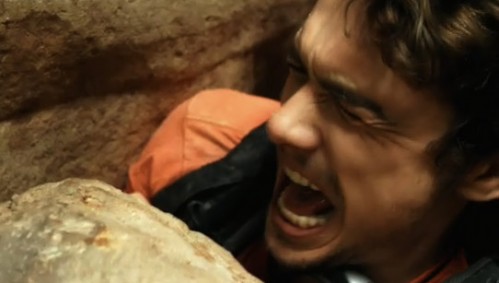
After exactly 15 minutes, Aron falls: the film’s inciting incident. He’s trapped by the rock. Danny Boyle inserts the film’s title 127 Hours here, telling us the movie, the real story, starts now. Like any Act 2 this is the new world, the upset Status quo which must be re-balanced.
So Act 2 begins at 15 minutes.
Then, 15 minutes into Act 2 (30 minutes into the movie) we have Plot Point 1 which points us towards the film’s major Theme.
So what happens here? Well, we see Aron as a small boy sitting on the Grand Canyon in his father’s loving embrace as they both stare out at the rising sun. (Theme: interconnectedness + familial love).
Between 30 minutes and the midpoint at 45 minutes we witness Aron beginning to make his video diary. He addresses his mom and dad – we hear his mother’s voice saying ‘call me – lots of love’ (Theme reinstated: connectedness + familial love).
The Midpoint or Point of No Return comes at exactly 45 minutes: Aron takes his pocket knife and tries to cut his arm – foreshadowing the Climax. Why is this the Point of No Return? Because Aron is considering another option, if all else fails.
And we’re into the second part of Act 2 which we’ll call Act 2b.
Immediately after the Midpoint we’re back with the video camera and treated to the hilarious spoof radio show and Aron’s self-examination. This is a superb blend of comedy and tragedy. He reveals the fact he’s always seen himself as a ‘big fucking hard American superhero’ who can do everything ‘on his own’. This is writing of the highest quality; the hero’s moral / psychological revelation that his ‘supreme selfishness’ – his character flaw – has led him to this place of captivity and isolation, later to become a place of extreme suffering, is delivered with a ‘spoon full of sugar’ as this self-revelation is presented to us by the writers gift-wrapped in brilliant dialogue as Aron attacks his own flaws with scathingly funny self-deprecating humor.
Then, 15 minutes after the Midpoint at Plot Point 2 Aron rams the blade into his arm. Danny Boyle takes us visually inside his arm and we see the blade ‘close to the bone.’ An idiom often used when remarks cut close to the truth. And the truth Aron has just revealed to us? He has been living life selfishly. In fact, he apologizes to his mom and dad into the camera for being ‘unappreciative.’
After another 15 minutes, at around the 75th minute of the movie – leading towards the End of Act 2 Turning Point Aron apologizes to his sister that he won’t be able to play piano at her wedding. Another apology. This dialogue tells us he has accepted his fate and that fate is death. Michael Hague calls this the ‘All is Lost’ moment. Blake Snyder the ‘Visit to Death’.
Then, still at the 75th minute mark, we enter ACT 3 as Aron makes one last ‘do or die’ drive to set himself free, and, as a mirror to the Midpoint – BANG! – he rams the blade back into his arm and drags us, screaming and terrified, feeling every nerve of his tortuous pain, into the bloody, horrific Climax.
The next 15 minutes are the Resolution as Aron is rescued. Here Aron’s learning curve – his character arc – is clear as the ‘big hard fucking superhero’ who can do ‘everything on his own’ screams for help from strangers – a changed man.
127 Hours sticks to perfect 3 Act Structure as taught by Michael Hague and also adheres to John Truby’s teachings on Moral and Psychological Revelations in his book Anatomy of Story.
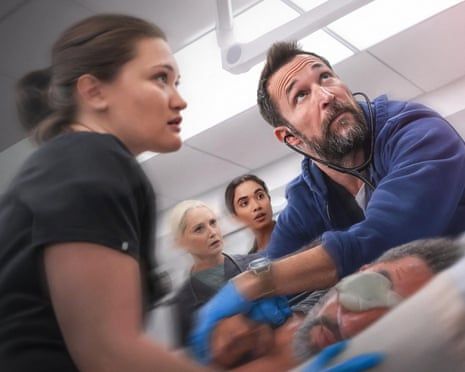
#ThePITT is a supreme example of how producers and execs can support the acting industry. Not only is it a massive ensemble piece with a huge team of series regular doctors, nurses and admin staff. It has a fast revolving door of brilliant roles for guest character actors, as well as supporting artists. Add that to crew, pre and post production staff, technical staff, ER and police advisors, incredible prosthetics and make-up, catering and every other dept. it needs to make this brilliant show, we have a 15 ep season that seems built to support the entire American #television industry. In the UK among shows that give so many opportunities to actors and production staff we tragically lost #Doctors, #TheBill and #HolbyCity, but thankfully still have #Casualty. Hats off to the creator R. Scott Gemmil, producer John Wells and actor/writer exec prod Noah Wyle for this fast moving conveyor belt of amazing opportunities for #actors. Thanks for supporting the #acting and #television industry. Deserving of all the #Emmys.
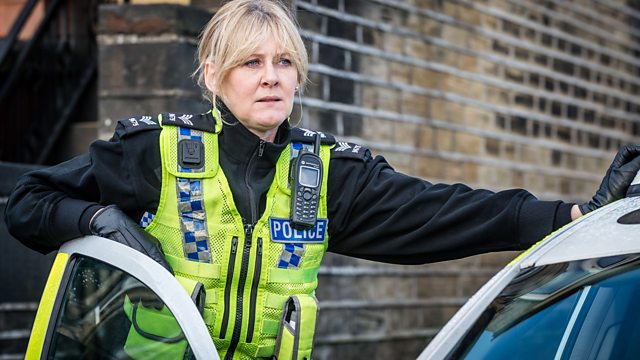
This exploration of the opening episode of Sally Wainwright’s award-winning crime drama trilogy Happy Valley reveals 4 story threads, a 5 act structure, multiple antagonists, blurred boundaries and how the structure follows the journey not of trilogy protagonist Catherine but of the season antagonist Kevin. Dive in and discover.
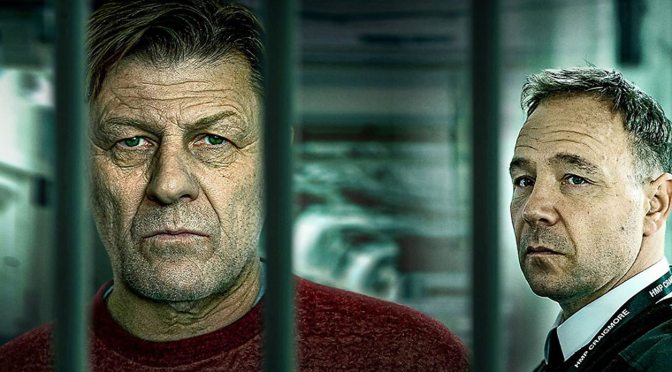
I asked chatgpt how does Jimmy McGovern structure episode 1 of Time. This was the response.
In Episode 1 of Time, Jimmy McGovern skillfully structures the episode to immerse viewers in the harsh, tense environment of a British prison while introducing the complex inner lives of the main characters. McGovern, known for his gritty, character-driven storytelling, uses a dual narrative approach to introduce the two main characters, Mark Cobden (played by Sean Bean) and Eric McNally (played by Stephen Graham), and to establish the emotional stakes that drive the story forward.
Establishing Characters and Context: The episode opens with Mark, a former teacher, who is sentenced to four years for causing a fatal car accident. The narrative dives directly into his vulnerability and isolation as he enters prison, giving viewers a raw look at the fear and guilt he feels. In parallel, we meet Eric, a seasoned prison officer, whose moral integrity and deep care for the inmates contrasts sharply with the brutality of the prison environment.
Conflict and High Stakes: McGovern quickly escalates tension by throwing Mark into confrontations with fellow inmates, exposing the brutal reality of prison life. He also creates immediate tension for Eric, who is forced into a moral dilemma when a gang threatens his family. This dual conflict (Mark’s survival and Eric’s integrity) drives the episode’s structure, balancing empathy and suspense.
Developing Themes of Guilt and Redemption: Throughout the episode, McGovern interweaves themes of guilt, redemption, and justice, exploring these through the contrasting lives of Mark and Eric. Flashbacks and dialogue subtly reveal Mark’s remorse, highlighting his emotional journey, while Eric’s ethical struggles reveal his vulnerability, adding depth to the narrative.
By ending the episode on cliffhangers for both characters, McGovern effectively hooks viewers, leaving them invested in the fate of these two men whose lives are irrevocably intertwined within the brutal confines of prison.
Having analysed Happy Valley season 1 episode by episode, act by act, I decided to write my TV pilot in 5 act structure.
I am using the same colour code as I used in my HV analysis, with an extra colour as I am working with two protagonists (my first time attempting this).
I am certainly not expecting a perfect result from this first attempt at a TV pilot but hopefully something which I can continue to work on when the MA has finished and something which I can submit with an element of confidence that it will pass.
Here is the way I have colour coded the first act, inspired by my analysis of the structure of Happy Valley.
What about you? Are you colour-coding your outlines?
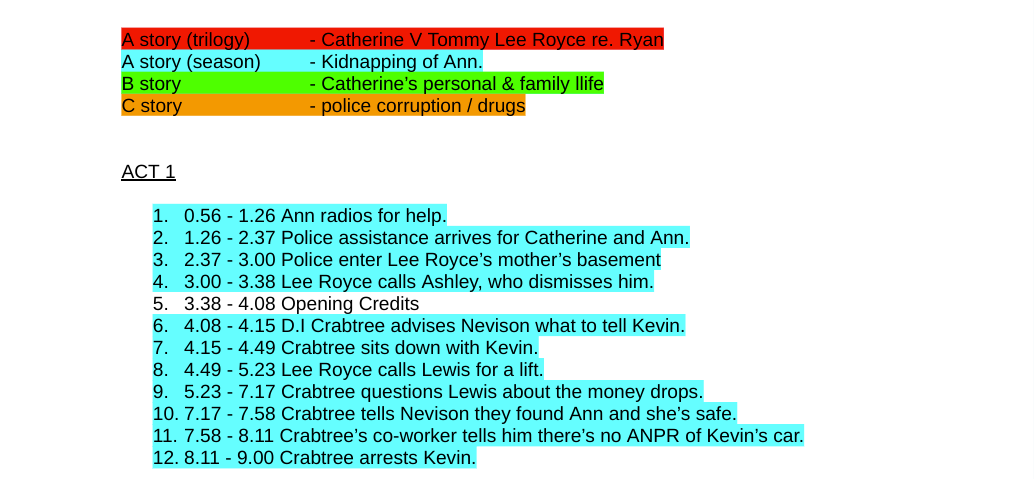
Having looked at the previous 4 episodes, we are now on to episode 5.
It is actually really interesting to see the colour codes change.
Whereas in episode 1, act 5 is colour-coded mostly blue – dealing with the A story (season) main plot, as we near the season finale of episode 6, act 5 of episode 5 is mostly red – dealing with the A story (trilogy).
So, as we near the end of season 1, writer Sally Wainwright is preparing the ground for the season trilogy.
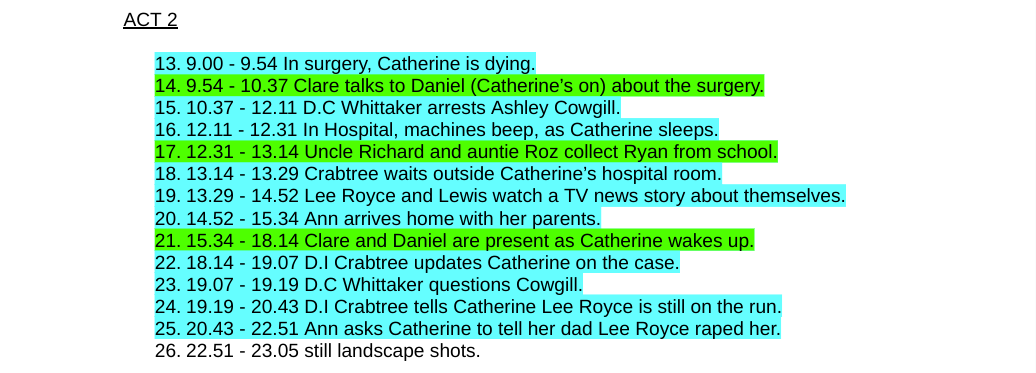
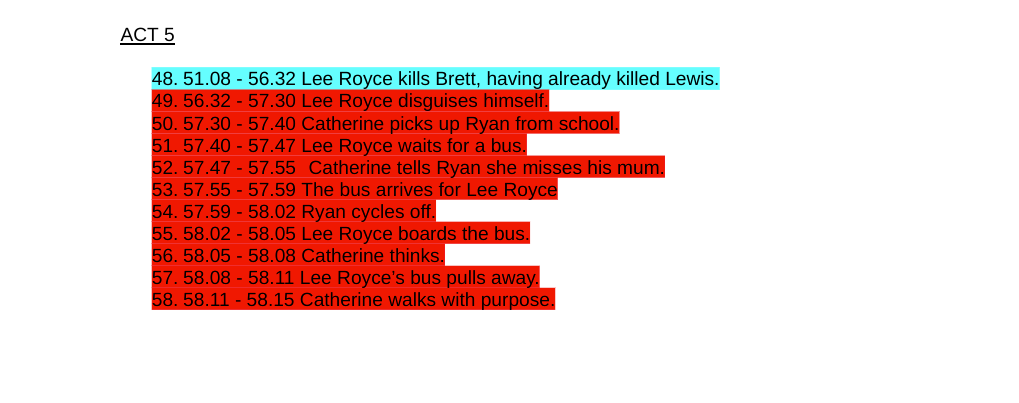
Here are the 5 acts of episode 5.
Colour codes as follows:
Interesting to note that act 1 is completely focused on A story for the season – Ann’s kidnap plot.
Act 2 gives us mostly season plot scenes but 3 family scenes inserted as well.
In Act 3 we see the writer bring us back to the main plot of the trilogy with splashes of red mixed in with the blue (season plot) and green (family).
In Act 4 we start to see the trilogy become more pronounced with red trilogy scenes outweighing blue and green. There is also one scene which ties one of the season antagonists to the background issue of drugs (colour code: brown) from where Happy Valley gets its name.
Finally, to kick us into the finale that is going to be Episode 6, we have the last act of Episode 5, which, with the exception of the first scene, is completely focused on Catherine, Ryan and Tommy Lee Royce and the deceased Becky.
SPOILER ALERT
In scene 52 Catherine explains to her grandson Ryan that she is crying because she misses his mum – Becky – who committed suicide after being raped by Tommy Lee Royce. This storyline will play out over the next two seasons, culminating in Episode 6 of Season 3. And in a twist of genius, the final scene of season 3 pays off the opening scene of season 1, even though season 1 and season 3 were made 8 years apart.
If you have any interesting notes about Happy Valley please let me know on Twitter @screenwriteorg