Category Archives: TV

Writing Television

Happy Valley S1E1: act length

If you watch my breakdown here, you will find the act lengths are:

Act 1: 0.00 – 24.32

Act 1 length: 24.32

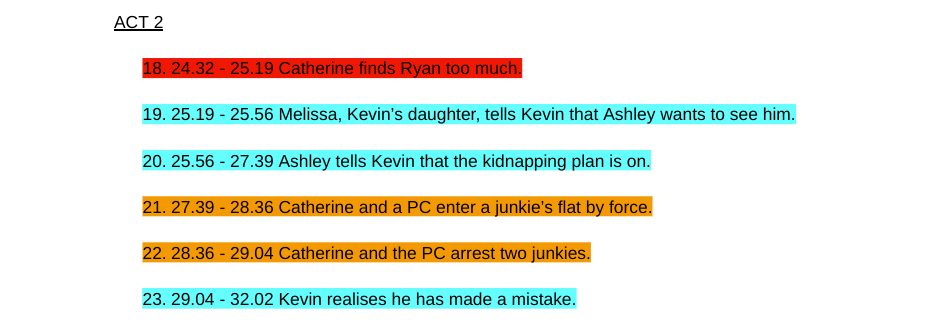
Act 2: 24.32 – 32.02

Act 2 length: 7.30

Act 3: 32.02 – 41.08

Act 3 length: 9.06

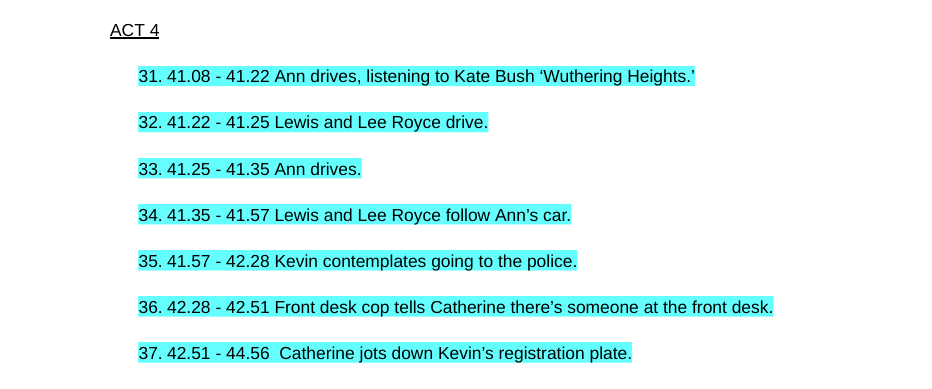
Act 4: 41.08 – 44.56

Act 4 length: 3.48

Act 5: 44.56 – 57.44

Act 5 length: 12.48

This article explains how many scenes in each act are dedicated to each story thread: Trilogy, Season, Personal and Storyworld:

Happy Valley – a deep dive into structure

This exploration of the opening episode of Sally Wainwright’s award-winning crime drama trilogy Happy Valley reveals 4 story threads, a 5 act structure, multiple antagonists, blurred boundaries and how the structure follows the journey not of trilogy protagonist Catherine but of the season antagonist Kevin. Dive in and discover.

From this article:

“Time” by Jimmy McGovern – episode 1 structure

I asked chatgpt how does Jimmy McGovern structure episode 1 of Time. This was the response.

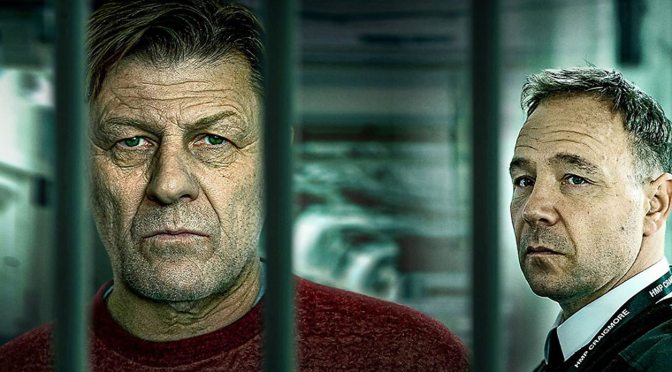
In Episode 1 of Time, Jimmy McGovern skillfully structures the episode to immerse viewers in the harsh, tense environment of a British prison while introducing the complex inner lives of the main characters. McGovern, known for his gritty, character-driven storytelling, uses a dual narrative approach to introduce the two main characters, Mark Cobden (played by Sean Bean) and Eric McNally (played by Stephen Graham), and to establish the emotional stakes that drive the story forward.

  1. Establishing Characters and Context: The episode opens with Mark, a former teacher, who is sentenced to four years for causing a fatal car accident. The narrative dives directly into his vulnerability and isolation as he enters prison, giving viewers a raw look at the fear and guilt he feels. In parallel, we meet Eric, a seasoned prison officer, whose moral integrity and deep care for the inmates contrasts sharply with the brutality of the prison environment.
  2. Conflict and High Stakes: McGovern quickly escalates tension by throwing Mark into confrontations with fellow inmates, exposing the brutal reality of prison life. He also creates immediate tension for Eric, who is forced into a moral dilemma when a gang threatens his family. This dual conflict (Mark’s survival and Eric’s integrity) drives the episode’s structure, balancing empathy and suspense.
  3. Developing Themes of Guilt and Redemption: Throughout the episode, McGovern interweaves themes of guilt, redemption, and justice, exploring these through the contrasting lives of Mark and Eric. Flashbacks and dialogue subtly reveal Mark’s remorse, highlighting his emotional journey, while Eric’s ethical struggles reveal his vulnerability, adding depth to the narrative.

By ending the episode on cliffhangers for both characters, McGovern effectively hooks viewers, leaving them invested in the fate of these two men whose lives are irrevocably intertwined within the brutal confines of prison.

MA Writing for Script & Screen: final project – reflective blog

Having analysed Happy Valley season 1 episode by episode, act by act, I decided to write my TV pilot in 5 act structure.

I am using the same colour code as I used in my HV analysis, with an extra colour as I am working with two protagonists (my first time attempting this).

I am certainly not expecting a perfect result from this first attempt at a TV pilot but hopefully something which I can continue to work on when the MA has finished and something which I can submit with an element of confidence that it will pass.

Here is the way I have colour coded the first act, inspired by my analysis of the structure of Happy Valley.

What about you? Are you colour-coding your outlines?

Happy Valley S1 E05 Act structure & story threads.

Having looked at the previous 4 episodes, we are now on to episode 5.

It is actually really interesting to see the colour codes change.

Whereas in episode 1, act 5 is colour-coded mostly blue – dealing with the A story (season) main plot, as we near the season finale of episode 6, act 5 of episode 5 is mostly red – dealing with the A story (trilogy).

So, as we near the end of season 1, writer Sally Wainwright is preparing the ground for the season trilogy.

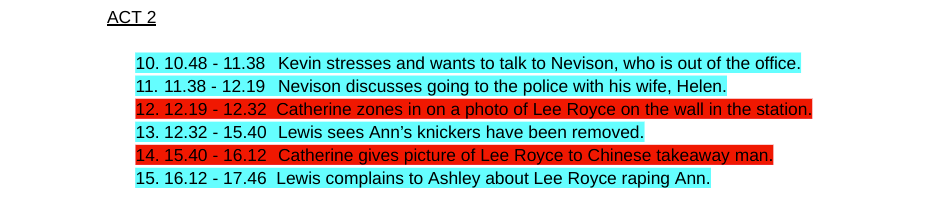
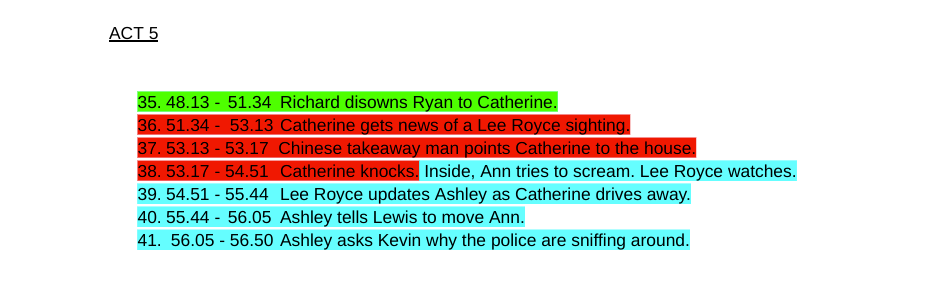
Here are the 5 acts of episode 5.

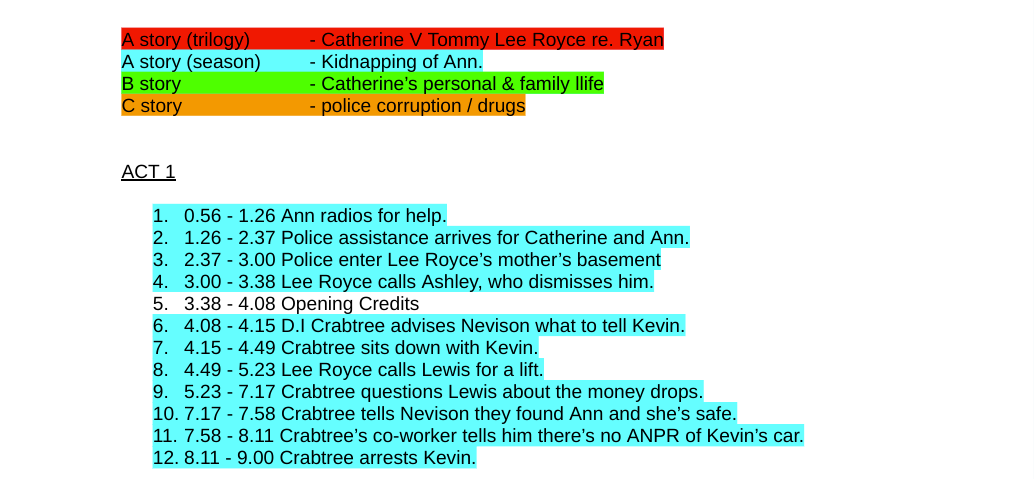
Colour codes as follows:

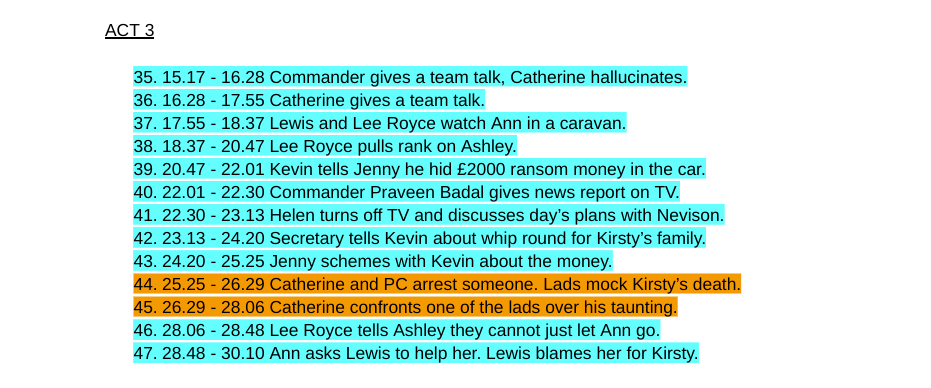
Interesting to note that act 1 is completely focused on A story for the season – Ann’s kidnap plot.

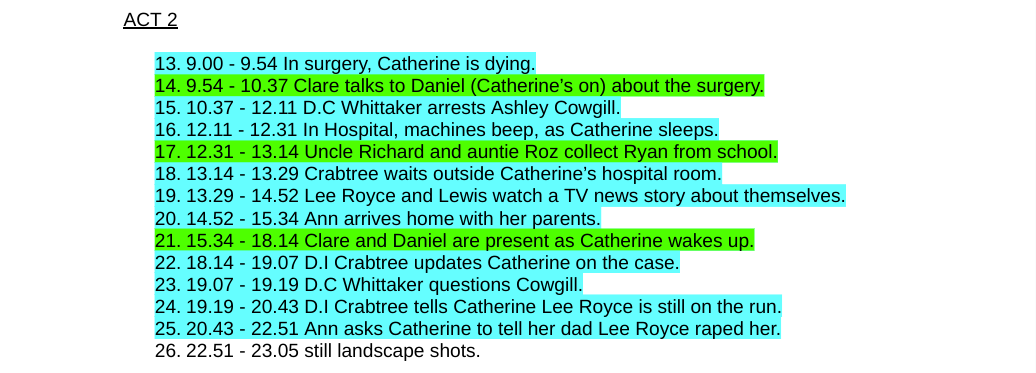
Act 2 gives us mostly season plot scenes but 3 family scenes inserted as well.

In Act 3 we see the writer bring us back to the main plot of the trilogy with splashes of red mixed in with the blue (season plot) and green (family).

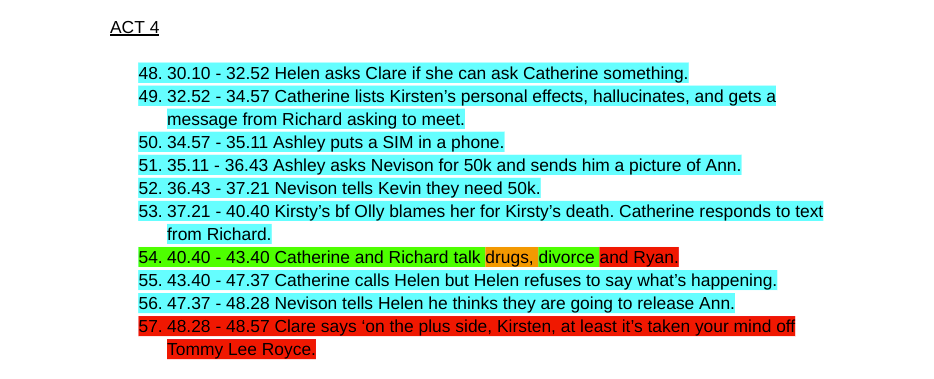
In Act 4 we start to see the trilogy become more pronounced with red trilogy scenes outweighing blue and green. There is also one scene which ties one of the season antagonists to the background issue of drugs (colour code: brown) from where Happy Valley gets its name.

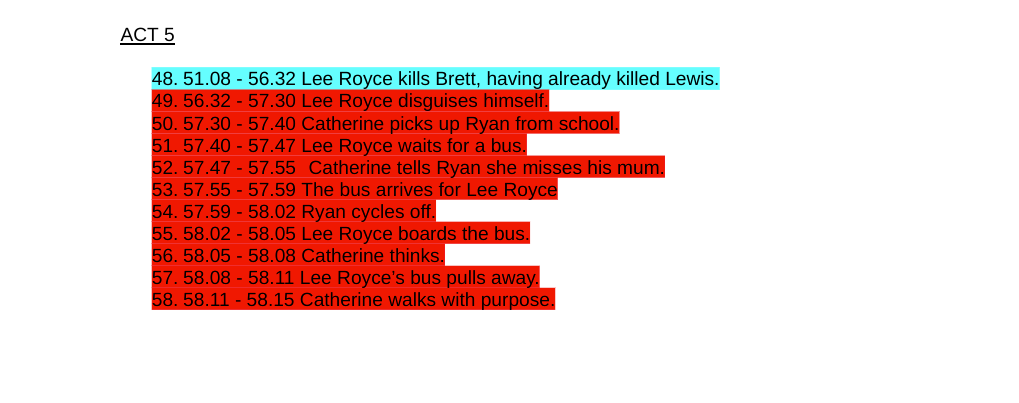
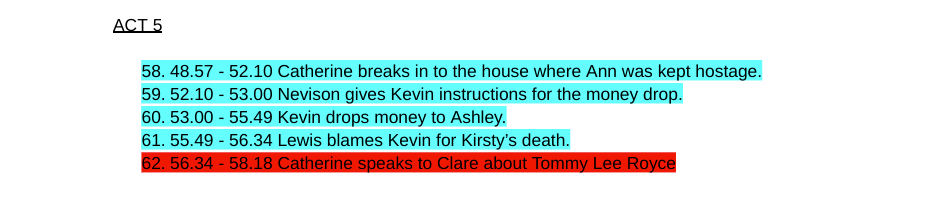
Finally, to kick us into the finale that is going to be Episode 6, we have the last act of Episode 5, which, with the exception of the first scene, is completely focused on Catherine, Ryan and Tommy Lee Royce and the deceased Becky.

SPOILER ALERT

In scene 52 Catherine explains to her grandson Ryan that she is crying because she misses his mum – Becky – who committed suicide after being raped by Tommy Lee Royce. This storyline will play out over the next two seasons, culminating in Episode 6 of Season 3. And in a twist of genius, the final scene of season 3 pays off the opening scene of season 1, even though season 1 and season 3 were made 8 years apart.

If you have any interesting notes about Happy Valley please let me know on Twitter @screenwriteorg

Happy Valley Season 1 Episode 1 step outline / story threads

SPOILER ALERT & CONTENT WARNING: ADULT THEMES

Let’s look at the structure of Episode 1 and see how writer Sally Wainwright weaves the 4 story threads together:

NB: The A story (trilogy) refers to the story overarching the entire 3 seasons. A story (season) means the story which expands throughout Season 1.

Episode 1 seems to be written in 5 acts, and follows the actions of the season protagonist (Kevin) rather than the trilogy antagonist (Tommy Lee Royce).

The end of each act is a turning point instigated by the actions of Kevin.

The final shot of the 1st act also reveals the trilogy antagonist Tommy Lee Royce.

Because of this, I have broken the episode into 5 acts:

Episode 1 opens with Catherine’s day to day – police procedure – not related to either A story (season) or A story (trilogy).

The following scene after the opening credits starts off the A story (season).

Scenes 4/5/6 refer to the A story (trilogy).

Midway through Act 1 Catherine kisses her ex-husband – already with someone new – referring to her personal life. She still has a thing for her ex-husband.

Then, we’re back into the Season story.

Next, trilogy story.

Season story.

Trilogy story.

Then 2 scenes which set up the season story (the inciting incident)

The final scene of Act 1 cleverly weaves together both A story (season) and A story (trilogy) around antagonist Tommy Lee Royce.

Act 2 opens with conflict between Ryan and Catherine – A story trilogy.

Next 2 scenes A story season.

Then 2 scenes C story.

Finally, A story season.

Act 3, the central act of the episode, begins with A story trilogy telling us the reason for this Protagonist / Antagonist battle – an immensely powerful scene where Catherine tells Ryan’s teacher the entire backstory of her daughter Becky, Lee Royce’s violent sexual assault and Becky’s consequent suicide.

We might call this the midpoint.

The following scene takes us to Catherine arranging to meet ex-husband Richard. I have included this as A story trilogy, as opposed to B story (family) because it leads up to Catherine’s expression to Richard of her absolute hatred of Tommy Lee Royce.

The next 3 scenes are dedicated to A story season.

Act 4 is completely dedicated to A story season.

Scenes 38/39/40 focus on A story season.

Scene 41 refers to police protocol as Catherine tells an amusing story to Kirsty about drugs.

Then, she spots Tommy Lee Royce, midway through the final act.

The final 4 scenes of act 5 all represent the season A story.

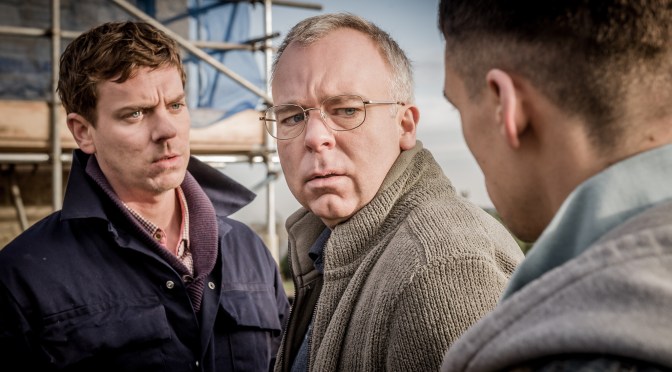
Ashley (JOE ARMSTRONG), Kevin (STEVE PEMBERTON), Lewis (ADAM LONG)

Happy Valley Season 1 Episode 3 step outline

SPOILER ALERT.

We can see that this episode is structured very differently from Episode 2

Like Episode 2, let’s explore in 5 acts.

Again, as previously, the 4 story threads are colour coded as follows:

Let’s start.

As you can see, unlike Episode 2, (we will do a comparison in another post) the entire act is dedicated to the A story (season) and the cop-murder of Kirsty.

Actually, this storyline could have its own colour code as an episode storyline, I decided to keep blue because the murder of Kirsty is a consequence of Ann’s kidnapping: A story (season).

The act is a furiously tragic depiction of the murder of Kirsty: emotional, brutal, shocking. It’s a terrific opener to Episode 3.

Many of these scenes are quick fire editing between the four characters: Kirsty, Lewis, Ann and Tommy Lee Royce.

The act break is clear, as Tommy Lee Royce leaves the body of Kirsty dead on the floor and the lights of her police van flashing.

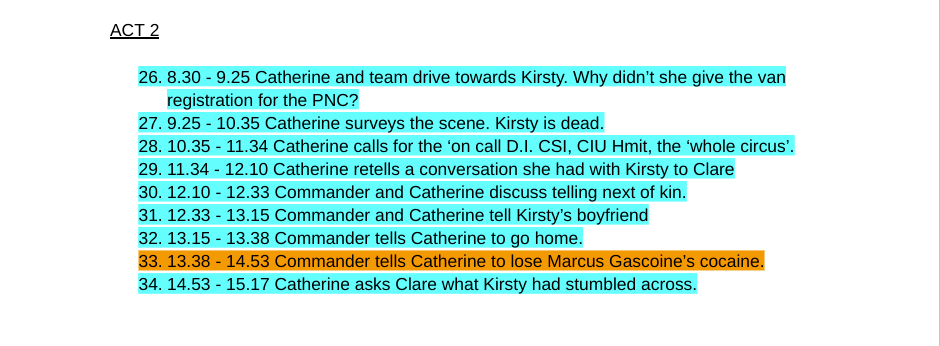
Again, Act 2 is dedicated to the A story (season) with a slight nod to the C story of police, drugs & corruption.

The act again is clearly marked as a dramatic sequence and follows Catherine dealing with the crime scene.

Again, Act 3 is almost fully dedicated to the season A story – the kidnapping of Ann.

Again, there is a slight nod to Catherine’s day to day world of police protocol. Actually, these two scenes (44/45) depict Catherine dealing with anti-police hate speech.

Act 4, right up to minute 40 (scene 54) deals with the A story (season) the kidnapping of Ann.

Scene 54 is the first time in the entire episode we have seen any C story – Catherine’s personal life, with a slight nod to the A story of the trilogy – Ryan’s relationship with his dad Tommy Lee Royce.

Act 4 ends with a shocking line from Clare which brings Catherine crashing back to hell and hooks us to the A story for the trilogy:

“On the plus side… ” says Clare, “at least it (the murder of Kirsten) has taken your mind off Tommy Lee Royce.”

Act 5 is also dedicated to the A story of the season – the kidnapping of Ann.

Only the final scene brings us back to the A story for the trilogy – Catherine V Tommy Lee Royce.

What do you think about this structure?

Happy Valley Season 1 Episode 2 step outline

SPOILER ALERT. Please do not read if you have not seen Happy Valley Season 1.

We explore this episode in 5 acts.

Please note – Happy Valley is a trilogy: 3 seasons with 1 main overarching story.

In this post we will look at the various story threads, and how writer Sally Wainwright weaves them together.

We can observe four story threads:

The main story which runs through the three seasons is about Catherine and her grandson Ryan and his relationship with his father – trilogy antagonist Tommy Lee Royce. I have called this the ‘A’ story (trilogy).

Next, there is the season story: the kidnapping of Ann Gallagher by Kevin, Ashley, Lewis and Tommy Lee Royce. Let’s call this the ‘A’ story (season).

We can see immediately how the two A stories – season and trilogy – intertwine around the character of Tommy Lee Royce (the trilogy’s main antagonist).

Thirdly, we have Catherine’s extended family: her sister Clare, her ex-husband Richard and her son Daniel. Let’s call this the ‘B’ story.

Fourthly, we have the theme of drugs, police procedure, and corruption. Let’s call this the ‘C’ story.

The different story threads are colour coded.

Let’s look at Act 1.

So, here we can see the episode opens with the C story, followed by opening credits.

It is interesting to note there is no B story.

Immediately following the credits we are into the season A story – the kidnapping.

Next, we are nudged into the A story for the trilogy – Catherine (protag) V Tommy Lee Royce (antag).

The next two scenes introduce Catherine’s day to day of busting small time drugs gangs so represent the C story.

The act finishes focusing on the A story (season) of kidnapping with season victim Ann whimpering, bound and gagged, to carry us into Act 2.

Now let’s check Act 2. Again, no B story.

Here we can see that Act 2 focuses only on the two A stories, expertly interweaving the season story and trilogy story.

The act again finishes with Ann (season victim) and her ordeal, propelling us into Act 3.

Act 3 finally gives us some insight into Catherine’s personal life.

In fact, Act 3 blends all 4 storylines.

This central act opens with a scene introducing Daniel, Catherine’s son, inviting her and her sister Clare to dinner (paid off in Act 4 Scene 32.)

The next scene, 17, interweaves the C story, drugs and corruption, with the B story and the A story (trilogy).

The next 4 scenes, 19-22, focus on the season A story.

Scene 23, which we might call the midpoint of the episode, points to the A story of the trilogy.

Again, the act ends by focusing on Ann and her ordeal.

Act 4 steers away from the A story for the trilogy (Catherine / Ryan / Tommy Lee Royce) and opens with a 4 minute scene which references drugs and corruption, the C story.

The next scene, 27, foreshadows Kirsty’s death.

Scenes 28 / 29 focus on the A story (season).

The central scene of Act 4 brings us back to the C story: drugs and corruption.

Scenes 31/32 revolve around Catherine’s son, ex-husband and grandson – B story.

Act 4 ends with us focusing again on the A story for the season (33/34).

Act 5 opens with B story, with a powerful moral conflict between Catherine and Richard discussing the consequences on their family of dealing with bringing up a child who was born to their (deceased) daughter as the consequence of a rape.

The rest of this final act is equally split between A story (season) and A story (trilogy) – expertly separated by one scene, 38, which glues both stories together and brings protagonist and antagonist (almost) face to face.

Catherine has yet to meet her trilogy antagonist, but here, we the viewer – in privileged superior position – know that only a wall separates her from direct confrontation with her arch enemy Tommy Lee Royce. Dramatic irony at its finest.

The final 3 scenes draw us back into the A story for the season to propel us into the next episode.

Do you agree with this analysis? Please let me know your thoughts.

Happy Valley – S1 E01 – Character Revealed through Action and Dialogue.

In the last post we summarized Season 1 Episode 1.

Analysis:

The purpose of this exercise is to see and understand what the writer discloses about each character in the pilot regarding character.

What is revealed through a) dialogue and b) action?

Let’s take it scene by scene:

NB these scenes do not correspond to the shooting script. They are according to my breakdown from watching the show.

Scene 1:

Action: Catherine is compassionate, skilled and professional.

Dialogue: Catherine is witty, with a dark sense of humour and has a complicated family life, which we learn about in detail.

Scene 2 is opening credits.

Scene 3:

Dialogue: we learn that Weatherill is the accountant and that Nevison, his boss is from a poor background.

Scene 4: 

Dialogue: we learn that Richard is a journalist, and that Tommy Lee Royce (series antagonist) has been released from prison.

Scene 5: 

Dialogue: Ryan has been aggressive and using unacceptable language at school.

Scene 6: 

Dialogue: we learn from Clare that Lee Royce has been released. This is the second time we have heard this, so it must be important.

Scene 7: 

Dialogue: Kevin is jealous of Nevison. He is falling apart. Feels undervalued. 

    Jenny is positive and reassuring, even in the midst of severe illness.

Scene 8:

Dialogue: Normal family friction. Nevison reveals he does value Kevin as he at least is thinking about his pay rise.

Scene 9: 

Dialogue: Richard and Catherine have a good relationship as friends. 

Scene 10:

Action: Richard and Catherine still fancy each other.

Scene 11:

Dialogue: Jenny positive, Kevin negative and self-pitying.

Action: Jenny needs help being put to bed and so is physically dependent on Kevin.

Scene 12:

Action: Writer Sally Wainwright is a fan of Sylvia Plath.

Scene 13: 

Dialogue: Ashley Cowgill presents himself as generous and considerate. Kevin is jealous and self-pitying.

Scene 14:

Catherine is concerned about the whereabouts of Tommy Lee Royce.

Scene 15: 

Action: Cowgill is a cannabis dealer to scale. 

Dialogue: Cowgill is passive / aggressive and a bully.

Scene 16:

Dialogue: Kevin Weatherill is cowardly, deceitful and manipulative.

Scene 17: 

Dialogue: The ‘other’ man working for Cowgill has been in jail for 8 years, and is therefore      the man Catherine is worried about, Tommy Lee Royce. NB we don’t yet know what Lee Royce has done. (We find out in scene 24 / 25).

    Lewis, Cowgill’s other worker, doesn’t like Lee Royce.

Scene 18:

Dialogue: Catherine is tired and impatient with her grandchild, Ryan. She is taking her worry over Tommy Lee Royce out on Ryan, his son – projecting her anxiety onto him.

Scene 19:

Action: We are reminded that Kevin is a father with a daughter.

Scene 20:

Dialogue: Kevin is self-deceiving as he believes he has the power to negotiate over his kidnapping arrangement fee.

Scene 21:

Action: Catherine is active, fearless, professional and strong.

Scene 22:

Dialogue: Catherine wittily makes fun of her own challenges in the job – but not regarding Lee Royce.

Scene 23:

Dialogue: Nevison is generous and kindhearted.

Scene 24 / 25

Dialogue and Action: Catherine is broken over her daughter’s ordeal of sexual violence and subsequent suicide. Through this scene of emotional turbulence exposition and backstory about her daughter Becky and Tommy Lee Royce’s crime and character are expertly revealed.

Scene 26:

Dialogue: Catherine desires intimacy with Richard.

Scene 27:

Dialogue: Catherine hates Lee Royce

Scene 28:

Action: Kevin cannot sleep.

Scene 29:

Dialogue: Kevin is nervous and scared.

Scene 30:

Action: Ashley seems cool and focused / Kevin is aggressive and careless.

Dialogue: Ashley sounds anxious.

Scene 31:

Action: Ann is fervent, youthful and life-loving.

Scene 32 / 33 as 31.

Sceen 34:

Lewis and Lee Royce are in conflict.

Scene 35:

Action: Kevin is experiencing inner conflict between doing what is right and fear of the consequences.

Scene 36:

Action: Catherine is busy at work.

Scene 37:

Action: Catherine is quick-thinking / Kevin is impulsive and irrational.

Scene 38:

Action: Lee Royce is brutal, misogynistic and violent / Lewis is naive.

Dialogue: Lee Royce is brutal, misogynistic and violent.

Scene 39:

Dialogue: Kevin is naive.

Scene 40:

Action: Lee Royce is a narcissist (signified by his adjusting his hair in the rear view mirror immediately after having been violent to Ann).

Dialogue: Lee Royce is vulgar, misogynistic and violent / Lewis is inexperienced, thoughtless and naive.

Scene 41:

Dialogue: Catherine is chatty, convivial.

Scene 42:

Action: Catherine is fearless.

Scene 43:

Action: Catherine is intensely angry.

Scene 44:

Action: Nevison is terrified.

Dialogue: Kevin is nervous.

Scene 45:

Dialogue: Lee Royce is heartless, cruel, and sadistic.

Scene 46:

Dialogue: Nevison loves his daughter.

Dialogue: Kevin is duplicitous.

Scene 47:

Action: Catherine is smart, resourceful, investigatively skillful.