
Category Archives: #screenwriting

Happy Valley S1E1: act length

If you watch my breakdown here, you will find the act lengths are:

Act 1: 0.00 – 24.32

Act 1 length: 24.32

Act 2: 24.32 – 32.02

Act 2 length: 7.30

Act 3: 32.02 – 41.08

Act 3 length: 9.06

Act 4: 41.08 – 44.56

Act 4 length: 3.48

Act 5: 44.56 – 57.44

Act 5 length: 12.48

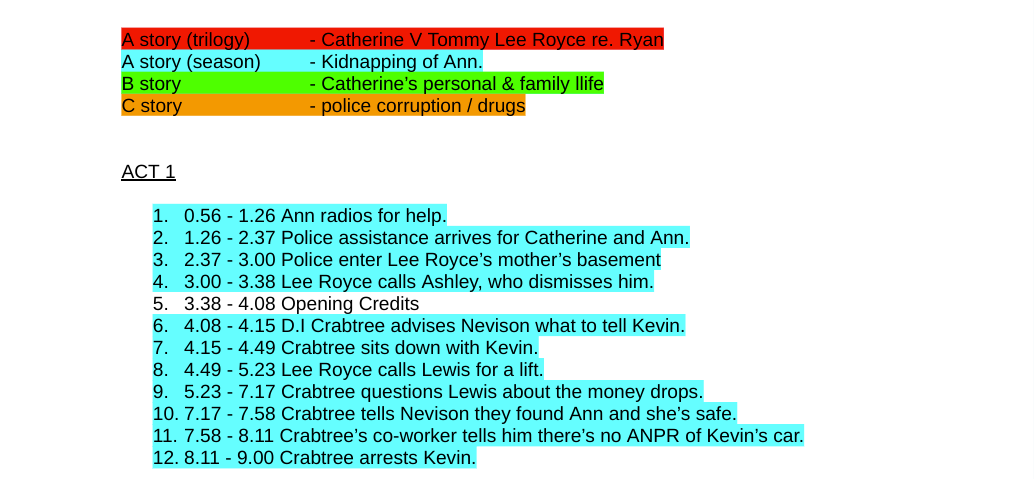
This article explains how many scenes in each act are dedicated to each story thread: Trilogy, Season, Personal and Storyworld:

Happy Valley – a deep dive into structure

This exploration of the opening episode of Sally Wainwright’s award-winning crime drama trilogy Happy Valley reveals 4 story threads, a 5 act structure, multiple antagonists, blurred boundaries and how the structure follows the journey not of trilogy protagonist Catherine but of the season antagonist Kevin. Dive in and discover.

From this article:

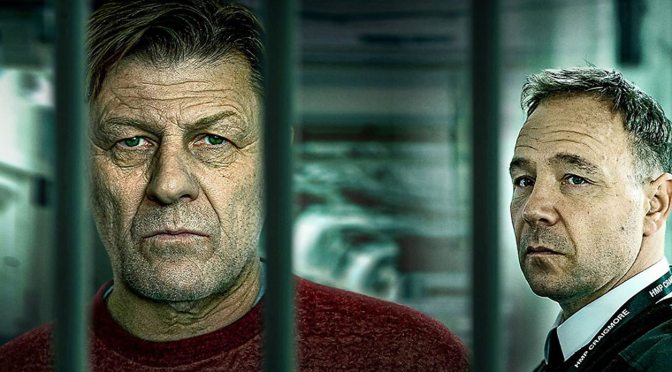
“Time” by Jimmy McGovern – episode 1 structure

I asked chatgpt how does Jimmy McGovern structure episode 1 of Time. This was the response.

In Episode 1 of Time, Jimmy McGovern skillfully structures the episode to immerse viewers in the harsh, tense environment of a British prison while introducing the complex inner lives of the main characters. McGovern, known for his gritty, character-driven storytelling, uses a dual narrative approach to introduce the two main characters, Mark Cobden (played by Sean Bean) and Eric McNally (played by Stephen Graham), and to establish the emotional stakes that drive the story forward.

  1. Establishing Characters and Context: The episode opens with Mark, a former teacher, who is sentenced to four years for causing a fatal car accident. The narrative dives directly into his vulnerability and isolation as he enters prison, giving viewers a raw look at the fear and guilt he feels. In parallel, we meet Eric, a seasoned prison officer, whose moral integrity and deep care for the inmates contrasts sharply with the brutality of the prison environment.
  2. Conflict and High Stakes: McGovern quickly escalates tension by throwing Mark into confrontations with fellow inmates, exposing the brutal reality of prison life. He also creates immediate tension for Eric, who is forced into a moral dilemma when a gang threatens his family. This dual conflict (Mark’s survival and Eric’s integrity) drives the episode’s structure, balancing empathy and suspense.
  3. Developing Themes of Guilt and Redemption: Throughout the episode, McGovern interweaves themes of guilt, redemption, and justice, exploring these through the contrasting lives of Mark and Eric. Flashbacks and dialogue subtly reveal Mark’s remorse, highlighting his emotional journey, while Eric’s ethical struggles reveal his vulnerability, adding depth to the narrative.

By ending the episode on cliffhangers for both characters, McGovern effectively hooks viewers, leaving them invested in the fate of these two men whose lives are irrevocably intertwined within the brutal confines of prison.

MA Writing for Script & Screen: final project – reflective blog

Having analysed Happy Valley season 1 episode by episode, act by act, I decided to write my TV pilot in 5 act structure.

I am using the same colour code as I used in my HV analysis, with an extra colour as I am working with two protagonists (my first time attempting this).

I am certainly not expecting a perfect result from this first attempt at a TV pilot but hopefully something which I can continue to work on when the MA has finished and something which I can submit with an element of confidence that it will pass.

Here is the way I have colour coded the first act, inspired by my analysis of the structure of Happy Valley.

What about you? Are you colour-coding your outlines?

Happy Valley S1 E05 Act structure & story threads.

Having looked at the previous 4 episodes, we are now on to episode 5.

It is actually really interesting to see the colour codes change.

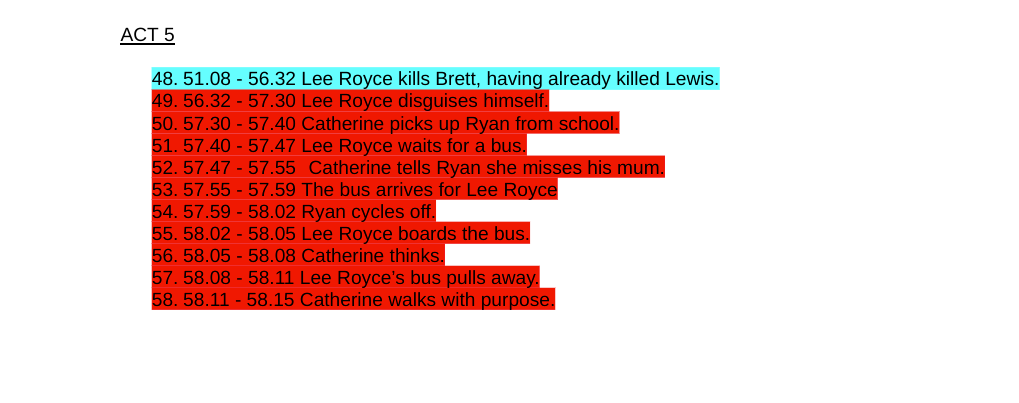
Whereas in episode 1, act 5 is colour-coded mostly blue – dealing with the A story (season) main plot, as we near the season finale of episode 6, act 5 of episode 5 is mostly red – dealing with the A story (trilogy).

So, as we near the end of season 1, writer Sally Wainwright is preparing the ground for the season trilogy.

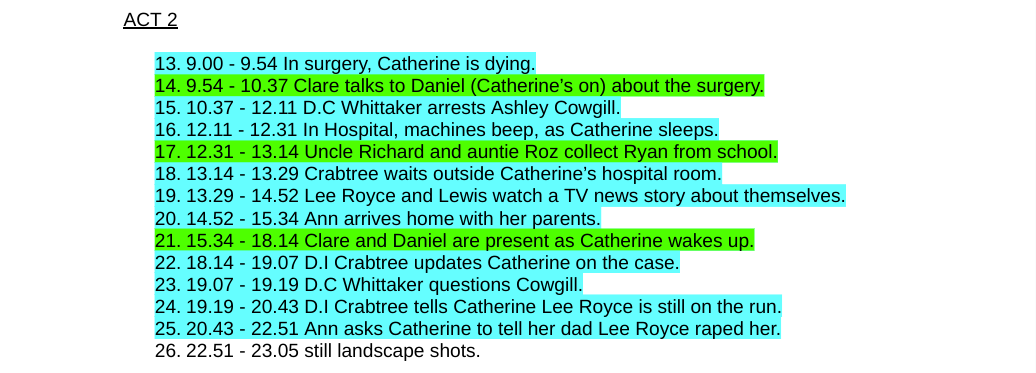
Here are the 5 acts of episode 5.

Colour codes as follows:

Interesting to note that act 1 is completely focused on A story for the season – Ann’s kidnap plot.

Act 2 gives us mostly season plot scenes but 3 family scenes inserted as well.

In Act 3 we see the writer bring us back to the main plot of the trilogy with splashes of red mixed in with the blue (season plot) and green (family).

In Act 4 we start to see the trilogy become more pronounced with red trilogy scenes outweighing blue and green. There is also one scene which ties one of the season antagonists to the background issue of drugs (colour code: brown) from where Happy Valley gets its name.

Finally, to kick us into the finale that is going to be Episode 6, we have the last act of Episode 5, which, with the exception of the first scene, is completely focused on Catherine, Ryan and Tommy Lee Royce and the deceased Becky.

SPOILER ALERT

In scene 52 Catherine explains to her grandson Ryan that she is crying because she misses his mum – Becky – who committed suicide after being raped by Tommy Lee Royce. This storyline will play out over the next two seasons, culminating in Episode 6 of Season 3. And in a twist of genius, the final scene of season 3 pays off the opening scene of season 1, even though season 1 and season 3 were made 8 years apart.

If you have any interesting notes about Happy Valley please let me know on Twitter @screenwriteorg

BETWEEN THE LINES

THEME in FOUR FILMS of AARON SORKIN

Warning – contains spoilers, crude language, and sexual references.

Screenshot 2021-10-02 01.29.14 (1)-1.png

Introduction

Having watched four of Sorkin’s films over three days: A Few Good Men, Moneyball, Steve Jobs, and Molly’s Game, I learned that Sorkin has a style which is not immediately apparent. That he writes snappy, humorous dialogue is undisputed. However, the underlying idiosyncratic skill he has as writer, is evident in the parody of himself in 30 Rock when Sorkin states: ‘Listen, Lady (a gender I write extremely well if the story calls for it )… ’ (0.44)

Sorkin portrays conflicting attributes to his characters. Perhaps this is why his screenplays are so successful. Yet there is a hidden elixir in his writing to be shared.

All four films have a plot which we are aware of, on the surface. However, the writer asks us to look more closely, and dig a little deeper to a play within a play. Underneath the plot, is the theme, the message Sorkin wants us to think about, go away with, learn from – the elixir of our viewing journey. This theme is not immediately apparent. I believe if we are to learn from Sorkin, and share the elixir he presents to us, we must discover the treasure that lies between the lines, below the surface, the subtext. Maybe it is there we will find Sorkin’s true value as a writer; the reason for his success, and why he may have been the catalyst for a cultural shift in favor of the way in which screenwriters are perceived.

In order to search for the elixir to share, I watched Molly’s Game first, followed by Moneyball. When I realised both shared a father-daughter theme I was eager to watch Steve Jobs, thinking to myself that it must deviate from the theme. There is no way Steve Jobs can be a father-daughter story in the way Molly’s Game and Moneyball is. It’s Steve Jobs. It’s about Apple. So, I watched it and learned… guess what? It’s a father-daughter story! I wonder how much screen time is dedicated to Job’s relationship with his daughter and his personal life goal of being a good father, in comparison with his work goal of selling 1 million computers in 90 days.

I have noticed that in all four films the theme is parental love and specifically, father-daughter (in A Few Good Men: father figure – daughter.) The plots have their own trajectories. Yet I believe the message Sorkin wants us to take from each of these stories – the theme – is the value and importance of parenthood. The plots are simply wallpaper in which to tell the real story – which is the theme. Let’s face it, what’s more important? Selling a million computers or having a good relationship with your daughter? As Phoebe Waller-Bridge says to Daniel Craig: “The mission’s not the real story, the relationships are.” (Spitting Image S2 E03). Let’s look at the four films one by one.

1. A FEW GOOD MEN (1992) directed by Rob Reiner, screenplay by Aaron Sorkin.

Screenshot 2021-10-03 00.36.18.png

The first thing we should notice about this story is the oxymoron between title and poster image. One of the ‘few good men’ in the image is a not a man, but a woman. Notice how both men look us in the eye. The woman looks somewhere else -a visual metaphor, perhaps. In the film, Lieutenant Commander Joanne Galloway (Demi Moore) is subjected to sexual harassmentfrom both her younger protege Daniel Kaffee (Tom Cruise) and her superior officer Colonel Jessup (Jack Nicholson).

Galloway, the only female in this story world, acts as mentor to Kaffee, inspiring him to take his work seriously and fight for justice for the two young men accused of murder. Kaffee is hired by the Navy for his reputation for plea bargains.  Galloway wants Kaffee, rather than enter a plea bargain, to search for the truth and fight for justice. In John Yorke’s vernacular, by the denouement, Kaffee has assimilated Galloway’s quality of truth-seeking. What is the truth that lies behind the lines of Sorkin’s writing? And can we handle it?

First, when Galloway briefs Kaffee on the court case he ‘jokes’ that he’s “sexually aroused”. Next, Jessup is in the Officer’s Mess with Kaffee, Kendrick, Markinson, other lawyers and Joanne Galloway. As well as having the opportunity to be a father-figure / mentor / role model to Tom Cruise’s character – Kaffee, Jessup also has the opportunity to be a role model to Galloway – a mentor or father-figure to a young, brilliant, smart female officer. Tragically, he bypasses this opportunity in favor of bravado, machismo and sexist banter in front of a group of men. Jessup chooses not to serve and protect but to humiliate the female officer under his command with crude, salacious, offensive language:

JESSUP 

(to Kaffee)

There is, believe me gentlemen, nothing sexier on earth 

than a woman you have to salute in the morning…

Promote ‘em all I say, cause this is true:

If you haven’t gotten a blow job from a superior 

officer, well, you’re just letting the best in life pass you by.

Sorkin achieves two things with this dialogue. Firstly, he highlights the issue of sexual harassment women are subjected to in the workplace, in this case, by state actors (US military personal). Secondly, he evokes our disgust and creates enmity between the audience and the story’s main antagonist.

2. MONEYBALL (2011) directed by Bennett Miller, screenplay by Steven Zaillian & Aaron Sorkin

image (9)-1.png

Moneyball is ostensibly about Billy Beane (Brad Pitt) GM of a baseball team, and about his relationship with a young economist, Pete (Jonah Hill), who creates a winning team based on statistics. However, let me draw your attention to the scene, on p128 in the screenplay, where Billy and Pete are in Billy’s office, and Billy is frantically calling teams trying to do deals on players. At one point it’s a wide shot, and Billy (Brad Pitt) kicks back in his chair, and spins around so he’s side on, and the scene goes still and quiet, as Billy thinks and waits for a phone call. This space and time with nothing happening allows us, the viewer, to take in the details mise en scène. And what do we see?

image (8).png

Three photos: two of his daughter, one of him and his daughter, and a mug – obviously a gift from his daughter – which says ‘Daddy.’ This happens again, and the actor, writer, director, gives us time to assimilate the details. This scene portrays the theme: father-daughter parental love. NB – a word of warning – only the dialogue is in the script. There is no action stating “Billy kicks back revealing photos of his daughter and a mug with the word ‘Daddy’ on.” This leads me to believe the screenplay is a transcript. When we write screenplays, we are writing what is on screen. We describe the whole screen / scene. If something is on screen, it should be in the screenplay, right? If not, we would just have a close up of Brad Pitt, thinking! But Brad turns away from the camera and kicks back, doing nothing, saying nothing, giving us space and time to assimilate the important information intended – relating to the theme. I suggest the only reason this scene exists is for us to witness Billy’s office, to see the photos he has of his daughter, to see the mug on his desk saying ‘Daddy.’ The trade deals, the baseball, the phone calls are plot. The photos, the mug saying ‘Daddy’ are theme.

Earlier in the story, Billy and his colleague visit an injured player Scott Hatterberg (Chris Pratt) to offer him a contract. It’s late. Here’s an excerpt from the screenplay:

HATTEBERG’s YOUNG DAUGHTER comes down the staircase in her pajamas, having just woken up in the middle of the night. 

BILLY 

Hello. 

HATTEBERG’S DAUGHTER 

Hi. 

SCOTT 

That’s our youngest daughter. 

BILLY 

Great. 

SCOTT 

Do you have kids?

BILLY doesn’t like to share personal lives with the players, but he covers well– 

BILLY 

–yeah, I have a daughter.

Brad Pitt, aware of the utmost importance of this line as it relates to the theme, basically shrugs off the question before getting back to business. Next we witness Billy in a guitar shop with his daughter, Casey (Kerris Dorsey). She sings a song. Billy brings his hand to cover his face in total shock. He cannot believe how beautiful his daughter is. Tears fill his eyes. Later, when Billy’s team are about to break the record of 20 wins in a row, he’s driving away from the stadium because he can’t bear the pressure. He receives a phone call from his daughter. Casey advises her father to turn around and head back to the stadium. Billy listens to his daughter and turns around.

Then, just after Billy has been offered a contract with the Boston Red Sox as the ‘highest paid GM in the history of sport’, the screenplay states:

EXT. FREEWAY – DAY 

BILLY’s driving along and listening to the continued DRONE of talk radio criticism. BILLY keeps listening a moment, then reaches in the glove box and pulls out a CD marked “Dad’s Mix”. 

BILLY slips it in the CD player. 

The sound of the radio immediately snaps off and the momentary silence is soon broken by CASEY’s VOICE– 

CASEY (V.O)

Hey, Dad. I picked these songs out just for you. 

And then the first track on the CD comes on…

And BILLY smiles.

We know that for the whole movie, with all the buying and selling of players and talk of baseball, Billy has been thinking about his daughter.

3. MOLLY’S GAME (2017) written and directed by Aaron Sorkin (in his directorial debut).

image (13).png

Molly’s Game frequently flips back to Molly’s childhood. 

In this scene (p61) Sorkin has us witness Molly (Jessica Chastain) at home as a teenager with her emotionally abusive psychologist father (Kevin Costner):

The FATHER looks at MOLLY then throws his fork down on his plate with a frightening clang. 

FATHER 

Don’t disrespect me like that at the table.

GIRL 

I wasn’t disrespecting you, I was disrespecting Freud and it’s a kitchen table, it’s not the Tomb of the Unknown Soldier. 

FATHER 

And I’m a professional psychologist, not a quack. 

GIRL 

I never said (you were a)– 

FATHER (over) 

Yeah you did and don’t do it again and don’t ever use that language again. 

GIRL 

Okay, ignore my teachers, watch my language and respect the kitchen table. What else do I need to do before I’m allowed to disagree with you? 

FATHER 

Make your own money so you can live in your own house and eat your own food.

Later, Molly’s agent, Lois (Joey Brookes) makes a flippant comment which causes Molly’s regression, evoking this painful childhood memory.

LOIS

Millions or nothing. Go big or go home and 

go live with your mother. For the rest of your life.

Sorkin writes:

This is excruciating for MOLLY…

In Act 3, Molly is visited by her father in New York, in a redemption scene. Her father admits that his anger was misdirected. He was angry at Molly because when she was 5 years old she had seen him in a car with another woman. Molly can’t remember this, but her father does. He held this shame – expressing itself as anger towards Molly – throughout her childhood and teenage years, alienating him from his daughter until this moment. 

image (11).png

What is tragically ironic about Costner’s character is the fact that he is a psychologist and psychotherapist. He is trained to see defence mechanisms of the psyche, such as transference, misdirected anger etc. in others, yet he did not recognise it in himself until years later. This irony is played out in the final scene between father and daughter when he tells Molly he’s going to give her three years of therapy in three minutes. He gives her three minutes of therapy yet it took him many years to admit his own flaw to his daughter, the reason for his estrangement from her. It was this ‘moral self-revelation’ (Truby) which brought him back to her. Realizing his need he was able to achieve his want – to be in relationship with his daughter. Costner’s character has a strong character arc. We are able to forgive her father as Molly does. Again, the plot is the poker games, the FBI, the court case. This father-daughter subplot relates to, what I believe is, the story’s main theme: parental love.

image (12).png

4. STEVE JOBS (2015) directed by Danny Boyle and written by Aaron Sorkin.

SteveJobspic4.jpg

Ostensibly the main plot of Steve Jobs is Apple and the launch of the iMac (Job’s work goal), yet his relationship with his daughter and his character growth as a father runs alongside the main plot as another main plot – a personal life goal. So Jobs has two goals: a work life goal and a personal life goal.1. In the next paragraph I will explore gender balance in screen time in Steve Jobs.

In conclusion, I believe Sorkin’s value lies between the lines, underneath the main plot, and is related to theme. Furthermore, in my opinion criticism for gender bias towards Sorkin in his stories is unfair. In fact, when I watched the four films I had no idea of this criticism and I was shocked to discover it because after watching the four films I was impressed by Sorkin’s clear stance as an advocate for women’s rights.

Beneath the main plot of A Few Good Men, Sorkin was raising an issue in women’s rights which is still causing problems, even today. Thirty years later, we still face the same issues.  Even today here in the UK we read of police officers colluding with a convicted rapist and murderer with sexist comments in a misogynistic whatsapp group and The Guardian has reported on sexual harassment in the UK armed forces. Janet Hills, Chairperson of the Metropolitan Black Police Association has been speaking out recently regarding her call for zero tolerance on “sexist police banter.” Recently, the British TV and Film has followed the US #metoo movement / cancel culture (Noel Clarke), making it fiercely clear that misogynistic behaviour, in word or deed, will not be tolerated.

Doesn’t Sorkin’s raising of these issues raise an eyebrow to anyone excoriating him with negative gender bias criticism? In fact, if Sorkin is responsible for the cultural shift in the way the world perceives screenwriters, perhaps it’s fair to say that is a consequence of the way his films illuminate gender bias issues notwithstanding the strong female characters he creates.

My advice to anyone wishing to imitate Sorkin’s writing style is to look beyond the dialogue to discover what is happening between the lines, on the screen, relating to theme, to invest thought and time in reflecting issues relating to women’s rights, to create conflicting characters, consider male characters with personal goals, to think about character arcs in all of the main characters and finally, to write female characters “extremely well when the story calls for it.”