John Truby’s book The Anatomy of Story details how to write a story about a hero with a moral flaw. He teaches storytelling with moral argument, moral needs and moral vision.
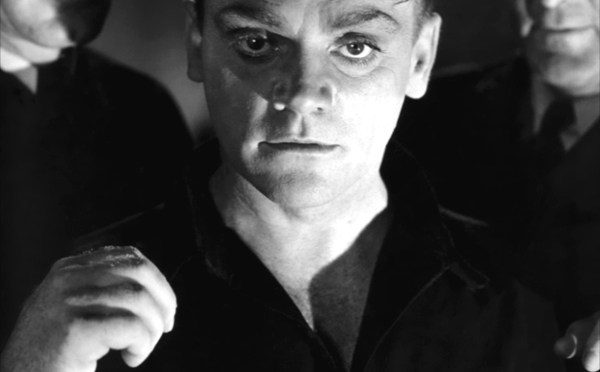
In one of my favorite films, Angels with Dirty Faces (1938), James Cagney’s character Rocky is a tough gangster admired by all the street kids in his neighborhood.
When Rocky is sentenced to death the priest, Father Connolly, Rocky’s childhood friend, wants him to feign fear as he goes to the electric chair.
Connolly believes this will act as a deterrent to the street kids who admire him and want to be like him. They will see that gangsters aren’t cool, but cowards.
Rocky immediately refuses, but is faced with a moral dilemma: does he maintain his tough guy image and die a hero to the kids who idolize him? Or sacrifice his hero status to save them from a life of crime and perhaps the same fate?
Watch this powerful scene to see what happens:
In a stroke of genius by the filmmakers we the audience are not let into the secret if Rocky’s screams of fear are feigned or not. Perhaps they are real.
I choose to believe Rocky had a moral revelation and acted upon it, feigning fear and appearing ‘yellow’ as he went to the chair.
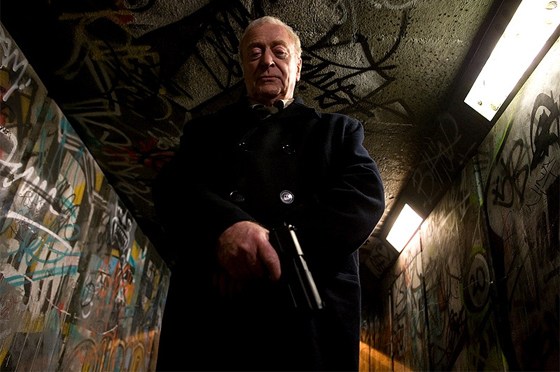
I think the problem with the moral vision in Harry Brown is that the writer – Gary Young – has Harry compare the Troubles in Northern Ireland with social unrest on the council estates of England.
Harry states that those fighting in Northern Ireland were fighting for ‘a cause’, whereas the youth hurling petrol bombs at riot police on London’s council estates were doing it for ‘entertainment.’
I don’t believe lower class social unrest is ‘entertainment’ at all, but that this anger comes from deep-seated resentment at the rich, ruling classes and at capitalism. I agree with this statement:
“…self-destructive or antisocial behavior is a response to circumstances and not a moral failing.”
– from this article on the Open Democracy website about capitalism and drug legalization.
In this post we’ll explore how theme emerges from dialogue, thematic subtext from text.
Into the scene:
JEM
There’s people I can’t let you walk
away from.
DOUG
What? Who?
JEM
Come on!
A beat. Doug realizes.
DOUG
Are you serious, Jimmy?
She’s not my kid….
(beat)
Cut it out. All you give a fuck
about is coke and Xbox and now
you’re trying to play it off you
care about Shyne, come on now!
JEM
You know what your fucking problem
is?
DOUG
What?
JEM
You think you’re better than
people.
DOUG
Uh-huh.
JEM
Mister fucking clean, mister
fucking goddamn high and mighty,
right?
DOUG
Yeh, I’m better than all these
people, you’re right. I’m better
than anybody in this fucking
project.
JEM
Yeah, that’s what you think, but
you grew up right here. Same rules
that I did.
DOUG
OK. What else?
Beat.
JEM
Who the fuck’s the father?
DOUG
I know I’m not the father.
JEM
You were the one fucking her.
DOUG
Yeh, and I wasn’t the only one, brother, OK?
She knew I knew I’m not the father
and I have enough respect for her
not to ask her. OK? Because I don’t
think she knows. Alright? Now I
don’t wanna shatter your illusions
here, partner, but there aren’t
enough free clinics here in
Mattapan to find out who the father
of that kid is…
Beat.
DOUG (cont’d)
And I don’t know who the fuck you
think you are, either. You aren’t
letting me or not letting me do
shit. Alright? Here’s a little
fucking cheat sheet for you. Its
never gonna be me and you and your
sister and Shyne fucking playing
house up there. Alright? You got
it? Get that in your fucking head!
I’m tired of your one way fucking
bullshit. If you wanna see me
again, come down and visit me in
Florida.
So, what’s going on here in the way of exposition? What are we being exposed to thematically?
Later, at the end of the scene, we find out that Jem’s family took Doug in when his dad went to prison. Doug obviously started to fuck Krista, Jem’s sister – who isn’t mentioned by name here. Krista got pregnant, had a daughter, and from this we learn that she doesn’t know who the father is. Next, Doug, in quite an eloquent way, basically tells Jem his sister was a slut:
…there aren’t enough free clinics here in Mattapan to find out who the father of that kid is.
But this section of the scene is working subtextually on two more levels – interconnected by theme.
1. Krista & Shyne.
Krista’s motherly love for her daughter Shyne is the reason she later sacrifices her brother and Doug, giving them up to the FBI.
2. Doug’s mother.
When Doug asks his dad, on a visit to prison, why he didn’t look for his mother when she walked out on them, Doug’s dad says ‘because there was ‘nothing to find.’
He infers because Doug’s mother was no different to all the other single parent girls he sees on the projects ‘fucking around’ – was no different, in fact, to Krista.
So, underlying this section of dialogue, ostensibly conflict between Doug and Jem about the identity of Shyne’s father, is one of The Town’s major themes: parenthood and its absence.
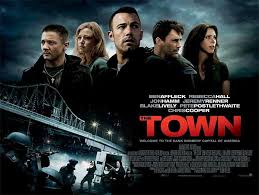
The Town boasts an incredibly in-depth story world with complex back-stories and subplots. As Doug, the protagonist, says, “There’s a lot going on here.”
As this scene reveals information regarding three separate subplots I’m going to split it into three parts.
First, the back-story & subplot regarding the character The Florist which happens in the first few lines of the scene.
So, let’s study the dialogue from two perspectives:
First, what information is revealed?
Secondly, what information is concealed?
Let’s start at the beginning of the scene.
Doug approaches Jem not knowing what this meeting is about. He thinks it’s about the apartment.
However, Jem tells him he’s bought some information from The Florist about a potential robbery and now he has to do the heist and pay up.
But Doug tells Jem he’s not interested.
Let’s read the dialogue:
DOUG
Something wrong with the apartment?
JEM
No. The Florist.
DOUG
The Florist what?
JEM
Came through.
DOUG
Oh, Jesus Christ.
JEM
It’s large, Dougie. It’s large.
DOUG
We’re smoked. Punt it.
JEM
Who else is gonna buy it?
DOUG
You should have thought about that
before you fucking kept breaking
the guy out for forty dimes after
every job.
JEM
There’s an expectation rate.
DOUG
I’ll correct his expectation.
JEM
Oh, you will?
DOUG
Yeh.
Let’s look at the lines more closely.
From this we can see that Jem is paying The Florist after every job, even though The Florist doesn’t do any of the ‘heavy lifting.’
The heists are done by Doug, Jem and the other two men in the gang.
The Florist, Doug infers, gets a cut of every job they do.
But that’s just the way it is to Jem. But not to Doug. Doug is changing things.
In fact, Doug’s line:
I’ll correct his expectation.
is actually foreshadowing.
But look at Jem’s line:
You will?
When we watch the scene in action, Renner delivers this line with sarcasm.
Jem doesn’t believe Doug has the power, will, or ability to ‘correct his expectation.’
From these two words, from the way the line is delivered, we might think that Jem fears The Florist.
We learn later that Jem would rather die than go back to prison, when he says, in one of the best lines of the movie:
I can’t do any more time, Dougie. So if we get jammed up, we’re holding court on the streets.
In a previous post we noticed how Jem is actually scared of expressing himself emotionally. We learned how Jem and Doug love each other ‘like brothers’ and actually Jem is terrified of losing ‘Dougie.’ Jem’s a tough cookie with a soft centre; capable of extreme violence and incapable of expressing brotherly love – except perhaps through a play-fight – yet Doug reads between his lines.
Jeremy Renner manages to play this tough guy with immense vulnerability. It’s easy to see why he was nominated for an Academy Award for this role and why he’s become such an in-demand film actor.
OK, so back to our scene.
We’ve learned what the writers have revealed regarding The Florist.
Now, what is being concealed?
Firstly, there is a deep back-story regarding Doug and The Florist, concerning both Doug’s father and his mother.
Although we never meet her, Doug’s absent mother is a vital character in this story.
We learn from Doug’s dad that his mother was ‘no different’ than the other single parent 20 year olds he sees on the streets.
Doug’s father worked for The Florist, and, we learn, was a victim of his brutal violence.
So, these few lines of dialogue are hiding deep layers of back stories and subplots – yet the writers’ touch on them is as light as a feather.
How heavy is your dialogue?
David Mamet says people speak to conceal, not reveal.
How much are your characters revealing and concealing?
You can also read a studio version of the screenplay here.
NB. this script is different from the final cut that made the movie – but that’s another study.
The first aspect of the scene I’d like to look at is the power play between Doug (Ben Affleck) and Jem (Jeremy Renner).
(Analysis in brackets and in bold).
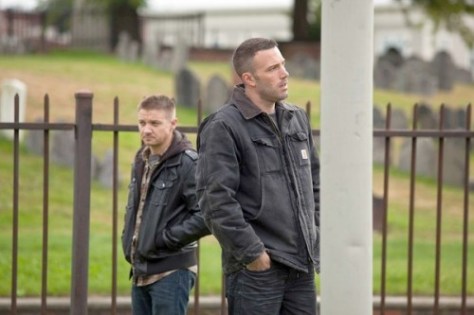
EXT. PROJECTS – PARKING LOT/CEMETERY – DAY
Jem waits for Doug by the ancient cemetery near the projects. Doug approaches him.
DOUG
Something wrong with the apartment?
(So, from Doug’s question we know that Doug doesn’t know why Jem has arranged the meeting. Jem has called Doug, and Doug doesn’t yet know why. So, we might say that at the beginning of the scene Jem holds the power. )
JEM
No. The Florist.
DOUG
The Florist what?
JEM
Came through.
DOUG
Oh, Jesus Christ.
(If you’ve yet to see the film The Florist is The Town’s ‘godfather’ gangster, played by Pete Postlethwaite, a fearsome Northern Irishman, whose ability to cut flowers symbolizes his trademark ability and pleasure to ‘cut your fucking balls off.’ A lovely rose he is not. Doug obviously doesn’t want to do the job, whatever it is. Power with Doug.)
JEM
It’s large, Dougie. It’s large.
(Jem tries to tempt Doug with money. But Doug has enough money. Jem’s bait doesn’t work. The power is still with Doug.)
DOUG
We’re smoked. Punt it.
(‘We’re smoked’ means Doug knows the FBI are watching them. Power: Doug.)
JEM
Who else is gonna buy it?
DOUG
You should have thought about that before you fucking kept breaking the guy out for forty dimes after every job.
JEM
There’s an expectation rate.
DOUG
I’ll correct his expectation.
JEM
Oh, you will?
(No one makes demands or disobeys The Florist. Jem tries to intimidate Doug. It doesn’t work. Power : Doug. It’s a one way fight so far.)
DOUG
Pick up an extra guy or go with three guys or… fucking be smart and boot it.
JEM
Oh so you’re not going?
DOUG
No.
JEM
Why is that?
DOUG
Because we got a ton of fucking heat on us for one thing.
JEM
We’ll put a move on them, right? We’ve done it a hundred fucking times before.
DOUG
You know what, forget it. Do what you wanna do. I’m done.
(Read a separate post on the difference between the studio script and the dialogue in this scene here.)
JEM
What?
DOUG
I’m done.
JEM
You’re done?
DOUG
What does it sound like?
JEM
What’s that.. what’s that mean?
DOUG
What the fuck do you think it means?
JEM
What does that mean you’re done? It sounds like a bunch of fucking bullshit.
(Why the confusion? Doug doesn’t want to do the job. More than that, he wants out completely. Why isn’t Jem just letting it go? And why is Doug even entertaining him? Why not just tell him to fuck off? If he’s done, he’s done. There must be more to it. There must be more to this relationship. Something deeper. Doug seems to be struggling to hold onto his power. OK, he’s holding his corner, but why take the questioning? In a previous scene with the Feds Doug runs rings around them with their questioning. What’s going on? The power balance is shifting. Power: shared.)
DOUG
Let me put it to you this way, I’m putting this whole fucking town in my rear view.
(OK, so there we have it. Doug states his outward goal – a reflection of the visual we get earlier of Doug watching the plane in the sky as he waits for his girl outside the cafe. Power, back with Doug.)
JEM
There’s people I can’t let you walk away from.
DOUG
What? Who?
(Confusion again. What is Jem talking about? Power unbalanced again.)
JEM
Come on!
(Doug realizes Jem is talking about his (Jem’s) sister, Krista and her young daughter, Shyne. So, finally, we get to what this meeting is really about – the subtext rises, and it’s not work, but family. Jem grabs the power.)
DOUG
Are you serious, Jimmy? She’s not my kid….
(beat)
Cut it out. All you give a fuck about is coke and Xbox and now you’re trying to play it off you care about Shyne, come on now!
(Doug ridicules him. Assassinates his character. Coke and Xbox. Doug uses humor to disparage him, snatching the power back easily.)
JEM
You know what your fucking problem is?
(Come on, Jem, fight back.)
DOUG
What?
JEM
You think you’re better than people.
DOUG
Uh-huh.
JEM
Mister fucking clean, mister fucking goddamn high and mighty, right?
(Some info on Doug. He’s clean. He was an addict. He goes to AA / NA meetings. We know that. But is Jem right? Does Doug think he’s better than the other people on the ‘projects’? Remember his back-story, he was drafted as a pro hockey player, got into trouble for fighting other guys on his team, and lost his opportunity. Jem is really pressing Doug’s buttons here. In Truby terms, this could be Doug’s moral flaw. Does he think he’s ‘better’ than other people? Or does he simply believe he’s capable of a better life than the one he’s living, the one he’s been born into? Who’s holding the power here? I would say it’s definitely not Doug, but possibly shared, because we’re not sure if Doug’s ‘uh-hu’ and his agreeing with and repeating what Jem accuses him of is him being truthful, or him being sarcastic. Therefore – Power: shared.)
DOUG
Yeh, I’m better than all these people, you’re right. I’m better than anybody in this fucking project.
JEM
Yeah, that’s what you think, but you grew up right here. Same rules that I did.
DOUG
OK. What else?
Beat.
(Doug’s three little words here are very interesting. Doug now knows why Jem has called this meeting. He’s given him an earful about the job with The Florist, and he’s accused him of being self-righteous, proud, of seeing himself as ‘high and mighty.’ But Doug knows that’s not all. He knows this is all leading somewhere. When you watch the scene you’ll see a change of pace here. There’s a beat change. It’s as though Doug admits defeat, but really, to Doug, defending himself from Jem’s childish accusations just isn’t a battle worth fighting. Doug’s tired of the bullshit now. He’s had enough. He asks the direct question: What else?)
JEM
Who the fuck’s the father?
(OK. Now we know what this is all about. Finally. His niece, his sister’s beautiful little girl – Shyne. Power: Jem)
DOUG
I know I’m not the father.
JEM
You were the one fucking her.
DOUG
Yeh, and I wasn’t the only one, brother, OK? She knew I knew I’m not the father and I have enough respect for her not to ask her. OK? ‘Cause I don’t think she knows. Alright? Now I don’t wanna shatter your illusions here, partner, but there aren’t enough free clinics here in Mattapan to find out who the father of that kid is…
(Doug snatches the power back easily again. Watch the acting here. Affleck’s doing all the talking, but you can feel Renner about to explode. He represses his rage, but it’s rising to the surface. Doug doesn’t back down. He’s got the power, and he goes in for the kill).
DOUG
And I don’t know who the fuck you think you are, either. You aren’t letting me or not letting me do shit. Alright?
(Exactly! Why does Jem feel he can ‘let Doug or not let Doug’ do anything? And why was Doug letting him act like his boss? Now we know, Doug doesn’t let anyone tell him what he can or can’t do. He lays down the law. Power: Doug).
DOUG
Here’s a little fucking cheat sheet for you. It’s never gonna be me and you and your sister and Shyne fucking playing house up there. Alright? You got it? Get that in your fucking head! I’m tired of your one way fucking bullshit. If you wanna see me again, come down and visit me in Florida.
(Jem’s lost this argument, this verbal argument, so he attacks with all he’s got left, his physical toughness. Affleck’s tough, too. But Jem pulls a pistol, and cracks Doug on the head with it. Physical power: Jem. Emotional power: Doug.)
Doug recovers.
He sits up, panting.
JEM
In the 302 the Feds have me dropping Brendan right here. But I got him back on Tibbetts… shot him right in the chest. I remember he looked at me…and, I don’t know who was more fucking surprised he wasn’t dead – him or me. We just fucking stood there a second waiting for some shit to happen, I don’t know what, but…then he started running. Fucking guy ran a 100 yards with a bullet in his heart…The fucking guy should have run track, y’know what I’m saying?
(So Jem has called this meeting exactly where he killed ‘Brendan’ whoever Brendan is.)
Jem laughs.
DOUG
I didn’t ask you to do that.
JEM
Yeh, well, you didn’t have to, Dougie, come on. They told me Brendan Leahey was coming down here to roll up on you with a glock 21 so I came over here, and I put him in the fucking ground. Did nine years for it. Now, you don’t gotta thank me, but you’re not walking away.
(Jem wrenches the emotional power from Doug. Jem had saved his life. And what, now he was leaving town? Leaving him, and his sister, and his niece? Doug knows Jem isn’t capable of being open emotionally, and that all this tough talk about ‘not letting him walk away’ is just a cover up for the pain he feels. Power: Doug).
DOUG
I’m grateful for everything you’ve done for me. Your family took me in when my father went away. (Exposition at the height of tension. Jem’s family kind of ‘adopted’ Doug when his dad went to prison). You’re like a brother to me. (Doug, without saying the words directly, tells Jem that he loves him). But I’m leaving. (Outward goal stated again.) You gonna shoot me? Go ahead. But you’re gonna have to shoot me in the back.
(Of course, Jem doesn’t. He has lost this conflict and he knows it. Doug gets up, holding all the power, and walks away.)
SPOILER ALERT – watch the movie before reading this post.
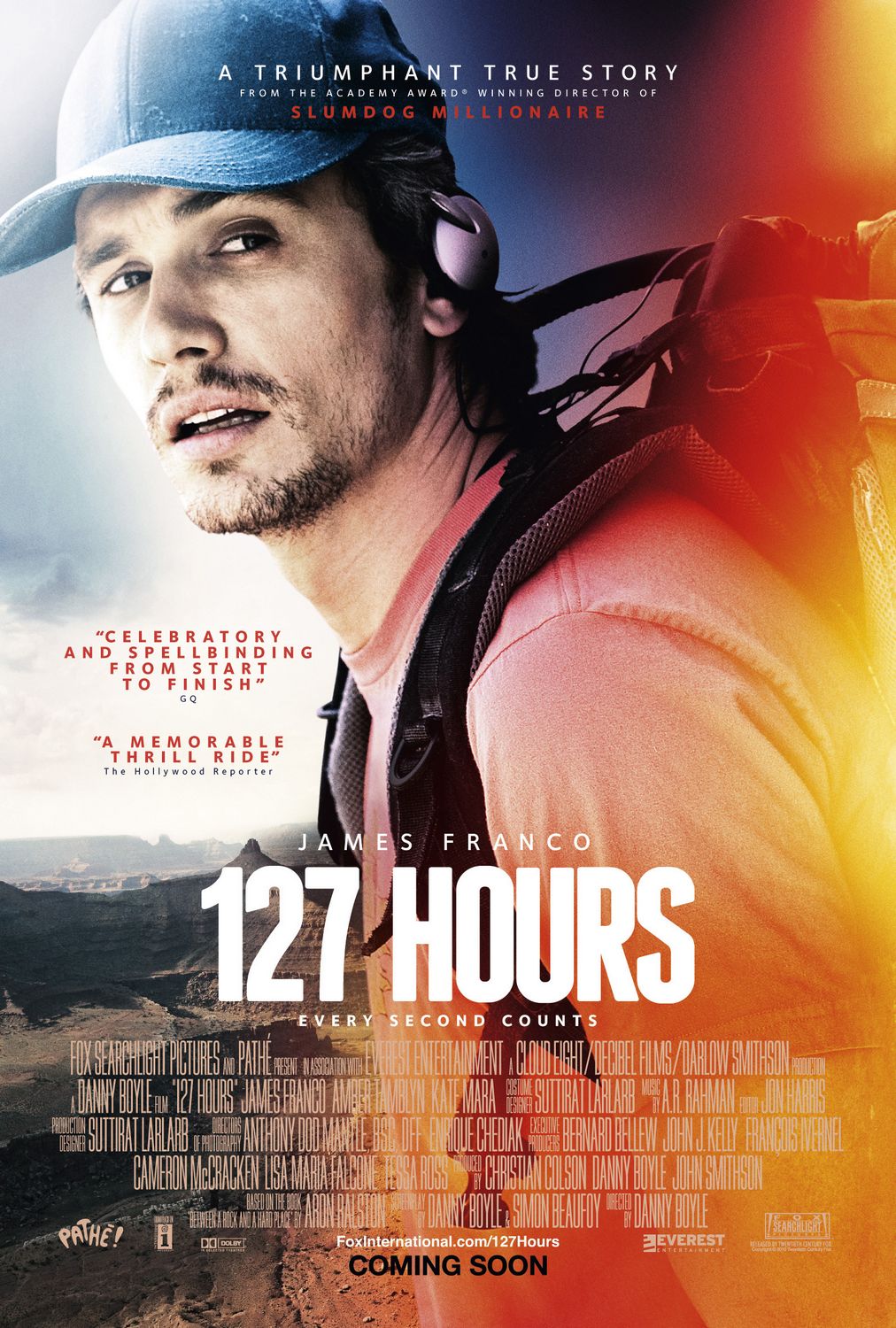
What most impresses me about 127 Hours is, although it’s an intensely visual film, the dialogue is deep with subtext. Take the Friday 13th joke in the opening sequence. Aron is out exploring on the Grand Canyon, and sees two girls, obviously lost. He bounds down the canyon and offers his assistance. We know he’s charming and likeable, but his face is covered by a dust mask, and he’s wearing a cap and shades. He looks scary – like Jason.
“Sorry about the Friday 13th thing,” he wisecracks.
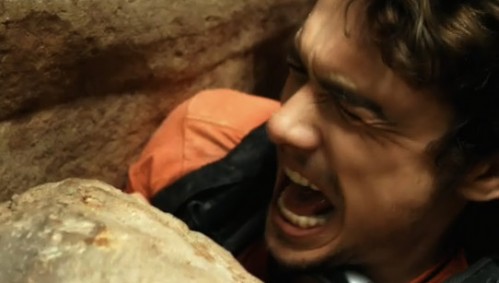
Joke, right? Throw-away line, simple. Actually it’s very cleverly foreshadowing the fact that this family wilderness drama is going to suddenly twist genre in the final act to a gruesome slasher movie as Aron slashes off his own arm to free himself from the rock. It’s horrific to watch, terrifying and extremely bloody. The pain is excruciating. In this throw-away ‘joke’ the film makers are actually apologizing to us, the viewer, for the excruciating horror they’re about to endure.
Genius!
Also, look at the line when Aron makes a joke about the insects crawling beneath him waiting for him to defecate. Although a simple joke, coupled together with the bird circling above, which feeds on insects, this seemingly irrelevant line is pointing to the film’s theme – that all living creatures are interdependent, that our world is interdependent, that no man is an island – that we, as people, as human beings, depend on each other.
This is the lesson Aron must learn, in Truby terms the ‘moral and psychological revelation’ he must have in order to change and become a better human being. This is his character arc: if Aron hadn’t been so selfish, if he’d have answered his mom’s calls, and told her where he was going, he wouldn’t be in this nightmare. He wouldn’t be suffering alone between a rock and a hard place.
Aron goes through an intense furnace of change – a terrifying, horrific experience.
It’s his – and therefore our – Friday the 13th.
How about your script? Have you foreshadowed the climax with a seemingly throw-away line?
In 127 Hours, immediately after the midpoint, we’re treated to Aron’s video camera antics and the hilarious spoof radio show self-examination. This is a superb blend of comedy and tragedy. Aron reveals the fact he’s always seen himself as a ‘big fucking hard American superhero’ who can do everything ‘on his own’.
This segment is writing of the highest quality. The hero has a moral and a psychological revelation. John Truby describes a psychological revelation as being a self-realization that affects the hero directly, that is, causes him to see how he is destroying himself.
A moral revelation in Truby terms is our hero’s realization that his actions are hurting the world around him: loved ones, friends, society.
Most heroes will have one revelation but in great movies like 127 Hours the hero will have both. Not only does Aron stop blaming his mother and take responsibility for his own actions, admitting he has been living his life with ‘supreme selfishness’ but he tells his parents directly into the camera how he wishes he’d told them how much he appreciates them.
Not only do we see Aron scream for help from strangers in the resolution of the movie illustrating Aron’s character arc, but Danny Boyle points us back to this theme of family love and connectedness with a little insert during the closing credits:
“Now Aron always leaves a note to say where he’s going.”
This pays off the opening dialogue where his sister leaves a message on the answerphone asking him to call his mom back as ‘she worries’.
So Aron’s moral revelation is realized: he has changed the world around him, outside of himself. Due to his harrowing ordeal he has lost his selfishness and now thinks of others ahead of himself.
But the genius of Danny Boyle’s and Simon Beaufoy’s script here is how Aron’s revelation – that his ‘supreme selfishness’ led him to this place of extreme suffering – is delivered with a ‘spoon full of sugar’ gift-wrapped in scathingly funny self-deprecating dialogue.
So what actually should be a tragic moment has us weeping with laughter. But then, as we’re pulled back to the seriousness of the situation, we’re crying again, our tears of laughter mingling nervously with tears of pain.
Perfect writing.
Recommended reading: Anatomy of Story by John Truby
Reading the Industrial Scripts newsletter this week (which is brilliant – you should definitely sign up) there was a link to an article by Lyndsay Doran in the New York Times (read it here) where she had researched the emotional components of successful movies and the qualities audiences most value in a character. One such quality was ‘accomplishment’, but not how we might think:
“The accomplishment the audience values most is not when the heroine saves the day or the hero defeats his opponent. Instead the accomplishment the audience values most is resilience.”
This set me thinking about the hero I’m working with in my feature script. I realized that his problem is he doesn’t know who his enemy is until the end of Act 2.
However, in Training Day and The Recruit the enemy is also revealed late in the story, although having been there all along. This is what John Truby in his Anatomy of Story calls the fake-ally opponent –
‘…the fake-ally opponent is one of the most complex and fascinating characters in a story because he is usually torn by a dilemma.’
But the problem still remains: if our heroes don’t know who their enemies are how do they fight against them and show that all important empathy-inducing resilience?
Take 127 Hours (screenplay by Danny Boyle and Simon Beaufoy). Here is a hero who shows incredible resilience in the harrowing few minutes of the Climax. The story up to this point is the character figuring out how to battle and overcome his enemy whilst analyzing how he managed to get in such a terrible predicament. Gradually, after attempting to blame his mother, his moral revelation comes and he blames himself (character arc). But all the way from the Act 1 Turning Point until the Climax this hero knows his enemy – the rock.
So, back to my story, how does my character show resilience throughout if he doesn’t know who his enemy is until the end of Act 2 ? For this we have to come back to Truby and his theories on threefold opposition. Truby teaches our heroes should be facing opposition from all three corners of the ring (with our hero in the other corner). So, even if the main antagonist is hidden there are two more antagonistic forces in play.
Take the 2005 movie North Country (screenplay by Michael Seitzman) where the female protagonist is fighting against sexual harassment in the work place. Opposition is flying at her from all angles. First and foremost from her male co-workers; secondly from the patriarchal management system; then from her Father (also one of her co-workers) and lastly (perhaps most surprisingly) from her female workmates. The resilience she shows is immense.
The opening lines in 127 Hours (screenplay by Danny Boyle and Simon Beaufoy) are an answerphone message from Aron’s sister:
“Hey, Sonia here…again… I know you’re probably gonna be away this weekend, but listen… just think about what we’re gonna play, ‘cause we have to decide if we need to practice, it will be fun, anyway…oh…and, please call Mom, ‘cause, you know, she worries…”
These lines refer to 5 things:
1. Character Arc.
Why doesn’t Aron answer the phone? We see he’s super-busy preparing his trip, grabbing the bits and pieces he needs. And we all know how annoying phone calls are when we’re trying to get stuff done. But this preoccupation with himself shows us he is more focused on his own needs than his sister’s. The fact that Sonia emphasizes again tells us this isn’t the first time she’s called. And so Aron’s character flaw is illuminated – the flaw that will not only cause his extreme suffering but will also cause him to grow and change.
2. Foreshadowing.
‘Think about what we’re gonna play’ foreshadows a line of dialogue at the Act 2 Turning Point paid off when Aron apologizes to his sister for not being able to play the piano at her wedding. This apology tells us something way deeper and more important: that he has lost the battle. He is defeated. Michael Hague calls this the All is Lost moment. Blake Synder the Visit to Death.
3. Theme.
Sonia reminds Aron to call Mom as ‘she worries’. Later Aron realizes that if he hadn’t have been so selfish, if he had returned his mom’s calls, he would’ve told her where he was going and he would’ve been rescued. Major theme: interconnectedness + familial love.
So these opening lines not only foreshadow the Act 2 Turning Point before Aron’s do or die drive to survive, but they immediately point us to both theme and character arc.
SPOILER alert – please watch the movie before reading the rest of this post.
4. Endearing us to the Hero.
One of my favorite lines of dialogue comes where Aron meets the two lost female hikers. Aron rocks down the hill, superhero to the rescue, to help them with their map-reading. Realizing his mask is high on his face and he must look pretty scary, Aron jokes something about looking like Jason from Friday the 13th. Not only is this funny, and, as Michael Hague tells us in Screenwriting for Hollywood, funny alwaysendears us to a hero, but it’s oozing subtext. Which brings us to –
5. Subtext.
Aron’s lines hiding a much deeper and far more sinister meaning. Check out his line:
Sorry about the Friday 13th thing. I’m only a psychopath on weekdays.
We don’t read much into it on first viewing. But actually it’s preparing us for – or foreshadows – the sudden Act 3 genre twist from family adventure drama to slasher/horror.
‘I’m not usually a psychopath,’ he’s saying (my paraphrase) ‘but stick around and later you can watch me hack my own arm off, Saw style.’