Here is a scene length breakdown of the first episode of The Capture (screenwriter Ben Chanan).
NB – the on screen version differs slightly from the shooting script.


Analysis to follow…
Here is a scene length breakdown of the first episode of The Capture (screenwriter Ben Chanan).
NB – the on screen version differs slightly from the shooting script.
Analysis to follow…
In this post we looked at Acts 2 + 3
Now let’s check Act 4.

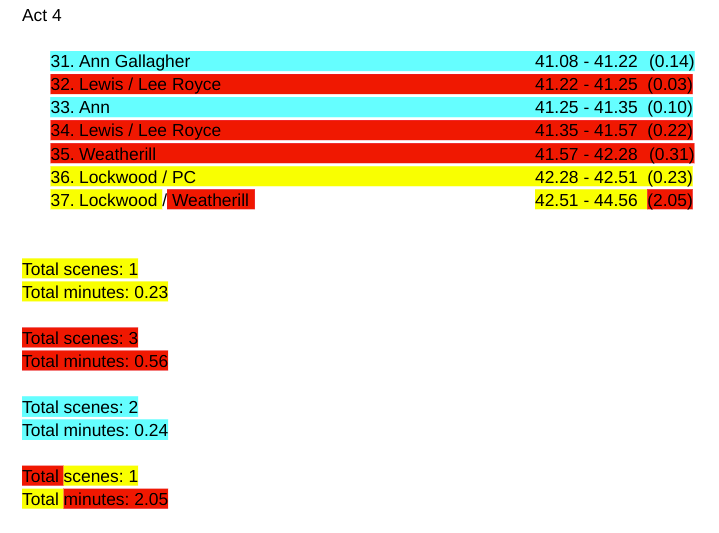
This act takes a different shape to the previous act as we build towards the climax of the episode.
First of all, we meet Ann, the main victim, for the first time since mid way through act 1 (scene 8). And it is the first time we spend time with her alone.
The next 3 scenes cut between the antagonists and the victim in short bursts, as we lead up to their showdown in Act 5.
Finally, before we propel into Act 5, we have by far the longest scene of the act (2.05) between the protagonist and the episode’s main antagonist – Lockwood and Weatherill.
Finally, Act 5.

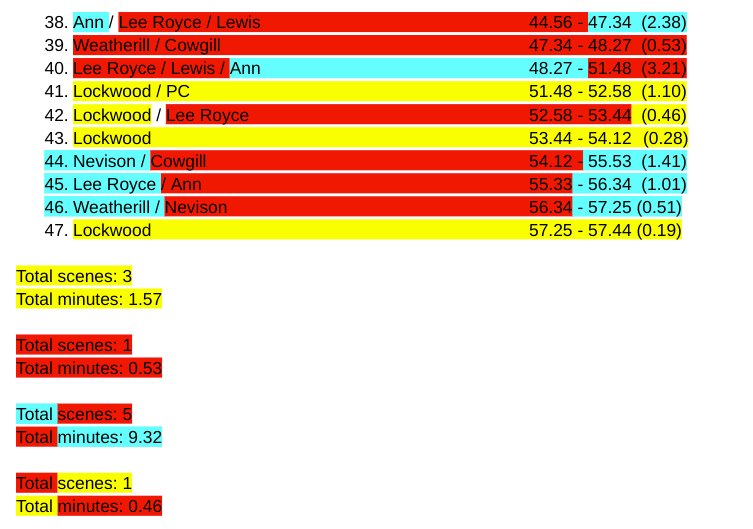
What can we notice?
Follow this blog for more analysis.
In the previous post we looked at Act 1.
In this post we look at Acts 2 + 3.

As we can see in Act 2, the balance of scenes are fairly equal between protag and antags.
The victim only appears in the final scene, together with the main episode’s antag.
The balance of time between protag / antag / victim is very well balanced: 2.21 / 2.20 / 2.58.
Now let’s look at Act 3.

What do we notice here?
The balance is heavily weighted in favour of the protagonist and dedicated to the episode’s B story – which in fact is the A story of the season – the son of the main antagonist being the grandson of the protagonist (extremely complicated and intricate story telling).
We can also notice that none of the victims appear in Act 3. The entire act is dedicated to protag and antags.
Acts 4 + 5 to follow.
SPOILER ALERT.
If I had to break this episode down into act breaks, I think I would break it into 5.
Act 1: scenes 1 – 17 (0.00 – 24.32) Act Length: 24.32
End of act: Weatherill proposes Cowgill kidnap Ann Gallagher.
Act 2: scenes 18 – 23 (24.32 – 32.02) Act Length: 5.30
End of Act: Weatherill realises he has made a mistake.
Act 3: scenes 23 – 30 (32.02 – 41.08) Act Length 9.06
End of act: Weatherill tells Cowgill he has made a mistake.
Act 4: scenes 31 – 37 (41.08 – 44.56) Act length 3.48
End of Act: Weatherill attempts to tell Cawood about the plan. (Antag and Protag 1st meet).
Act 5: scenes 38 – 47 (44.56 – 57.44) Act Length 12.48
End of Act: Weatherill learns from Nevison that the plan has been activated and Ann has been kidnapped
The final scene, (47) Catherine alone, is a hook to intrigue the audience to return.
Lockwood runs Weatherill’s number plate and gets his name and address. The protagonist is on to the antagonist.
Below is a breakdown:
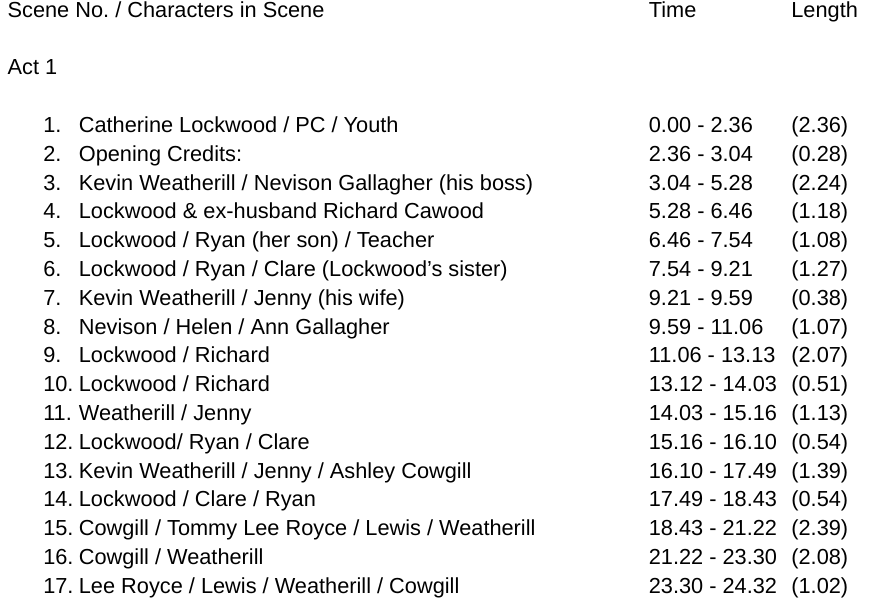
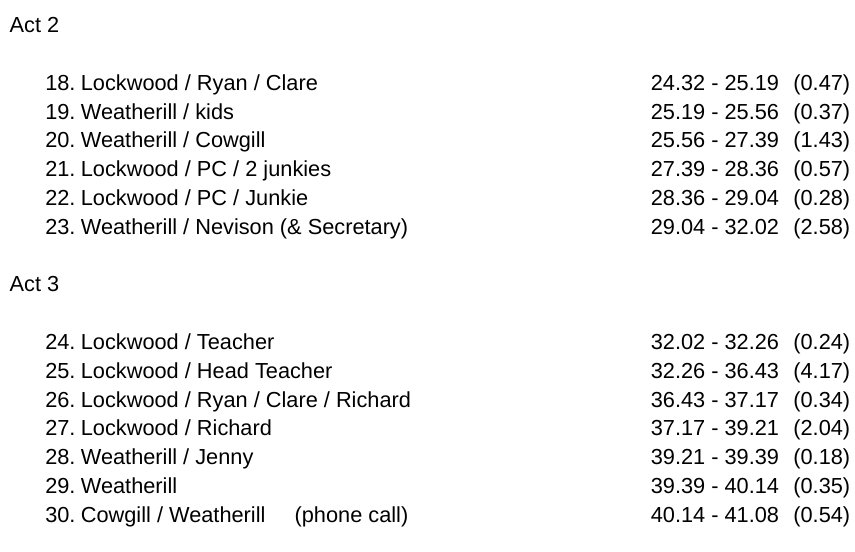
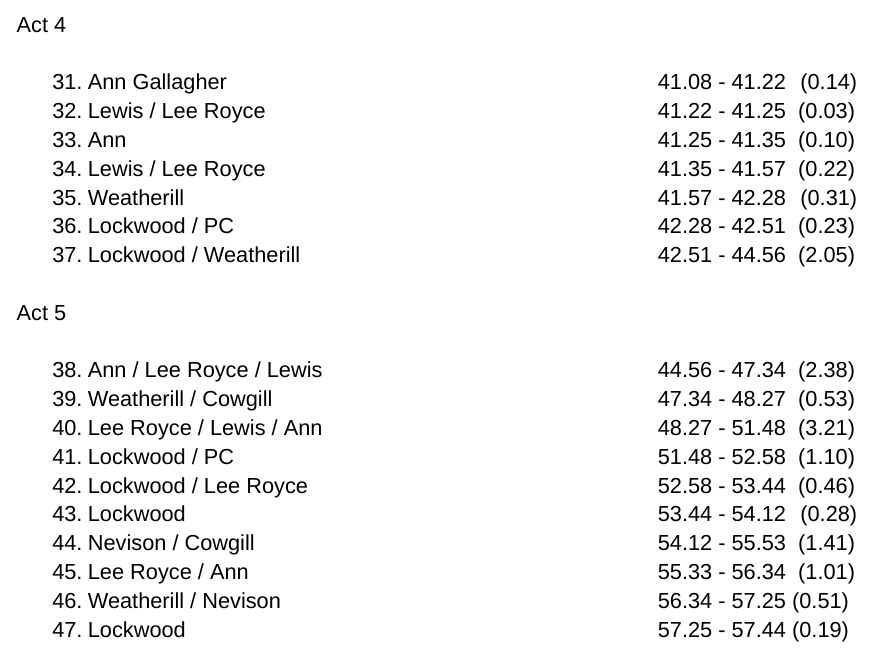
What else can we notice?
We can notice that the set up (Act 1) is much longer than any of the other 4 acts. However, since this is the opening episode of a six part series this is understandable. The 24 minute set up is setting up a 6 hour story.
Interestingly, protagonist LOCKWOOD does not meet any of the 4 male antagonists face to face until she meets WEATHERILL in Act 4, scene 37, almost 10 minutes before the end.
Lockwood’s next close shave with her main antagonist Tommy LEE ROYCE happens in Act 5, scene 42. She doesn’t meet him but almost meets him.
So, at the end of episode 1, Lockwood, the protagonist, has so far met Weatherill, without realising he is an antagonist, and has seen – but not yet met – Tommy Lee Royce, her main antagonist.
What else can you notice about the structure of this episode?

As discussed in the last post, I suggest the shortest scene (19) 0.02 secs is The Midpoint.
This scene is a series of flashing stills as apparently time stands still – a phenomenon thought to represent alien abduction.
In this scene Scully and Mulder are caught in the same brilliant, flashing, bright light we see in scene 1 in the forest and see again in the climax.
So, perhaps this is further evidence that the light punctuates the structure. We see the bright light in Act 1 at The Midpoint and in The Climax.

So week 4 was 1:1 tutorials. I was privileged to pitch my 15 minute short film Piano to the course leader.
I had already decided to rewrite my female character as a law student without being an escort. The story itself is already a metaphor for consent. Nuff said.
I pitched it as a romantic comedy, even though in my short, as in Notting Hill, rather than the two central characters sharing equal screen, time narrative weight seemed to favor the boy.
So it was suggested to perhaps pitch it as a personal drama with a comedic tone. That way I won’t have to worry about giving the two central characters equal screen time, but can focus on the learning curve of the male character – learning his lesson at the feet of the woman he loves – following his journey.
I checked the defining qualities of the personal inner drama genre as per Philip Parker‘s breakdown and decided that my story fits.
John Truby (22 Steps of a Master Storyteller) teaches about transcending the genre.
The reading this week was Alternative Screenwriting, one of the chapters is called ‘Working against Genre.’
So, my task this week is to pitch this story as a personal inner drama with elements of the rom com, and, importantly, to be specific about which elements of each genre.
And then, record and upload it for grading.
After that, my task will be to ensure the want and need of my hero is in place. Not only that, but to ensure that the climax happens like this:
The Hero has a moral revelation of his ‘need’. The revelation causes him to take new moral action. As a result of this change my hero is able to achieve his goal.
So, my second task this week is to ensure my hero’s outward physical goal and inner need is set in stone in my mind.
What are your tasks this week?

I asked multi-produced screenwriter Mark Sanderson aka @scriptcat this question:
What’s the most important thing you show in the opening ten pages?
This was his reply:
First ten eh? Get right into the action! Definitely something with the character, who he or she is just from one thing they do or how they act — we know instantly… and their dilemma — and the important characters on the journey. Maybe open with a memorable image – definitely all set up stuff — fewer words the better and more images. Cut into the story in progress – definitely.
I always remember the opening scenes (first minute & a half) of COOL HAND LUKE – says it all about his character for sure.
Hell, I’m just trying to please my producer! But he loved my opening scene in my first draft. The location, atmosphere, character in action doing something specific and “in character” that tells us some of her back story, the antagonist comes into scene and stops her, and we’re off to the races!
“What comes from the Heart, goes to the Heart.”
– True and False

Welcome to my series of posts on DEXTER – The Crafting of an Episode – where we’ll be analyzing one episode in detail over the coming weeks.
The objective? To arm ourselves to write awesome television!
The episode we’re looking at is Season 7 Episode 7.
Please watch first as this analysis will contain SPOILERS!
I’ve begun by listing the scenes in numerical order including scene length,a short description of what happens and the number of characters.
What’s surprised me the most so far is how many scenes have 2 characters. Most scenes.
Feel free to take a quick look at the breakdown and comment.
In future weeks we’ll analyze in much more detail, scene by scene. We’ll look at characters, plots and subplots, action and dialogue, use of subtext, story world, motifs, goals, needs, morals and theme.
Here’s the scene by scene breakdown: DEXTER – Season 7 Episode 7
Hold tight – it’s gonna be a breathtaking ride!
The most important thing an actor learns is to listen. This is the key to great acting. This is the art of acting.
Why?
Because to listen is to be in ‘the moment’ – to be spontaneous. To react as it’s happening. No two takes by any actor worth her salt will be the same. If it is it won’t be in the moment. Which is to say… it won’t be organic.
Organic.
Key word.
So, because actors listen, does that mean characters should?
Well, do you always listen? And I’m not just talking about to the words being said to you, but do you listen between the lines? As @scriptcat says: sometimes we say more by not speaking.
So, are you listening to what’s not being said?
And characters may listen but it doesn’t mean that they always answer. Sometimes characters are so focused on their own goals that they fail to listen to what anyone else wants or needs.
Look at Aron in 127 Hours. If he’d have listened he’d have returned his mum’s calls, told her where he was going and would have escaped his suffering.
Writers – are you listening?
Are your characters?