Tag Archives: #writers #scriptchat #amwriting #screenwriting

Writing Resilient Characters

Reading the Industrial Scripts newsletter this week (which is brilliant – you should definitely sign up) there was a link to an article by Lyndsay Doran in the New York Times (read it here) where she had researched the emotional components of successful movies and the qualities audiences most value in a character. One such quality was ‘accomplishment’, but not how we might think:

“The accomplishment the audience values most is not when the heroine saves the day or the hero defeats his opponent. Instead the accomplishment the audience values most is resilience.”

This set me thinking about the hero I’m working with in my feature script. I realized that his problem is he doesn’t know who his enemy is until the end of Act 2.

However, in Training Day and The Recruit the enemy is also revealed late in the story, although having been there all along. This is what John Truby in his Anatomy of Story calls the fake-ally opponent

‘…the fake-ally opponent is one of the most complex and fascinating characters in a story because he is usually torn by a dilemma.’

But the problem still remains: if our heroes don’t know who their enemies are how do they fight against them and show that all important empathy-inducing resilience?

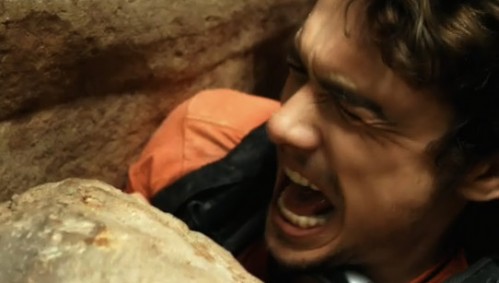
Take 127 Hours (screenplay by Danny Boyle and Simon Beaufoy). Here is a hero who shows incredible resilience in the harrowing few minutes of the Climax. The story up to this point is the character figuring out how to battle and overcome his enemy whilst analyzing how he managed to get in such a terrible predicament. Gradually, after attempting to blame his mother, his moral revelation comes and he blames himself (character arc). But all the way from the Act 1 Turning Point until the Climax this hero knows his enemy – the rock.

So, back to my story, how does my character show resilience throughout if he doesn’t know who his enemy is until the end of Act 2 ? For this we have to come back to Truby and his theories on threefold opposition. Truby teaches our heroes should be facing opposition from all three corners of the ring (with our hero in the other corner). So, even if the main antagonist is hidden there are two more antagonistic forces in play.

Take the 2005 movie North Country (screenplay by Michael Seitzman) where the female protagonist is fighting against sexual harassment in the work place. Opposition is flying at her from all angles. First and foremost from her male co-workers; secondly from the patriarchal management system; then from her Father (also one of her co-workers) and lastly (perhaps most surprisingly) from her female workmates. The resilience she shows is immense.

How resilient is your hero?
5 things to include in your opening dialogue.

The opening lines in 127 Hours (screenplay by Danny Boyle and Simon Beaufoy) are an answerphone message from Aron’s sister:

“Hey, Sonia here…again… I know you’re probably gonna be away this weekend, but listen… just think about what we’re gonna play, ‘cause we have to decide if we need to practice, it will be fun, anyway…oh…and, please call Mom, ‘cause, you know, she worries…”

These lines refer to 5 things:

1. Character Arc.

Why doesn’t Aron answer the phone? We see he’s super-busy preparing his trip, grabbing the bits and pieces he needs. And we all know how annoying phone calls are when we’re trying to get stuff done. But this preoccupation with himself shows us he is more focused on his own needs than his sister’s. The fact that Sonia emphasizes again tells us this isn’t the first time she’s called. And so Aron’s character flaw is illuminated – the flaw that will not only cause his extreme suffering but will also cause him to grow and change.

2. Foreshadowing.

‘Think about what we’re gonna play’ foreshadows a line of dialogue at the Act 2 Turning Point paid off when Aron apologizes to his sister for not being able to play the piano at her wedding. This apology tells us something way deeper and more important: that he has lost the battle. He is defeated. Michael Hague calls this the All is Lost moment. Blake Synder the Visit to Death.

3. Theme.

Sonia reminds Aron to call Mom as ‘she worries’. Later Aron realizes that if he hadn’t have been so selfish, if he had returned his mom’s calls, he would’ve told her where he was going and he would’ve been rescued. Major theme: interconnectedness + familial love.

So these opening lines not only foreshadow the Act 2 Turning Point before Aron’s do or die drive to survive, but they immediately point us to both theme and character arc.

SPOILER alert – please watch the movie before reading the rest of this post.

4. Endearing us to the Hero.

One of my favorite lines of dialogue comes where Aron meets the two lost female hikers. Aron rocks down the hill, superhero to the rescue, to help them with their map-reading. Realizing his mask is high on his face and he must look pretty scary, Aron jokes something about looking like Jason from Friday the 13th. Not only is this funny, and, as Michael Hague tells us in Screenwriting for Hollywood, funny always endears us to a hero, but it’s oozing subtext. Which brings us to –

5. Subtext.

Aron’s lines hiding a much deeper and far more sinister meaning. Check out his line:

Sorry about the Friday 13th thing. I’m only a psychopath on weekdays.

We don’t read much into it on first viewing. But actually it’s preparing us for – or foreshadows – the sudden Act 3 genre twist from family adventure drama to slasher/horror.

‘I’m not usually a psychopath,’ he’s saying (my paraphrase) ‘but stick around and later you can watch me hack my own arm off, Saw style.’

Are your opening lines of dialogue:

1. Pointing us to character arc?

2. Foreshadowing the climax?

3. Reflecting the theme?

4. Endearing us to your hero?

5. Harboring hidden meaning?

How deep is your dialogue?

127 Hours – motifs

Part of the genius of 127 Hours (screenplay by Danny Boyle + Simon Beaufoy) are the recurring motifs which illuminate the major theme – that every living thing on earth is dependent on each other. We cannot survive without each other. But how do the writers portray this theme visually?

Two major motifs are Light and Water. Watch the movie again and see how prominent these are and how the writers and director uses them. And what are Light and Water ? Sources of Life itself. We can’t survive without either. Our very planet would die and so would we.

Another motif the writers use with subtle but powerful effect are how other creatures we share the earth with (symbolized by birds and insects) are also interdependent: the raven which flies overhead each day; the ants crawling on Aron’s skin. Birds feed on insects. Aron jokes in a seemingly irrelevant line of dialogue that almost escapes us:

‘I’ve peed twice but no number 2’s – which must disappoint my insect friends.’

But far from a throw-away line this is actually a profound statement about how we living creatures depend on each other – feed on each other. Literally.

A third motif used in this multi-layered movie is familial love, especially between child + parent. The memory of his father’s hug juxtaposed with the repeated use of his mother’s voice on the answer phone asking him to call her back, to connect.

We are all connected. We cannot survive alone. The laws of nature confirm this. No living thing can survive without  another. We all need Light + Water. Without them we could not survive.

What are your themes, and how are you expressing them visually and through dialogue?