Category Archives: TV

Writing Television

Peaky Blinders Opening 10: Scene 4

We’re analyzing the opening 10 minutes of Peaky Blinders.

We’re up to Scene 4 (which is also the Opening Credits scene.)

Let’s get stuck in.

What are we going to discover?

Firstly, that this scene is a brilliant example of showing character through action as we learn 3 characteristics of series protagonist Thomas Shelby.

(You can read the scene in the actual script here.)

There are 4 major actions. I’ve taken the action directly from Steven Knight’s script.

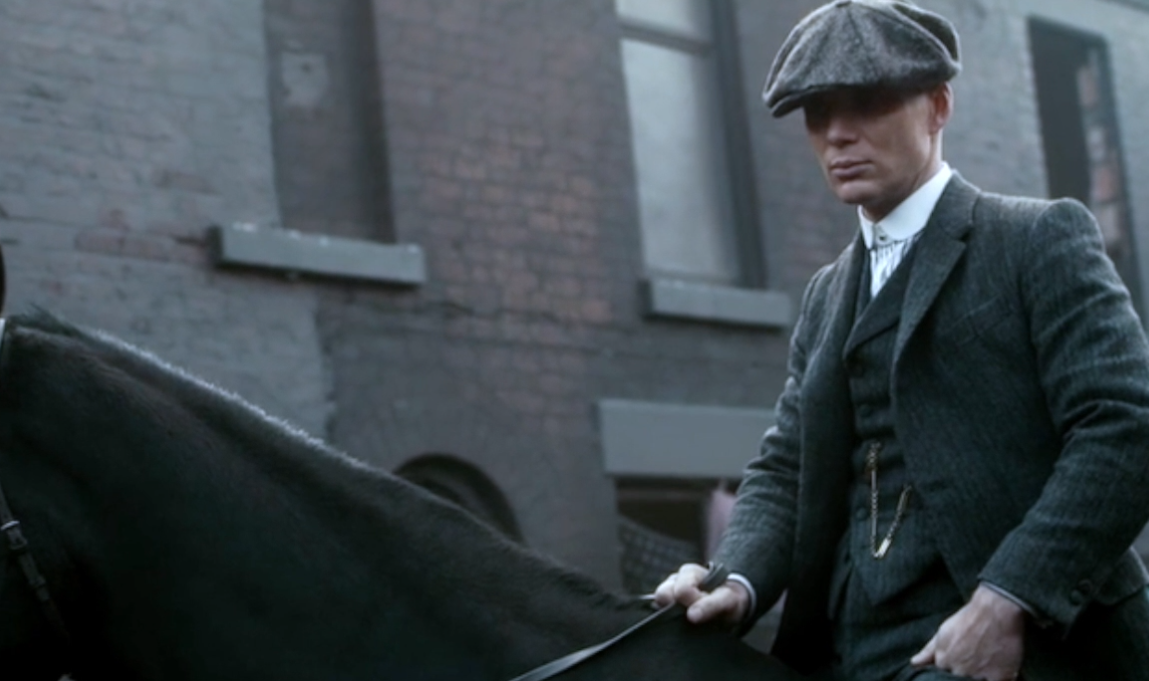
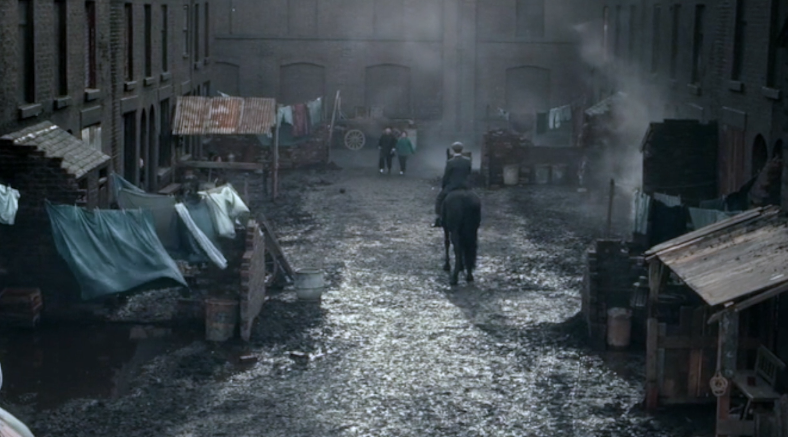
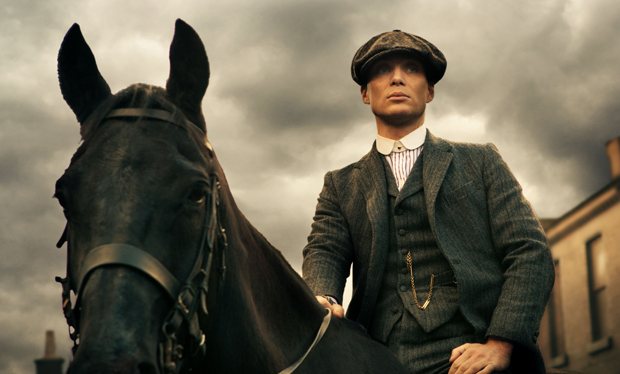
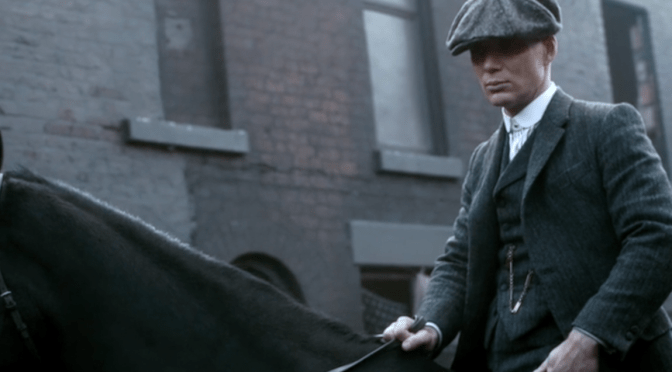
1. Thomas rides through a dark, grimy, industrial street on a beautiful black horse.

Why a black horse rather than a white one?

The website Universe of Symbolism  says a black horse is:

A symbol of mystery and intrigue, power, independence, sexual allure and a strong sense of self.

2. Jimmy Jesus – an Afro-Caribbean street preacher – glances up and nods a greeting.

This is from the script. However, on screen he doesn’t nod a greeting, he fully removeshis hat from his head – showing both social distance and reverence (more on this later).

3. Thomas slows to allow a line of men to cross the road. (These are men blinded in the war, now begging for pennies.) Thomas leans down in the saddle to drop a coin into their bowl.
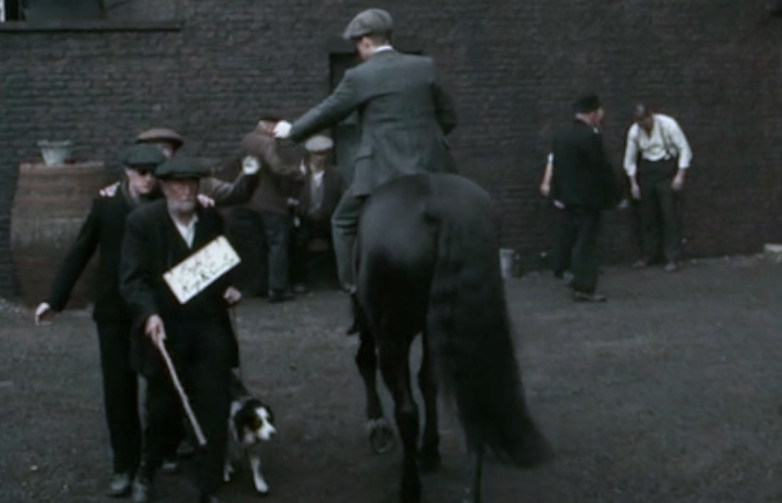
Interesting phrase Steven Knight uses here – leans down. He could have just written ‘he drops a coin in their bowl.’ But he doesn’t. He says he leans down. When Thomas leans down he is equating himself with these beggars, showing humility.

So why show humility to a group of men who were blinded in the war and now begging ‘for pennies’? Does Thomas share an affinity with the beggars?

4. Two policemen see Thomas. They both look nervous and touch their caps. Thomas ignores them and urges his horse on.
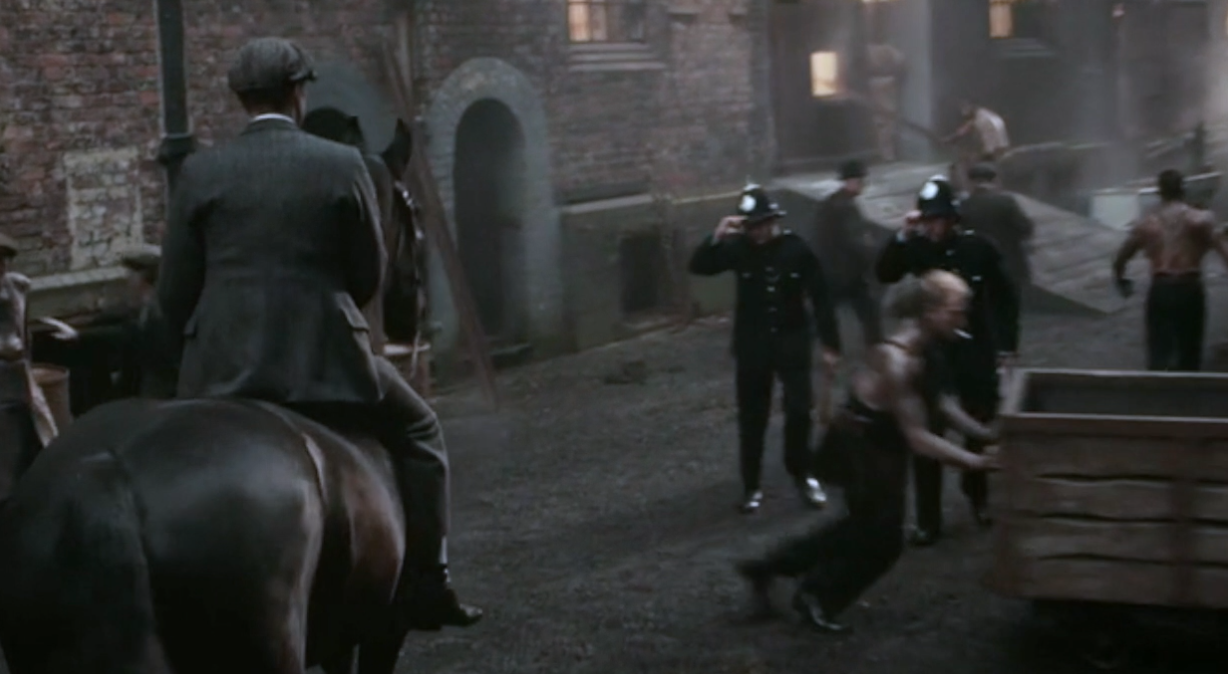
This action of touching your hat is called a hat tip.

Check out what Wikipedia has to say about it:

In Western societies of the 19th and early 20th centuries, a hat tip was a common non-verbal greeting between friends or acquaintances. Typically, two men would lift or tip their hats to each other.

But Thomas doesn’t lift or tip his hat. This is not to each other.

Wiki continues:

Where the ritual was used to emphasize social distance the subordinate was obliged to make the more elaborate gesture, for example fully removing his hat while the superior merely touched his.

Who fully removes his hat? Jimmy Jesus – the  street preacher. Jimmy’s full removal of his hat shows social distance. As well as showing reverence he is admitting to Thomas that he is his subordinate. Jimmy’s preaching echoes this social distance:

God does not care if you live in a slum or in a mansion.

Back to the policemen then. Not only does Thomas not tip his hat to them, he doesn’t even respond. Steven Knight makes a point of this:

Thomas ignores them.

So why do the police look nervous? And why do they tip their hats? Isn’t Thomas Shelby a criminal? Why are the police tipping their hats to him? The fact that Thomas doesn’t tip his hat reveals a lot. Wikipedia says:

The subordinate was obliged to make the more elaborate gesture…

But Thomas doesn’t even touch his hat, let alone make a more ‘elaborate gesture.’ He doesn’t make any gesture. As Steven Knight states:

He ignores them.

So Thomas doesn’t see himself as subordinate to the police. And if he’s not subordinate, he must consider himself as above them. Does Thomas consider himself above the police? Above the law?

But isn’t this pride?

Summing up then, in addition to the power, independence and sexual allure symbolized by the black horse, which 3 characteristics of Thomas Shelby are we shown through action?

I suggest respect, humility and pride.

Will his pride be his downfall?

This visual, opening credits scene ends around 3.57 and we get the title credit:
Screen Shot 2015-11-29 at 1.36.23 PM.png
We linger in this for 3 seconds then, at exactly 4 minutes, we cut to:
Scene 5.

A Sneaky Peak at Peaky Blinders: Scene 3.

So, we’re exploring the opening ten minutes of Peaky Blinders.

We’re onto Scene 3.

(Catch up here with Scene 1 and Scene 2).

So, what happens?

Thomas Shelby rides through the street and comes to a standstill.

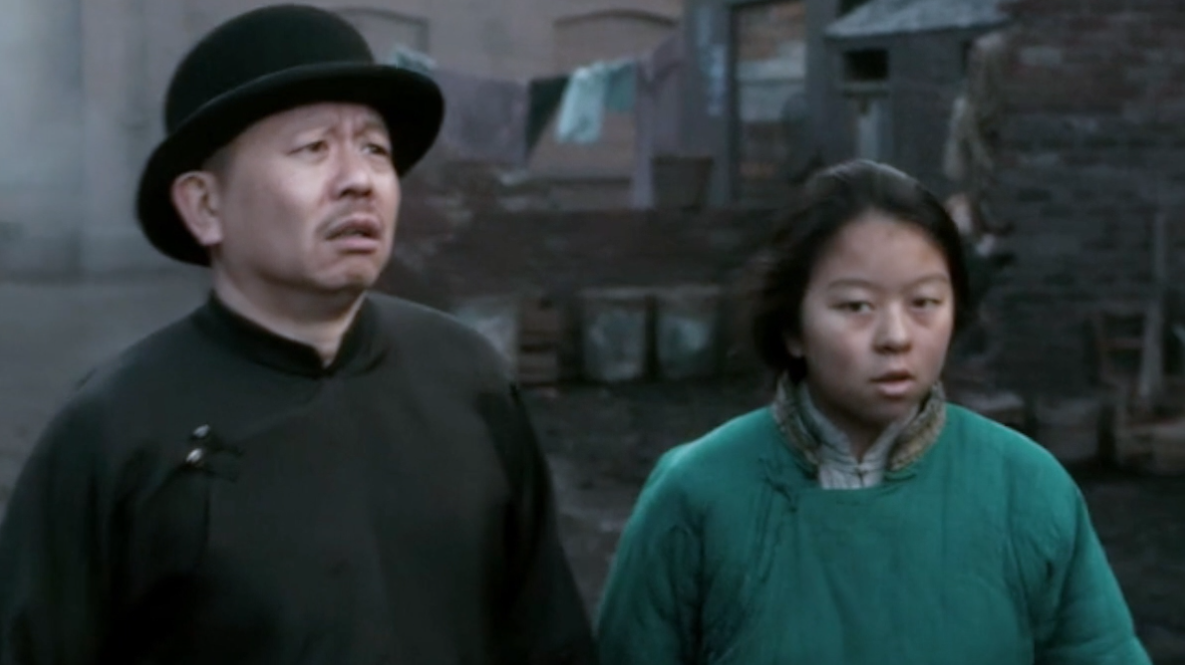
The Chinese Man and Girl from scene 1 come running and stop in front of him.

CHINESE MAN

Sir, this is her.

This is the first time we hear Thomas speak.

A shadow  blinds us to his eyes by the peak of his cap.

But we hear his deep, warm voice.

THOMAS

The girl who tells fortunes?

He takes money from his pocket and gives it to the Man.

He accepts it.

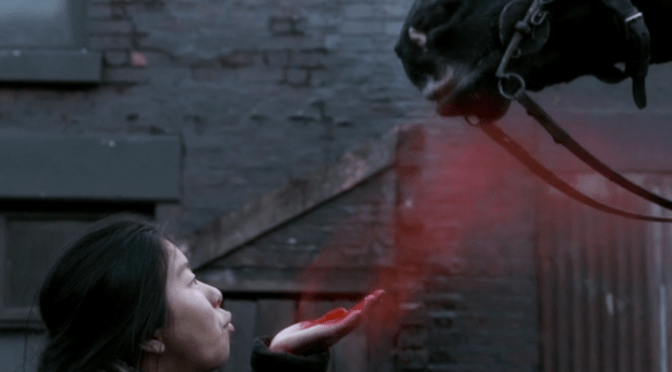
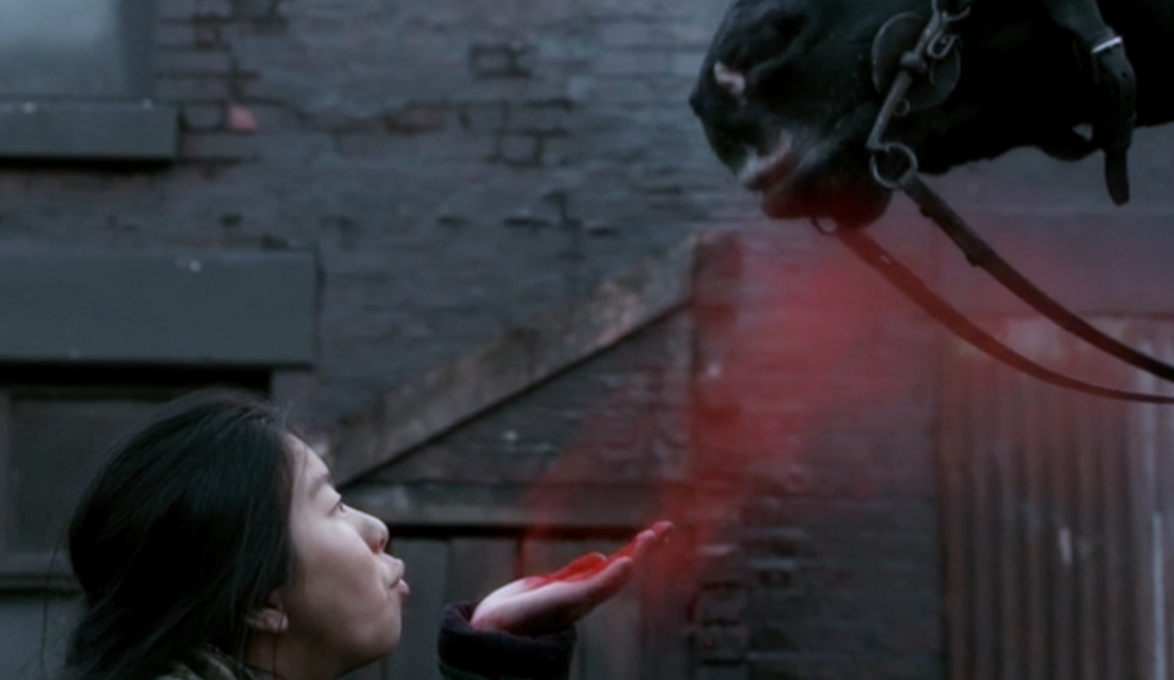
Then, the Girl takes out a small, red, Chinese purse and tips out a handful of red dust.

The director cuts to different villagers watching from their hiding places: grown women, young boys.

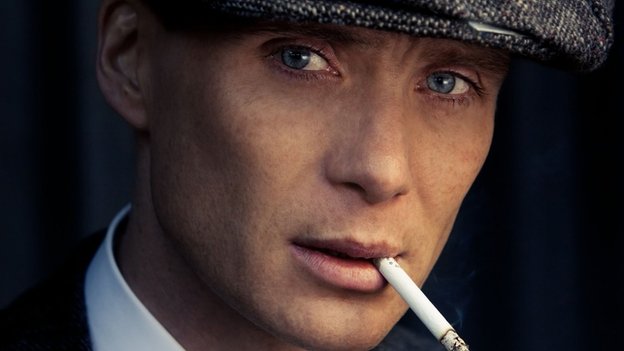
We also get our first CLOSE UP of Thomas, almost revealing his eyes, but not quite.

Then, the Chinese Girl blows the red dust into the horse’s nostrils.

Cut to three young boys peeking out from their hiding place. One Boy speaks.

BOY

They’re doing a magic spell to make him win a race.

Then, the Chinese Man and Girl both bow, and, holding hands, turn and run away.

Thomas speaks, loudly, to all of the hiding villagers.

THOMAS

The horse’s name is Monahon Boy. Kempton, 3 o’clock, Monday. You ladies have a bet yourself but don’t tell anyone else.

Thomas rides off.

The women and children come back out to the streets.

Theme music kicks in. And we get a title insert:

End of scene.

So, how is Thomas Shelby’s character revealed in this scene through action?

1. When the women and children run to hide we see that Thomas is feared.

2. When the Chinese Man calls him ‘Sir’ he seems to be revered. When the Man and Girl bow as they leave we could also say that Thomas is revered (but this of course could also be fear.)

3. We see that Thomas is well dressed: a three piece suit, a waist coat and a gold watch chain. Wealth, or at least the appearance of wealth.

4. When he pays the Chinese Girl we learn that Thomas is not a tyrant, but generous, paying for her service rather than forcing it for free.

5. Thomas gives the locals a racing ‘tip’ – telling them that the horse will win.

But is this generosity or a scam and therefore revealing an unscrupulous man?

We’re not yet sure.

To sum up then, this scene reveals 5 characteristics of Thomas Shelby:

1. He appears wealthy.

2. He sounds warm and friendly.

3. He seems generous.

4. He seems to be revered.

5. He seems to be feared.

Click here for Scene 5.

Peaky Blinders Opening 10: Scene 2.

Peaky Blinders Scene 2.

From a blacked out screen we hear the quick clip clop of a horse’s hooves.

Fade in to reveal –

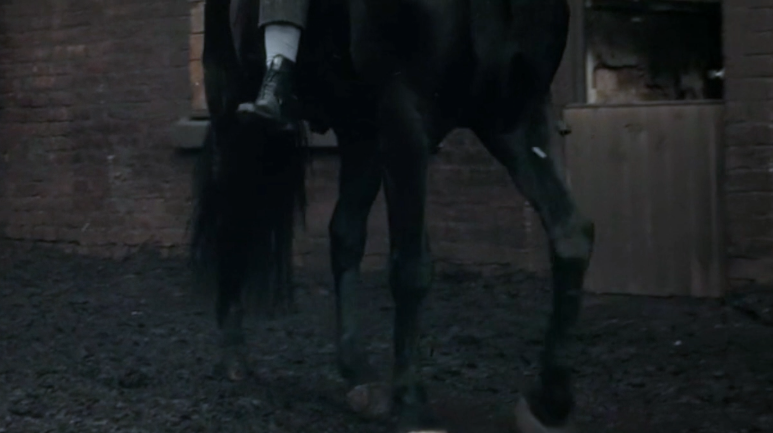
The legs of a shiny black horse, trotting through a grimy inner city backstreet on a gritty, uneven road.

The rider on the horse is revealed only by one shiny black shoe, sock and grey suit trouser leg – the attire a glimpse of an important person?

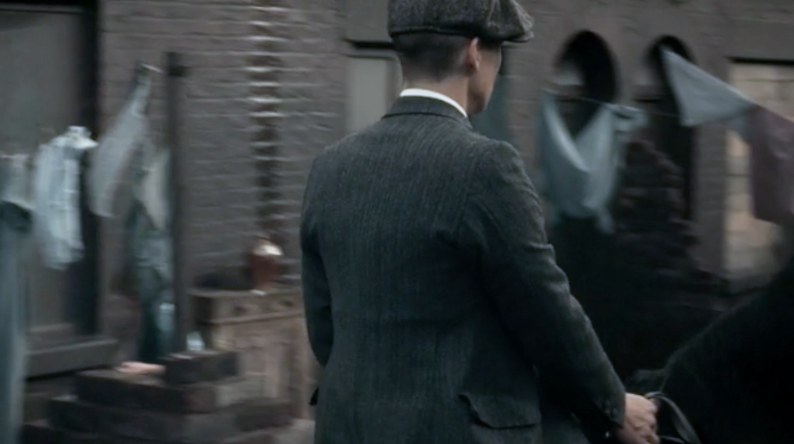
The camera gradually reveals the rider – but only from behind, wearing a grey suit and peaked cap.

NB. We are yet to see his face.

We follow him he rides along a busy, grimy, poor urban street.

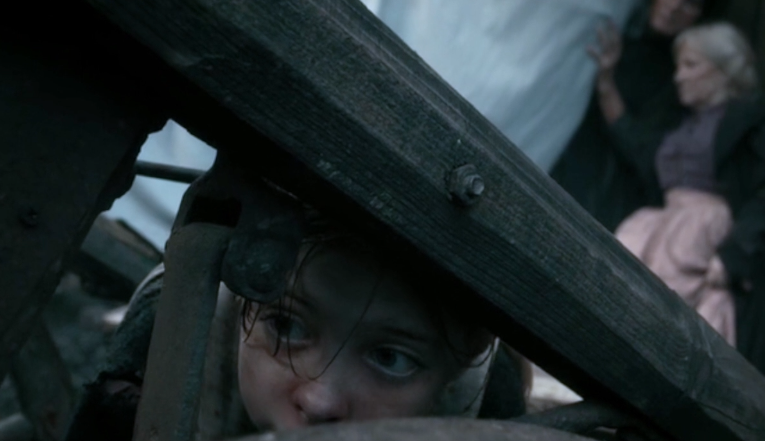
Women and children run to hide.

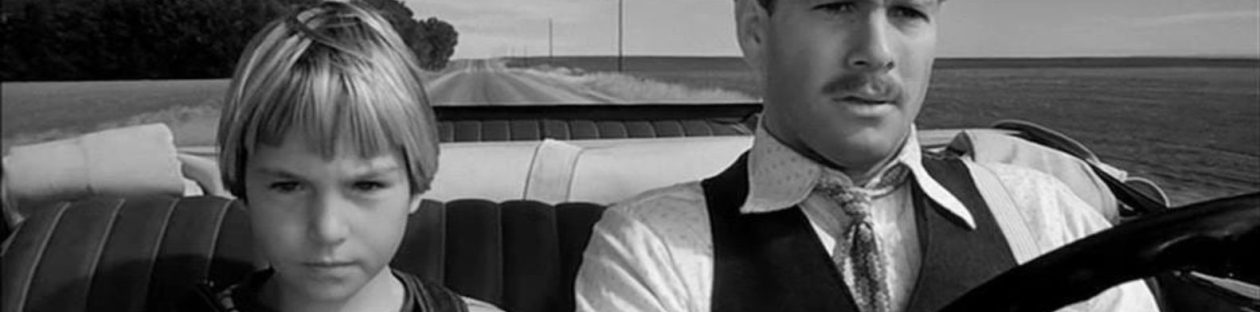
It reminds me of the Gene Pitney song my dad used to sing, based on the old John Ford western The Man Who Shot Liberty Valance.

The song goes like this:

When Liberty Valance comes to town women folk would hide.

They’d hide.

When Liberty Valance walked around the men would step aside.

Here’s the song with some great scenes from the classic movie:

Scene 2 of Peaky Blinders is completely visual.

There is no dialogue.

The women and children running to hide confirm the fear the Chinese men expressed in the opening scene is shared by the local community.

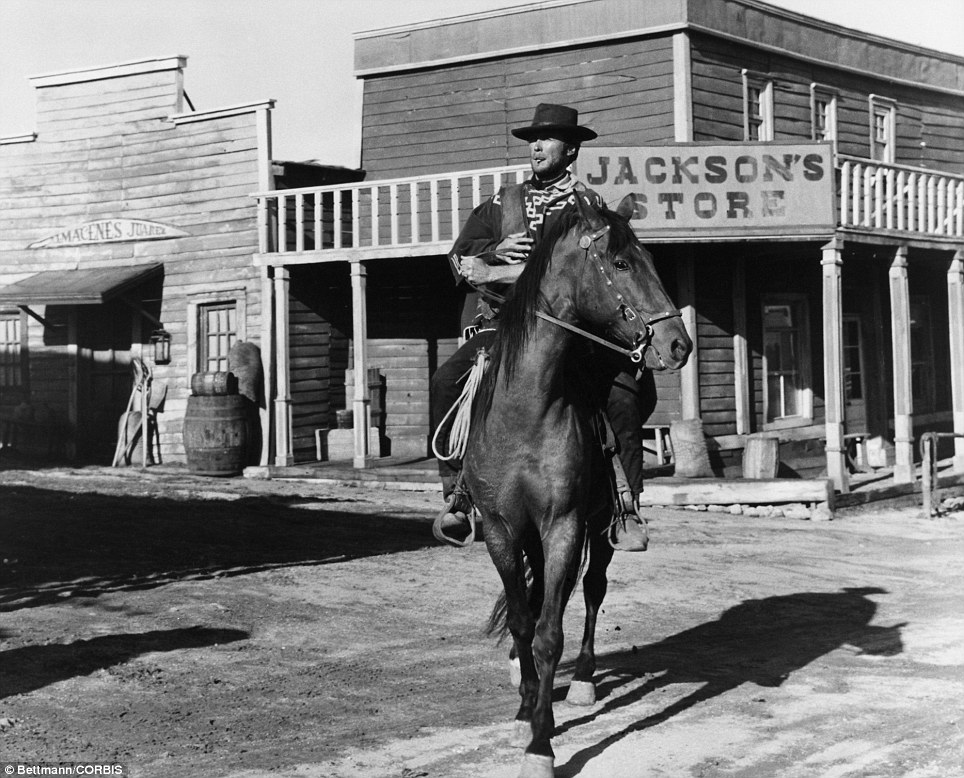
The lonely horseman riding through town gives a definite ‘nod’ to the Western.

It’s got a definite Clint Eastwood feel about it.

The Man with No Name.

For a Few Dollars More

In scene 2 of Peaky Blinders, up to this moment, we are still yet to see the Man on the Horse’s face.

The Man with No Face.

We are blinded by the peak of his cap.

The cinematography here is astounding.

Women still run inside to hide.

Boys hide and peak at the Man on the Horse.

Screen Shot 2015-01-01 at 3.06.41 PMThe Man on the Horse comes to a standstill in the now empty, grimy, Birmingham back street as washing blows in the wind.

Screen shot

The rider is still faceless as –

– the Chinese Man and Girl run as fast as they can towards the Man on the Horse.

And we’re into scene 3.

So, what information is revealed in this scene regarding character?

This man, this Man on the Horse, who we assume to be the leader of the Peaky Blinders, is feared.

But this is not necessarily, of course, who he is, but rather how he is perceived by those around him.

Click here for Scene 3.

Peaky Blinders Opening 10 mins: Scene 1. 中国劳工旅 Chinese Labor Corps

We’re analyzing the opening 10 minutes of Steven Knight’s crime drama Peaky Blinders.

How does Steven Knight grab our attention in the first few moments and draw us in?

Let’s study the action and dialogue:

Scene 1. 

EXT. BUSY MARKET – DAY.

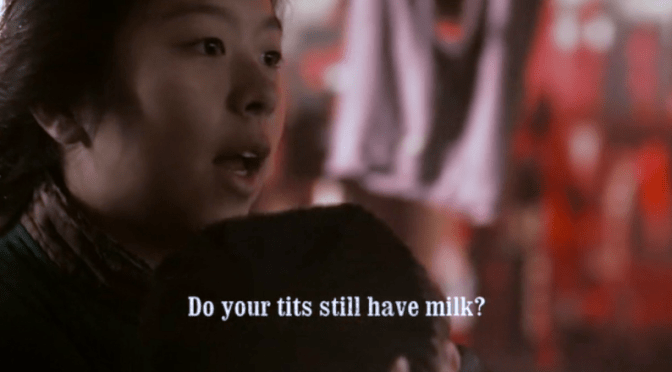
A CHINESE MAN runs through a busy market, followed by a teenage GIRL carrying a baby.

CHINESE MAN

Hurry up, or they will kill us all.

The Man and Girl reach another GIRL. Girl 1 hands the baby to Girl 2 (who looks about 12).

The next line is both shocking and funny.

Do your tits still have milk?

Girl 2 nods. Girl 1 hands her the baby.

(What?!! This 12 year old girl has milk in her breasts? She has had a baby?)

The Chinese Man looks desperate and worried at an OLD CHINESE MAN.

OLD CHINESE MAN

Where are you going?

CHINESE MAN

They have asked for her.

Zoom in close to the anxious Old Chinese Man’s face.

So, how does Steven Knight grab us and draw us in in his opening moments?

1. He creates intrigue. Who are they? And why have they asked for a girl?

2. He shocks us.

3. He delivers an unexpected, funny, unusual line of dialogue.

And bang! We’re in.

That’s the opening 18 second scene of Peaky Blinders.

But what are Chinese nationals doing in Birmingham in 1918? It’s a little known fact that during WW1 more than 140,000 Chinese ‘volunteers’ were recruited by the British government.

The Chinese thread continues with Thomas Shelby’s opium trafficking storyline in season 5.

The Chinese Labour Corps  中国劳工旅; traditional Chinese: 中國勞工旅; pinyin: Zhōngguó láogōng lǚ) was a force of workers recruited by the British government in the First World War to free troops for front line duty by performing support work and manual labour.

Click here for Scene 2.

Peaky Blinders Opening 10, dialogue or action?

In the opening 10 minutes of Peaky Blinders, do the 12 scenes contain action, dialogue or both?

Let’s go.

Scene 1. 

A Chinese man runs to find a girl, saying “Hurry, or they will kill us all.”

Scene length: 18 seconds.

Action and dialogue – but mostly action.

Scene 2. 

Thomas rides a horse through the streets. People run to hide.

Scene length: 1 minute.

Action only.

Scene 3.

The Chinese Girl does the ‘powder trick’ on the horse.

Scene length: 1.05

Action and dialogue – but mostly action. Only 4 lines of dialogue in 1.05 minutes of screen time.

Scene 4.

Thomas rides through town.

Scene length: 1.35

Action and dialogue –  but mostly action – only one line of dialogue in 1.35 of screen time.

Scene 5.

Thomas walks across a normal busy street and enters a house.

Scene length: 17 seconds.

Action only.

Scene 6.

Inside, youngest brother Finn warns Thomas that Arthur is angry.

Scene length: 30 seconds.

Action and dialogue.

Scene 7.

Thomas enters and walks through the gambling den and speaks to his younger brother John.

Scene length: 52 seconds.

Action and dialogue.

Scene  8.

Thomas and Arthur have a fiery duologue.

Scene length: 1.28

Dialogue.

(There is basic action: the pouring of a glass of whiskey signifies Arthur’s drinking but mostly this is a dialogue-driven scene displaying the power-struggle between the two oldest Shelby brothers . We’ll study this scene in detail later).

Scene 9.

Introduction to series antagonist C.I Campbell on a moving train studying files on Arthur and Thomas Shelby as well as a document about a ‘munitions robbery.’

Scene length: 54 seconds.

Action only.

Scene 10.

Introduction to ‘communist’ Freddie Thorne.

Scene length: 1.21

Dialogue – a political speech by Freddie rallying workers to strike.

Scene 11.

C.I Campbell studies a file on Freddie Thorne.

Scene length: 22 seconds.

Action only.

Scene 12.

Thomas walks along a street towards a local pub.

Action only.

Summing up then, in the opening 10 minutes, we might notice that out of 12 scenes only 2 scenes are driven by dialogue.

Click here for 1 THING about WOMEN in Peaky Blinders.

Which characters do we meet in the opening 10 minutes of Peaky Blinders?

There are 12 scenes in the opening ten minutes of Peaky Blinders.

But which characters do we meet?

Are they the protagonist, antagonist, main characters, minor characters or extras?

Scene 1. A Chinese man and a Chinese girl. (Extras).

Scene 2. Thomas. (Protagonist)

Scene 3. Thomas + the Chinese Girl and Chinese Man. (Protagonist + Supporting).

Scene 4. Thomas. (Protagonist)

Scene 5. Thomas. (Protagonist)

Scene 6. Thomas + youngest brother Finn. (Protagonist + Supporting)

Scene 7. Thomas + younger brother John. (Protagonist + Supporting)

Scene  8. Thomas + older brother Arthur. (Protagonist + Main)

Scene 9. C.I Campbell alone. (Main Antagonist)

Scene 10. Freddie Thorne + workers. (Main + Extras)

Scene 11. C.I Campbell alone. (Main Antagonist)

Scene 12. Thomas. (Protagonist)

So, an interesting opening with the Chinese characters considering this is Birmingham 1919.

So, considering the Chinese characters are extras in the opening 10 minutes we actually meet the Protagonist, the Antagonist, 2 main characters and 2 supporting characters.

The Protagonist is Thomas Shelby.

The Antagonist is Chief Inspector Campbell.

The 2 main characters are communist agitator Freddie Thorne and Thomas’ oldest brother Arthur Shelby.

The 2 supporting characters are Thomas’ 2 younger brothers John and Finn.

Here they are in order or appearance: (notice we meet the 4 Shelby brothers first.)

  1. Thomas Shelby.
  2. Finn Shelby.
  3. John Shelby.
  4. Arthur Shelby.
  5. Chief Inspector Campbell.
  6. Freddie Thorne.

Summing up then, we can note 3 important things:

  1. We meet The protagonist.
  2. We meet The Antagonist.
  3. We meet the 4 Shelby brothers first.

Click here for another sneaky peak at Peaky Blinders.

CILLIAN-GRADED

A Sneaky Peak at Peaky Blinders – Scene Length.

In the opening 10 minutes of Peaky Blinders there are 12 scenes.

Let’s break them down into scene length:

Scene 1 (0.18)
Scene 2 (1.00)
Scene 3 (1.05)
Scene 4 (1.35)
Scene 5 (0.17)
Scene 6 (0.30)
Scene 7 (0.52)
Scene 8 (1.28)
Scene 9 (0.54)
Scene 10 (1.21)
Scene 11 (0.22)
Scene 12 (0.18).
In the next post post we’ll find out how many characters in each scene.
CILLIAN-GRADED

A sneaky peak at Peaky Blinders – post 1.

In this series of posts we’re going to analyze Steven Knight’s superb historical crime drama Peaky Blinders.

To begin, we’re going to explore the first 10 minutes.

How often do you hear the first 10 pages are the most important?

If you don’t grab ’em in the first 10 pages, you lose ’em.

Well, let’s see how what a master of his craft does with his first 10 minutes.

First question: How many scenes are there?

Answer: 12.

Click here for Question 2. How long are the scenes?

CILLIAN-GRADED

Dissecting Dexter.

For those of you who missed my series of posts on Dexter, here is an easy access list.

The posts dissect one episode to see how theme is represented.

It checks dialogue tricks and techniques.

We see that the Climax is the longest scene, built up to with a series of shorter scenes.

We learn how much screen time Dexter has.

We see how many scenes have 2 characters, 3 characters, how many are ensemble.

We discover a 3 act structure, and much, much more.

Here are the posts. I hope you learn as much from them as I have.

1. Episode Breakdown: Scene by Scene.

2. Structure and Scene Length.

3. Characters in Scenes.

4. Interesting Script Facts.

5. Dexter’s Screen Time.

6. Titles and Meanings.

7. Old Cliches Die Hard.

8.a) Dialogue: Angel Batista.

8.b) Dialogue: Joey Quinn.

8.c) Dialogue: Debra Morgan.

9. Dialogue Technique: Answering Questions with Questions.

10. The Climax


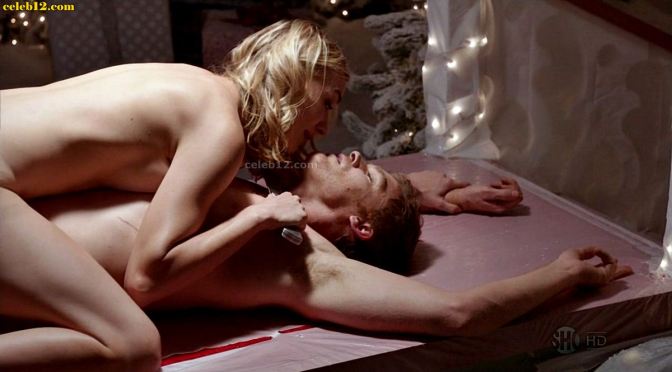
DEXTER part 10: The Climax

The episode we’re studying is Season 7 Episode 7 – CHEMISTRY  – (by Manny Coto & Karen Campbell).

Read the scene here.

This is the longest scene of the episode (approx. 3 mins) and is the ‘climax’.

First, we see that it breaks into 5 major beats.

We also see a clear ‘to and fro’ of power.

Here’s a summary:

Beat 1.

Dexter enters annoyed at the fact that Hannah’s latest victim died in his apartment. He’s angry with her and asks her how she killed him. Hannah disarms Dexter by answering his question.

We could say the power holder at the start of the beat is Dexter, but at the end of the beat, Hannah.

Beat 2.

Dexter confesses he got rid of some evidence which would have incriminated Hannah. Hannah thanks him.

Power holder:

start of beat – Hannah.

end of beat – Shared.

Beat 3.

Hannah says she could ‘feel’ Dexter watching her when she was being interviewed by the police. She tries to draw him into an awareness of a spiritual, supernatural bond. Dexter refuses to go there.

Power holder:

start of beat – Shared.

end of beat – Dexter.

Beat 4.

Dexter needs to know if the story he heard about Hannah is true. Did she kill her husband because he wanted a family? Hannah again disarms him.

Power holder:

start of beat – Dexter.

end of beat – Hannah.

Beat 5.

Hannah tries again to draw Dexter in to an awareness of their deep, spiritual connection.  This time she succeeds. Dexter is overwhelmed by her intoxicating power and the sexual ‘chemistry’ between them reaches its inevitable climax.

Power holder:

start of beat – Hannah

end of beat – Shared.

The shared power at the climax of this scene is echoed in Hannah’s line: ‘We were looking out for each other.’

So, the to and fro of power goes like this:

Dexter – Hannah – Shared / Dexter – Hannah – Shared

Two equal halves of the same sequence.

Interesting.

Do you agree? What else do you notice about this scene?

For a scene-by-scene breakdown of the entire, episode click here.