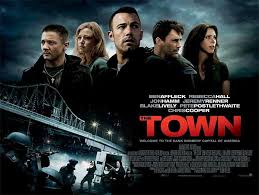
The Town boasts an incredibly in-depth story world with complex back-stories and subplots. As Doug, the protagonist, says, “There’s a lot going on here.”
As this scene reveals information regarding three separate subplots I’m going to split it into three parts.
First, the back-story & subplot regarding the character The Florist which happens in the first few lines of the scene.
So, let’s study the dialogue from two perspectives:
First, what information is revealed?
Secondly, what information is concealed?
Let’s start at the beginning of the scene.
Doug approaches Jem not knowing what this meeting is about. He thinks it’s about the apartment.
However, Jem tells him he’s bought some information from The Florist about a potential robbery and now he has to do the heist and pay up.
But Doug tells Jem he’s not interested.
Let’s read the dialogue:
DOUG
Something wrong with the apartment?
JEM
No. The Florist.
DOUG
The Florist what?
JEM
Came through.
DOUG
Oh, Jesus Christ.
JEM
It’s large, Dougie. It’s large.
DOUG
We’re smoked. Punt it.
JEM
Who else is gonna buy it?
DOUG
You should have thought about that
before you fucking kept breaking
the guy out for forty dimes after
every job.
JEM
There’s an expectation rate.
DOUG
I’ll correct his expectation.
JEM
Oh, you will?
DOUG
Yeh.
Let’s look at the lines more closely.
From this we can see that Jem is paying The Florist after every job, even though The Florist doesn’t do any of the ‘heavy lifting.’
The heists are done by Doug, Jem and the other two men in the gang.
The Florist, Doug infers, gets a cut of every job they do.
But that’s just the way it is to Jem. But not to Doug. Doug is changing things.
In fact, Doug’s line:
I’ll correct his expectation.
is actually foreshadowing.
But look at Jem’s line:
You will?
When we watch the scene in action, Renner delivers this line with sarcasm.
Jem doesn’t believe Doug has the power, will, or ability to ‘correct his expectation.’
From these two words, from the way the line is delivered, we might think that Jem fears The Florist.
We learn later that Jem would rather die than go back to prison, when he says, in one of the best lines of the movie:
I can’t do any more time, Dougie. So if we get jammed up, we’re holding court on the streets.
In a previous post we noticed how Jem is actually scared of expressing himself emotionally. We learned how Jem and Doug love each other ‘like brothers’ and actually Jem is terrified of losing ‘Dougie.’ Jem’s a tough cookie with a soft centre; capable of extreme violence and incapable of expressing brotherly love – except perhaps through a play-fight – yet Doug reads between his lines.
Jeremy Renner manages to play this tough guy with immense vulnerability. It’s easy to see why he was nominated for an Academy Award for this role and why he’s become such an in-demand film actor.
OK, so back to our scene.
We’ve learned what the writers have revealed regarding The Florist.
Now, what is being concealed?
Firstly, there is a deep back-story regarding Doug and The Florist, concerning both Doug’s father and his mother.
Although we never meet her, Doug’s absent mother is a vital character in this story.
We learn from Doug’s dad that his mother was ‘no different’ than the other single parent 20 year olds he sees on the streets.
Doug’s father worked for The Florist, and, we learn, was a victim of his brutal violence.
So, these few lines of dialogue are hiding deep layers of back stories and subplots – yet the writers’ touch on them is as light as a feather.
How heavy is your dialogue?
David Mamet says people speak to conceal, not reveal.
How much are your characters revealing and concealing?
You can also read a studio version of the screenplay here.
NB. this script is different from the final cut that made the movie – but that’s another study.
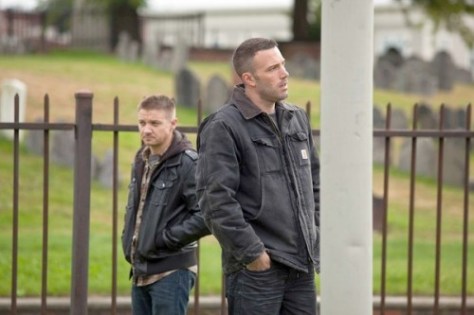
The first aspect of the scene I’d like to look at is the power play between Doug (Ben Affleck) and Jem (Jeremy Renner).
(Analysis in brackets and in bold).
EXT. PROJECTS – PARKING LOT/CEMETERY – DAY
Jem waits for Doug by the ancient cemetery near the projects. Doug approaches him.
DOUG
Something wrong with the apartment?
(So, from Doug’s question we know that Doug doesn’t know why Jem has arranged the meeting. Jem has called Doug, and Doug doesn’t yet know why. So, we might say that at the beginning of the scene Jem holds the power. )
JEM
No. The Florist.
DOUG
The Florist what?
JEM
Came through.
DOUG
Oh, Jesus Christ.
(If you’ve yet to see the film The Florist is The Town’s ‘godfather’ gangster, played by Pete Postlethwaite, a fearsome Northern Irishman, whose ability to cut flowers symbolizes his trademark ability and pleasure to ‘cut your fucking balls off.’ A lovely rose he is not. Doug obviously doesn’t want to do the job, whatever it is. Power with Doug.)
JEM
It’s large, Dougie. It’s large.
(Jem tries to tempt Doug with money. But Doug has enough money. Jem’s bait doesn’t work. The power is still with Doug.)
DOUG
We’re smoked. Punt it.
(‘We’re smoked’ means Doug knows the FBI are watching them. Power: Doug.)
JEM
Who else is gonna buy it?
DOUG
You should have thought about that before you fucking kept breaking the guy out for forty dimes after every job.
JEM
There’s an expectation rate.
DOUG
I’ll correct his expectation.
JEM
Oh, you will?
(No one makes demands or disobeys The Florist. Jem tries to intimidate Doug. It doesn’t work. Power : Doug. It’s a one way fight so far.)
DOUG
Pick up an extra guy or go with three guys or… fucking be smart and boot it.
JEM
Oh so you’re not going?
DOUG
No.
JEM
Why is that?
DOUG
Because we got a ton of fucking heat on us for one thing.
JEM
We’ll put a move on them, right? We’ve done it a hundred fucking times before.
DOUG
You know what, forget it. Do what you wanna do. I’m done.
(Read a separate post on the difference between the studio script and the dialogue in this scene here.)
JEM
What?
DOUG
I’m done.
JEM
You’re done?
DOUG
What does it sound like?
JEM
What’s that.. what’s that mean?
DOUG
What the fuck do you think it means?
JEM
What does that mean you’re done? It sounds like a bunch of fucking bullshit.
(Why the confusion? Doug doesn’t want to do the job. More than that, he wants out completely. Why isn’t Jem just letting it go? And why is Doug even entertaining him? Why not just tell him to fuck off? If he’s done, he’s done. There must be more to it. There must be more to this relationship. Something deeper. Doug seems to be struggling to hold onto his power. OK, he’s holding his corner, but why take the questioning? In a previous scene with the Feds Doug runs rings around them with their questioning. What’s going on? The power balance is shifting. Power: shared.)
DOUG
Let me put it to you this way, I’m putting this whole fucking town in my rear view.
(OK, so there we have it. Doug states his outward goal – a reflection of the visual we get earlier of Doug watching the plane in the sky as he waits for his girl outside the cafe. Power, back with Doug.)
JEM
There’s people I can’t let you walk away from.
DOUG
What? Who?
(Confusion again. What is Jem talking about? Power unbalanced again.)
JEM
Come on!
(Doug realizes Jem is talking about his (Jem’s) sister, Krista and her young daughter, Shyne. So, finally, we get to what this meeting is really about – the subtext rises, and it’s not work, but family. Jem grabs the power.)
DOUG
Are you serious, Jimmy? She’s not my kid….
(beat)
Cut it out. All you give a fuck about is coke and Xbox and now you’re trying to play it off you care about Shyne, come on now!
(Doug ridicules him. Assassinates his character. Coke and Xbox. Doug uses humor to disparage him, snatching the power back easily.)
JEM
You know what your fucking problem is?
(Come on, Jem, fight back.)
DOUG
What?
JEM
You think you’re better than people.
DOUG
Uh-huh.
JEM
Mister fucking clean, mister fucking goddamn high and mighty, right?
(Some info on Doug. He’s clean. He was an addict. He goes to AA / NA meetings. We know that. But is Jem right? Does Doug think he’s better than the other people on the ‘projects’? Remember his back-story, he was drafted as a pro hockey player, got into trouble for fighting other guys on his team, and lost his opportunity. Jem is really pressing Doug’s buttons here. In Truby terms, this could be Doug’s moral flaw. Does he think he’s ‘better’ than other people? Or does he simply believe he’s capable of a better life than the one he’s living, the one he’s been born into? Who’s holding the power here? I would say it’s definitely not Doug, but possibly shared, because we’re not sure if Doug’s ‘uh-hu’ and his agreeing with and repeating what Jem accuses him of is him being truthful, or him being sarcastic. Therefore – Power: shared.)
DOUG
Yeh, I’m better than all these people, you’re right. I’m better than anybody in this fucking project.
JEM
Yeah, that’s what you think, but you grew up right here. Same rules that I did.
DOUG
OK. What else?
Beat.
(Doug’s three little words here are very interesting. Doug now knows why Jem has called this meeting. He’s given him an earful about the job with The Florist, and he’s accused him of being self-righteous, proud, of seeing himself as ‘high and mighty.’ But Doug knows that’s not all. He knows this is all leading somewhere. When you watch the scene you’ll see a change of pace here. There’s a beat change. It’s as though Doug admits defeat, but really, to Doug, defending himself from Jem’s childish accusations just isn’t a battle worth fighting. Doug’s tired of the bullshit now. He’s had enough. He asks the direct question: What else?)
JEM
Who the fuck’s the father?
(OK. Now we know what this is all about. Finally. His niece, his sister’s beautiful little girl – Shyne. Power: Jem)
DOUG
I know I’m not the father.
JEM
You were the one fucking her.
DOUG
Yeh, and I wasn’t the only one, brother, OK? She knew I knew I’m not the father and I have enough respect for her not to ask her. OK? ‘Cause I don’t think she knows. Alright? Now I don’t wanna shatter your illusions here, partner, but there aren’t enough free clinics here in Mattapan to find out who the father of that kid is…
(Doug snatches the power back easily again. Watch the acting here. Affleck’s doing all the talking, but you can feel Renner about to explode. He represses his rage, but it’s rising to the surface. Doug doesn’t back down. He’s got the power, and he goes in for the kill).
DOUG
And I don’t know who the fuck you think you are, either. You aren’t letting me or not letting me do shit. Alright?
(Exactly! Why does Jem feel he can ‘let Doug or not let Doug’ do anything? And why was Doug letting him act like his boss? Now we know, Doug doesn’t let anyone tell him what he can or can’t do. He lays down the law. Power: Doug).
DOUG
Here’s a little fucking cheat sheet for you. It’s never gonna be me and you and your sister and Shyne fucking playing house up there. Alright? You got it? Get that in your fucking head! I’m tired of your one way fucking bullshit. If you wanna see me again, come down and visit me in Florida.
(Jem’s lost this argument, this verbal argument, so he attacks with all he’s got left, his physical toughness. Affleck’s tough, too. But Jem pulls a pistol, and cracks Doug on the head with it. Physical power: Jem. Emotional power: Doug.)
Doug recovers.
He sits up, panting.
JEM
In the 302 the Feds have me dropping Brendan right here. But I got him back on Tibbetts… shot him right in the chest. I remember he looked at me…and, I don’t know who was more fucking surprised he wasn’t dead – him or me. We just fucking stood there a second waiting for some shit to happen, I don’t know what, but…then he started running. Fucking guy ran a 100 yards with a bullet in his heart…The fucking guy should have run track, y’know what I’m saying?
(So Jem has called this meeting exactly where he killed ‘Brendan’ whoever Brendan is.)
Jem laughs.
DOUG
I didn’t ask you to do that.
JEM
Yeh, well, you didn’t have to, Dougie, come on. They told me Brendan Leahey was coming down here to roll up on you with a glock 21 so I came over here, and I put him in the fucking ground. Did nine years for it. Now, you don’t gotta thank me, but you’re not walking away.
(Jem wrenches the emotional power from Doug. Jem had saved his life. And what, now he was leaving town? Leaving him, and his sister, and his niece? Doug knows Jem isn’t capable of being open emotionally, and that all this tough talk about ‘not letting him walk away’ is just a cover up for the pain he feels. Power: Doug).
DOUG
I’m grateful for everything you’ve done for me. Your family took me in when my father went away. (Exposition at the height of tension. Jem’s family kind of ‘adopted’ Doug when his dad went to prison). You’re like a brother to me. (Doug, without saying the words directly, tells Jem that he loves him). But I’m leaving. (Outward goal stated again.) You gonna shoot me? Go ahead. But you’re gonna have to shoot me in the back.
(Of course, Jem doesn’t. He has lost this conflict and he knows it. Doug gets up, holding all the power, and walks away.)
When you finish your precious screenplay you’re eager to receive feedback and this can be a vulnerable time for you and the script. This is why you never want to give out your script for a read before it’s ready—only when you’re confident it’s the best draft you can possibly write and you feel that you’re “written out.” Feedback is an important part of any screenwriter’s growth on their journey, but make sure you don’t set your expectations too high and then become disappointed when you don’t receive the praise you expected. I think Hemingway said it best:
All you need to do is write truly and not care what the fate of it is.
I think too many aspiring screenwriters write new scripts and suffer under their self-imposed pressure of having to sell it. What are the odds? Astronomical. The safer bet is writing a new script for the sake of telling a story that you need to tell and making sure it’s the best example of your ability. Many times something does not sell but garners you meetings and eventually screenwriting assignment jobs—the bread and butter of working writers.
Many new screenwriters don’t take feedback well or don’t know how to execute the notes that are given. As they say, “everyone has an opinion” and that’s true, but you need to be able to filter the good feedback from the bad and be open enough to use the good notes and push your screenplay closer to a better draft.
When you’re finally working at a professional level, you’ll need to be a team player and not a diva when it comes to feedback. Screenwriting is all about the execution of the script and as you continue to write new material you will need to execute your ideas on a professional level. This is necessary to compete in a very crowded and competitive marketplace.
Be careful when open yourself up to feedback and set your expectations too high. We all have expectations after we complete a script. You know the creative high that you felt during writing and now you might be coming off that high as you turn in your draft and await feedback. Did you get notes and they are not exactly what you expected? Were you disappointed they didn’t appreciate the work enough — or maybe didn’t understand it enough? Maybe they felt your execution was off? Perhaps you become down on yourself as the insecure voices scream in your head about your lack of ability? You may even question what you thought was some of your best work only a week ago. You are not alone my fellow screenwriters.
We all need a pat on the back or just a “job well done” when we finish a screenplay. Most of the time, the pat on the back will come from you alone. Writing the script is one thing, turning it into your producer and waiting for feedback is entirely another. It’s easy to take notes personally because your script is your baby and your writing exposes yourself and your talents to criticism.
If you can’t handle criticism, start to work on acceptance of feedback, as it will make your journey as a working writer a lot less bumpy. Notes and changes are a given with a screenplay. Perhaps it will make the process easier to always remember that screenwriting is all about rewriting. Detach from the material and expectation from any outcome. Do not hang on every word or sentence. You’re not alone. A writer’s life is a tough job at best.
As screenwriters we must stay open to constructive criticism because screenwriting is all about collaboration. We will always receive notes because a script is an ever-changing blueprint for a movie. Once producers, a director and actors get involved there will be many changes and you should welcome the creative input from your co-creators on a project. These fellow artisans will bring it to an entirely new level of creativity.
You can become frustrated and feel like throwing in the towel if the process gets dragged down by so many changes. Stay positive, focused and persistent at executing the notes and turning in a better script. Find the passion you had for the first draft and put that energy into shaping a new draft that will please not only yourself, but also the talent it will eventually attract.
Along with the successes, I’ve had to deal with disappointments and frustration throughout my writing career from feedback, but I continue to love the craft of screenwriting. I’ve been able to view the entire process from a larger perspective and focus on the task at hand — to get the script into better shape as a team player.
If you are lucky enough to be paid to write, it becomes your job. You go to work, write all day, go home, come back tomorrow and wash, rinse and repeat. Screenwriters have pages to write and without filling those blank pages there would be no script.
Take your feedback seriously, but don’t take it to heart. Trust in your writing abilities and if you allow the disappointments to take you into a bad place, address your feelings but then focus on the task of executing your notes.
Stay out-of-the-way of the story and put your ego aside. Everyone is here to serve the story to the best of their creative ability. If you want to play with the big boys, at some point you’re going to be bruised and beat up. It’s just the rites of passage necessary for the growth of a writer.
Part of the deal is that you want people to read and love your material, right? If producers or executives agree to a read, give them ample time to get back to you. A gentle nudge in a few weeks is completely acceptable, but if you contact them before, you’ll seem desperate and no one likes to be hounded.
I remember a producer warned me, “Stay on me about your project, because I tend to get busy.” That’s fine. But use common sense and put yourself in their situation for a second. Your script is the most important thing in the world to you after you finish, but you have to understand that it’s not on their front burner at the moment. One E-mail or text is fine to check up — four is not.
Be open to the entire process of writing — the feedback, rewrites and all. No disappointments only triumphs when you complete a project. There will always be creative highs and lows.
Do your best not to allow your disappointment to be perceived as a failure and then sink into the morass of fear and insecurity in your creative soul. This will lead to the horrible act of chasing screenplay notes. Avoid this at all costs. A good discipline to follow for the long haul of a screenwriter’s survival is Chinese philosopher Lao Tzu’s advice:
Act without expectation.
Also be patient. A career does not happen overnight and part of your journey is becoming a better writer and finding your unique voice — one that producers will grow to love, trust and hopefully employ!
Keep filling your blank pages and keep the faith.
Scriptcat out!
Mark Sanderson (aka @Scriptcat) is a Los Angeles based veteran of the screenwriting game with over fifteen years of professional experience and has worked with Academy Award® winning producers, veteran directors, and Academy Award®, Emmy® and Golden Globe® acting nominees on his produced films and screenwriting assignments. Mark’s films have been recognized and distributed around the world and have opened and premiered at major festivals.
His popular screenwriting blog MY BLANK PAGE was Script Magazine’s pick for “Website of the Week” and had over 50,000 reads last year. He also offers screenplay consultation services and workshops on his website:
As you’re navigating the trenches on your screenwriting journey, do your best to keep the intimate details of your work to yourself. Do not continually talk about the status of your projects, your “writing process,” or how each project is moving forward or not. I know it’s tempting to share the intimate details with friends and family or even strangers, but keep your business to yourself. Your stock reply should be, “I’m busy working on a handful of interesting projects.” Hemingway said it best, “I still believe, though, that it is very bad for a writer to talk about how he writes. He writes to be read by the eye and no explanations or dissertations should be necessary. You can be sure that there is much more there than will be read at any first reading and having made this it is not the writer’s province to explain it or…
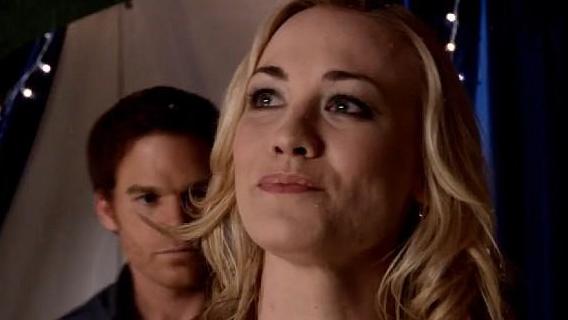
We’re studying the explosive climax from DEXTER Season 7 Episode 7 – ‘Chemistry’.
This post will look at the way the writers use the technique of answering questions with questions and how questions form part of the power play between characters.
Dexter, angry that Hannah’s latest victim died in his apartment, asks Hannah how she killed him.
DEXTER
How did you do it?
HANNAH
Is it really important?
DEXTER
Is life in prison important?
Hannah bats Dexter’s question away. But Dexter counters with force.
3 questions in a row.
Note the way the number of syllables increase: 5, 7, 8. As the tension increases, so do the number of syllables.
Now this is really interesting: when Hannah finally answers, she tells the truth.
HANNAH
I’m never going to prison.
Price liked to chew on his pens.
The last one had a little something on it…completely undetectable.
Another section of the script where Dexter responds to a question with a question is the break between Beat 2 and Beat 3.
Hannah attempts to make Dexter aware they have a ‘spiritual connection’, to draw him in:
HANNAH
I could feel you watching me while I was being interrogated.
You saw the whole thing didn’t you?
But Dexter refuses to go with her, still needing more information before he commits to this spiritual partnership, to this bond Hannah is convinced they share. Dexter responds to her question with a completely unrelated question – a question that pierces deep:
DEXTER
Is it true about your husband?
Did you kill him because you didn’t want a family?
Hannah answers this question, telling the truth. It’s as though she knows what Dexter needs, and she’s willing to make herself vulnerable to him, to allow herself to be known. She’ll do anything to draw him in to her world, even tell him the truth.
HANNAH
It was the opposite.
I wanted a family and he didn’t.
He threatened to leave me unless I got an abortion.
Hannah also answers Dexter’s next question directly:
DEXTER
What happened to the baby?
HANNAH
It was a miscarriage.
Sometimes life subtracts, sometimes it adds…
So what do we see here? Hannah answers truthfully when she believes doing so will draw Dexter towards her.
And when Dexter refuses to be drawn in, refuses to give up power, he bats the question away with a question of his own.
Questions are part of the power play between characters.
Hannah’s next and final question is a rhetorical one, which she answers herself, not giving Dexter the chance to bat it away, she answers for him in order to draw him in to their spiritual bond:
HANNAH
Do you see what just happened? We were looking out for each other…
This is the longest scene of the episode (approx. 3 mins) and is the ‘climax’.
First, we see that it breaks into 5 major beats.
We also see a clear ‘to and fro’ of power.
Here’s a summary:
Beat 1.
Dexter enters annoyed at the fact that Hannah’s latest victim died in his apartment. He’s angry with her and asks her how she killed him. Hannah disarms Dexter by answering his question.
We could say the power holder at the start of the beat is Dexter, but at the end of the beat, Hannah.
Beat 2.
Dexter confesses he got rid of some evidence which would have incriminated Hannah. Hannah thanks him.
Power holder:
start of beat – Hannah.
end of beat – Shared.
Beat 3.
Hannah says she could ‘feel’ Dexter watching her when she was being interviewed by the police. She tries to draw him into an awareness of a spiritual, supernatural bond. Dexter refuses to go there.
Power holder:
start of beat – Shared.
end of beat – Dexter.
Beat 4.
Dexter needs to know if the story he heard about Hannah is true. Did she kill her husband because he wanted a family? Hannah again disarms him.
Power holder:
start of beat – Dexter.
end of beat – Hannah.
Beat 5.
Hannah tries again to draw Dexter in to an awareness of their deep, spiritual connection. This time she succeeds. Dexter is overwhelmed by her intoxicating power and the sexual ‘chemistry’ between them reaches its inevitable climax.
Power holder:
start of beat – Hannah
end of beat – Shared.
The shared power at the climax of this scene is echoed in Hannah’s line: ‘We were looking out for each other.’
When I watched The Graduate on stage in London’s West End I saw what was, for me, the perfect ending.
Why was it perfect?
Somehow the writer had managed to bring me to a point where tears were rolling down my cheeks. Tears of empathy, of pity, of pain.
But then, as the tears flowed, and I thought my heart was going to break, came a terrific one-liner, which made me burst out in ferocious laughter, making the tears flow even harder.
Was I laughing or crying? I didn’t know! Both! At the same time!
Screenwriting teacher Chris Soth, in his Million Dollar Screenwriting podcasts, discusses how the hero, as a direct result of understanding his inner need is able to either-
a) achieve his outward goal
or
b) discern that his original goal isn’t important after all.
Either way the character arc is complete.
John Truby splits ‘need’ into 2 categories: ‘psychological’ and ‘moral’.
Let’s break this down:
A psychological need is something the hero must achieve in order to stop causing harm to himself.
A moral need is something he must achieve in order to stop causing harm to others.
Truby says the best stories have both.
In order to realize these needs, for the subconscious to become conscious, the hero must have a revelation, either psychological, moral, or both.
However, it’s not always as simple as that.
In some stories the hero may be incapable of a revelation. For example, in The Godfather, Truby explains, the writers give the revelation to Kay, Michael Corleone’s wife (read Anatomy of Story for the full analysis.)
Truby explains how a hero should take new moral action to prove the change has taken place.
What about your hero? What is his psychological and moral need? Is he capable of having a revelation? Is he capable of change?
If your hero is often the object, coming under attack a lot, this is good! Heroes should be attacked !
2. Put your hero first.
Walt is threatened by Skyler.
Subject: Walt
Verb: Threaten
Object: Skyler
Here the subject and object have switched. Walt is the hero so he always stays the subject – that is – first in the sentence, followed by the verb.
The verb ‘is threatened’ here is passive which tells us that Walt is passive in this scene, too. He is under attack. Of course, he doesn’t remain passive. He fights back. That’s what heroes do.
This method means we always:
1. See the story from the hero’s viewpoint.
2. See if our hero is active or passive.
3. See who is attacking our hero or who he is attacking.
It’s good to step outline both ways, to get a really clear picture of the to-and-fro of attack, defend, attack, defend, as your hero advances towards his goal.
Angel Batista is dreaming of retiring and opening a restaurant on the beach. Joey is feeling guilty about the dirty money he took from the Koshka Brotherhood.
NB it’s not pure altruism from Joey; earlier in the episode Batista ‘suggested’ he may be the one who stole the evidence against the Koshkas, which of course he was.
INT. MIAMI METRO POLICE – NIGHT
All is quiet in the office. Joey writes a check for $10,000 and hands it to Batista.
BATISTA
What’s this?
JOEY
It’s for your restaurant.
BATISTA
It’s ten grand.
JOEY
You know I got that inheritance a while back. I’ve been looking for the right place to invest.
BATISTA
I can’t take this. What are you crazy?
JOEY
Come on, are you too good for my fucking money?
BATISTA
No. This is way too generous.
JOEY
Bullshit. It’s family money. You’re family to me.
BATISTA
Quinn…
JOEY
Look, you’re stuck with it. I’m not taking it back. I do expect a few free meals, though.
BATISTA
This is a loan you asshole. I’m gonna pay you back.
So, let’s take the last line of Batista and see what we can glean. What does it tell us about Batista’s character?
First of all, considering the context, that earlier in the scene Batista put his professional relationship before his ‘friendship’ with Joey, Batista falls easily for Joey’s snake-like charm.
For $10,000, Batista is ready to accept Joey as ‘family’ – a man, who, a few scenes ago he was ready to lock away and ruin forever.
With Batista, money talks.
But is he greedy? Or simply so desperate for his restaurant, to retire from the stress of police life, that he is willing to ignore the evidence staring him in the face – that this money is dirty.
Does Batista really believe this 10 grand is from Joey’s inheritance? If he does, does it make him naive, or gullible? Or is he just blind to the truth, unable to see what is in front of him?
I would say here Batista is living with his eyes closed. Where he showed discernment earlier when he confronted Joey over the missing evidence, here he is either lacking discernment or willing to turn a blind eye. If he is lacking discernment that makes him kind of wavering, easily tricked. Is Batista, this hard-nosed, authoritarian, super-ambitious cop so easily susceptible to Joey’s charm? Is he really that gullible? On a positive note, his refusal to take the money as a gift shows Batista is fiercely proud and independent.
So, for me this dialogue suggests Angel Batista is: