 ‘Twin Peaks: The Entire Mystery‘ is now out on Blu-ray DVD (including deleted David Bowie scenes.) To celebrate its release yesterday, I’m very excited to welcome UK film maker & screenwriter Zennis to my blog with his superb article.
WARNING: Some minor spoilers may affect your enjoyment of Twin Peaks.
Prior to its debut airing on 8 April, 1990, Television had never before known anything remotely like the show that co-creator David Lynch chose to set in the northwest logging town of Twin Peaks. Nearly quarter of a century on, Television hasn’t known anything like it since.
The inhabitants of Twin Peaks are rarely what they seem. For the most part they are, in themselves, manifestations of the secrecy that engulfs them like the town’s surrounding forest, itself darkly cloaking their illicit desires and fantasies played out in the local bordello, ‘One-eyed Jacks’ – reached only by a murky water crossing, as if to symbolize the elusive ‘truth’ lurking deep beneath the surface of all that is visible.
Washed up on the shore of this truth, the most mysterious Twin Peaks resident appears in the opening minutes: a beauty queen ‘filled with secrets’ and delivered to us plastic-wrapped (as opposed to the tight-sweater wrapping usually preferred by Lynch for his female twin-peakers).

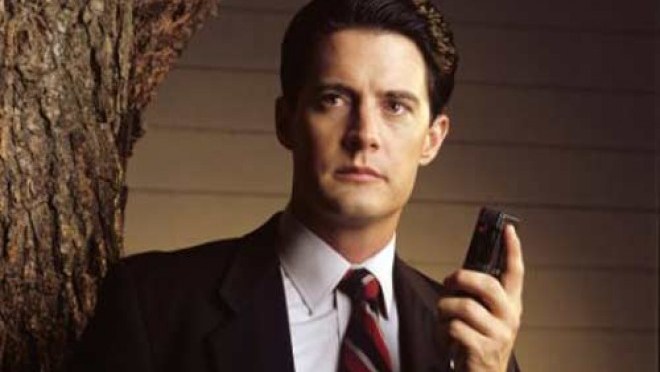
Thus the series is furnished with its first and most compelling dramatic question: Exactly who – or what – killed Laura Palmer? Indeed it is this burning unknown that must be made known by the show’s seeker-protagonist detective, Dale Cooper, an FBI Special Agent with powers of perception to rival Sherlock Holmes. Simply put, ‘Cooper is able to sees things that other people can’t,’ according to one of the series episode directors, Lesli Linka Glatter.
Naturally our detective has his very own Doctor Watson sidekick – here in the form of the local Sheriff and all-round-stand-up guy, Harry Truman – but Cooper seems more ably aided (although as often hindered) by his three muses, all of whom are as intriguing as each other in the secrets stakes. If ever there were riddles truly wrapped in mysteries inside enigmas, they are these young women conceived inside Lynch’s Jungian mind.
 Firstly, there is Audrey Horne (played by the circumflex-eyebrowed Sherilyn Fenn), who can knot a cherry stalk with her tongue and scare off a smörgåsbord of her wealthy father’s business partners with a one-minute performance of feigned grief for her brutally murdered friend – quickly prompting the audience to ponder on the deeper cause of such provocative behavior by this saddle-shoed minx.
As for the chemistry we feel instantly bubbling beneath the surface between Agent Cooper and Audrey (at their first meeting, she serves his breakfast table in her tight-form cardigan, prompting him to ask if the grapefruits are freshly squeezed), Glatter states: ‘Audrey knows what she wants and how to get it … There was definitely a kind of unspoken sensuality there.’
Later, when she turns up naked between Cooper’s sheets, he declines her offer, stating: “Secrets are dangerous things, Audrey”. But exactly what is Audrey’s mysterious secret?
According to Fenn it’s her virginity. For despite all indicators to the contrary it is intact: ‘She absolutely hasn’t been with anybody,’ Fenn has said of her character in interview. ‘She acts like she has. She wants to. That is her secret.’
Indeed, when Cooper asks Audrey how old she is at their very first meeting she stares him straight in the eye when replying, “eighteen”. Clearly no more blind than we are to the ‘old enough’ subtext here, Cooper replies without blinking, “I’ll see you later Audrey,” then exits with his heroic code of conduct established.
Of Fenn’s character, David Lynch, hints at what may be rooted in Audrey’s psyche: ‘Uh, well, she has trouble at home,’ whilst Glatter plumbs these depths further, commenting on Audrey’s decision to turn detective herself: ‘Audrey wants to know all the secrets. Because of her lack of relationship with her father, she lives in that darker world. If she has the secret she has the power.’
 And then there is Agent Cooper’s second muse, Shelly Johnson (played by Mädchen Amick), a bad-boy magnet who does for her waitress uniform what Barbarella did for, well, every costume she ever wore, and who clearly knows how to do more than just pour a damn fine cup of coffee because she quickly teams up with Laura Palmer’s former boyfriend, Bobby Briggs, to shoot Shelly’s husband, Leo, who has a penchant for abusive behavior and an abundance of plastic sheeting in his unfinished house…
Summing up Shelley, episode director Tim Hunter says, ‘Mudchen’s character always knows what’s going on. She’s very manipulative in a very subtle way.’
 Finally comes Cooper’s third muse in the form of Donna Hayward (played by Lara Flynn Boyle), the butter-wouldn’t-melt-in-my-mouth Miss goodie-two-shoes, set up early on when a policeman enters her class during morning registration. We effectively see the rest of the scene as if through Donna’s empathic eyes: first as she looks at the policeman whispering in her teacher’s ear, then at another female student screaming as she runs past the window outside, and then to an empty chair that we immediately understand to be Laura Palmer’s.
Donna shares this establishing ‘non-dit’ moment by exchanging a look with Laura’s former secret lover, James Hurley, and then clasping her hand to her heart, mumbling Laura’s name before breaking down in tears. When the teacher tells the class there will shortly be an announcement from the principal, the scene’s end is punctuated by James’ pencil snapping in his hand. This is a sequence with all the power of an iceberg, revealing only its shining tip yet making us feel much, much more. Hemingway would be proud.
So here we are, not half way into the first episode and we could already be forgiven for wondering of Donna: surely nobody can be this sensitive and good in Twin Peaks? Indeed, only a few hours after this unspoken announcement of her best friend’s death, Donna promptly falls into the arms of the grieving James.
In narrative terms, if the ellipsis is about the gap (or the parts of the story withheld from us by the story-teller), then it is effectively about secrets – and Agent Cooper’s muses are nothing if not bundles of secrets; each one a key-keeper to doors that loath to be unlocked; each a majestic vessel positively brimming with the unknown.
If you haven’t watched Twin Peaks yet then you’re not just missing out on one of the best TV shows ever, you’re also missing out on one of the best examples of storytelling, fullstop.
Check out this interview with co-creator David Lynch. And for Zennis’ complete take on Twin Peaks, check out his essay here.
Formerly a Hollywood-based product placement specialist, in addition to all the major studios Zennis has worked closely with the producer partners of Tom Cruise, Steven Spielberg, and Michael Bay. Currently evolving from film marketer into film-maker, he is now on the last furlong of his Master’s at Newport Film School. Of his first award-winning short, ‘Drink?’, BBC programming chief, Sian Thomas, said: “This winning film had impact and style from the outset … It was targeted and hard hitting.” More recently, after 50,000+ online film viewings and giant screenings across the UK, the judging panel of the British Big Voice Festival (headed by Lord David Puttnam) awarded its 2012 Silver Prize to the first-cut of his most recent short, ‘Shine’. His film-making is now focused on a pilot adapted from the novel he has been writing for more moons than he can remember. All other things Zen can be found on his website at Ze-Hub.com