Category Archives: #screenwriting

A Sneaky Peak at Peaky Blinders extra: 3 Opponents.

In studying the opening 10 minutes of the very first episode of Peaky Blinders I was enthralled to discover that in one scene, around 6 minutes into the episode, Steven Knight reveals to us not one but THREE opponents!

And, what’s even more startling and impressive is that the opponents, like Shakespeare’s great plays, work on 3 levels:

Personal. Social. Political.

And Steven Knight points to these opponents – not only in one 1 minute scene – but also in order of power.

Let’s explore.

1. Personal:

Arthur Shelby – personal because he’s Thomas’s older brother and current ‘king’ of the Shelby family.

2. Social:

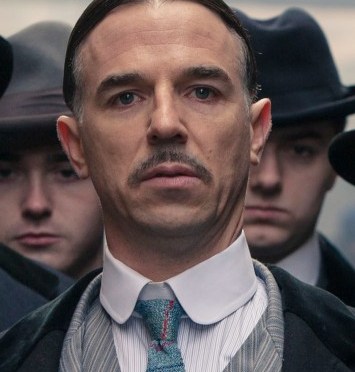
Billy Kimber – social because he is in Thomas’s social class – the criminal class. He is Thomas’s gangland foe.

3. Political:

Chief Inspector Campbell – who represents the police, the government and The Crown.

Let’s sneak a peak at them one by one:

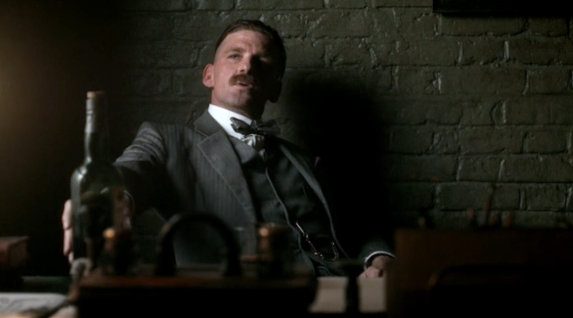
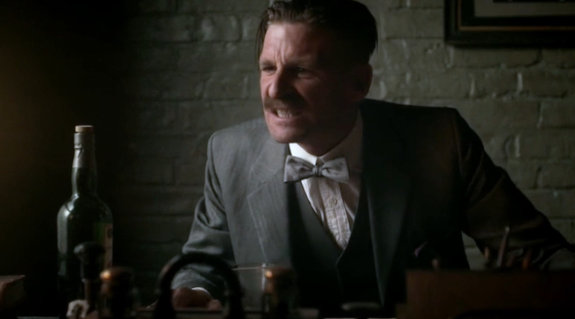
1. ARTHUR

Arthur kingly holds bottleArthur will be easy to depose. He’s a drunk. He can barely keep himself together let alone run the family business. Plus, he doesn’t share Thomas’s intellect. He will be the first to fall in Thomas’s rise to power.

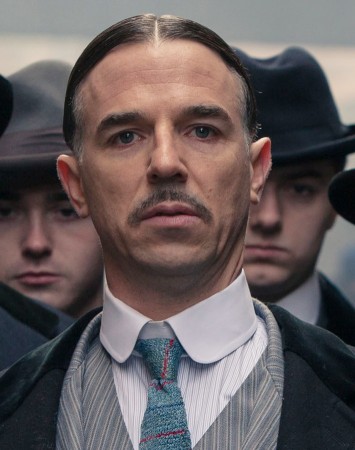
 2. BILLY KIMBER

Billy KimberBilly is a season opponent. Billy will be more difficult to defeat. We learn from Arthur’s dialogue that in order to “fix” races Thomas would need to get permission from Billy. He is powerful in the world of horse racing and gambling – Thomas’s world. Thomas aims to take him on. But Arthur’s afraid of him, as we learn when he warns his little brother “Billy’s got a bloody army!”

3. CHIEF INSPECTOR CAMPBELL

C.I Campbell is the series opponent. The most powerful of the three, Campbell goes to the very top of the food chain – representing the police, the government and The King.

So, to sum up, in one scene Steven Knight reveals 3 opponents – representing the personal, the social and the political and he reveals them in order of power!

Now that’s economic screenwriting for you.

A Sneaky Peak at Peaky Blinders post 12

We’re analyzing the opening 10 minutes of Steven Knight’s powerful crime drama Peaky Blinders.

We’re onto scene 8 and answering this question:

What is revealed in this scene about character?

First we’ll focus on action. In the next post we’ll explore the dialogue.

ACTION

The only real action in the scene revolves around Arthur and his bottle of rum and Thomas’s cool, controlled presence in the face of Arthur’s blustery anger.

As the scene begins, Arthur slumps drunkenly into his seat.

In the screenplay, Steven Knight describes:

The office has a photograph of the King dominating the wall. Beneath it sits the King of the Shelby gang, Arthur Shelby.

Even though we don’t actually see this photograph until later in the scene, Steven Knight is making a strong statement about the story genre and one of the major themes:

The Rise of a King.

Read more about this here.

However, back to the scene. Let’s see how Arthur’s character plays out visually.

First, we see him sitting back on his ‘throne’ full of pride, as Steven says, The King of the Shelby’s – yet with his right hand on the bottle.

His leaning back might show us he is on the defensive. As Steven Knight describes in his screenplay, he “feels threatened.”

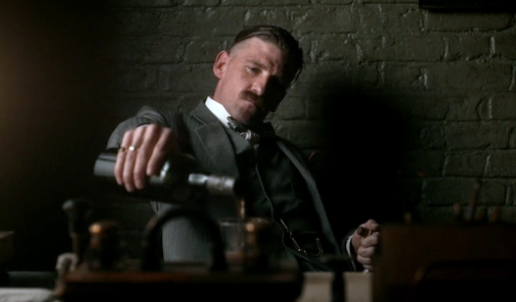
Next, Arthur pours his rum.

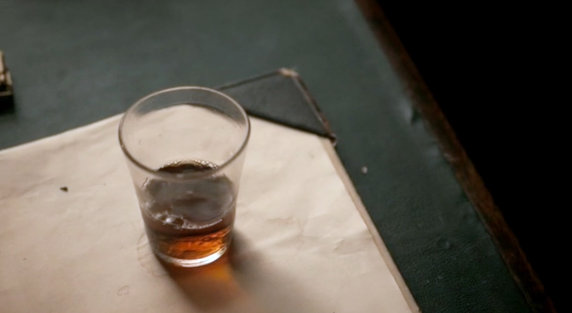
Arthur pours rumThe director pulls us in close on the sauce of Arthur’s weakness:

Close rumThen, Arthur drinks.

Arthur drinksAgain, the director brings us in close:

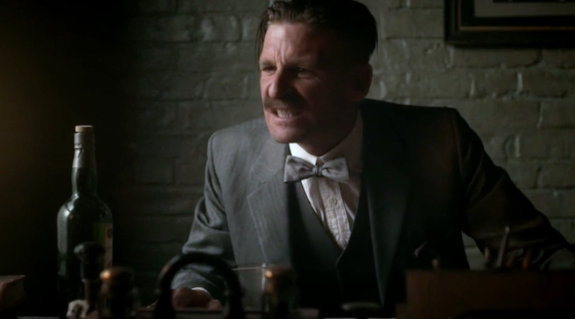
Arthur drinks closeFinally, we see the fruits of Arthur’s labor, as he becomes – as the writer describes – angry and blustery.

Arthur blusteryThomas, however, remains calm, cool and self-controlled as his brother erupts into drunken anger.

Thomas looks at glassSo, from this action, what do we learn about Arthur’s character?

1. He has a problem with alcohol.

2. He feels threatened.

3. He is defensive.

4. He is angry (and blustery.)

What do we learn about Thomas?

1. He is cool.

2. He is calm.

3. He is self-controlled.

4. He looks down (literally) at his brother’s drinking, possibly with pity and disappointment, but also full aware that his brother doesn’t have the self-control or thought process to build the business empire Thomas dreams of.

Stay tuned for the next sneaky peak at Peaky Blinders!

A Sneaky Peak at Peaky Blinders – Scene 6.

In Scene 6 Thomas enters the Shelby house and has a quick interchange with Finn, his youngest brother.

In the screenplay Steven Knight describes this short, 30 second scene in detail:

Thomas breezes through a hallway decorated with brass and fancy floral crockery. The Shelby home is compact, a typical terrace, but we might notice a surfeit of brass and flowery ornamentation around the place. The Shelbys are cash rich but without conventional good taste. The home is decorated like a gypsy caravan, or a boatman’s barge with lots of roses, elephants and castles.

We might glance a photograph of three brothers in military uniform, smiling (this is Arthur, Tommy, and John – all in Warwickshire Yeomanry uniform, with a freshly dug trench behind them).

Thomas tosses his coat aside and passes through a small kitchen, where a young boy (FINN, 10, Thomas’s youngest brother) is smoking a cigarette into the flames of a coal fire. A rabbit roasts on a spit. Finn hides the cigarette and calls out as Thomas passes…

FINN

Arthur’s mad as hell.

THOMAS

What does a ten year old know about hell?

FINN

I’m eleven Sunday.

Let’s have a quick look at how much of this is realized on screen.

The first paragraph –

Thomas breezes through a hallway decorated with brass and fancy floral crockery.

– is on screen.

However the first thing we notice when Thomas enters is a crucifix on the wall, illuminated by a shaft of sunlight as Thomas opens and closes the front door. This is perhaps a nod to the Shelby’s Irish – Catholic heritage. Aunt Polly is described as “half Romany, half catholic” and the city of Birmingham in the UK in 1919 had “a large Irish Catholic” community. (Sources: Telegraph/Guardian).

From Steven Knight’s description we do notice on screen –

 flowery ornamentation around the place.

– and the home is

decorated like a gypsy caravan.

It’s interesting to note Thomas is referred to several times as being a “gypsy.”

However, the rabbit on the spit, the action of tossing the coat, and specifically the photo of the three brothers in uniform are all absent from the screen.

(Note to self – not everything you write will make it on to the screen – even if you’re at the top of your game!)

So, to answer our two questions:

1. What is revealed in this scene regarding plot?

Nothing per se. However the line of dialogue from Finn prepares us for familial conflict between Thomas and Arthur – itself revealing one of the series’ major themes – the rise of a king – and this theme is itself revealed in plot – the various actions Thomas takes in order to achieve his ambitions.

And why is Arthur ‘mad as hell’ ? Because, as we soon find out, Thomas has been treading on Arthur’s toes. There’s a battle for leadership going on. A battle for kingship. Who is the King of the Shelby clan? Who is The King of Small Heath ? Is it older brother Arthur, or his younger, smarter, brother Thomas?

2. What is revealed in the scene regarding character?

Firstly, through Thomas’s action – a playful bash on Finn’s head with his cap (on screen not in the script – actor’s choice?) – and by his tone of voice – we see that Thomas is friendly to Finn.

He could curse and swear at him for smoking, but he doesn’t.

Thomas is revealed in this scene as friendly, gentle and playful – a stark contrast to the fear and reverence he evokes out on the streets.

Secondly, through dialogue, Knight cleverly and with subtlety reveals that Thomas has experienced ‘hell.’

Thomas asks what Finn, a ten year old, can possibly know about hell.

“Hell” here refers to the horrific war Thomas has just returned from – the blood, the bombs, the death, the injured and dying men screaming – portrayed to us later in his vivid nightmares.

Tommy Shelby is a paradoxical character: ruthless, yet with an almost angelic aura; youthful, but with the air of one who has already seen it all.

– The Guardian.

Stay tuned for the next post analyzing the opening ten minutes of Peaky Blinders!

1 thing Dexter & Peaky Blinders have in common: the hero’s screen time.

Out of 50 scenes, Dexter is on screen for 25.

Exactly half.

This adds up to exactly 23.06 minutes of screen time – just less than half of the 50 minute episode.

Approximately 50%.

Out of 42 scenes, Thomas Shelby is on screen for 20 scenes – just less than half.

This is 27.21 minutes of screen time – just less than half of the 56 minute episode.

Approximately 50%.

How long is your hero on screen for?

3 facts about your hero’s screen time.

Here is a list of scenes + scene length for Peaky Blinders opening episode.

It also shows which characters are in each scene.

The hero is Thomas Shelby. His scenes are highlighted in red.

  1. 0.18 Chinese Man and Girl.
  2. 1.00 Thomas + extras.
  3. 1.05 Thomas + Chinese Man + Girl.
  4. 1.35 Thomas + various (opening credits).
  5. 0.17 Thomas.
  6. 0.30 Thomas + Finn.
  7. 0.52 Thomas + John.
  8. 1.28 Thomas + Arthur.
  9. 0.54 C.I Campbell.
  10. 1.21 Freddie Thorne + workers.
  11. 0.22 C.I Campbell.
  12. 0.18 Thomas.
  13. 4.33 Thomas + Freddie Thorne + Danny.
  14. 0.10 C.I Campbell.
  15. 0.57 Aunt Polly + John Shelby.
  16. 1.52 Thomas + Polly + Arthur + The Shelby Family.
  17. 1.02 Jimmy Jesus + C.I Campbell + extras.
  18. 3.11 Polly and Thomas.
  19. 0.38 Thomas + Ada (transition).
  20. 1.35 Ada and Freddie.
  21. 0.24 Grace.
  22. 2.01 Grace + Harry the barman
  23. 3.49 Campbell + police.
  24. 0.46 Arthur + police.
  25. 3.28 Campbell + Arthur.
  26. 1.21 Grace + Thomas + Barman.
  27. 1.43 Aunt Polly + Arthur.
  28. 0.07 Ada.
  29. 1.01 Grace + Thomas.
  30. 1.14 Freddie + Ada.
  31. 2.09 Thomas (war dream sequence.)
  32. 0.45 Danny + Italian butcher.
  33. 0.15 Campbell.
  34. 1.46 Campbell + Winston Churchill.
  35. 2.04 Thomas + Uncle Charlie
  36. 0.17 Campbell.
  37. 1.53 Campbell + Grace
  38. 4.03 Thomas + Danny.
  39. 1.10 Arthur + Thomas.
  40. 1.14 Danny and Uncle Charlie.
  41. 0.18 Aunt Polly + Thomas.
  42. 0.36 Thomas + Grace

3 things to note.

1. Thomas is in 7 of the opening 8 scenes.

2. In total, Thomas is in 20 out of 42 scenes (approximately 50%).

3. Thomas is on screen for 27.21 minutes (the episode runs at 56.12 so again approximately 50%).

How long is your hero on screen for?

5 facts about scene length in your TV drama.

Here is a list of scenes and scene length from Episode 1 of Steven Knight’s Peaky Blinders.

For an in-depth study of the opening ten minutes click here.

The breakdown is color-coded as follows:

Scenes less than 1 minute.

Scenes over 1 minute.

Scenes over 2 minutes.

Scenes over 3 minutes.

Scenes over 4 minutes.

  1. 0.18
  2. 1.00
  3. 1.05
  4. 1.35
  5. 0.17
  6. 0.30
  7. 0.52
  8. 1.28
  9. 0.54
  10. 1.21
  11. 0.22
  12. 0.18
  13. 4.33
  14. 0.10
  15. 0.57
  16. 1.52
  17. 1.02
  18. 3.11
  19. 0.38
  20. 1.35
  21. 0.24
  22. 2.01
  23. 3.49
  24. 0.46
  25. 3.28
  26. 1.21
  27. 1.43
  28. 0.07
  29. 1.01
  30. 1.14
  31. 2.09
  32. 0.45
  33. 0.15
  34. 1.46
  35. 2.04
  36. 0.17
  37. 1.53
  38. 4.03
  39. 1.10
  40. 1.14
  41. 0.18
  42. 0.36

The episode runs at 56 minutes.

Out of 42 scenes it’s interesting to note 5 things.

1. There are 18 scenes less than 1 minute.

2. There are 16 scenes over 1 minute.

3. There are 3 scenes over 2 minutes.

4. There are 3 scenes over 3 minutes.

5. There are 2 scenes over 4 minutes.

Check out the latest sneaky peak at Peaky Blinders, about the opening ten minutes last scene.

A Sneaky Peak at Peaky Blinders Extra: The Rise of a King

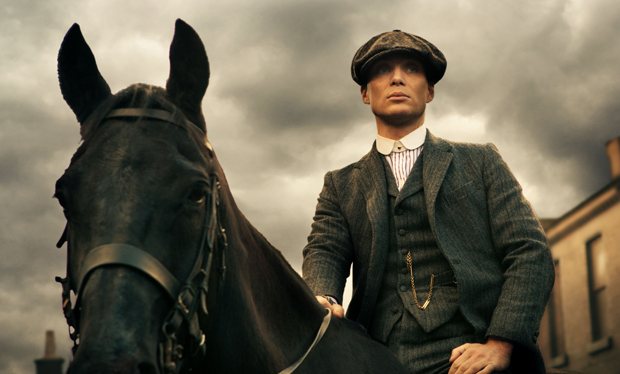
In the opening ten minutes, as Thomas Shelby rides majestically through the backstreets of Birmingham on a beautiful black horse, dressed immaculately in three piece suit, polished black shoes and a gold watch chain – it’s a stark contrast with the dirt and grime of the laborers and beggars around him.

As beggars, the preacher, and even policemen bow and tip their hats we see Thomas is revered by all.

Refusing to tip his hat in return to the police, Thomas is making a strong statement. He doesn’t see himself as subordinate to the police. And if he’s not subordinate, he must be above them. Above the law.

But in the UK only The King or Queen is above the law.

In the United Kingdom the Crown has never been able to be prosecuted or proceeded against in either criminal or civil cases.

– Wikipedia

This theme of Thomas as King runs through the series.

In scene 13, as communist leader Freddie Thorn examines the razor blades sown into Thomas’s cap, he says:

The crown of a prince. Soon to be king, I’d say.

Later, Freddie says to his girlfriend, Ada, Thomas Shelby’s sister:

Oh my Ada. The only princess of the royal family of the Kingdom of Small Heath.

But Freddie isn’t the only one to recognize Thomas as King.

When Thomas’s wealthy, aristocratic horse trainer visits him in the backstreets of Birmingham, she says:

I mentioned your name and it was like being led to a king.

But Thomas, when he leans down to drop a coin into the bowl of a line of begging soldiers, blinded in the war, he shows he shares status with them.

We might say Thomas is both king and beggar – a favorite theme of Shakespeare:

Your fat king and your lean beggar are but variable service – two dishes but to one table.

– Hamlet.

Also, Thomas leaning down to drop a coin in the bowl of the soldiers might be compared to King Henry V when he humbles himself to sit with his ordinary soldiers just before battle.

John Truby, in his review of another rise of a king story, House of Cards, says:

The struggle for power is one of the prime human motivations.

Is your opening 10 mins a cool hand?

I asked multi-produced screenwriter Mark Sanderson aka @scriptcat this question:

What’s the most important thing you show in the opening ten pages?

This was his reply:

First ten eh? Get right into the action!  Definitely something with the character, who he or she is just from one thing they do or how they act — we know instantly… and their dilemma — and the important characters on the journey. Maybe open with a memorable image – definitely all set up stuff — fewer words the better and more images. Cut into the story in progress – definitely.

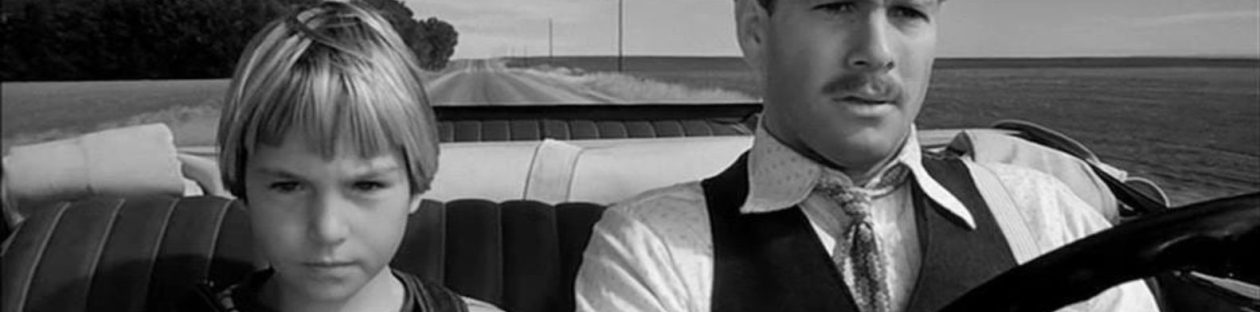
I always remember the opening scenes (first minute & a half) of COOL HAND LUKE – says it all about his character for sure.


Hell, I’m just trying to please my producer!  But he loved my opening scene in my first draft. The location, atmosphere, character in action doing something specific and “in character” that tells us some of her back story, the antagonist comes into scene and stops her, and we’re off to the races!

Mark Sanderson aka Scriptcat
Follow Mark on Twitter @scriptcat

3 ways to show character.

As I explore the opening 10 minutes of Peaky Blinders it’s clear that Steven Knight shows Thomas Shelby’ character visually, through action, in 3 ways.

1. How he acts.

2. How he reacts.

3. How others react to him.

By his actions we learn he is generous and humble.

By his reactions we learn he does not bow down to authority.

By others’ reactions to him we learn he is feared and revered, by both the common people and the police.

How are you showing character in your opening ten pages?