MA Writing for Script & Screen: Year 1 Module 2 Week 5
This week was pitch assignment week. Having delivered my pitch for my romcom to my tutor, I received feedback which forced me to learn defining qualities of other dramas.
What I mean is, I’d pitched it as a romcom, for which I’d learned and memorised the necessary defining qualities.
However, my tutor suggested my story might actually be a personal drama as the romcom shares screen time between the two central characters, whereas my story seemed to weight slightly more in favour of the male. I suggested that Notting Hill (1999 dir. Roger Michell, screenplay by Richard Curtis)follows the male story and screen time is probably slightly more balanced in favor of the male there as well. Although my tutor agreed he still felt the personal drama might give me more ‘space to breathe.’
So, I returned to Phil Parker’s genre breakdowns and realised my story has defining qualities of three genres: the personal ‘inner’ drama, the romantic drama, and the romcom.
This led me to wondering what comes first, the genre or the story?
Should a writer write the story first, and then see which genre/s fit? Or should we decide on a genre/s and write the story to fit the defining qualities of the drama?
The ol’ chicken egg question.
What do you think? Which comes first, the story or the genre?
So, it’s week 2, and, to be honest, I’m struggling so far this term. The assignment is to write another short film, and present a video pitch, due in week 5, together with premise, treatment, and reflective essay at the end of term.
So what’s my problem? It’s not like I don’t have ideas. I have a lot. The two I am considering for this project are a romantic comedy and a rite of passage crime drama. I can’t decide which to pursue. I’ve written a premise for both, a treatment for both, and a step outline for both, but I’m still undecided.
The romantic comedy gives me more enjoyment. It’s fun and full of light. The rite of passage crime drama is dark. No light. If I’m to write this story I need to find a way of allowing the light in. If I go with the romantic comedy I need to figure out how to squeeze it into the rules of the genre.
As for genre, we have been pointed to Philip Parker and The Art and Science of Screenwriting, which is next on my buy-list. Initial readings of the rules of the three ‘romance’ genres seems to slot my story into comedy, as opposed to romantic drama or romantic tragedy (in this case art doesn’t imitate life).
Of the romantic comedy, our genre reading states this:
“The aim of the plot is to provide as many comedic moments as possible between the two central protagonists and their environment or other characters.“
But my question is this: comedic to whom?
Interviewed about his play The Comedians playwright Richard Griffiths paraphrases Mark Twain when he says the source of all comedy is pain. Just because we are laughing, it doesn’t mean the character finds what’s happening funny. Don’t we often laugh at people schadenfreude style? Not laughing with them, but rather at them? At least, that is how it seems to work in Soap Operas.
Which gives me a task, to take a romantic comedy and see if I am laughing with the characters, or at them? What is your screenwriting task this week?
I decided to print out my portfolio and essay and do one last red pen edit before submission. I print and plod off to a local, comfy coffee shop, order a hot chocolate, sit down and set to work. I notice some errors I hadn’t spotted when reading on the computer screen. I make the necessary edits on Celtx (I am a final draft owner but it doesn’t run on my new Chromebook, which I should have checked first before I bought it) and set off back home to print it out. But I’m quietly content that my portfolio: Premise, Treatment, Writer’s Statement and Screenplay is ready to submit.
But now I make the cardinal sin. I have a bright idea of how to improve the dialogue, and start to rewrite the script, shifting dialogue between Act 2 and Act 3 to execute these improvements. But, all of a sudden, I’m in a mess. And guess what, I hadn’t saved the previous draft.
In the words of Scooby Doo’s Shaggy: Yikes!
I check my pdf file of the version I’ve edited, and it seems fine. I go onto Ilovepdf.com to merge the script with the text docs as a single pdf file and think to myself I’d better print again and check, one last time, to be sure (having already repeated the red pen edit umpteen times prior to my coffee shop trip.)
Alas, my printer is out of ink. Oh, I’m sure it’s fine. I’ll read it through on my laptop, just to make sure, and submit. It’s 3am, and I’m twelve hours before the deadline.
Submitted! Phew!
Then, the next day, hours after the deadline passes, I see the option to read your file after it’s been submitted. I read the essay. Fine. Premise, Treatment, Writer’s Statement, all fine. Script…. OMG. I merged a previous version. A version before the final red pen edit. WTF? Must be tired, insomnia, anxiety.
I email my course tutor and exclaim my distress.
“There are extra spaces between dialogue, and some of the dialogue has the wrong character names!!!”
I’m reassured that those issues are not something to stress over too much, but please proof read, especially before submitting a script to a producer.
There’s no point saying I’ve proof read a zillion times, and used up (almost) a whole cartridge of printer ink, if the version I upload has errors. The fact is, I should have gone to the stationers and spent precious money on more ink, rather than on an excess of cappuccinos and hot chocolates.
(Who knew cappuccino has two ‘p’s and two ‘c’s? I know about Coppola’s two ‘p’s. Two ‘p’s or not two ‘p’s – that is the question. I’m easy to p’s. Two peas in a pod. That’s my two p’s worth.)
I’m also advised to let someone else proofread, as our eyes can often overlook simple errors when we’ve been writing and rewriting something over and over again.
Good advice.
I apply for an extension to hopefully iron out the errors in my script, but alas, no go, as I’ve already submitted.
It was worth a try.
As I express my frustration in our cohort’s Whatsapp group one of my fellow students says my whining is like witnessing one of Shakespeare’s tragic heroes breaking down on stage.
So, it’s getting closer to the assignment submission deadline, and all weekly tasks have gone out the window. However, I’m looking forward to backtracking once the portfolio and essay have been submitted to explore Vince Gilligan’s writers room on Breaking Bad and Writing and Producing Television Drama in Denmark by Eva Nordrup Redval – From The Kingdom to The Killing.
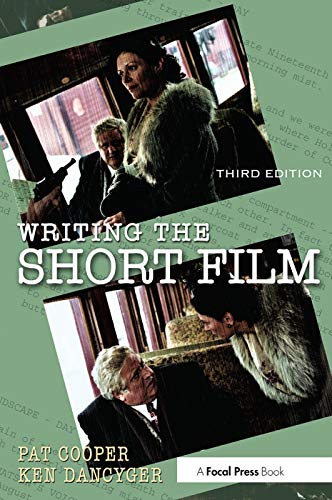
Something I’ve been struggling with is articulating my screenwriting techniques in the essay. For example, where as the story is told primarily with images, I’ve employed a video game effect as dialogue which serves as a metaphor. Death Penalty is the story of an ex-child soldier who escapes the war in Tigray and makes the dangerous migrant crossing to London where he finds himself imprisoned in a dark, forced labor football underworld – reflecting two human rights issues. One, labor violations in Qatar where more than 6,500 young men have been killed on construction sites building the world cup stadiums, and secondly, young men being lured from Africa to the Middle East on the promise of a professional football contract only to wind up as cheap labor on construction sites, their passports confiscated until they have paid back the traffickers who lured them there. My football commentary dialogue offers comic relief to the human rights violations on screen, while at the same time serving as a metaphor for western news media’s preference for reporting on football stories over escalating tensions and threats of genocide in developing world conflicts e.g. Ethiopia / Eritrea / Tigray. However, articulating this is in the essay proved difficult until I read Patricia Cooper’s Writing the Short Film which explains the use of asynchronous sound which offers ‘a multilayered view’ and can also serve as a metaphor. This seemed to describe exactly what I was aiming to do.
My head must be in a daze. I had to check what week it was. Week 9 just gone. Week 10 ahead. This online MA is zooming along (no pun intended).
So, it’s assignment time. The most refreshing words I heard this week were from our course leader, who said don’t worry about sounding academicky. Which, if you mistype, can come out like acamedicky. Which is probably what I sound like.
Writing an academic (reflective) essay is a strange thing for a creative writer, because, with an opportunity to write an academic paper, after messing around with fiction and screenplays for years, the desire to write academicky is very hard to resist. I have to say, I’m enjoying all the quotes and Harvard referencing. (Can I mention Harvard on my CV now?) I’ve got John Yorke to thank for 99% of quotes in my paper, all about assimilation, peripeteia and the Jungian theory of quaternity. Thanks, Signor Yorke.
Next task is my writer’s statement. I have written one already, but since the sample we were given – David Simon’s overview for The Wire – follows a 9 paragraph structure, I think I’m going to write a new one and follow the same structure.
Reflecting on my creative writing for this week, rewriting my short screenplay, was guided by a discussion we had on the BBC Writer’s Room and on formatting in one of our student led online meetings. I hadn’t realized the BBC had such a rich source of scripts. So, confused at what or what shouldn’t be capitalized in current screenwriting practice, I thought I’d dip into a Jimmy McGovern script, to see how he does it, and follow his example, imagining I am writing something that he is going to read. He is, after all, according to John Yorke, the ‘Godfather of British television.’ And so far, in the script, there are no capitals – not verbs, not sounds, not even the first time we see a name – except, in TIME, it says, in bold and capitals: SIMULTANEOUS TO THE ABOVE. But don’t quote me on that. I’m usually wrong. Check for yourself at BBC Writer’s Room.
This week was tutorials with the module leader. During my tutorial I insisted on doing a table read of my screenplay, for 2 reasons.
Firstly, I had written the language of one opponent in Chinese, with the transcription in English phonetics, so I was eager to see how the script sounded as if it were on screen, with the Chinese language spoken, rather than hearing it in English (which is akin to watching a foreign movie dubbed).
I was pleasantly surprised and thought it worked well. Why did I change the language of this opponent to Chinese? Firstly, as it’s set in the future (2080) I thought it would be fun to suggest that by 2080 Chinese will have overtaken English as the international language. Secondly, China are huge investors in film and China’s cinemas are a lucrative market.
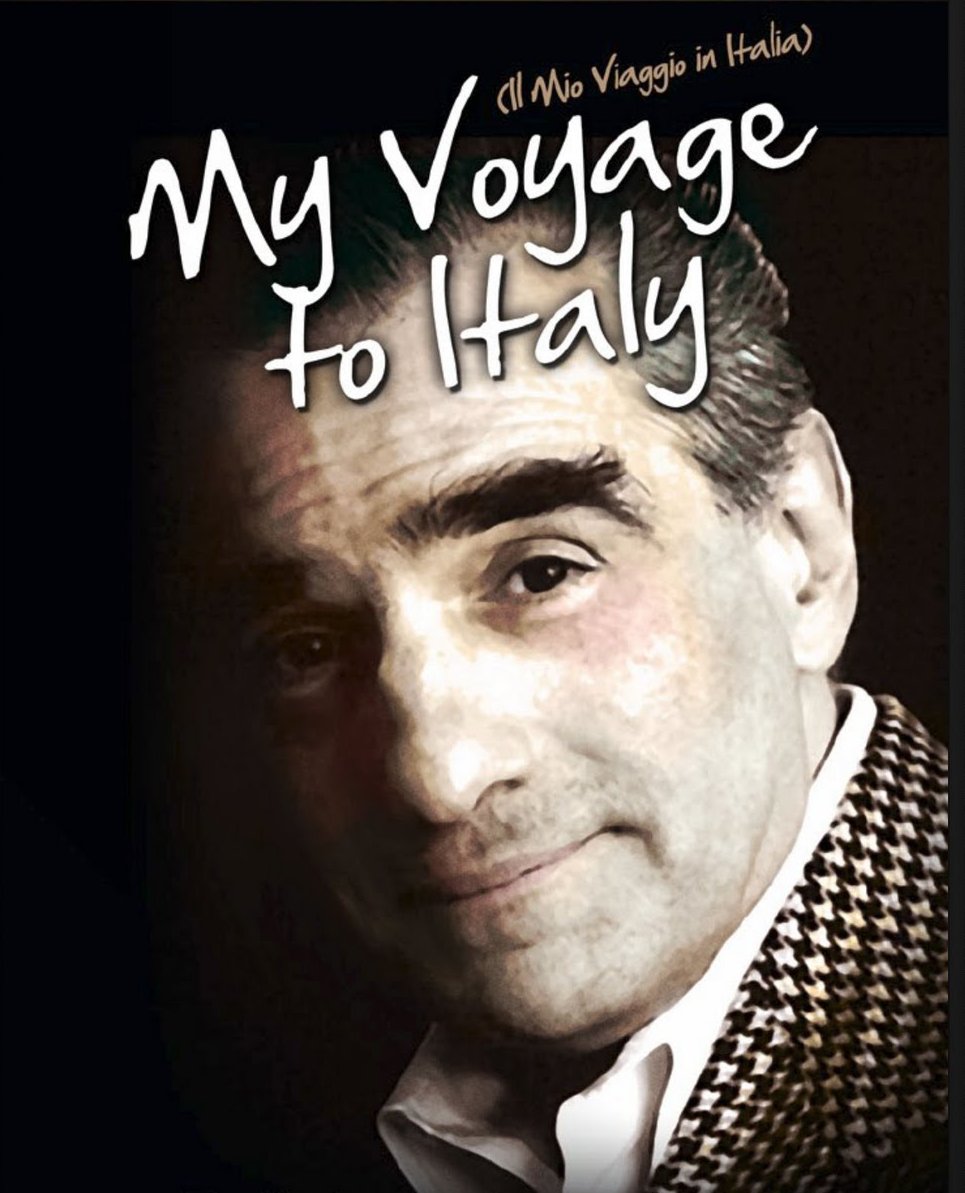
Secondly, I decided to change the protagonist’s first language from Tigrinya (Eritrean) to Italian. I did this as Eritrea is an Italian colony and Italian is spoken there. Furthermore, I thought it might be a nod to Scorsese. Why nod to Scorsese? An old friend once told me I should learn Italian, so I moved to Italy. I lived there for 18 months and still enjoy learning Italian today. Recently I’ve been learning by listening to podcasts related to classic Italian cinema on the Babbel app. This led me to discover Scorsese’s beautiful 4 hour documentary about the Italian films which inspired him as he was growing up – My Voyage to Italy – available on BFI player. As a result of watching this documentary, wonderfully narrated by the legendary director, Scorsese’s love of Fellini led me to watch La Strada which instantly became one of my favorite classic Italian films.
So, back to my screenplay. My protagonist now attempts to communicate with his traffickers / captors in Italian. But it’s no use. They speak Chinese. It might as well have been Tigrinya. Perhaps he’ll switch between Tigrinya, Italian and Mandarin. But that might all be a bit much for a short film. Not that they are saying anything important. What’s important is demonstrated by the action. The scenes can be understood without understanding the dialogue. There is no exposition. The story is told visually. No important information is conveyed through dialogue. Just as well. As when the film is screened I want to insist on no subtitles, to give the audience the same experience as the characters in not being able to understand what the hell is being said. Which leads me to empathy and John Yorke.
But that’s my 250 words done for now, and I’ve got an essay to write.
Oh, I almost forgot. After studying the craft of screenwriting for 10 of the last 15 years, I only this week discovered the term ‘easter egg’ from my module leader. I explained to him that the football video game commentary in my short film signposts the act breaks and turning points – which will only be understandable to industry insiders, e.g. ‘He’s a great midfielder,’ midpoint) and ‘Time to act. Penalty no. 3’ – Act 3 etc etc. On asking if this was a bit pretentious my module leader said no, it was an ‘easter egg.’ When I googled easter egg I discovered these are secret messages put in films by writers and directors – inside jokes.
I love this MA. You learn something new every week.
Below I have broken down The Wire bible overview into an interview in order to see its structure.
As you will see below, there are 9 paragraphs which each cover a different subject as follows:
Paragraph
Genre / Setting
Theme
Grand Theme / Philosophy
Transcending the Genre
Structure
Story Arcs
Style
Influences
Introduction of what follows in the series “Bible”.
NB. Questions in italics are mine.Answers are David Simon, writer and creator.
PARAGRAPH 1: GENRE / SETTING
What genre is The Wire?
The Wire is a drama that offers multiple meanings and arguments.
Can you be specific? What kind of drama and where is it set?
It will be, in the strictest sense, a police procedural set in the drug culture of an American rust-belt city.
Is it like other stuff on TV?
(It is) a cops and players story that exists within the same vernacular as other television fare.
PARAGRAPH 2: THEME
What are its themes and does it break new ground?
As with the best HBO series, it will be far more than a cop show, and to the extent that it breaks new ground, it will do so because of larger, universal themes that have more to do with the human condition, the nature of the American city and, indeed, the national culture.
Would you say it is a descendant of Homicide or NYPD Blue?
The Sopranos becomes art when it stands as more than a mob story but as a treatise on the American family. Oz is at its best when it rises beyond the framework of a prison story and finds commonalities between that environment and our own external world. So, too, The Wire should be judged not merely as a descendant of Homicide or NYPD Blue, but as a vehicle for making statements about the American city and even the American experiment.
PARAGRAPH 3: GRAND THEME / PHILOSOPHY
What is its grand theme?
The grand theme here is nothing less than a national existentialism. It is a police story set amid the dysfunction and indifference of an urban department — one that has failed to come to terms with the permanent nature of urban drug culture, one in which thinking cops and thinking street players must make their way independent of simple explanations.
PARAGRAPH 4: TRANSCENDING THE GENRE
How is it different from other cop dramas?
The Wire extends the cop drama beyond the us-against-them heroics, even past the flawed-but-still-viable family of the Homicide squad room.
How will it be visually?
Visually, this drama will be the next generation in what has become classic American television fare, and as such, it will be hard for other police procedurals to ignore the implications.
PARAGRAPH 5: STRUCTURE
How is the series structured?
Structurally, each season of The Wire – be it nine or thirteen episodes – exists as a stand alone journey. Some characters may progress to the following season for continuity; most others will have their stories resolved in a single season (a design that allows for greater latitude in casting). Each story arc must provide episodes that stand alone as dramatic television, but at the same time the whole must make a cogent argument about the national condition, using the streets and stones of one city as a microcosm.
PARAGRAPH 6: STORY ARCS
Do the story arcs have a common feature?
Each story arc ultimately gravitates toward one common feature, a prolonged wiretap / surveillance effort, (hence the title) that reveals intricacies and connections in the urban landscape that would ordinarily pass as unseen to even the best street cops. And each wiretap proves as discomfiting to the authorities as it does to those targeted. This is a world in which knowledge is always a double-edged sword.
PARAGRAPH 7: STYLE
What is the style of the show? Would you describe it as realism? How would you shoot it?
The style of the show can be called hyper realism. It should be shot 16mm and hand-held, though the coming video technologies may argue for something more experimental. But more than just visually, The Wire — by using precise geography, a fully conceptualized city and police bureaucracy, and story developments culled from actual case work, should present itself as something so clearly real that the traditional conceits of police melodrama are seen as such.
How will it be ‘clearly real’, as you say?
Nothing should happen on screen that hasn’t in some fashion happened on the streets, and the show will utilize a series of veteran detectives and Baltimore street figures for storylines and technical assistance.
Do you think the style of The Wire will be an important development in the cop procedural genre?
As The Corner is to every other inner city melodrama, so should The Wire be to any other presentation of police work.
PARAGRAPH 8: INFLUENCES:
So would you say it’s an exercise in realism?
But more than an exercise in realism for its own sake, the verisimilitude of The Wire exists to serve something larger.
How so?
In the first story-arc, the episodes begin what would seem to be the straight-forward, albeit protracted pursuit of a violent drug crew that controls a high rise housing project. But within a brief span of time, the officers who undertake the pursuit are forced to acknowledge truths about their own department, their role, the drug war and their city as a whole. In the end, the cost to all sides begins to suggest not so much the dogged police pursuit of the bad guys, but rather a Greek tragedy.
What’s the reward for the viewer?
At the end of the thirteen episodes, the reward for the viewer — who has been lured all this way by a well-constructed police show — is not the simple gratification of hearing handcuffs click. Instead, the conclusion is something Euripides or O’Neill might recognize: an America at every level at war with itself.
PARAGRAPH 9: STRUCTURE OF THE SERIES “BIBLE”.
How is the bible structured?
What follows is careful description of the setting, followed by a roll of major first season characters, some of which can continue into a second story arc. After that, the first season episodes are charted in some detail.
Have you done much advanced work on the story beats?
Because this show relies on the singular spine of one wiretap case to link every episode and propel the story, more advanced work has been done on the beats than might otherwise be necessary with another drama.
The task is to reflect on the creative work done this week on our short film projects.
As I began to write draft 2 of my screenplay Death Penalty, about a corrupt football underworld, I realised that I had lost my 3 act structure.
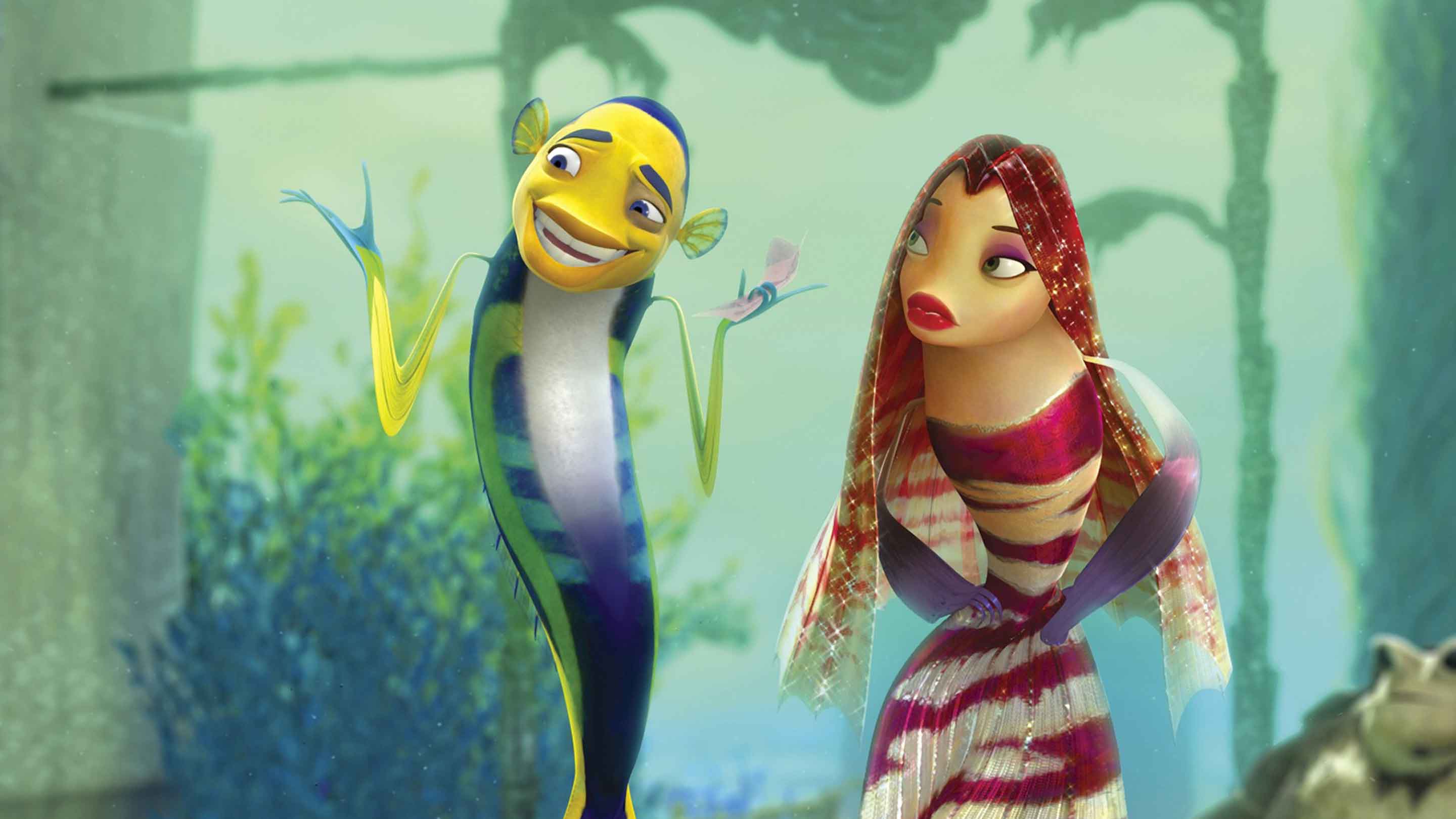
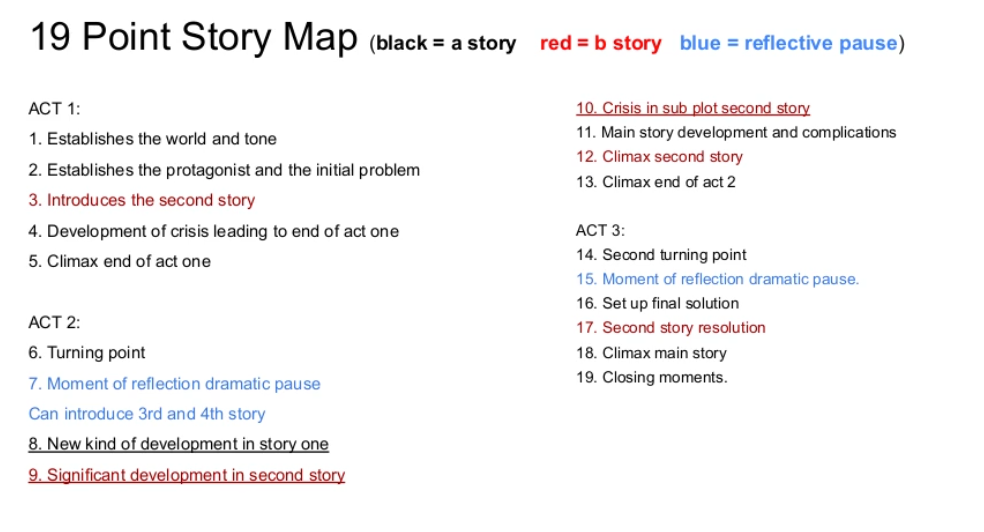
I put this down to having adopted the new 19 step approach, which omits a midpoint, but focuses on development of the inner and outward journeys of the protagonist and choreographs each journey separately. I decided to go back to my step outline and 19 step journey and rewrite each, keeping the choreography of the 19 step structure but fitting that structure into 3 acts as taught by Michael Hague. I was partly inspired to do this after watching Shark Tale.
Shark Tale (Screenplay by Michael J. Wilson and Rob Letterman), like 127 Hours (screenplay Danny Boyle & Simon Beaufoy) adheres to perfect 3 act structure. The two films match in structural form minute for minute, as follows:
Act 1: 15 mins
Act 2: 60 mins
Act 3: 15 mins
Both have very clear midpoints which mirror the Act 3 climax. In 127 Hours the midpoint is Aaron’s consideration of using the knife. In the climax he uses the knife. Shark Tale’s midpoint is where Lenny tells Oscar he is a liar and asks him what would happen when everyone found out the truth? In the climax Oscar admits to everyone he is a liar and tells the truth. John Yorke calls the midpoint ‘a moment of supreme significance.’ (Into the Woods p58).
Further development of my script changed one of my protagonist’s opponents to a Chinese national. I received peer feedback which asked me what year was my story set it, as there is a video game element where a VR goalkeeper, which I described as a hologram, was able to physically interact in the real world. So I decided to set the short film in a dystopian future where this science might exist (a little like the creatures the games masters introduce into the arena in The Hunger Games). Actually, the feature script the short story is taken from is set in a dystopian future.
As a consequence I changed one of my opponents to Chinese speaking. The reason for this is 1) to be diverse and 2) China is a huge market, for both investment and distribution. I am also toying with the idea to changing my main antagonist from male to female as I’m feeling a little hypocritical, constantly protesting for more female lead characters yet, when the opportunity presents itself to write a short film, all of my characters are male. (Again, in the feature film version, Kora, the lead character is female.) However, in the short film I may keep the lead as male as I want to show that young men are victims of labor trafficking as well.
I now have two or three foreign languages in my short film. The young male lead, Isaac, is from Eritrea and speaks Italian and Tigrinya (the language of Tigray). (Eritrea was colonized by Italy and Italian remains a spoken language). One opponent speaks Chinese. The main antagonist speaks Russian, Punjabi and Chinese.
I began by writing the opponent’s lines in Chinese using google translate. Then I realised that if we were to do a table read of the script, unless we could read Chinese, we wouldn’t be able to say the lines. Even if in the film itself I didn’t want the lines to have subtitles (because I wanted the audience to empathise with the confusion the language barrier caused in the protagonist) it meant a table read would be impossible. The subtitles decision could be made later, with the director. So I googled how to write dialogue in a foreign language. I found this page. It gives different options on ‘how to’ write foreign languages in screenplays with examples.
To sum up, then, I didn’t yet go back and rewrite the 19 step outline with a midpoint. I did look for the midpoint on the page in my screenplay, and found that the midpoint was in the (almost) perfect position already. 17 page screenplay, the midpoint should be half way down page 8. There it was, my midpoint, halfway down page 8!
I had been very attempted to start again, combining the 19 step paradigm with 3 act structure. It would have been a lot of work. Perhaps it was time to trust my process. I had put in the initial work, developed the story from premise through synopsis, treatment, inner / outer journey / want / need and 19 step structure, so maybe I just had to trust that that early work would pay off, and trust that the screenplay would hit all the beats in the right places. Because when I watch a movie like Shark Tale or 127 Hours and see how precise the structure is to the minute, I think to myself, I want to do that. No, I have to do that. I need to do that. After all, if I can’t write a perfectly structured short film in 10 or 15 minutes, how can I do it in 90?
So, this week we studied a 19 point breakdown (see below).
I initially rebelled.
But then I thought, having spent 10 years getting to grips with 3 Act Structure and The Hero’s Journey – as well as John Truby’s teaching on moral story world and moral argument – the problem of Act 2 still existed.
It’s one thing to know 3 act structure or The Hero’s Journey. To know the beats. (And don’t forget the eight sequence approach). But there’s still a lot of Act 2 to fill. So I was ready to embrace any set of rules or any system that allows me to breakdown a screenplay into smaller parts to make its writing more doable.
Yet in this 19 point approach my hackles raised when I realized there was no midpoint. Having spent the last two weeks reading John Yorke’s Into the Woods which advocates a 5 act structure (which I am still getting to grips with) and stresses the importance of a midpoint – to write a 19 point breakdown without a midpoint seemed like it was missing something.
Can’t we have 20 points and have a midpoint?!
Nevertheless, I wrote my short film story according to this 19 point structure and was shocked to discover the story / treatment I have been working on for the last 4 weeks fit the 19 point structure perfectly.
It felt like a gift from God!
Having a structure laid out to follow the inner journey (need) and a separate thread for the outer journey I found immensely helpful.
And it seemed to fit organically.
How weird.
So, I wrote my step outline, not according to my treatment, but according to this 19 point structure.
The question still remains about the midpoint. I take my mark from Danny Boyle and Simon Beaufoy, who, in 127 Hours (dir. Danny Boyle, screenplay Danny Boyle and Simon Beaufoy), use the midpoint as a mirror for the climax at exactly 45 mins in (of 90 mins).
It is the moment Aaron first considers using the knife to free himself. The 3 act structure is clear. John Yorke notes the same strict adherence to a midpoint in Being John Malkovich (dir. Spike Jonze, screenplay Charlie Kaufman) which happens at exactly 54 mins (of 108).
Into the Woods p243
So, where is my midpoint? This is the terror and excitement of my week ahead.