X-Files pilot – episode structure part ii

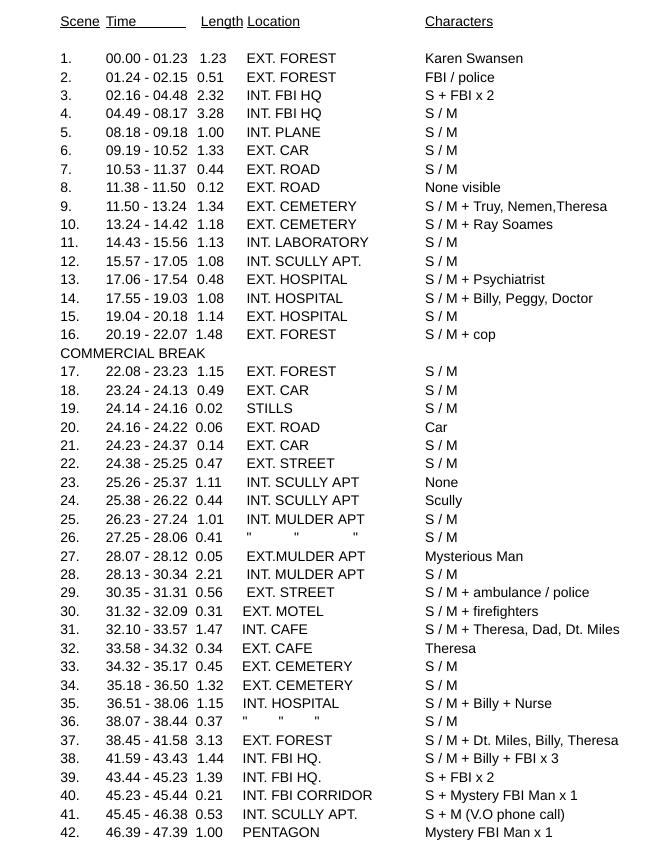
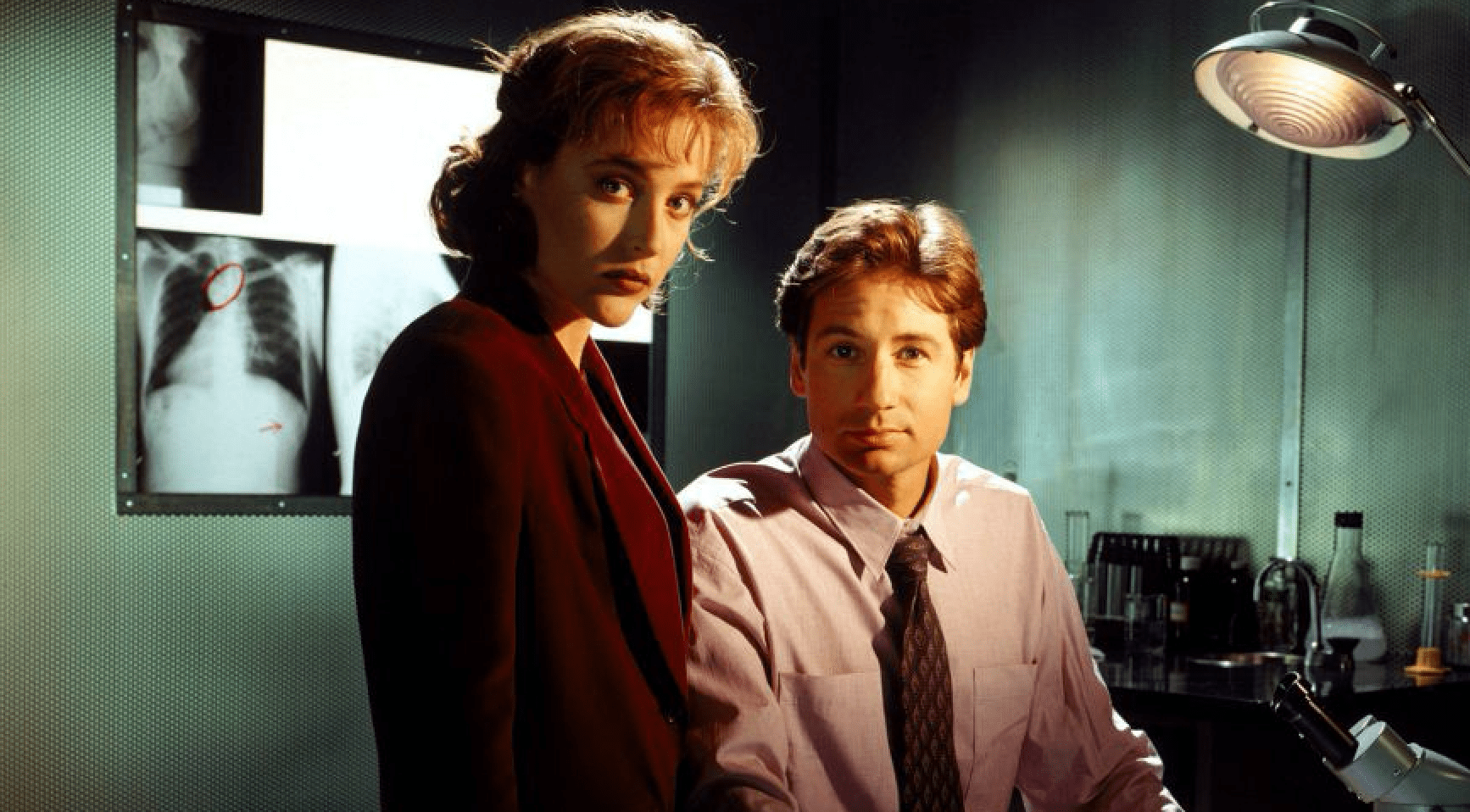
So, what else should we take away from this scene-by-scene breakdown?

First, let’s determine how many scenes our two protagonists are in (or, perhaps more importantly, not in).

Like Criminal Minds, and the UK’s Silent Witness, the opener is the crime to be solved.

Next, we head straight to Scully’s recruitment by the FBI – her task: to investigate Mulder.

Her task set, Scully meets Mulder. They are then in every scene EXCEPT an exterior cutaway of their car driving along the road (scene 8) until the commercial break.

(This must have been written in a time when writers had to leave a cliffhanger before the commercial break). It happens here between scene 16 and 17.

Then, it’s Scully and Mulder again until another car cutaway in scene 20.

Scene 23 is 11 seconds of words being typed by Scully on a computer screen.

Scene 27 is 5 seconds of a mysterious man loitering outside Scully’s motel room.

Then, it’s Scully / Mulder right through until Scully reports back to the FBI suits in scene 39.

I suggest the next 3 scenes are the resolution:

Scene 40 – Scully wonders who the Strange Man is at the FBI.

Scene 41 – Scully takes a call from Mulder while in bed.

Scene 42 – the Strange Man at FBI revealed to be a storeroom clerk at the Pentagon

So, in conclusion, Scully and Mulder are in a total of 32 of the 42 scenes together.

(Of those 32 scenes, 19 scenes are only Scully and Mulder and 13 involve other characters).

Scully and Mulder are absent from 7 scenes.

Of those 7 scenes:

2 scenes are the crime opener

2 scenes are exterior cutaways

1 scene is words being typed on a screen by Scully, and

2 are mysterious men.

Scully is in a total of 5 scenes without Mulder.

Scully has 1 scene alone.

Stay tuned for the next post when we will step outline the episode.

X – Files Pilot – episode structure

As module 3 of the MA Writing for Script and Screen is to write a step outline, treatment and character breakdown of a rebooted X files, here is a breakdown of the original pilot, including number of scenes, scene lengths, location and characters.

So, what can we learn?

The first thing to note is the ouroboros nature, the mythological snake with its tail in its mouth – a technique taught in many a creative writing class – meaning simply a circular shape to the episode.

In scene 3, Scully is given a task – report on Mulder’s investigations. In scene 39, Scully fulfills her task and reports back. Scully achieves her goal.

Stay tuned for the next post analysing the X-Files pilot.

Sid Field Key Incident

So, I’m reading Sid Field’s seminal book SCREENPLAY – The Foundations of Screenwriting. Sid makes a distinction between what he calls the ‘key incident’ and the ‘inciting incident’.

On p35, Sid says this:

“In Mystic River, the inciting incident is in the past, when Dave (Tim Robbins) was abducted by the two perverts; it sets the story in motion and leads to the ‘key’ incident: the discovery of Jimmy’s (Sean Penn’s) murdered daughter.”

Then, two paragraphs later, Sid writes:

“Sometimes the key incident will be something that has affected your character’s life at an earlier time, as in Mystic River.

But wait a minute, Sid just said the earlier life event in Mystic River is the ‘inciting incident.’ Now it’s the ‘key incident.’

Ironically, on p36, Sid writes:

“When you begin writing your screenplay it’s essential that you know the distinctions between the inciting incident and the key incident.”

But Sid, haven’t you just confused the key incident and inciting incident yourself?

MA Screenwriting Year 1 Mod 2 Week 9

I missed a week I think, thinking, well, should I bother with this weekly reflective blog, because apparently we’re not being graded on it. But, the truth is, I had grown into a habit of doing it on Sunday nights before tackling the next week’s inbox of tasks. And I miss it. Besides which, it is actually useful to organize my thoughts, progress, or lack thereof.

The war in Ukraine has taken up my attention and I’ve been finding it increasingly difficult to focus on my short screenplay. I did, though, manage to get a step outline done this week, as well as weaving in an unexpected pixar-style animation into my script, which took me by surprise, which I’m enjoying writing, exploring the internal workings of the urinary system. (If I hear another ‘are you taking the piss’ joke I may just throw my laptop at you.)

My task this week is to get a first draft of the screenplay down. I’ve applied for an extension for my portfolio submission date, so I’ve got an extra two weeks, thankfully. This at least allows me to make up for some of the time I lost due to being glued to The Guardian’s Ukraine invasion live stream 24/7.

An important decision I have to make is what kind of law is my female half of the romcom studying. The story serves as a metaphor for female empowerment. The key will be to subtly hint at the theme rather than spelling it out and bashing my readers over the head with the European Convention on Human Rights.

Until next time.

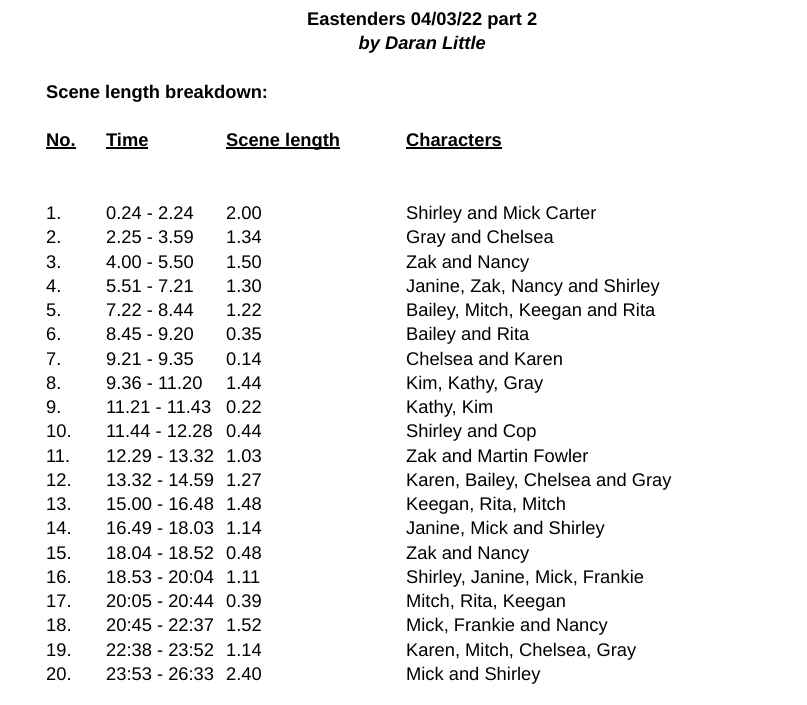
Eastenders – Scene Breakdown 16 March 2022

From this breakdown we can see there are 19 scenes. The previous two episodes analyzed consisted of 20 scenes, so we can presume that approximately 20 scenes are required per episode.

We can also note that there are three families with major storylines: The Taylors, The Carters, and The Mitchells. However, The Pansars and The Foxes have one scene each, too.

It is my understanding that there are 5 storylines in this episode:

Chelsea Fox

Tommy Mitchell

Keegan Taylor

Kheerat Panesar

Mick and Shirley Carter.

BBC Eastenders scene breakdown analysis #2

Notice that like the episode previously studied, this episode has 20 scenes.

How many storylines are there in this episode?

We might say that there are four storylines.

  1. The Carters – characters: Mick, Nancy, Frankie, Shirley, Janine
  2. Gray and Chelsea – characters: Gray, Chelsea, Kathy, Kim
  3. Zack and Nancy – characters: Zack and Nancy.
  4. Mitch & Karen – characters: Keegan, Mitch, Bailey, Karen, Rita.

Reflective blog: No Time to Die.

MA Writing for Script & Screen 1:2:6 (Year 1 Module 2 Week 6)

Well, what a week. Very difficult to focus on this MA with the horror of the invasion of Ukraine. In way, though, it’s made me even more determined to write a good project, this term, because life is precious, and no tyrant like Vladimir Putin should be able to steal our love of culture and art.

So, on I press.

Also, having worked so hard on the video pitch assignment submitted in week 5, I need a little time to shift to the next phase of the process – treatment, outline and script.

Last night I went to a private screening of No Time to Die with a Q & A with Barbara Broccoli and some British members of the sound and visual effects team. I had seen it before. But after this screening at the Soho Hotel, I’ll never go to see a movie at my local picture house ever again – such was the difference in sound and visual quality of this small, private audience movie theatre.

I also couldn’t help realizing how relevant this espionage thriller was. If only MI6 did have a nanobot – a biomolecular DNA targeting lethal virus that can move through human bodies, harming no one, until it reaches its intended target.

But what about my short film project. I was pleased with the pitch. I wrote it, rewrote it, memorised it and practised it, and finally, after 200 or so takes, submitted what I thought was an OK version. Most importantly of all, I never broke eye contact with the camera. As a classical actor, perfection of words is paramount – and because I hadn’t memorised the pitch as exact as I would a Shakespeare piece, I suffered and kept slipping up. If I had taken longer perfecting the memorisation, I probably could have delivered it in one take. Still, it was my first pitch, and overall I was pleased with it. Lesson learned.

Next steps: rework the treatment and step outline. I’m a firm believer that the form of the short film should be as visual as possible, and we should tell the story without words as much as possible. This project, called Piano, will have a strong focus on audio as it centres around a jingle composer.

Most of the writing, so far, is taking place in my head.

Where is your writing taking place at the moment? And how is the Ukraine situation affecting you?

The Chicken or the Genre?

MA Writing for Script & Screen: Year 1 Module 2 Week 5

This week was pitch assignment week. Having delivered my pitch for my romcom to my tutor, I received feedback which forced me to learn defining qualities of other dramas.

What I mean is, I’d pitched it as a romcom, for which I’d learned and memorised the necessary defining qualities.

However, my tutor suggested my story might actually be a personal drama as the romcom shares screen time between the two central characters, whereas my story seemed to weight slightly more in favour of the male. I suggested that Notting Hill (1999 dir. Roger Michell, screenplay by Richard Curtis) follows the male story and screen time is probably slightly more balanced in favor of the male there as well. Although my tutor agreed he still felt the personal drama might give me more ‘space to breathe.’

So, I returned to Phil Parker’s genre breakdowns and realised my story has defining qualities of three genres: the personal ‘inner’ drama, the romantic drama, and the romcom.

This led me to wondering what comes first, the genre or the story?

Should a writer write the story first, and then see which genre/s fit? Or should we decide on a genre/s and write the story to fit the defining qualities of the drama?

The ol’ chicken egg question.

What do you think? Which comes first, the story or the genre?

MA Mod 2 Week 4: Transcending the Genre

So week 4 was 1:1 tutorials. I was privileged to pitch my 15 minute short film Piano to the course leader.

I had already decided to rewrite my female character as a law student without being an escort. The story itself is already a metaphor for consent. Nuff said.

I pitched it as a romantic comedy, even though in my short, as in Notting Hill, rather than the two central characters sharing equal screen, time narrative weight seemed to favor the boy.

So it was suggested to perhaps pitch it as a personal drama with a comedic tone. That way I won’t have to worry about giving the two central characters equal screen time, but can focus on the learning curve of the male character – learning his lesson at the feet of the woman he loves – following his journey.

I checked the defining qualities of the personal inner drama genre as per Philip Parker‘s breakdown and decided that my story fits.

John Truby (22 Steps of a Master Storyteller) teaches about transcending the genre.

The reading this week was Alternative Screenwriting, one of the chapters is called ‘Working against Genre.’

So, my task this week is to pitch this story as a personal inner drama with elements of the rom com, and, importantly, to be specific about which elements of each genre.

And then, record and upload it for grading.

After that, my task will be to ensure the want and need of my hero is in place. Not only that, but to ensure that the climax happens like this:

The Hero has a moral revelation of his ‘need’. The revelation causes him to take new moral action. As a result of this change my hero is able to achieve his goal.

So, my second task this week is to ensure my hero’s outward physical goal and inner need is set in stone in my mind.

What are your tasks this week?

MA Screenwriting – module 2 week 2, 2022

So, it’s week 2, and, to be honest, I’m struggling so far this term. The assignment is to write another short film, and present a video pitch, due in week 5, together with premise, treatment, and reflective essay at the end of term.

So what’s my problem? It’s not like I don’t have ideas. I have a lot. The two I am considering for this project are a romantic comedy and a rite of passage crime drama. I can’t decide which to pursue. I’ve written a premise for both, a treatment for both, and a step outline for both, but I’m still undecided.

The romantic comedy gives me more enjoyment. It’s fun and full of light. The rite of passage crime drama is dark. No light. If I’m to write this story I need to find a way of allowing the light in. If I go with the romantic comedy I need to figure out how to squeeze it into the rules of the genre.

As for genre, we have been pointed to Philip Parker and The Art and Science of Screenwriting, which is next on my buy-list. Initial readings of the rules of the three ‘romance’ genres seems to slot my story into comedy, as opposed to romantic drama or romantic tragedy (in this case art doesn’t imitate life).

Of the romantic comedy, our genre reading states this:

“The aim of the plot is to provide as many comedic moments as possible between the two central protagonists and their environment or other characters.

But my question is this: comedic to whom?

Interviewed about his play The Comedians playwright Richard Griffiths paraphrases Mark Twain when he says the source of all comedy is pain. Just because we are laughing, it doesn’t mean the character finds what’s happening funny. Don’t we often laugh at people schadenfreude style? Not laughing with them, but rather at them? At least, that is how it seems to work in Soap Operas.

Which gives me a task, to take a romantic comedy and see if I am laughing with the characters, or at them? What is your screenwriting task this week?