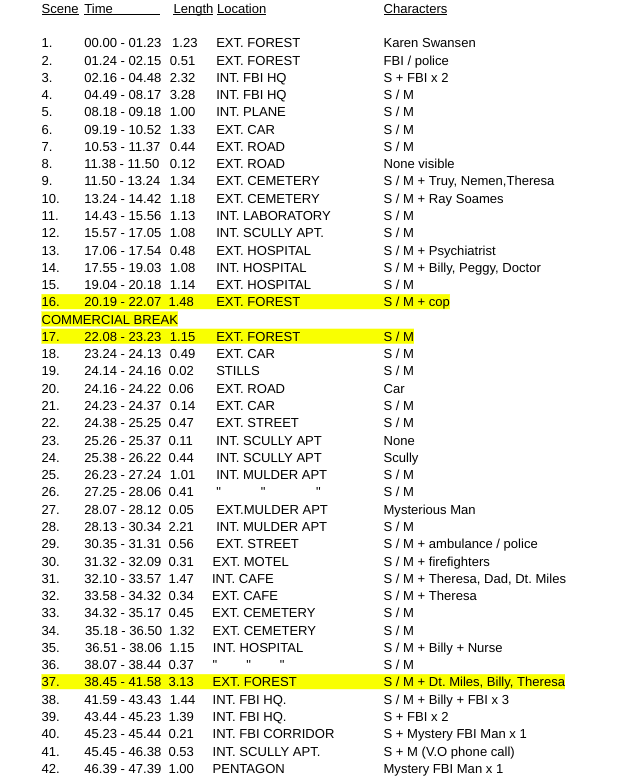
As I work through the step outline in the way Syd Field teaches in his book Screenplay – writing one sentence per scene – I noticed how Chris Carter follows the same structure in each scene in order to provide new information which moves the story forward.
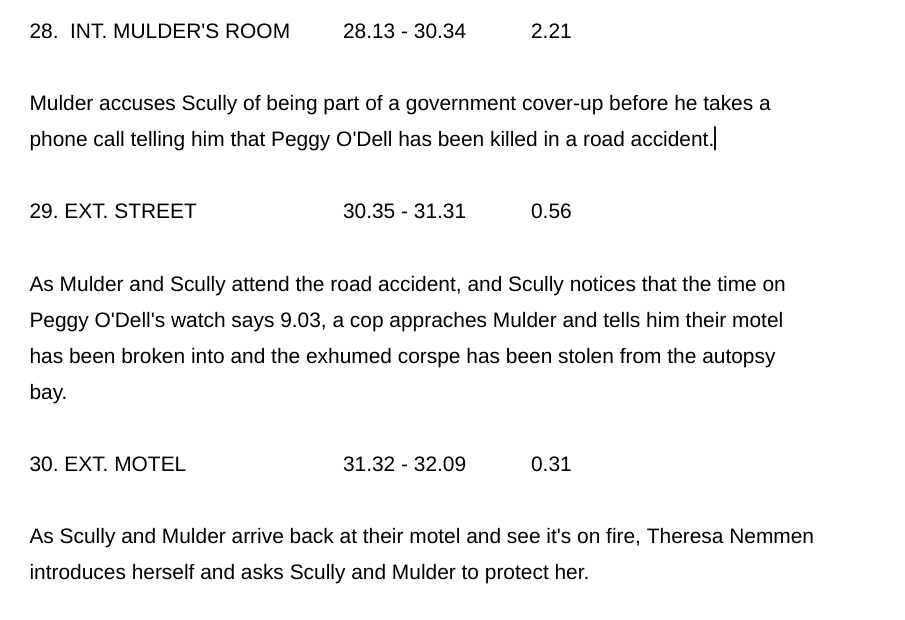
Take a look at these three scenes:
Scene 28 – a phone call interrupts
Scene 29 – a cop approaches
Scene 30 – Theresa shows up
It’s very simple, but worth noting: at the end of each of these scenes an outsider appears (someone who is not Mulder or Scully) and provides new information which moves the story forward.
Let’s look at this scene where Scully is called to a meeting and given her task of investigating Agent Mulder.
What can we learn from the dialogue in this scene?
Let’s look at Chris Carter’s action line after the first chunk of dialogue from Blevins. He says:
reading through to the subtext here.
So, what’s the subtext? It isn’t directly apparent that there is subtext, but Carter says there is. He tells us, with Scully’s next line:
Am I to understand you want me to debunk the X-files project, sir?
Carter writes ‘A tensile silence’. Tensile is an interesting word, which I had to look up.
relating to tension.
capable of being drawn out or stretched.
Blevins responds: Agent Scully, we trust you’ll make the proper scientific analysis.
In his answer Blevins response sets out Scully’s role for the rest of the episode. What we’ll find is that when Mulder poses his metaphysical theories, Scully often responds with ‘scientific analysis.’ So, we could say that the dialogue of this minor character, Chief Belvins, points us to, or foreshadows, the kind of dialogue we can expect from the main character, Scully.
In fact, when Scully finally agrees with Mulder about his theories, in a fit of hysterical laughter in the cemetery at the 35 / 36 minute mark, it is arguably at the end of Act 2.
Act 2 is traditionally the ‘all is lost’ moment in screenwriting structure, what Blake Snyder calls ‘visit to death.’
So, is this line from Chief Blevins, about Scully making proper scientific analysis, foreshadowing Scully’s ‘all is lost / visit to death’ moment at the end of Act 2 regarding her belief that all unexplained phenomena can be explained by scientific analysis?
The pilot episode is dialogue driven. However, I can think of six visual pieces of the puzzle they have to solve.
The corpse they exhume is non-human.
The unidentified metal device, found in the corpse’s nose, which Scully saves from being destroyed in the fire, and which in the final scene is filed away in the Pentagon.
The watches – one traditional, one digital – showing 9.03.
Mulder’s compass.
Scully’s computer.
The two skin growths on each of the victims.
Can you think of any more? Have I missed something?
In scene 18, at around the 24 minute mark (the midpoint) Mulder checks his watch. It’s 9.03.Then, in scene 29, about 7 minutes later, this is paid off when Peggy O’Dell dies, run over by a truck at exactly 9.03.
What is interesting to note is that the first watch, Mulder’s is digital.
The second watch, Peggy’s is traditional.
Furthermore, in scene 34, both Mulder and Scully refer to this particular time.
What other set-ups and pay-offs are in this pilot?
On the MA Writing for Script and Screen recently we covered how screenwriters use active questions, so I thought this was worth sharing.
Scene (15) 19.04 – 20.18
The scene is structured in 5 parts.
Question.
Theory.
Opposition.
Case update
Active questions.
Let’s look in more detail:
(The writing is my transcript.)
EXT. HOSPITAL – DAY
Question: Scully asks Mulder how he knew Peggy would have the same marks as the victim.
Theory: Mulder says he believes the kids have been abducted.
Opposition: Scully has a rational scientific explanation and ridicules Mulder’s theory that they have been ‘riding around in flying saucers.’
Case update: Scully says: “You’ve got four victims. All of them died in or near the woods. They found Karen Swenson’s body in the forest, in her pyjamas, ten miles from her house.”
Active questions: Scully asks two active questions: “How did she get there? What were the kids doing out there in the forest?”
I thought it interesting that these active questions are asked directly, by the character, to the audience.
What do you think? Do you agree? Can you think of any other examples where these kinds of questions are asked in other TV shows?
The purpose of the scene is twofold: either it moves the story forward or it reveals information about the character. If the scene does not satisfy one or both of these two elements, then it doesn’t belong in the screenplay.
(p162).
This scene is an example of how X-Files writer Chris Carter does both.
INT. PLANE
Mulder is lying horizontal, eyes closed, with headphones across three seats, while Scully sits in her seat upright, researching news articles.
First, Scully looks at a picture of a man in a student graduation uniform. The headline read: Former honor student’s body found in state park. Next, Scully flips the page to a picture of Karen Swenson, the girl whose death they are investigating. The headline: 4th tragic fatality befalls class of ’89.
The camera slow-mo zooms in on the inserted text: ‘autopsy, Dr. Nemman, untimely death.’
The plane shakes as it hits extreme turbulence. Scully breathes deeply, focusing on controlling her fear, while Mulder makes a joke, unperturbed.
(my transcription)
1.Moves the story forward
This information moves the story forward as it provides information which Scully and Mulder can use to join together the pieces of the puzzle and ultimately solve the mystery.
2. Reveals information about the character
The turbulence section exists only to show how different the two protagonists are. It reveals information about the characters. As the plane hits turbulence, Scully is scared and Mulder isn’t.
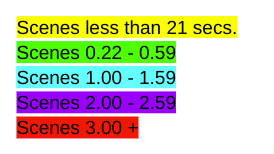
In the last post we noticed that only 1 scene is over 3 minutes (3.13).
Scene 37 – the Climax.
However, scene 16 & 17 either side of the commercial break, are actually one scene.
16. EXT. FOREST 1.48
COMMERCIAL BREAK
17. EXT. FOREST 1.15
So, if we join them together they are 1 scene totalling 3.03 minutes.
This scene is just about the midpoint, starting at 20.19 and ending at 23.23. But what happens in the scene to signal the midpoint? And since the midpoint should be a reflection of the climax, it is right that both scenes are 3 minutes. But it’s not enough that the midpoint and the climax are a similar length, there has to be something that happens that is a mirror image. So what happens in this middle scene that is a reflection of the climax?