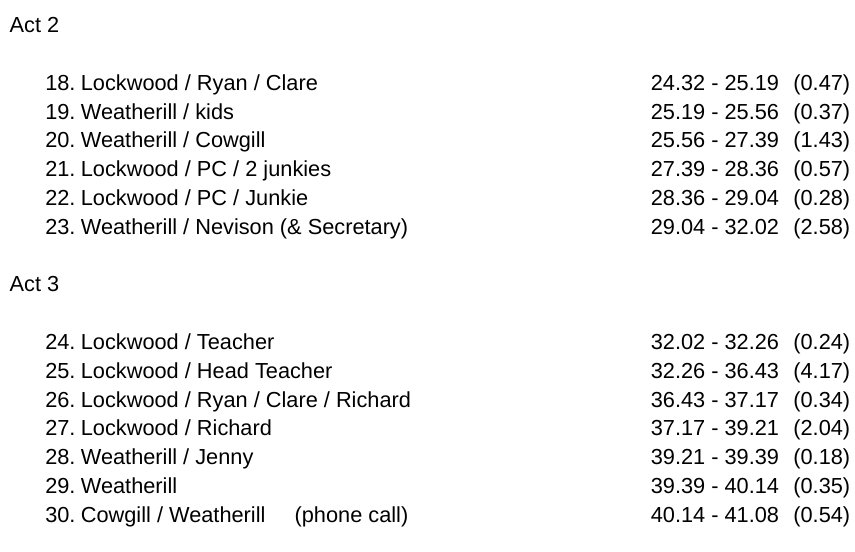
As we can see in Act 2, the balance of scenes are fairly equal between protag and antags.
The victim only appears in the final scene, together with the main episode’s antag.
The balance of time between protag / antag / victim is very well balanced: 2.21 / 2.20 / 2.58.
Now let’s look at Act 3.
What do we notice here?
The balance is heavily weighted in favour of the protagonist and dedicated to the episode’s B story – which in fact is the A story of the season – the son of the main antagonist being the grandson of the protagonist (extremely complicated and intricate story telling).
We can also notice that none of the victims appear in Act 3. The entire act is dedicated to protag and antags.
In the first post I explained why I believe the episode is written in 5 acts (because the final scene of each act is turning point instigated by the main antagonist).
In this post I want to look at two things:
The number of scenes.
The length of scenes
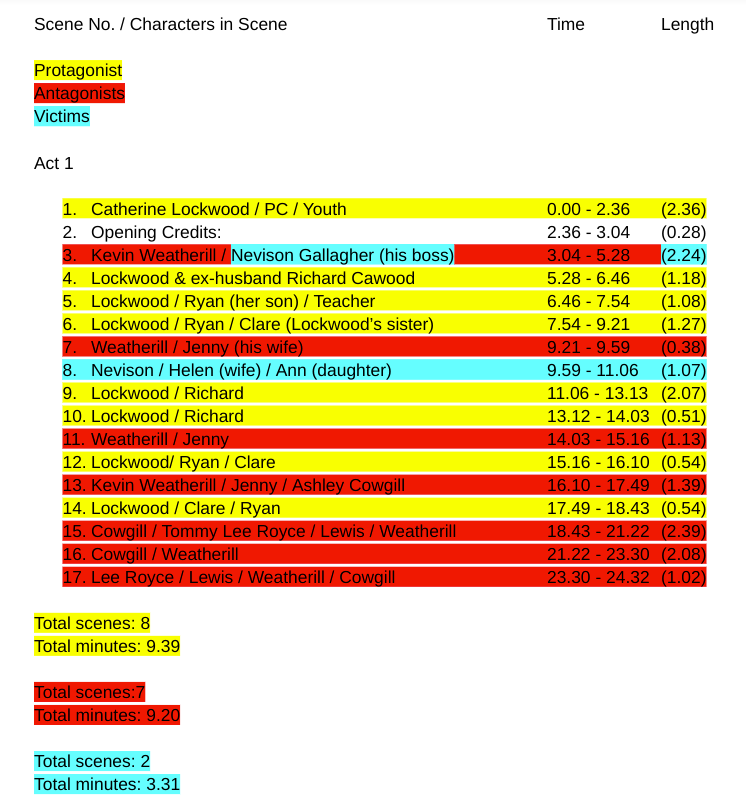
Scenes in yellow highlights are scenes with the protagonist.
Scenes in red highlights are scenes with the antagonists.
Scenes in light blue highlights are scenes with victims.
Scenes which are two colours are a mix, i.e. red / yellow are scenes with both protagonist and antagonist.
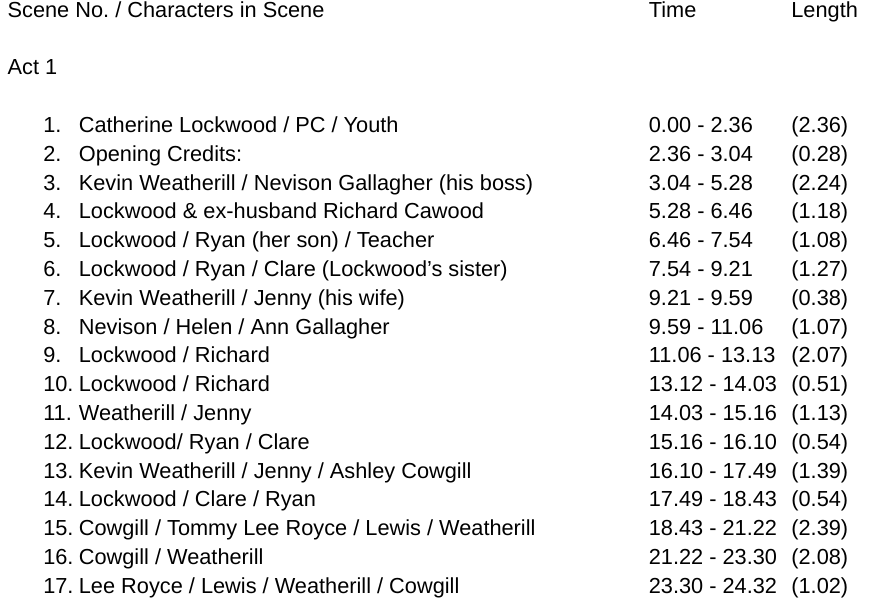
Let’s look at Act 1.
So, what can we notice?
First, there is quite an even balance of scenes between the protag and antag: 8 / 7.
The minutes of screen time are also equally balanced: 9.39 / 9.20
Victims inhabit only two scenes and 1/3 of the screen time of protag / antag at 3.31.
Secondly, almost exactly half-way through the act, scene 8, we are introduced to the main victim, Ann.
The purpose of this post is to analyse the balance of scenes between protagonist and their world i.e friends, family, and subplots that are non-case related (B stories) and antagonist, and as this is a police thriller, victim.
SPOILER ALERT.
Let’s start with Act 1.
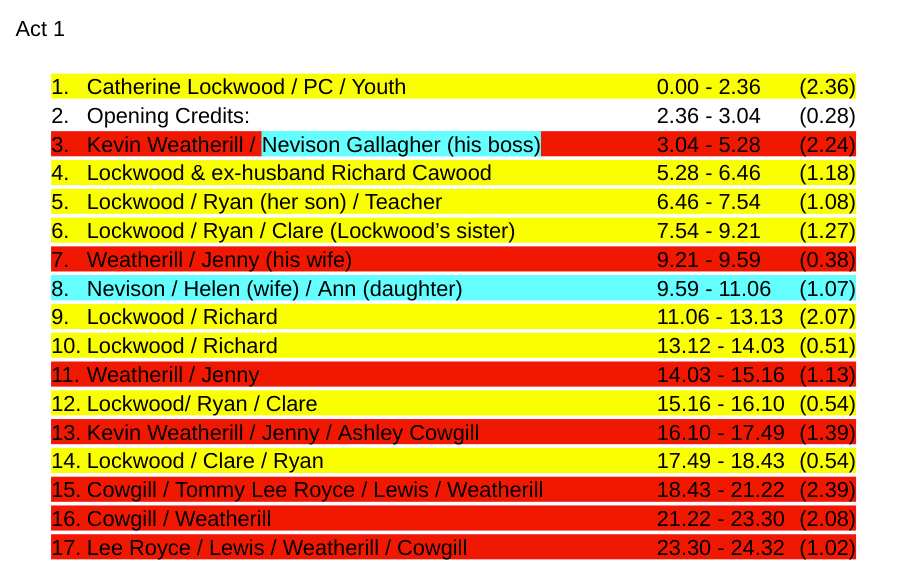
The yellow highlight = protagonist. Red = antagonists. Light Blue = victim.
So, what can we notice?
Firstly, there is very little of the victims.
The opening scene we meet the protag, but not in connection with the main case.
After the credits the main case begins.
Immediately we are introduced to this episode’s main antagonist: Kevin Weatherill. NB some may argue that either Tommy Lee Royce or Ashley Cowgill are the main antagonist. However, as the act breaks are all punctuated with Weatherill’s actions (see this post) I believe he is this episode’s main antagonist. He instigated the entire plot. Without him, we wouldn’t have the story.
As you can see, the scenes are quite balanced. After the initial scene with Nevison and Weatherill (scene 3) there are 8 scenes followed by 3 scenes dedicated to the antagonists at the end of the act.
One of the most interesting thing to notice is that the protag and antags have not yet met.
Now let’s look at Act 2 and Act 3.
Act 2 is another well balanced act between protag and antags. Interestingly, at the end of Act 2 we witness the victim with the main antagonist.
Act 3 are 4 scenes dedicated to the protag’s personal life (B story) although in this case the B story cleverly ties in with the main plot, as the child of the protag is also the child of one of the antags (not Weatherill and not related to the main case – this B story will take shape more clearly throughout the rest of the season).
In my opinion the way the writer intertwines the B story with A story is the major strength of the work.
Now, let’s look at Act 4 and Act 5.
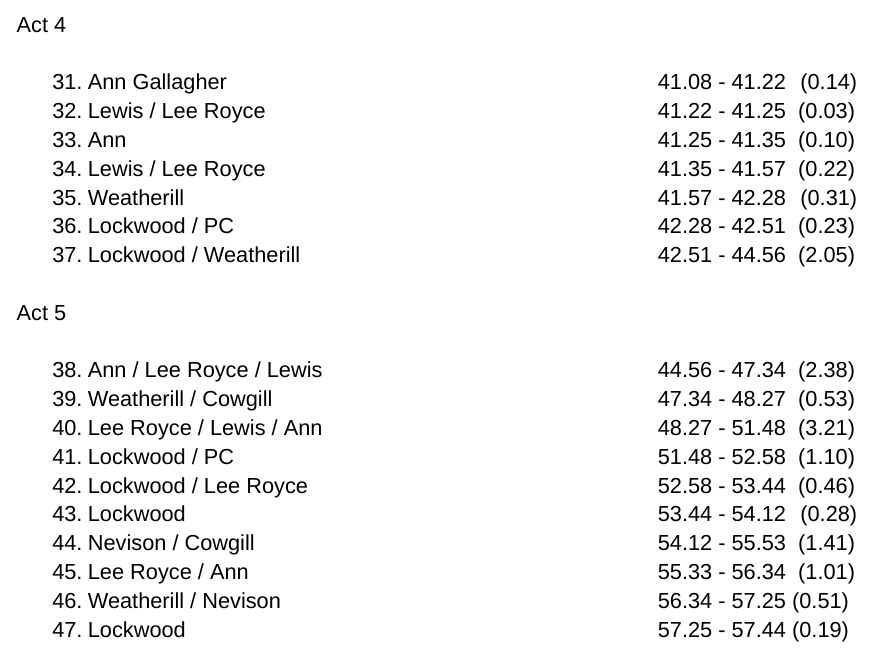
As we can see Act 4 begins with the main victim. This is the first time we spend any time with her. The first 5 scenes of this act are dedicated to the victim meeting the antagonists.
However, what is most important to note is the final scene of Act 4 is where the protag meets the antag for the first time (although in this case the protag has no idea she is meeting the antag.)
Act 5 has the second and third longest scenes in the entire episode (scenes 38 and 40) both dedicated to the major crime – the kidnap.
Scene 42 sees Lockwood see (but not meet) Lee Royce, who will become the season’s main antag.
The final scene is Lockwood discovering a major clue to the case and propels us into the next episode.
The three scenes prior to this final scene have victims and antags together for 3 scenes.
To sum up then, overall, protag and antags are kept apart until Act 4 and Act 5.
Act 5 is a glorious blending together of antags and victim.
The protag, however, is still kept separate. In fact, the only time protag meets antag is scene 37, at the end of Act 4.
What else do you notice?
Ashley (JOE ARMSTRONG), Kevin (STEVE PEMBERTON), Lewis (ADAM LONG)
End of Act: Weatherill learns from Nevison that the plan has been activated and Ann has been kidnapped
The final scene, (47) Catherine alone, is a hook to intrigue the audience to return.
Lockwood runs Weatherill’s number plate and gets his name and address. The protagonist is on to the antagonist.
Below is a breakdown:
What else can we notice?
We can notice that the set up (Act 1) is much longer than any of the other 4 acts. However, since this is the opening episode of a six part series this is understandable. The 24 minute set up is setting up a 6 hour story.
Interestingly, protagonist LOCKWOOD does not meet any of the 4 male antagonists face to face until she meets WEATHERILL in Act 4, scene 37, almost 10 minutes before the end.
Lockwood’s next close shave with her main antagonist Tommy LEE ROYCE happens in Act 5, scene 42. She doesn’t meet him but almost meets him.
So, at the end of episode 1, Lockwood, the protagonist, has so far met Weatherill, without realising he is an antagonist, and has seen – but not yet met – Tommy Lee Royce, her main antagonist.
What else can you notice about the structure of this episode?
I believe Tom Edge wrote this episode in 3 acts. In part 1 we look at Act 1 and part 2we look at Act 2.
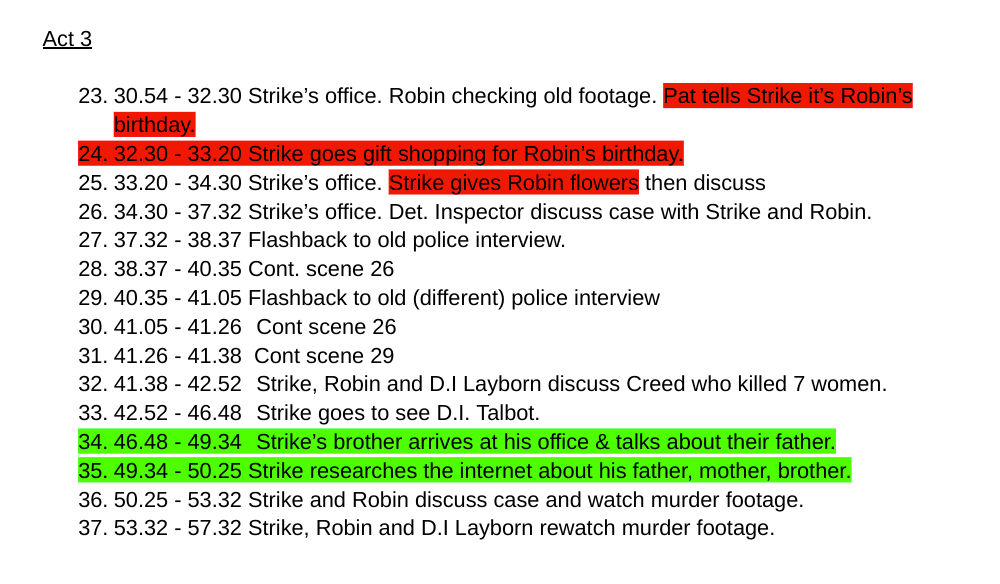
So, what can we notice about Act 3?
First of all, we are back to referencing the romance between Strike and Robin, which was absent in Act 2.
In scene 23 Pat, Strike’s receptionist, reminds Strike it’s Robin’s birthday. Then, in scene 24 we have a 50 second scene of Strike seeking a shop assistant’s advice over whether to buy Robin a ring. In scene 25 we see he gives her flowers before discussing the case.
Total screen time dedicated to this romance: 2 minutes.
Later, towards the end of this first episode (1 of 4) in scene 34 Strike’s brother arrives and they talk about their father. In scene 35 Strike researches his complex family history on the internet.
Total screen time dedicated to Strike’s personal family background: 4.37. (approx 5 mins).
So, to conclude, Act 3 is a total of approx 27 mins.
Total screen time dedicated to B and C stories: 7 mins (approx 25%) which is exactly the same percentage as Act 1.
Made up of:
2 mins dedicated to romance between the two protagonists (approx 7%)
5 mins dedicated to Strike’s family history (approx 18%).
20 minutes out of 27 are dedicated to solving the case. (approx 75%).
18. 26.22 – 27.34 Continue scene 15. Shows erotic painting of Margot by artist.
19. 27.34 – 28.17 Flashback artist fight with Margot about erotic photos.
20. 28.17 – 28.49 Cont. scene 15.
21. 28.49 – 29.51 Cont. flashback
22. 29.51 – 30.54 Cont. scene 15
What is interesting here is that, contrary to Act 1, there is no B story relating to the romantic relationship between Strike and Robin. Act 2 is dedicated solely to solving the case.
What is also interesting to note is the way the act is structured. The protagonists interview people who used to know the missing person back in the seventies. We then witness flashbacks of the missing person’s life, with VO from the person remembering.
Thirdly, women’s rights are again prevalent with regards to women working as ‘bunny girls’ in a club, and a debate about equal pay, which reminded me of the brilliant Made in Dagenham (dir. Nigel Cole, screenwriter William Ivory).
Troubled Blood, dir. Sue Tully, screenwriter Tom Edge.
Based on the books by Robert Galbraith aka JK Rowling.
13.55 – 15.03 Robin alone watches more videos on her phone about the case.
15.03 – 16.34 Strike on a ferry eavesdropping on strangers. Robin waits on the pier.
16.34 – 17.05 Strike and Robin talk in the car.
What can we notice about Act 1?
Firstly, three scenes are dedicated to the B story or personal stories of the characters, as opposed to the case.
Scene 6 revolves around Strike’s aunt having ovarian cancer. Scene 8 has his sister ask him why he doesn’t marry Robin. Scene 9 has Robin on the phone to her ex. We might argue the only reason we have scene 6 is so Strike can meet his sister for scene 8. I’m not sure what relevance the ovarian cancer scene has to the story, except perhaps, as it is a story by JK Rowling, pointing to the organs which are a main difference between men and women. Men cannot have ovaries. Clandestine argument? So, if scene 6 points to the feminist women’s rights theme which continues throughout the episode, then only 8 and 9 relate to the romance between Strike and Robin.
Then we might say:
1 scene relates to theme – feminism and women’s rights:
Scene 6: screen time: 2.21
2 scenes relate to Strike and Robin’s romance:
Scene 8: Screen time: 1.07
Scene 9: Screen time 1.49
The total screen time of Act 1 from 0.45 – 17.05 = 16.20
Total screen time dedicated to the new case: 12.03 (approx 75%)
Total screen time dedicated to non-case or B stories: 4.17 (approx 25%)
Total screen time dedicated to Strike and Robin’s romance: 2.56 (approx 20%)
Total screen time pointing to women’s issues / feminist themes: 2.21 (approx 15%)
Welcome to this series of posts looking at how different writers introduce their lead characters.
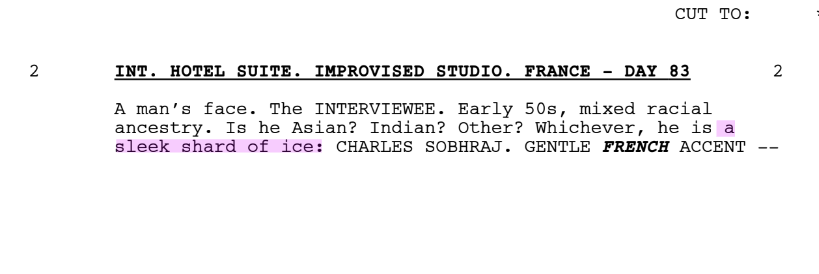
Let’s start with episode 1 of The Serpent written by Richard Warlow, produced by Mammoth Screen. The screenplay is available on the BBC Writers’ Room website.
Let’s take a look.
I love this. Charles Sobhraj is a sleek shard of ice. Richard Warlow chooses to describe him with a metaphor. Doesn’t it work well? Doesn’t it tell us everything we need to know about him?
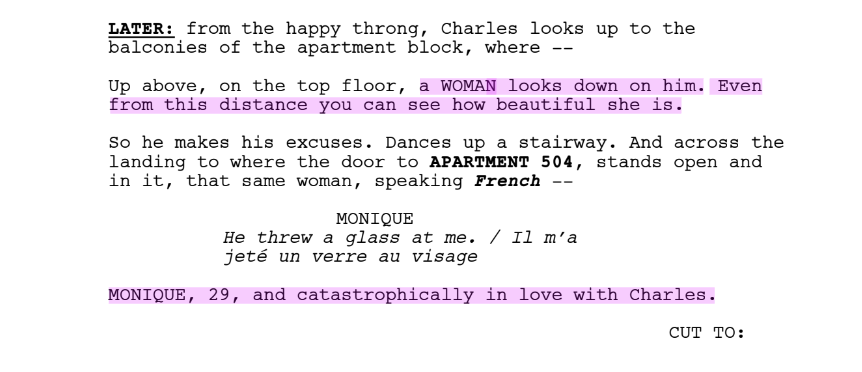
Next, we meet the other protagonist, Monique. Let’s see how Richard Warlow introduces her.
So, first, we simply see a WOMAN looking down on him. Before we know her name, from a distance, we can see how beautiful she is. Then, when Charles enters, and we can hear her as well as see her, the writer describes her as being ‘catastrophically in love with Charles.‘ And that’s all we need to know.
So, all in all, Charles is a sleek shard of ice and Monique is catastrophically in love with him.