BETWEEN THE LINES

THEME in FOUR FILMS of AARON SORKIN

Warning – contains spoilers, crude language, and sexual references.

Screenshot 2021-10-02 01.29.14 (1)-1.png

Introduction

Having watched four of Sorkin’s films over three days: A Few Good Men, Moneyball, Steve Jobs, and Molly’s Game, I learned that Sorkin has a style which is not immediately apparent. That he writes snappy, humorous dialogue is undisputed. However, the underlying idiosyncratic skill he has as writer, is evident in the parody of himself in 30 Rock when Sorkin states: ‘Listen, Lady (a gender I write extremely well if the story calls for it )… ’ (0.44)

Sorkin portrays conflicting attributes to his characters. Perhaps this is why his screenplays are so successful. Yet there is a hidden elixir in his writing to be shared.

All four films have a plot which we are aware of, on the surface. However, the writer asks us to look more closely, and dig a little deeper to a play within a play. Underneath the plot, is the theme, the message Sorkin wants us to think about, go away with, learn from – the elixir of our viewing journey. This theme is not immediately apparent. I believe if we are to learn from Sorkin, and share the elixir he presents to us, we must discover the treasure that lies between the lines, below the surface, the subtext. Maybe it is there we will find Sorkin’s true value as a writer; the reason for his success, and why he may have been the catalyst for a cultural shift in favor of the way in which screenwriters are perceived.

In order to search for the elixir to share, I watched Molly’s Game first, followed by Moneyball. When I realised both shared a father-daughter theme I was eager to watch Steve Jobs, thinking to myself that it must deviate from the theme. There is no way Steve Jobs can be a father-daughter story in the way Molly’s Game and Moneyball is. It’s Steve Jobs. It’s about Apple. So, I watched it and learned… guess what? It’s a father-daughter story! I wonder how much screen time is dedicated to Job’s relationship with his daughter and his personal life goal of being a good father, in comparison with his work goal of selling 1 million computers in 90 days.

I have noticed that in all four films the theme is parental love and specifically, father-daughter (in A Few Good Men: father figure – daughter.) The plots have their own trajectories. Yet I believe the message Sorkin wants us to take from each of these stories – the theme – is the value and importance of parenthood. The plots are simply wallpaper in which to tell the real story – which is the theme. Let’s face it, what’s more important? Selling a million computers or having a good relationship with your daughter? As Phoebe Waller-Bridge says to Daniel Craig: “The mission’s not the real story, the relationships are.” (Spitting Image S2 E03). Let’s look at the four films one by one.

1. A FEW GOOD MEN (1992) directed by Rob Reiner, screenplay by Aaron Sorkin.

Screenshot 2021-10-03 00.36.18.png

The first thing we should notice about this story is the oxymoron between title and poster image. One of the ‘few good men’ in the image is a not a man, but a woman. Notice how both men look us in the eye. The woman looks somewhere else -a visual metaphor, perhaps. In the film, Lieutenant Commander Joanne Galloway (Demi Moore) is subjected to sexual harassmentfrom both her younger protege Daniel Kaffee (Tom Cruise) and her superior officer Colonel Jessup (Jack Nicholson).

Galloway, the only female in this story world, acts as mentor to Kaffee, inspiring him to take his work seriously and fight for justice for the two young men accused of murder. Kaffee is hired by the Navy for his reputation for plea bargains.  Galloway wants Kaffee, rather than enter a plea bargain, to search for the truth and fight for justice. In John Yorke’s vernacular, by the denouement, Kaffee has assimilated Galloway’s quality of truth-seeking. What is the truth that lies behind the lines of Sorkin’s writing? And can we handle it?

First, when Galloway briefs Kaffee on the court case he ‘jokes’ that he’s “sexually aroused”. Next, Jessup is in the Officer’s Mess with Kaffee, Kendrick, Markinson, other lawyers and Joanne Galloway. As well as having the opportunity to be a father-figure / mentor / role model to Tom Cruise’s character – Kaffee, Jessup also has the opportunity to be a role model to Galloway – a mentor or father-figure to a young, brilliant, smart female officer. Tragically, he bypasses this opportunity in favor of bravado, machismo and sexist banter in front of a group of men. Jessup chooses not to serve and protect but to humiliate the female officer under his command with crude, salacious, offensive language:

JESSUP 

(to Kaffee)

There is, believe me gentlemen, nothing sexier on earth 

than a woman you have to salute in the morning…

Promote ‘em all I say, cause this is true:

If you haven’t gotten a blow job from a superior 

officer, well, you’re just letting the best in life pass you by.

Sorkin achieves two things with this dialogue. Firstly, he highlights the issue of sexual harassment women are subjected to in the workplace, in this case, by state actors (US military personal). Secondly, he evokes our disgust and creates enmity between the audience and the story’s main antagonist.

2. MONEYBALL (2011) directed by Bennett Miller, screenplay by Steven Zaillian & Aaron Sorkin

image (9)-1.png

Moneyball is ostensibly about Billy Beane (Brad Pitt) GM of a baseball team, and about his relationship with a young economist, Pete (Jonah Hill), who creates a winning team based on statistics. However, let me draw your attention to the scene, on p128 in the screenplay, where Billy and Pete are in Billy’s office, and Billy is frantically calling teams trying to do deals on players. At one point it’s a wide shot, and Billy (Brad Pitt) kicks back in his chair, and spins around so he’s side on, and the scene goes still and quiet, as Billy thinks and waits for a phone call. This space and time with nothing happening allows us, the viewer, to take in the details mise en scène. And what do we see?

image (8).png

Three photos: two of his daughter, one of him and his daughter, and a mug – obviously a gift from his daughter – which says ‘Daddy.’ This happens again, and the actor, writer, director, gives us time to assimilate the details. This scene portrays the theme: father-daughter parental love. NB – a word of warning – only the dialogue is in the script. There is no action stating “Billy kicks back revealing photos of his daughter and a mug with the word ‘Daddy’ on.” This leads me to believe the screenplay is a transcript. When we write screenplays, we are writing what is on screen. We describe the whole screen / scene. If something is on screen, it should be in the screenplay, right? If not, we would just have a close up of Brad Pitt, thinking! But Brad turns away from the camera and kicks back, doing nothing, saying nothing, giving us space and time to assimilate the important information intended – relating to the theme. I suggest the only reason this scene exists is for us to witness Billy’s office, to see the photos he has of his daughter, to see the mug on his desk saying ‘Daddy.’ The trade deals, the baseball, the phone calls are plot. The photos, the mug saying ‘Daddy’ are theme.

Earlier in the story, Billy and his colleague visit an injured player Scott Hatterberg (Chris Pratt) to offer him a contract. It’s late. Here’s an excerpt from the screenplay:

HATTEBERG’s YOUNG DAUGHTER comes down the staircase in her pajamas, having just woken up in the middle of the night. 

BILLY 

Hello. 

HATTEBERG’S DAUGHTER 

Hi. 

SCOTT 

That’s our youngest daughter. 

BILLY 

Great. 

SCOTT 

Do you have kids?

BILLY doesn’t like to share personal lives with the players, but he covers well– 

BILLY 

–yeah, I have a daughter.

Brad Pitt, aware of the utmost importance of this line as it relates to the theme, basically shrugs off the question before getting back to business. Next we witness Billy in a guitar shop with his daughter, Casey (Kerris Dorsey). She sings a song. Billy brings his hand to cover his face in total shock. He cannot believe how beautiful his daughter is. Tears fill his eyes. Later, when Billy’s team are about to break the record of 20 wins in a row, he’s driving away from the stadium because he can’t bear the pressure. He receives a phone call from his daughter. Casey advises her father to turn around and head back to the stadium. Billy listens to his daughter and turns around.

Then, just after Billy has been offered a contract with the Boston Red Sox as the ‘highest paid GM in the history of sport’, the screenplay states:

EXT. FREEWAY – DAY 

BILLY’s driving along and listening to the continued DRONE of talk radio criticism. BILLY keeps listening a moment, then reaches in the glove box and pulls out a CD marked “Dad’s Mix”. 

BILLY slips it in the CD player. 

The sound of the radio immediately snaps off and the momentary silence is soon broken by CASEY’s VOICE– 

CASEY (V.O)

Hey, Dad. I picked these songs out just for you. 

And then the first track on the CD comes on…

And BILLY smiles.

We know that for the whole movie, with all the buying and selling of players and talk of baseball, Billy has been thinking about his daughter.

3. MOLLY’S GAME (2017) written and directed by Aaron Sorkin (in his directorial debut).

image (13).png

Molly’s Game frequently flips back to Molly’s childhood. 

In this scene (p61) Sorkin has us witness Molly (Jessica Chastain) at home as a teenager with her emotionally abusive psychologist father (Kevin Costner):

The FATHER looks at MOLLY then throws his fork down on his plate with a frightening clang. 

FATHER 

Don’t disrespect me like that at the table.

GIRL 

I wasn’t disrespecting you, I was disrespecting Freud and it’s a kitchen table, it’s not the Tomb of the Unknown Soldier. 

FATHER 

And I’m a professional psychologist, not a quack. 

GIRL 

I never said (you were a)– 

FATHER (over) 

Yeah you did and don’t do it again and don’t ever use that language again. 

GIRL 

Okay, ignore my teachers, watch my language and respect the kitchen table. What else do I need to do before I’m allowed to disagree with you? 

FATHER 

Make your own money so you can live in your own house and eat your own food.

Later, Molly’s agent, Lois (Joey Brookes) makes a flippant comment which causes Molly’s regression, evoking this painful childhood memory.

LOIS

Millions or nothing. Go big or go home and 

go live with your mother. For the rest of your life.

Sorkin writes:

This is excruciating for MOLLY…

In Act 3, Molly is visited by her father in New York, in a redemption scene. Her father admits that his anger was misdirected. He was angry at Molly because when she was 5 years old she had seen him in a car with another woman. Molly can’t remember this, but her father does. He held this shame – expressing itself as anger towards Molly – throughout her childhood and teenage years, alienating him from his daughter until this moment. 

image (11).png

What is tragically ironic about Costner’s character is the fact that he is a psychologist and psychotherapist. He is trained to see defence mechanisms of the psyche, such as transference, misdirected anger etc. in others, yet he did not recognise it in himself until years later. This irony is played out in the final scene between father and daughter when he tells Molly he’s going to give her three years of therapy in three minutes. He gives her three minutes of therapy yet it took him many years to admit his own flaw to his daughter, the reason for his estrangement from her. It was this ‘moral self-revelation’ (Truby) which brought him back to her. Realizing his need he was able to achieve his want – to be in relationship with his daughter. Costner’s character has a strong character arc. We are able to forgive her father as Molly does. Again, the plot is the poker games, the FBI, the court case. This father-daughter subplot relates to, what I believe is, the story’s main theme: parental love.

image (12).png

4. STEVE JOBS (2015) directed by Danny Boyle and written by Aaron Sorkin.

SteveJobspic4.jpg

Ostensibly the main plot of Steve Jobs is Apple and the launch of the iMac (Job’s work goal), yet his relationship with his daughter and his character growth as a father runs alongside the main plot as another main plot – a personal life goal. So Jobs has two goals: a work life goal and a personal life goal.1. In the next paragraph I will explore gender balance in screen time in Steve Jobs.

In conclusion, I believe Sorkin’s value lies between the lines, underneath the main plot, and is related to theme. Furthermore, in my opinion criticism for gender bias towards Sorkin in his stories is unfair. In fact, when I watched the four films I had no idea of this criticism and I was shocked to discover it because after watching the four films I was impressed by Sorkin’s clear stance as an advocate for women’s rights.

Beneath the main plot of A Few Good Men, Sorkin was raising an issue in women’s rights which is still causing problems, even today. Thirty years later, we still face the same issues.  Even today here in the UK we read of police officers colluding with a convicted rapist and murderer with sexist comments in a misogynistic whatsapp group and The Guardian has reported on sexual harassment in the UK armed forces. Janet Hills, Chairperson of the Metropolitan Black Police Association has been speaking out recently regarding her call for zero tolerance on “sexist police banter.” Recently, the British TV and Film has followed the US #metoo movement / cancel culture (Noel Clarke), making it fiercely clear that misogynistic behaviour, in word or deed, will not be tolerated.

Doesn’t Sorkin’s raising of these issues raise an eyebrow to anyone excoriating him with negative gender bias criticism? In fact, if Sorkin is responsible for the cultural shift in the way the world perceives screenwriters, perhaps it’s fair to say that is a consequence of the way his films illuminate gender bias issues notwithstanding the strong female characters he creates.

My advice to anyone wishing to imitate Sorkin’s writing style is to look beyond the dialogue to discover what is happening between the lines, on the screen, relating to theme, to invest thought and time in reflecting issues relating to women’s rights, to create conflicting characters, consider male characters with personal goals, to think about character arcs in all of the main characters and finally, to write female characters “extremely well when the story calls for it.”
Happy Valley Season 1 Episode 1 step outline / story threads

SPOILER ALERT & CONTENT WARNING: ADULT THEMES

Let’s look at the structure of Episode 1 and see how writer Sally Wainwright weaves the 4 story threads together:

NB: The A story (trilogy) refers to the story overarching the entire 3 seasons. A story (season) means the story which expands throughout Season 1.

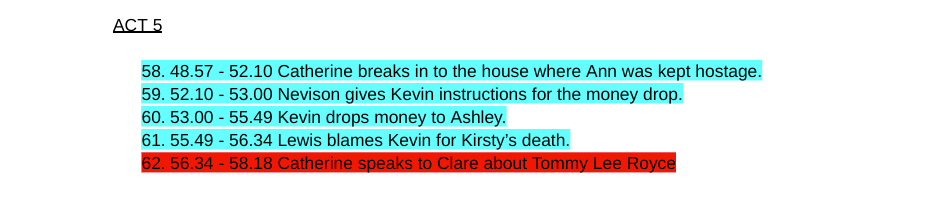
Episode 1 seems to be written in 5 acts, and follows the actions of the season protagonist (Kevin) rather than the trilogy antagonist (Tommy Lee Royce).

The end of each act is a turning point instigated by the actions of Kevin.

The final shot of the 1st act also reveals the trilogy antagonist Tommy Lee Royce.

Because of this, I have broken the episode into 5 acts:

Episode 1 opens with Catherine’s day to day – police procedure – not related to either A story (season) or A story (trilogy).

The following scene after the opening credits starts off the A story (season).

Scenes 4/5/6 refer to the A story (trilogy).

Midway through Act 1 Catherine kisses her ex-husband – already with someone new – referring to her personal life. She still has a thing for her ex-husband.

Then, we’re back into the Season story.

Next, trilogy story.

Season story.

Trilogy story.

Then 2 scenes which set up the season story (the inciting incident)

The final scene of Act 1 cleverly weaves together both A story (season) and A story (trilogy) around antagonist Tommy Lee Royce.

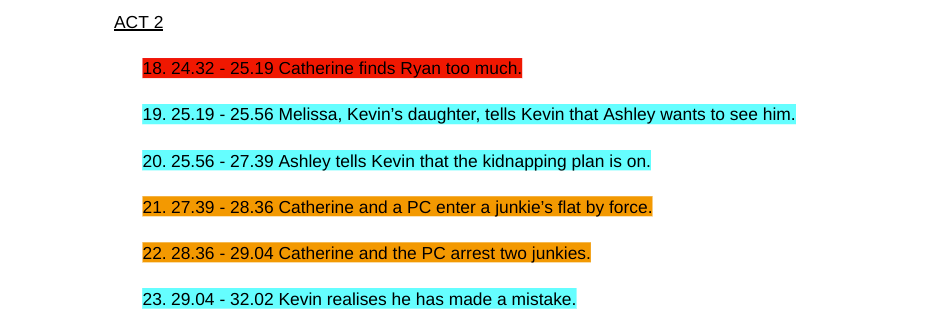
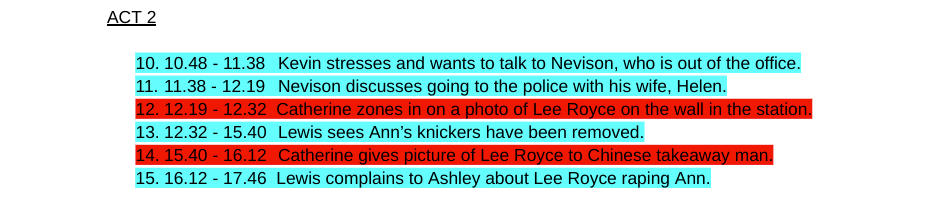
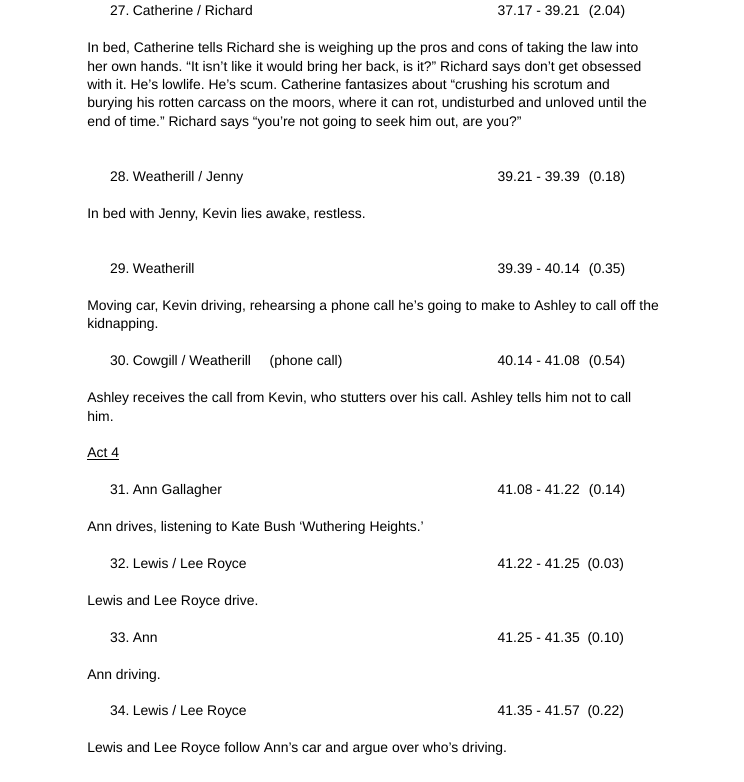
Act 2 opens with conflict between Ryan and Catherine – A story trilogy.

Next 2 scenes A story season.

Then 2 scenes C story.

Finally, A story season.

Act 3, the central act of the episode, begins with A story trilogy telling us the reason for this Protagonist / Antagonist battle – an immensely powerful scene where Catherine tells Ryan’s teacher the entire backstory of her daughter Becky, Lee Royce’s violent sexual assault and Becky’s consequent suicide.

We might call this the midpoint.

The following scene takes us to Catherine arranging to meet ex-husband Richard. I have included this as A story trilogy, as opposed to B story (family) because it leads up to Catherine’s expression to Richard of her absolute hatred of Tommy Lee Royce.

The next 3 scenes are dedicated to A story season.

Act 4 is completely dedicated to A story season.

Scenes 38/39/40 focus on A story season.

Scene 41 refers to police protocol as Catherine tells an amusing story to Kirsty about drugs.

Then, she spots Tommy Lee Royce, midway through the final act.

The final 4 scenes of act 5 all represent the season A story.

Ashley (JOE ARMSTRONG), Kevin (STEVE PEMBERTON), Lewis (ADAM LONG)

Happy Valley Season 1 Episode 4 step outline

SPOILER ALERT and CONTENT WARNING: references to suicide and sexual violence

I found Episode 4 more difficult to decipher the act breaks. I’ll explain why later. But let’s crack on and analyse the structure relating to the 4 storylines.

Before we start I have to admit I have missed a trick. There have been moments throughout the series where Catherine hallucinates her daughter’s suicide. This reflection on how this past trauma has affected her ‘mental health’ perhaps deserves its own colour code, or could be RED with the A story of the trilogy, considering it is connected to the A story of the trilogy: Catherine / Ryan V Tommy Lee Royce. I will have to analyse this thread in a separate post.

The colour codes are same as in the previous post.

Let’s begin.

So, Act 1 is dedicated completely to the A story (season) – Ann’s kidnapping.

Scene 12 seems to make sense for the act break if the act breaks in this episode revolve around the journey and rescue of kidnapping victim Ann.

Act 2 opens with Richard excitedly teaching a bemused Catherine all about the drugs trade – pointing to C story: police/drugs/corruption.

Next we’re into the A story of the season for a 3 minute scene where Catherine quizzes Ashley about the house. She also asks him if he has heard of Tommy Lee Royce, so actually scene 14 could also be RED, as Catherine is referencing her main antagonist – Lee Royce.

The following 3 scenes 15/16/17 – a 4 minute sequence – are solely focused on A story for the trilogy as at this point Catherine has no idea Lee Royce is connected to the kidnapping of Ann or the murder of Kirsty. As I said before, the hallucinating scene I included as A story for the trilogy as her daughter Becky killed herself on account of Lee Royce’s violent sexual assault.

The next 4 scenes, 18-21 are focused on the kidnapping.

I initially broke Act 2 after scene 18. However, I finally decided to break after scene 21 as it’s a harrowing scene when Helen tells Catherine that Ann has been kidnapped and breaking here means Act 3 will begin when D.I. Crabtree arrives from the National Crime Agency to question Helen and Nevison about the kidnap.

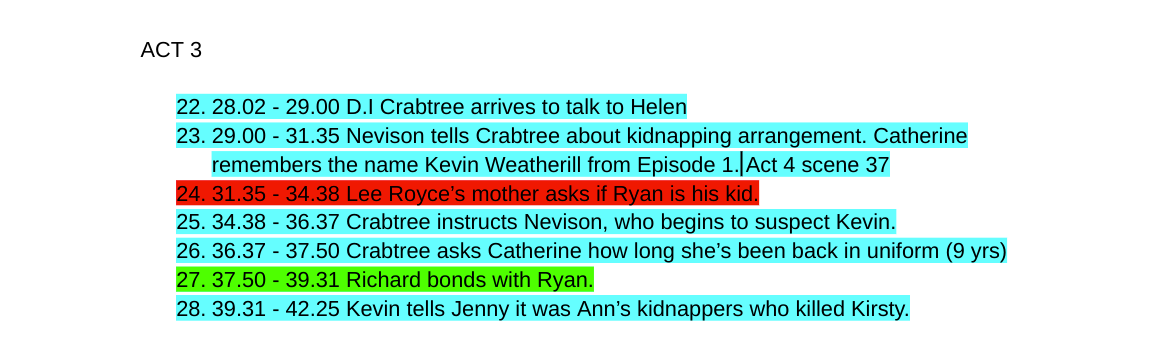
Act 3 opens with D.I Crabtree of the National Crime Agency arriving to interview Helen about the kidnapping.

The following scene Nevison arrives and explains that when the money is dropped they asked for the accountant, Kevin Weatherill. You can see the cogs in Catherine’s heads turning – superb thinking acting from Sarah Lancashire – as she remembers where she has heard the name Kevin Weatherill before. Actually, she didn’t hear it, but saw it, as she ran his number plate in the final scene of Episode 1 – which means the visual of Ep 1 was paid off with audio in Ep 4.

In Scene 24, Catherine visits Tommy Lee Royce’s mother. We might say that, although highlighted red for A story (trilogy) this scene is also A story (season) because Tommy Lee Royce is about to hide Ann there and it is the venue of the fight in the climax of the episode. However, at this moment, Ann is not yet there. He takes her there in scene 31 of Act 4. Scene 24 revolves around Ryan as Lee Royce’s mother asks Catherine if Ryan is Tommy’s son, which is the A story (trilogy). It is interesting to note that the location of this central scene of the episode foreshadows the location of the episode climax.

In Scenes 25 we’re back with D.I Crabtree giving instructions to Nevison and telling him that Kevin is a suspect.

Scene 26 is a little information about Catherine’s bio – we learn that she has been ‘back in uniform’ for 9 years. So actually, this scene needs its own colour code, as it relates to Catherine’s work history – the first time a scene has been dedicated fully to exposition about Catherine’s biography without being directly related to the two A stories.

Scene 27 shows Richard’s emotional arc for this season completing as he accepts Ryan as his grandson.

In Scene 28 Jenny is watching a news story on TV about Kirsty’s murder. Kevin snatches the remote control from her, turns the TV off, and tells her it was Ann’s kidnappers who killed her. I saw the act break broke here as it refers to Ann.

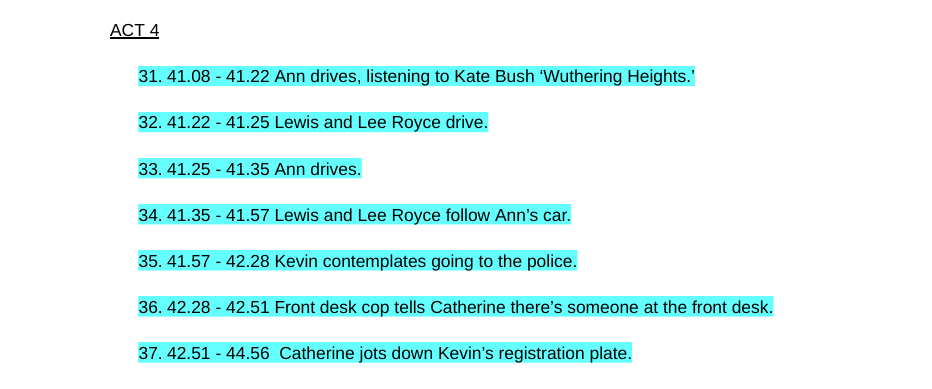
Act 4 gets much more entangled with story threads, with all 4 stories making an appearance.

We open with Clare telling Catherine the good news about Richard and Ryan. Catherine counters in the next scene with the bad news that Lee Royce’s mother knows Tommy is Ryan’s father – B story – family.

In Scene 31 Lee Royce brings Ann to his mother’s house and acts the most disturbing and creepiest scene of the season – A story (season).

Scene 32 brings us back to drugs and police corruption as Catherine’s Chief Super tells her, just as she wanted him to turn a blind eye at her illegal breaking and entry of the hostage house when she was looking for Tommy Lee Royce, so she should also turn a blind eye at the cocaine she found in Councillor Gascoine’s car. Quid pro quo – C story.

Scene 33 gives us the first direct confrontation between Catherine and Lee Royce in the street over Ryan – A story (trilogy).

Scene 34 – A story (trilogy) Catherine / Ryan V Tommy Lee Royce.

The final scene of the act brings us back to the season plot – the kidnapping of Ann.

Phew!

So, Act 5 is a little simpler. No B or C stories, only the two A stories: season and trilogy.

The final scene sees Protagonist and Antagonist in actual, physical, violent combat – interweaving both A stories together with juicy expertise.

Happy Valley Season 1 Episode 3 step outline

SPOILER ALERT.

We can see that this episode is structured very differently from Episode 2

Like Episode 2, let’s explore in 5 acts.

Again, as previously, the 4 story threads are colour coded as follows:

Let’s start.

As you can see, unlike Episode 2, (we will do a comparison in another post) the entire act is dedicated to the A story (season) and the cop-murder of Kirsty.

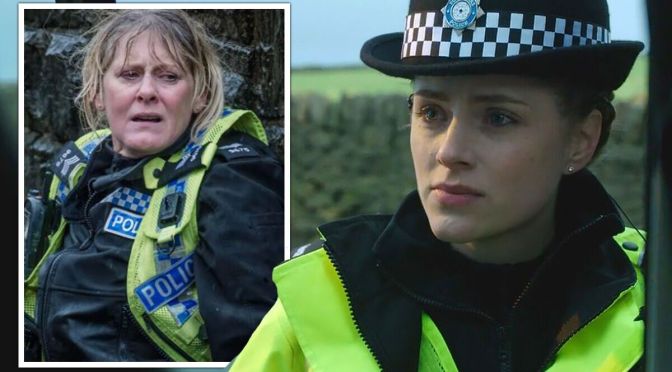
Actually, this storyline could have its own colour code as an episode storyline, I decided to keep blue because the murder of Kirsty is a consequence of Ann’s kidnapping: A story (season).

The act is a furiously tragic depiction of the murder of Kirsty: emotional, brutal, shocking. It’s a terrific opener to Episode 3.

Many of these scenes are quick fire editing between the four characters: Kirsty, Lewis, Ann and Tommy Lee Royce.

The act break is clear, as Tommy Lee Royce leaves the body of Kirsty dead on the floor and the lights of her police van flashing.

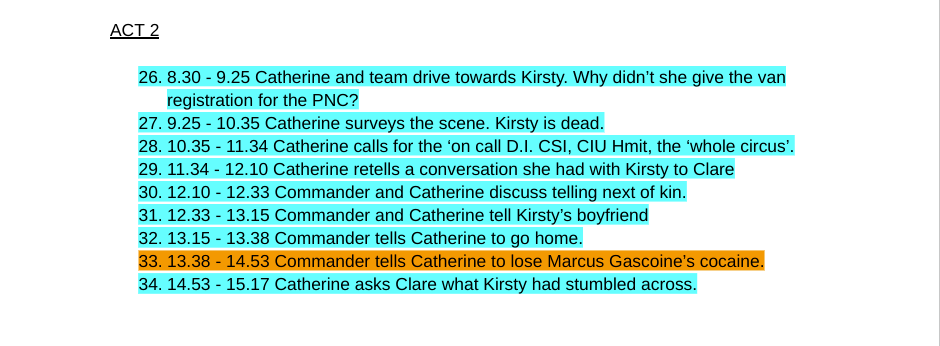
Again, Act 2 is dedicated to the A story (season) with a slight nod to the C story of police, drugs & corruption.

The act again is clearly marked as a dramatic sequence and follows Catherine dealing with the crime scene.

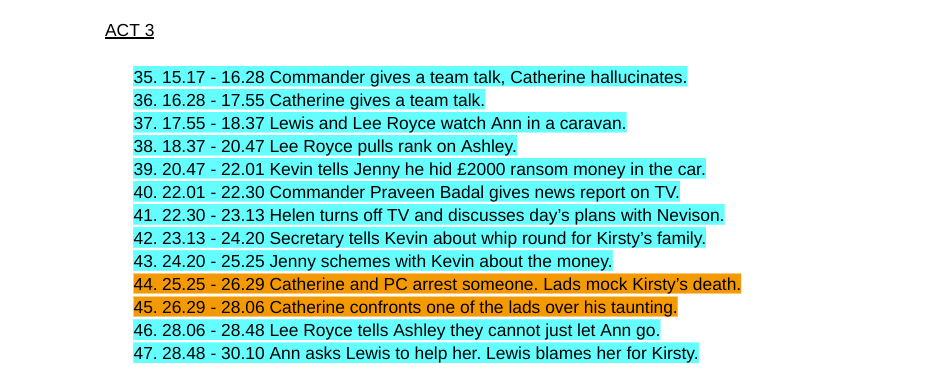
Again, Act 3 is almost fully dedicated to the season A story – the kidnapping of Ann.

Again, there is a slight nod to Catherine’s day to day world of police protocol. Actually, these two scenes (44/45) depict Catherine dealing with anti-police hate speech.

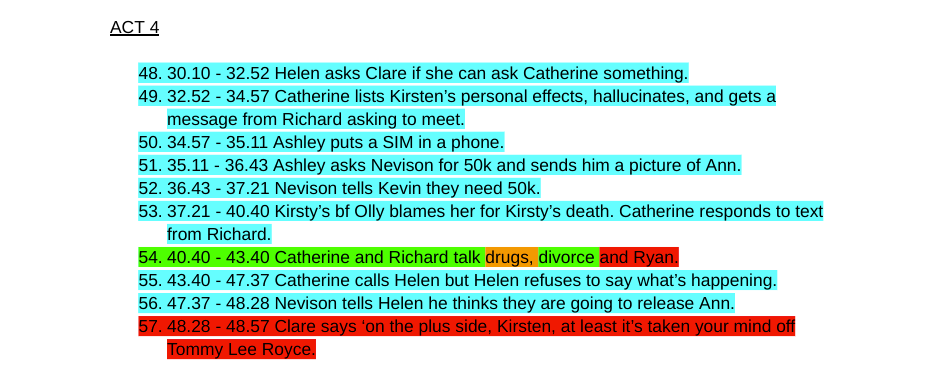
Act 4, right up to minute 40 (scene 54) deals with the A story (season) the kidnapping of Ann.

Scene 54 is the first time in the entire episode we have seen any C story – Catherine’s personal life, with a slight nod to the A story of the trilogy – Ryan’s relationship with his dad Tommy Lee Royce.

Act 4 ends with a shocking line from Clare which brings Catherine crashing back to hell and hooks us to the A story for the trilogy:

“On the plus side… ” says Clare, “at least it (the murder of Kirsten) has taken your mind off Tommy Lee Royce.”

Act 5 is also dedicated to the A story of the season – the kidnapping of Ann.

Only the final scene brings us back to the A story for the trilogy – Catherine V Tommy Lee Royce.

What do you think about this structure?

Happy Valley Season 1 Episode 2 step outline

SPOILER ALERT. Please do not read if you have not seen Happy Valley Season 1.

We explore this episode in 5 acts.

Please note – Happy Valley is a trilogy: 3 seasons with 1 main overarching story.

In this post we will look at the various story threads, and how writer Sally Wainwright weaves them together.

We can observe four story threads:

The main story which runs through the three seasons is about Catherine and her grandson Ryan and his relationship with his father – trilogy antagonist Tommy Lee Royce. I have called this the ‘A’ story (trilogy).

Next, there is the season story: the kidnapping of Ann Gallagher by Kevin, Ashley, Lewis and Tommy Lee Royce. Let’s call this the ‘A’ story (season).

We can see immediately how the two A stories – season and trilogy – intertwine around the character of Tommy Lee Royce (the trilogy’s main antagonist).

Thirdly, we have Catherine’s extended family: her sister Clare, her ex-husband Richard and her son Daniel. Let’s call this the ‘B’ story.

Fourthly, we have the theme of drugs, police procedure, and corruption. Let’s call this the ‘C’ story.

The different story threads are colour coded.

Let’s look at Act 1.

So, here we can see the episode opens with the C story, followed by opening credits.

It is interesting to note there is no B story.

Immediately following the credits we are into the season A story – the kidnapping.

Next, we are nudged into the A story for the trilogy – Catherine (protag) V Tommy Lee Royce (antag).

The next two scenes introduce Catherine’s day to day of busting small time drugs gangs so represent the C story.

The act finishes focusing on the A story (season) of kidnapping with season victim Ann whimpering, bound and gagged, to carry us into Act 2.

Now let’s check Act 2. Again, no B story.

Here we can see that Act 2 focuses only on the two A stories, expertly interweaving the season story and trilogy story.

The act again finishes with Ann (season victim) and her ordeal, propelling us into Act 3.

Act 3 finally gives us some insight into Catherine’s personal life.

In fact, Act 3 blends all 4 storylines.

This central act opens with a scene introducing Daniel, Catherine’s son, inviting her and her sister Clare to dinner (paid off in Act 4 Scene 32.)

The next scene, 17, interweaves the C story, drugs and corruption, with the B story and the A story (trilogy).

The next 4 scenes, 19-22, focus on the season A story.

Scene 23, which we might call the midpoint of the episode, points to the A story of the trilogy.

Again, the act ends by focusing on Ann and her ordeal.

Act 4 steers away from the A story for the trilogy (Catherine / Ryan / Tommy Lee Royce) and opens with a 4 minute scene which references drugs and corruption, the C story.

The next scene, 27, foreshadows Kirsty’s death.

Scenes 28 / 29 focus on the A story (season).

The central scene of Act 4 brings us back to the C story: drugs and corruption.

Scenes 31/32 revolve around Catherine’s son, ex-husband and grandson – B story.

Act 4 ends with us focusing again on the A story for the season (33/34).

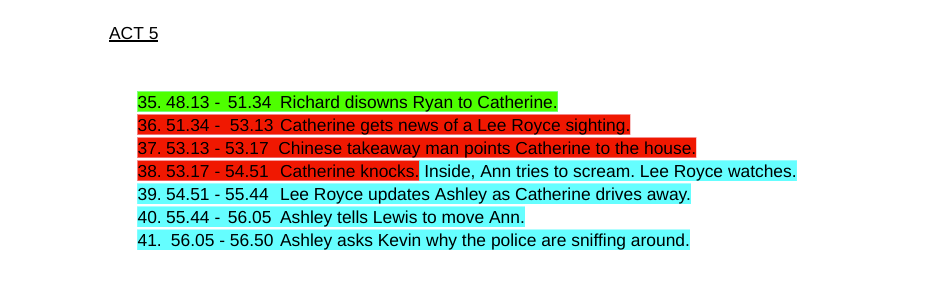
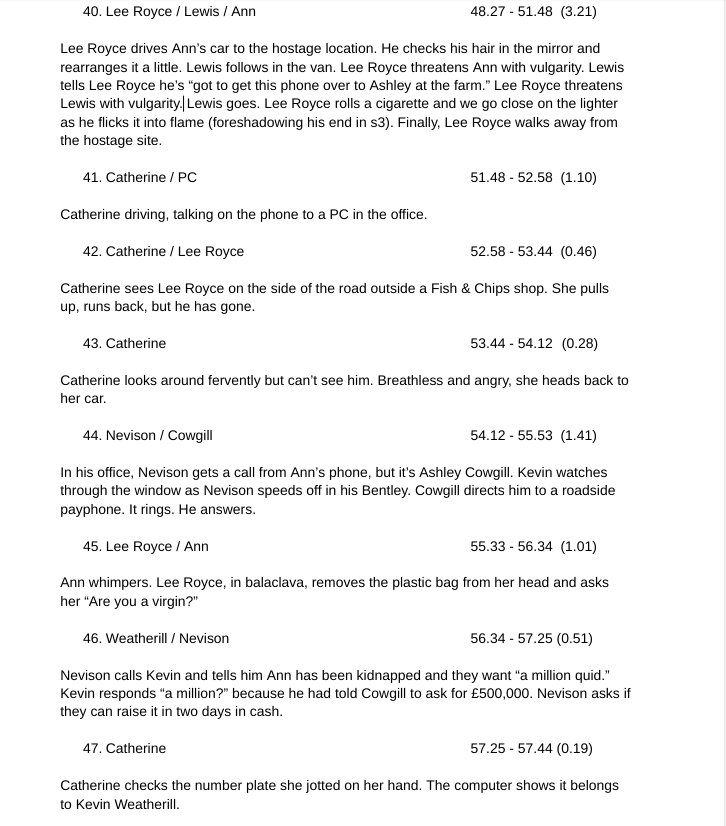
Act 5 opens with B story, with a powerful moral conflict between Catherine and Richard discussing the consequences on their family of dealing with bringing up a child who was born to their (deceased) daughter as the consequence of a rape.

The rest of this final act is equally split between A story (season) and A story (trilogy) – expertly separated by one scene, 38, which glues both stories together and brings protagonist and antagonist (almost) face to face.

Catherine has yet to meet her trilogy antagonist, but here, we the viewer – in privileged superior position – know that only a wall separates her from direct confrontation with her arch enemy Tommy Lee Royce. Dramatic irony at its finest.

The final 3 scenes draw us back into the A story for the season to propel us into the next episode.

Do you agree with this analysis? Please let me know your thoughts.

Happy Valley – S1 E01 – Character Revealed through Action and Dialogue.

In the last post we summarized Season 1 Episode 1.

Analysis:

The purpose of this exercise is to see and understand what the writer discloses about each character in the pilot regarding character.

What is revealed through a) dialogue and b) action?

Let’s take it scene by scene:

NB these scenes do not correspond to the shooting script. They are according to my breakdown from watching the show.

Scene 1:

Action: Catherine is compassionate, skilled and professional.

Dialogue: Catherine is witty, with a dark sense of humour and has a complicated family life, which we learn about in detail.

Scene 2 is opening credits.

Scene 3:

Dialogue: we learn that Weatherill is the accountant and that Nevison, his boss is from a poor background.

Scene 4: 

Dialogue: we learn that Richard is a journalist, and that Tommy Lee Royce (series antagonist) has been released from prison.

Scene 5: 

Dialogue: Ryan has been aggressive and using unacceptable language at school.

Scene 6: 

Dialogue: we learn from Clare that Lee Royce has been released. This is the second time we have heard this, so it must be important.

Scene 7: 

Dialogue: Kevin is jealous of Nevison. He is falling apart. Feels undervalued. 

    Jenny is positive and reassuring, even in the midst of severe illness.

Scene 8:

Dialogue: Normal family friction. Nevison reveals he does value Kevin as he at least is thinking about his pay rise.

Scene 9: 

Dialogue: Richard and Catherine have a good relationship as friends. 

Scene 10:

Action: Richard and Catherine still fancy each other.

Scene 11:

Dialogue: Jenny positive, Kevin negative and self-pitying.

Action: Jenny needs help being put to bed and so is physically dependent on Kevin.

Scene 12:

Action: Writer Sally Wainwright is a fan of Sylvia Plath.

Scene 13: 

Dialogue: Ashley Cowgill presents himself as generous and considerate. Kevin is jealous and self-pitying.

Scene 14:

Catherine is concerned about the whereabouts of Tommy Lee Royce.

Scene 15: 

Action: Cowgill is a cannabis dealer to scale. 

Dialogue: Cowgill is passive / aggressive and a bully.

Scene 16:

Dialogue: Kevin Weatherill is cowardly, deceitful and manipulative.

Scene 17: 

Dialogue: The ‘other’ man working for Cowgill has been in jail for 8 years, and is therefore      the man Catherine is worried about, Tommy Lee Royce. NB we don’t yet know what Lee Royce has done. (We find out in scene 24 / 25).

    Lewis, Cowgill’s other worker, doesn’t like Lee Royce.

Scene 18:

Dialogue: Catherine is tired and impatient with her grandchild, Ryan. She is taking her worry over Tommy Lee Royce out on Ryan, his son – projecting her anxiety onto him.

Scene 19:

Action: We are reminded that Kevin is a father with a daughter.

Scene 20:

Dialogue: Kevin is self-deceiving as he believes he has the power to negotiate over his kidnapping arrangement fee.

Scene 21:

Action: Catherine is active, fearless, professional and strong.

Scene 22:

Dialogue: Catherine wittily makes fun of her own challenges in the job – but not regarding Lee Royce.

Scene 23:

Dialogue: Nevison is generous and kindhearted.

Scene 24 / 25

Dialogue and Action: Catherine is broken over her daughter’s ordeal of sexual violence and subsequent suicide. Through this scene of emotional turbulence exposition and backstory about her daughter Becky and Tommy Lee Royce’s crime and character are expertly revealed.

Scene 26:

Dialogue: Catherine desires intimacy with Richard.

Scene 27:

Dialogue: Catherine hates Lee Royce

Scene 28:

Action: Kevin cannot sleep.

Scene 29:

Dialogue: Kevin is nervous and scared.

Scene 30:

Action: Ashley seems cool and focused / Kevin is aggressive and careless.

Dialogue: Ashley sounds anxious.

Scene 31:

Action: Ann is fervent, youthful and life-loving.

Scene 32 / 33 as 31.

Sceen 34:

Lewis and Lee Royce are in conflict.

Scene 35:

Action: Kevin is experiencing inner conflict between doing what is right and fear of the consequences.

Scene 36:

Action: Catherine is busy at work.

Scene 37:

Action: Catherine is quick-thinking / Kevin is impulsive and irrational.

Scene 38:

Action: Lee Royce is brutal, misogynistic and violent / Lewis is naive.

Dialogue: Lee Royce is brutal, misogynistic and violent.

Scene 39:

Dialogue: Kevin is naive.

Scene 40:

Action: Lee Royce is a narcissist (signified by his adjusting his hair in the rear view mirror immediately after having been violent to Ann).

Dialogue: Lee Royce is vulgar, misogynistic and violent / Lewis is inexperienced, thoughtless and naive.

Scene 41:

Dialogue: Catherine is chatty, convivial.

Scene 42:

Action: Catherine is fearless.

Scene 43:

Action: Catherine is intensely angry.

Scene 44:

Action: Nevison is terrified.

Dialogue: Kevin is nervous.

Scene 45:

Dialogue: Lee Royce is heartless, cruel, and sadistic.

Scene 46:

Dialogue: Nevison loves his daughter.

Dialogue: Kevin is duplicitous.

Scene 47:

Action: Catherine is smart, resourceful, investigatively skillful.

The Capture – S1 E01: 5 Act Structure

Screenwriter – Ben Chanan.

In the previous post we listed the number of scenes and scene lengths.

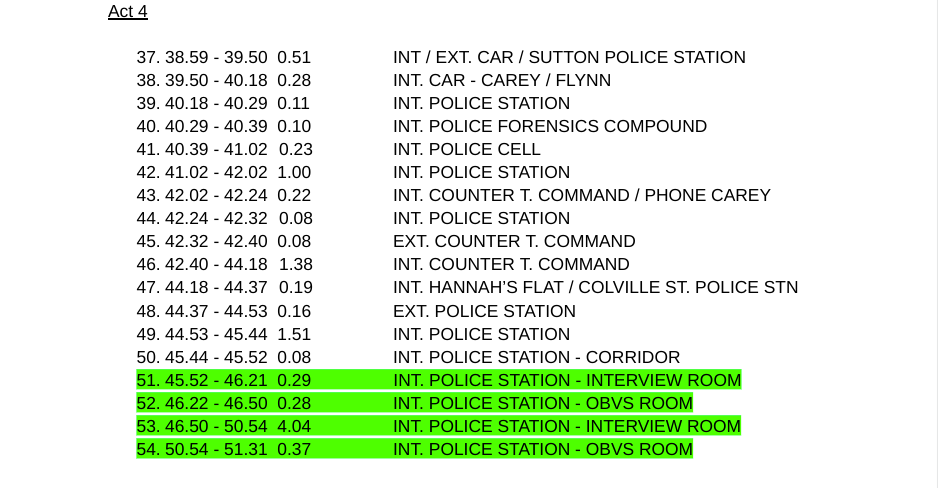
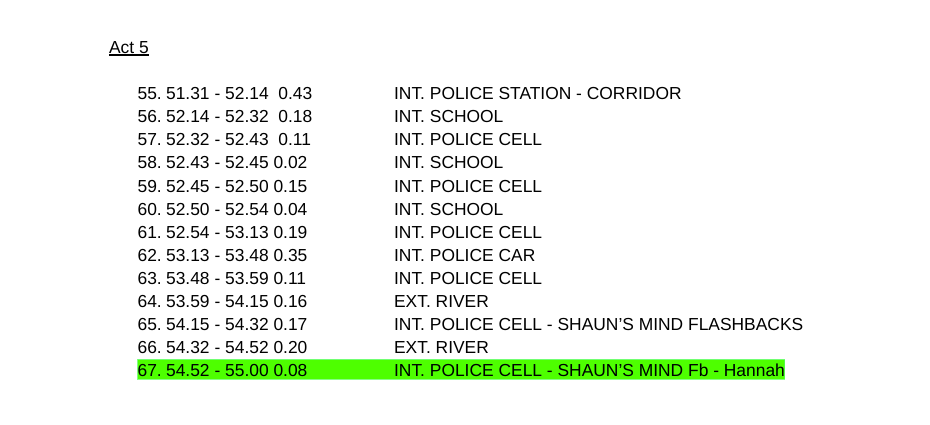
This post breaks episode 1 into a 5 act structure.

Like Happy Valley, The Capture decides its act breaks by following the antagonist (although in this story the lines between antagonist and protagonist in the character of Shaun Emery are blurred.)

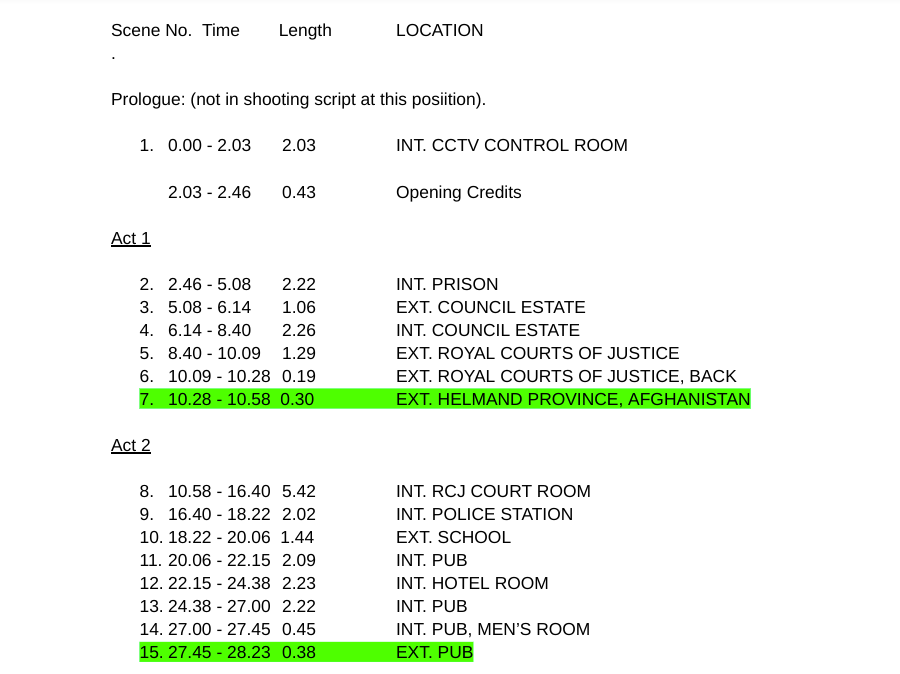
The end of Act 1 breaks with Shaun’s shooting of the soldier in Afghanistan, played on the video screen in court, which leads us neatly into Act 2, opening with the 5 minute courtroom scene.

Act 2 follows Sean’s acquittal and celebrations in the pub, culminating in an altercation and his leaving while looking for his barrister Hannah, who has left before him.

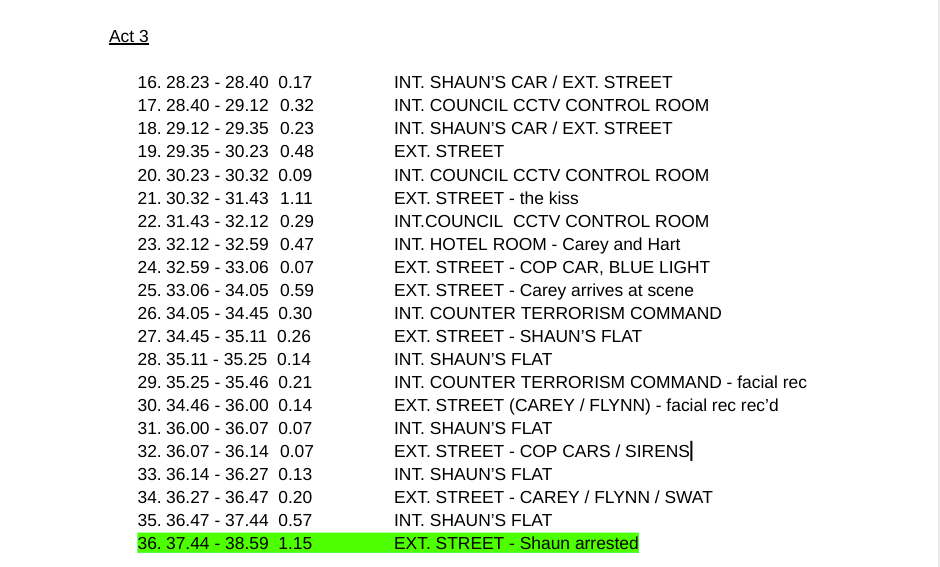
Act 3 There is a definite change of mood and tone, signed by a musical marker, as we are led into the sequence of scenes between Shaun and Hannah which become the heart of the story. Hence Act 3 is the heart of the act. Act 3 ends with Shaun’s dramatic arrest.

Act 4 is Shaun being interviewed by the police at the station by Carey and climaxes in his emotional explosion when he is played the fake video of the assault for which he has been arrested for.

Act 5 explores Shaun flashing back to the events with Hannah, interweaving with his daughter waiting for him at school, and Carey investigating the river. The episode ends with Shaun’s flashback and him sitting alone in the cell.

More analysis to follow.

Shooting script available at BBC Writers’ Room here.

Happy Valley (by Sally Wainwright) – S1 E01 summary: Act 1

What is interesting after watching this and reading the screenplay are two things:

  1. The writer only reveals the name of the antagonist (Tommy) at the end of the act in the script and on screen. Whereas on screen we can expect to have information held back from us, Sally Wainwright expertly withholds his name from us in the script as well.
  2. We know that this Tommy Lee Royce has been released, because we hear it several times, from Catherine, Richard and Clare. But we don’t know what the fascination is, who he is, and what he has done… yet.
  3. Tommy is the main antagonist of the trilogy, but arguably not the main antagonist of the episode, which goes to Kevin Weatherill. Yet his name stated marks the end of Act 1. ‘Tommy, do you wanna cup of tea?’ Now we know that this is the man everyone is talking about.
  4. The opening scene is a man threatening to set himself on fire. Everyone seems to hear about it, so it seems quite important, but Catherine doesn’t consider it worth talking about. In fact, it has nothing to do with the plot that unfolds. Is it possible that Sally Wainwright knew the end of season 3 even though she wrote season 1 a full 8 years before season 3 and foreshadowed the 2023 climax in episode 1 of season 1 in 2014?

Below is a summary of scenes in Act 1.

  1. PARK – 0.00 – 2.36 (2.36)

Catherine Cawood tries to stop a youth from setting himself on fire. So we open with a kind of save the cat scene. During the scene we instantly learn Catherine has a wicked sense of humour. Told to keep the kid engaged in conversation, introducing herself, Catherine tells the youth (and us) “I’m Catherine, by the way. I’m 47. I’m divorced. I live with my sister, who’s a recovering heroin addict. I’ve two grown-up children: one dead, one who doesn’t speak to me, and a grandson, so…” And we the audience have Catherine’s life in a nutshell. This is, in fact, a clever technique by the writer. As the season continues we learn that the ‘one dead’ and ‘a grandson’ are pivotal to the main story. An active question we are left asking ourselves is ‘why is her grown up child dead?’ 
What do we learn about Catherine in this scene? She is caring. She is witty, with a dark sense of humour. She has a complicated family life. 

  1. Opening Credits: 2.36 – 3.04 (0.28)
  1. NEVISON GALLAGHER’s OFFICE – 3.04 – 5.28 (2.24)

This scene introduces us to Kevin Weatherill who asks his boss Nevison Gallagher to give him a pay rise to cover his daughter’s school fees for a private school. We learn from the dialogue that Nevison Gallagher did not attend a private school ‘a clever kid will do well wherever they go – look at me.’ We learn that Kevin is the accountant.

  1. STREET – 5.28 – 6.46 (1.18)
  1. Richard asks about the kid who set fire to himself (he didn’t).
  2. Richard tells Catherine the local newspaper is going online so he’s losing his job. 
  3. He asks Catherine out. 
  4. He tells her Tommy Lee Royce has been released.
  1. RYAN’s SCHOOL 6.46 – 7.54 (1.08)

Ryan’s teacher asks Catherine to speak to her. Tells her Ryan has been aggressive and using unacceptable language.

  1. Catherine’s HOME 7.54 – 9.21 (1.27)

Clare mentions the youth setting fire to himself. Catherine tells her 

  1. Richard has asked her out 
  2. Ryan is in trouble at school.
  3. Tommy Lee Royce is out of prison.
  1. WEATHERILL’s HOME 9.21 – 9.59 (0.38)

Kevin Weatherill talks to Jenny (his wife) about being refused a pay rise. Jenny tries to be positive and reassuring. Kevin can’t hold it together. 

  1. GALLAGHER’S HOME 9.59 – 11.06 (1.07)

Family dinner. Nevison talks to his wife, Helen and daughter, Ann, about Kevin wanting a pay rise. Father-daughter friction between Nevison and Ann. He quips that paying for Anne’s private education was a waste of money – “might as well have pissed it up against the wall.”

  1. RESTAURANT 11.06 – 13.13 (2.07)

Catherine and Richard have dinner. Richard moans about being too old to change career. Richard asks about the kid setting fire to himself again. Catherine really doesn’t want to talk about work. She advises Richard to write a big story about drugs to sell to the national papers, then asks if Richard knows where Tommy Lee Royce is staying.

  1. RICHARD’S CAR 13.12 – 14.03 (0.51)

Richard and Catherine kiss. 

  1. WEATHERILL’S BEDROOM 14.03 – 15.16 (1.13)

Weatherill moans about Nevison as he puts Jenny, who is suffering with MS, to bed. Jenny is positive. Weatherill is self-deprecating and negative. Weatherill is bitter that he doesn’t own half of the company. He feels like he is is being shafted.

  1. CEMETRY 15.16 – 16.10 (0.54)

Catherine is looking at Rebecca’s grave stone. Clare and Ryan arrive. Ryan notices old pens left on the grave of Sylvia Plath Hughes.

  1.  COWGILL’s CARAVAN PARK 16.10 – 17.49 (1.39)

Ashley Cowgill greets Weatherill, Jenny and their daughters. Cowgill says he has worked out wheelchair access for Jenny to play table tennis. Weatherill groans about how wealthy Cowgill is compared to his own situation.

  1. OUTDOORS WALKING 17.49 – 18.43 (0.54)

Catherine speaks to Clare about where Tommy Lee Royce may be living.

  1. CARAVAN PARK 18.43 – 21.22 (2.39)

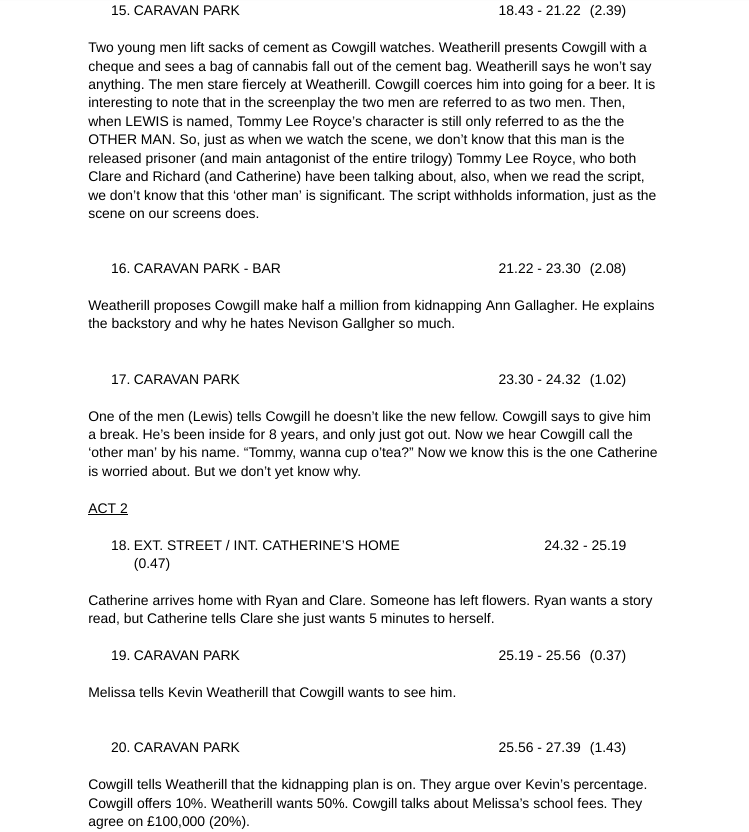
Two young men lift sacks of cement as Cowgill watches. Weatherill presents Cowgill with a cheque and sees a bag of cannabis fall out of the cement bag. Weatherill says he won’t say anything. The men stare fiercely at Weatherill. Cowgill coerces him into going for a beer. It is interesting to note that in the screenplay the two men are referred to as two men. Then, when LEWIS is named, Tommy Lee Royce’s character is still only referred to as the the OTHER MAN. So, just as when we watch the scene, we don’t know that this man is the released prisoner (and main antagonist of the entire trilogy) Tommy Lee Royce, who both Clare and Richard (and Catherine) have been talking about, also, when we read the script, we don’t know that this ‘other man’ is significant. The script withholds information, just as the scene on our screens does.

  1. CARAVAN PARK – BAR 21.22 – 23.30 (2.08)

Weatherill proposes Cowgill make half a million from kidnapping Ann Gallagher. He explains the backstory and why he hates Nevison Gallagher so much.

  1. CARAVAN PARK 23.30 – 24.32 (1.02)

One of the men (Lewis) tells Cowgill he doesn’t like the new fellow. Cowgill says to give him a break. He’s been inside for 8 years, and only just got out. Now we hear Cowgill call the ‘other man’ by his name. “Tommy, wanna cup o’tea?” Now we know this is the one Catherine is worried about. But we don’t yet know why.

screenwrite.org

Learning to write for the screen

Skip to content ↓