Below is a scene by scene breakdown of scenes, times, and a brief summary of what happens in each scene.




Analysis to follow…
Writing Television
Below is a scene by scene breakdown of scenes, times, and a brief summary of what happens in each scene.
Analysis to follow…
Screenwriter – Ben Chanan.
In the previous post we listed the number of scenes and scene lengths.
This post breaks episode 1 into a 5 act structure.
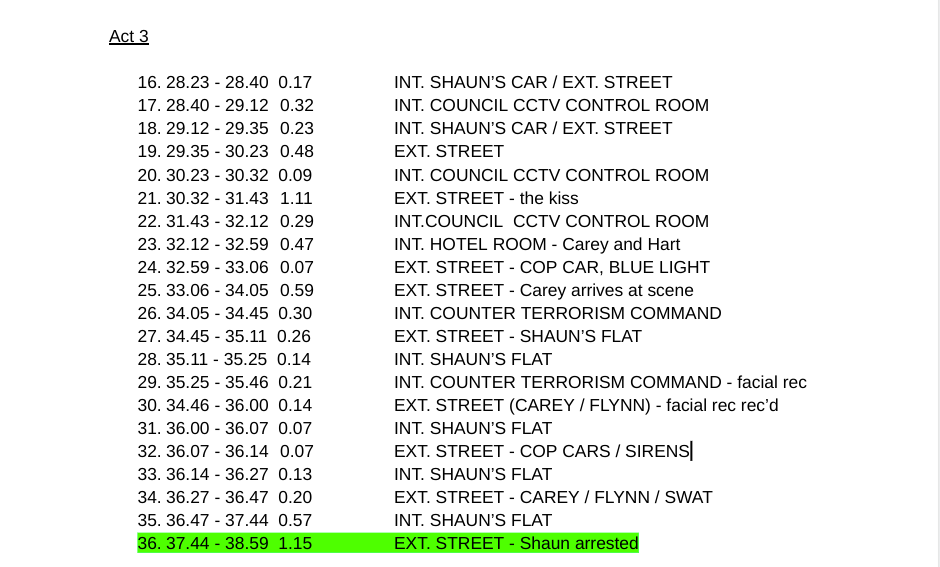
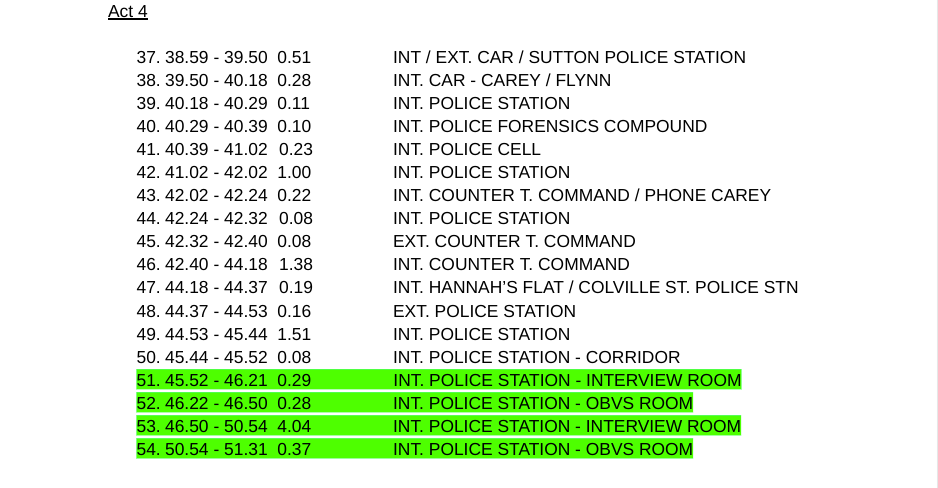
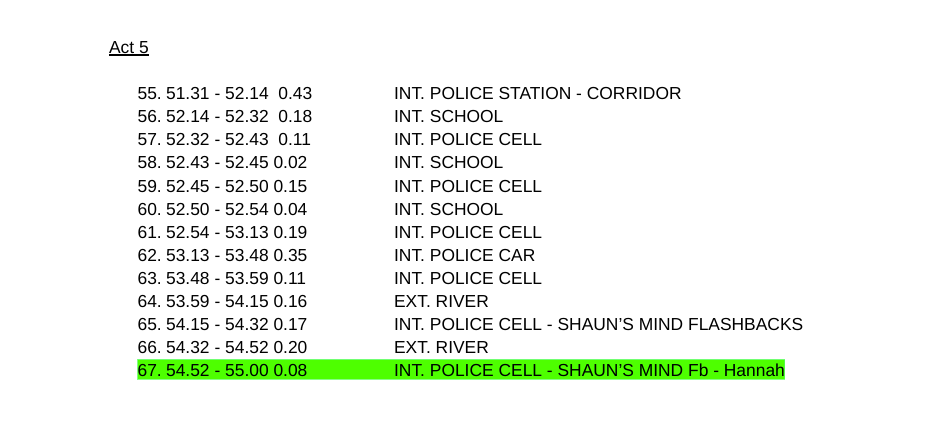
Like Happy Valley, The Capture decides its act breaks by following the antagonist (although in this story the lines between antagonist and protagonist in the character of Shaun Emery are blurred.)
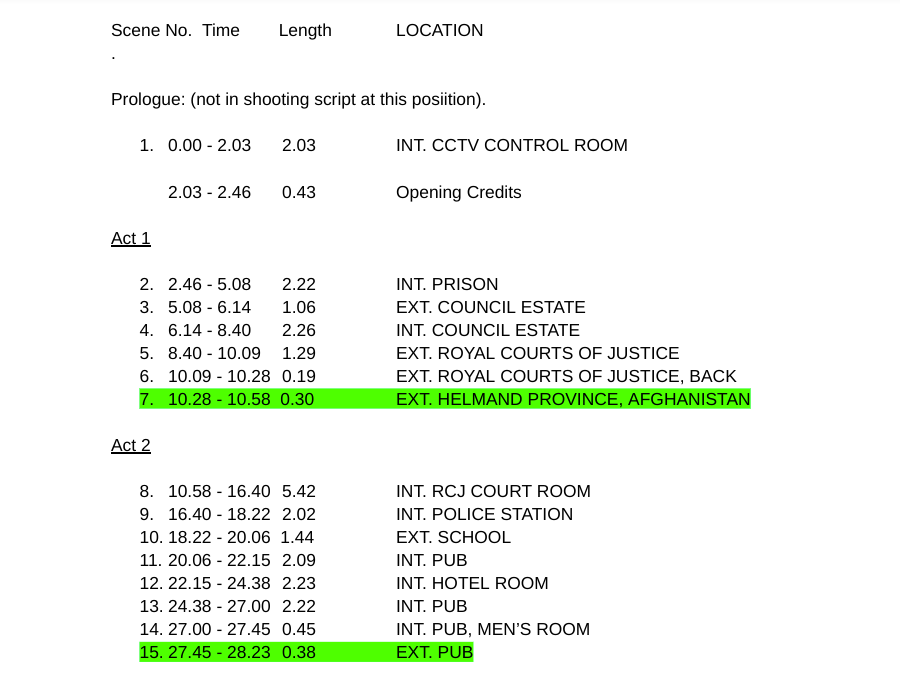
The end of Act 1 breaks with Shaun’s shooting of the soldier in Afghanistan, played on the video screen in court, which leads us neatly into Act 2, opening with the 5 minute courtroom scene.
Act 2 follows Sean’s acquittal and celebrations in the pub, culminating in an altercation and his leaving while looking for his barrister Hannah, who has left before him.
Act 3 There is a definite change of mood and tone, signed by a musical marker, as we are led into the sequence of scenes between Shaun and Hannah which become the heart of the story. Hence Act 3 is the heart of the act. Act 3 ends with Shaun’s dramatic arrest.
Act 4 is Shaun being interviewed by the police at the station by Carey and climaxes in his emotional explosion when he is played the fake video of the assault for which he has been arrested for.
Act 5 explores Shaun flashing back to the events with Hannah, interweaving with his daughter waiting for him at school, and Carey investigating the river. The episode ends with Shaun’s flashback and him sitting alone in the cell.
More analysis to follow.
Shooting script available at BBC Writers’ Room here.
Here is a scene length breakdown of the first episode of The Capture (screenwriter Ben Chanan).
NB – the on screen version differs slightly from the shooting script.


Analysis to follow…
What is interesting after watching this and reading the screenplay are two things:
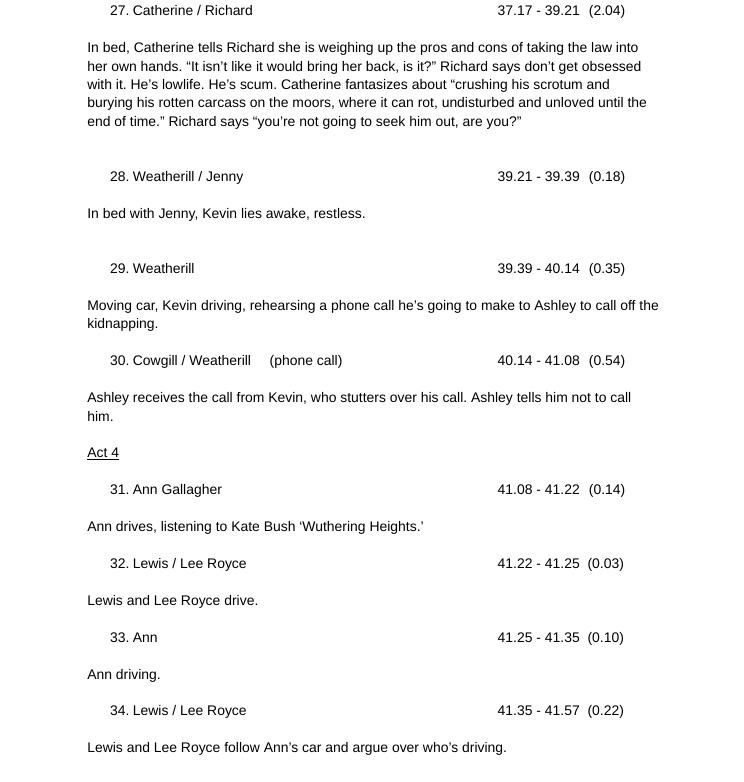
Below is a summary of scenes in Act 1.
Catherine Cawood tries to stop a youth from setting himself on fire. So we open with a kind of save the cat scene. During the scene we instantly learn Catherine has a wicked sense of humour. Told to keep the kid engaged in conversation, introducing herself, Catherine tells the youth (and us) “I’m Catherine, by the way. I’m 47. I’m divorced. I live with my sister, who’s a recovering heroin addict. I’ve two grown-up children: one dead, one who doesn’t speak to me, and a grandson, so…” And we the audience have Catherine’s life in a nutshell. This is, in fact, a clever technique by the writer. As the season continues we learn that the ‘one dead’ and ‘a grandson’ are pivotal to the main story. An active question we are left asking ourselves is ‘why is her grown up child dead?’
What do we learn about Catherine in this scene? She is caring. She is witty, with a dark sense of humour. She has a complicated family life.
This scene introduces us to Kevin Weatherill who asks his boss Nevison Gallagher to give him a pay rise to cover his daughter’s school fees for a private school. We learn from the dialogue that Nevison Gallagher did not attend a private school ‘a clever kid will do well wherever they go – look at me.’ We learn that Kevin is the accountant.
Ryan’s teacher asks Catherine to speak to her. Tells her Ryan has been aggressive and using unacceptable language.
Clare mentions the youth setting fire to himself. Catherine tells her
Kevin Weatherill talks to Jenny (his wife) about being refused a pay rise. Jenny tries to be positive and reassuring. Kevin can’t hold it together.
Family dinner. Nevison talks to his wife, Helen and daughter, Ann, about Kevin wanting a pay rise. Father-daughter friction between Nevison and Ann. He quips that paying for Anne’s private education was a waste of money – “might as well have pissed it up against the wall.”
Catherine and Richard have dinner. Richard moans about being too old to change career. Richard asks about the kid setting fire to himself again. Catherine really doesn’t want to talk about work. She advises Richard to write a big story about drugs to sell to the national papers, then asks if Richard knows where Tommy Lee Royce is staying.
Richard and Catherine kiss.
Weatherill moans about Nevison as he puts Jenny, who is suffering with MS, to bed. Jenny is positive. Weatherill is self-deprecating and negative. Weatherill is bitter that he doesn’t own half of the company. He feels like he is is being shafted.
Catherine is looking at Rebecca’s grave stone. Clare and Ryan arrive. Ryan notices old pens left on the grave of Sylvia Plath Hughes.
Ashley Cowgill greets Weatherill, Jenny and their daughters. Cowgill says he has worked out wheelchair access for Jenny to play table tennis. Weatherill groans about how wealthy Cowgill is compared to his own situation.
Catherine speaks to Clare about where Tommy Lee Royce may be living.
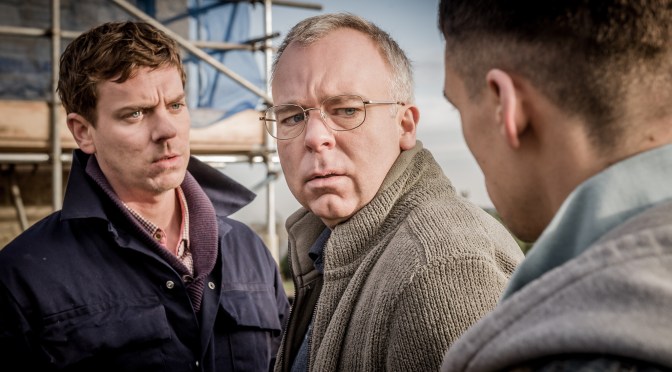
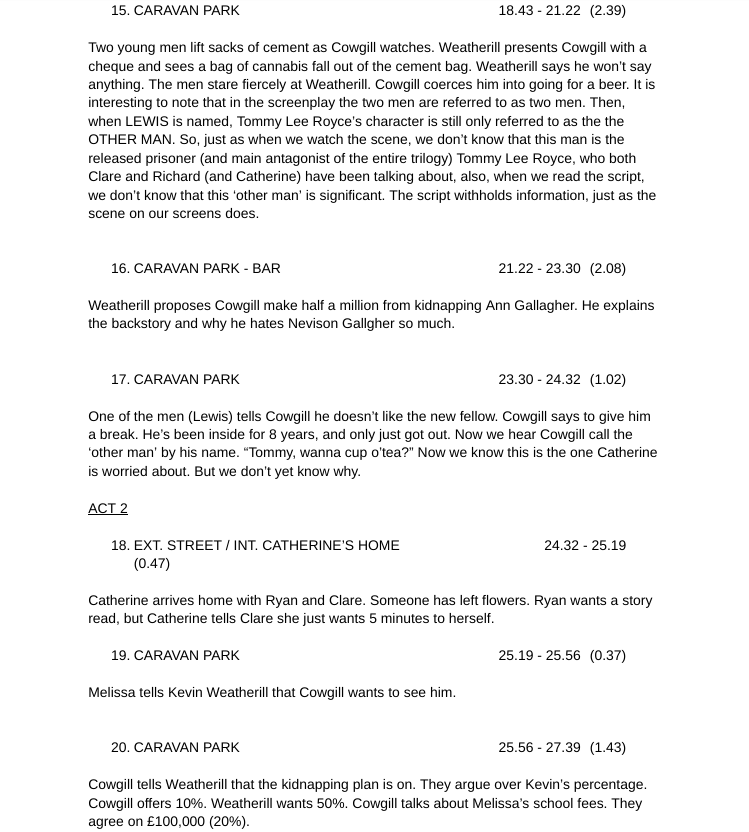
Two young men lift sacks of cement as Cowgill watches. Weatherill presents Cowgill with a cheque and sees a bag of cannabis fall out of the cement bag. Weatherill says he won’t say anything. The men stare fiercely at Weatherill. Cowgill coerces him into going for a beer. It is interesting to note that in the screenplay the two men are referred to as two men. Then, when LEWIS is named, Tommy Lee Royce’s character is still only referred to as the the OTHER MAN. So, just as when we watch the scene, we don’t know that this man is the released prisoner (and main antagonist of the entire trilogy) Tommy Lee Royce, who both Clare and Richard (and Catherine) have been talking about, also, when we read the script, we don’t know that this ‘other man’ is significant. The script withholds information, just as the scene on our screens does.
Weatherill proposes Cowgill make half a million from kidnapping Ann Gallagher. He explains the backstory and why he hates Nevison Gallagher so much.
One of the men (Lewis) tells Cowgill he doesn’t like the new fellow. Cowgill says to give him a break. He’s been inside for 8 years, and only just got out. Now we hear Cowgill call the ‘other man’ by his name. “Tommy, wanna cup o’tea?” Now we know this is the one Catherine is worried about. But we don’t yet know why.
In this post we looked at Acts 2 + 3
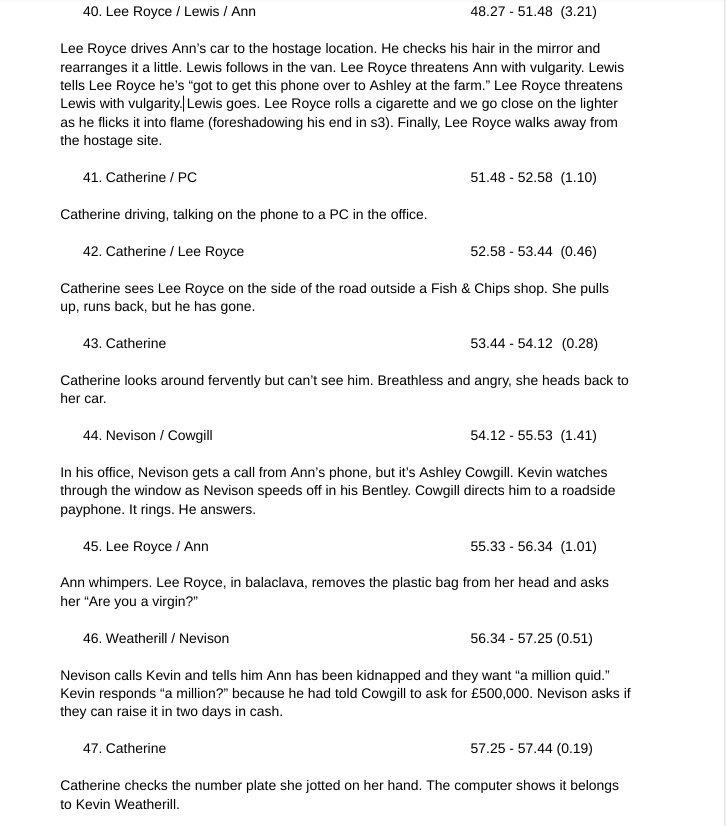
Now let’s check Act 4.

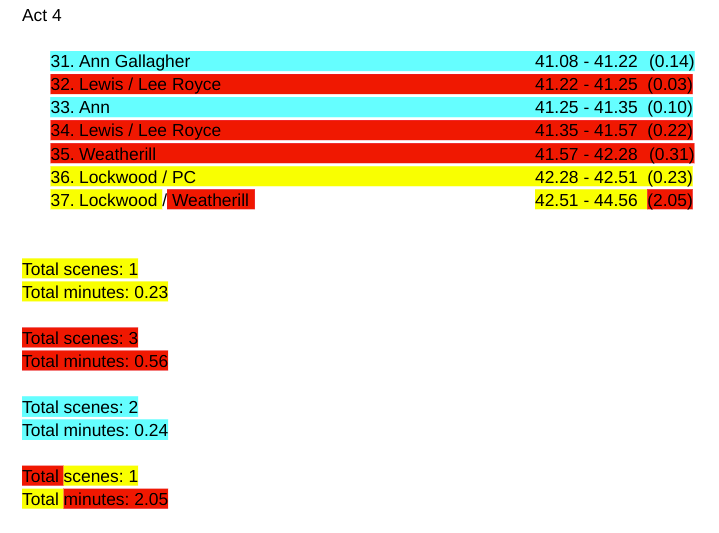
This act takes a different shape to the previous act as we build towards the climax of the episode.
First of all, we meet Ann, the main victim, for the first time since mid way through act 1 (scene 8). And it is the first time we spend time with her alone.
The next 3 scenes cut between the antagonists and the victim in short bursts, as we lead up to their showdown in Act 5.
Finally, before we propel into Act 5, we have by far the longest scene of the act (2.05) between the protagonist and the episode’s main antagonist – Lockwood and Weatherill.
Finally, Act 5.

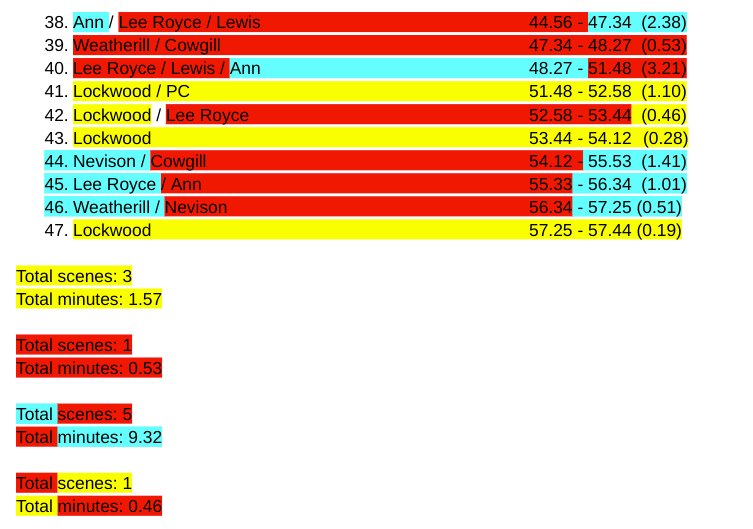
What can we notice?
Follow this blog for more analysis.
In the previous post we looked at Act 1.
In this post we look at Acts 2 + 3.

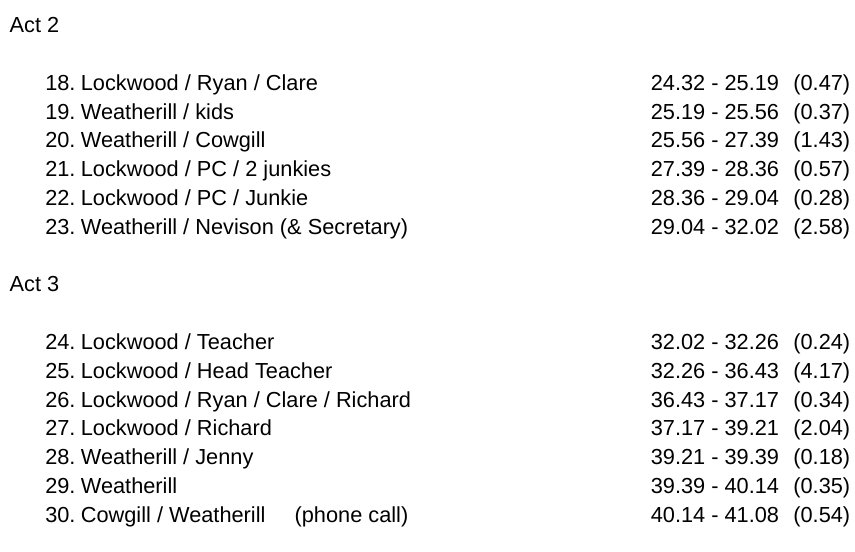
As we can see in Act 2, the balance of scenes are fairly equal between protag and antags.
The victim only appears in the final scene, together with the main episode’s antag.
The balance of time between protag / antag / victim is very well balanced: 2.21 / 2.20 / 2.58.
Now let’s look at Act 3.

What do we notice here?
The balance is heavily weighted in favour of the protagonist and dedicated to the episode’s B story – which in fact is the A story of the season – the son of the main antagonist being the grandson of the protagonist (extremely complicated and intricate story telling).
We can also notice that none of the victims appear in Act 3. The entire act is dedicated to protag and antags.
Acts 4 + 5 to follow.
In the first post I explained why I believe the episode is written in 5 acts (because the final scene of each act is turning point instigated by the main antagonist).
In this post I want to look at two things:
Scenes in yellow highlights are scenes with the protagonist.
Scenes in red highlights are scenes with the antagonists.
Scenes in light blue highlights are scenes with victims.
Scenes which are two colours are a mix, i.e. red / yellow are scenes with both protagonist and antagonist.
Let’s look at Act 1.
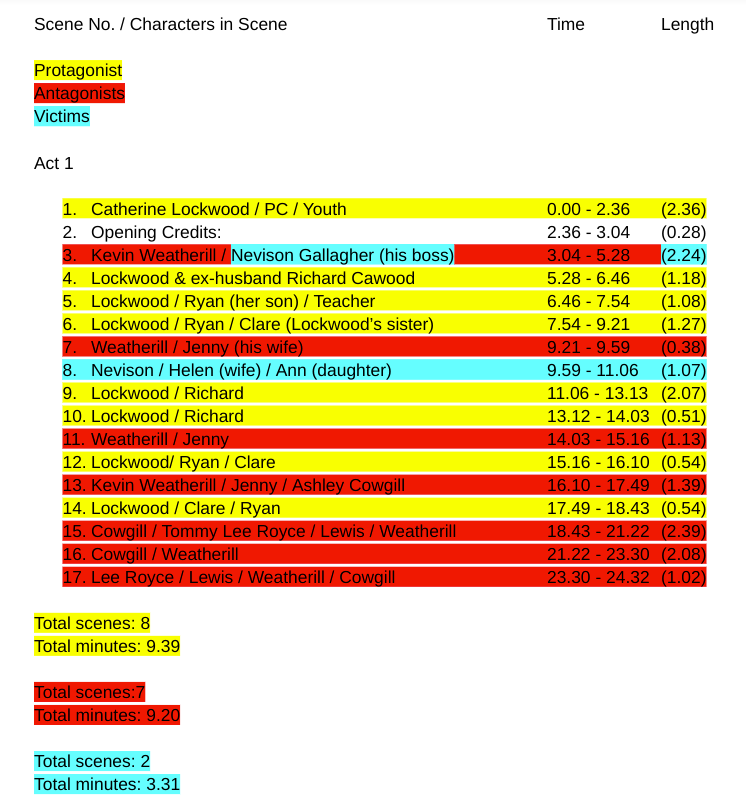
So, what can we notice?
First, there is quite an even balance of scenes between the protag and antag: 8 / 7.
The minutes of screen time are also equally balanced: 9.39 / 9.20
Victims inhabit only two scenes and 1/3 of the screen time of protag / antag at 3.31.
Secondly, almost exactly half-way through the act, scene 8, we are introduced to the main victim, Ann.
Please let me know if you notice anything else.
The purpose of this post is to analyse the balance of scenes between protagonist and their world i.e friends, family, and subplots that are non-case related (B stories) and antagonist, and as this is a police thriller, victim.
SPOILER ALERT.
Let’s start with Act 1.
The yellow highlight = protagonist. Red = antagonists. Light Blue = victim.
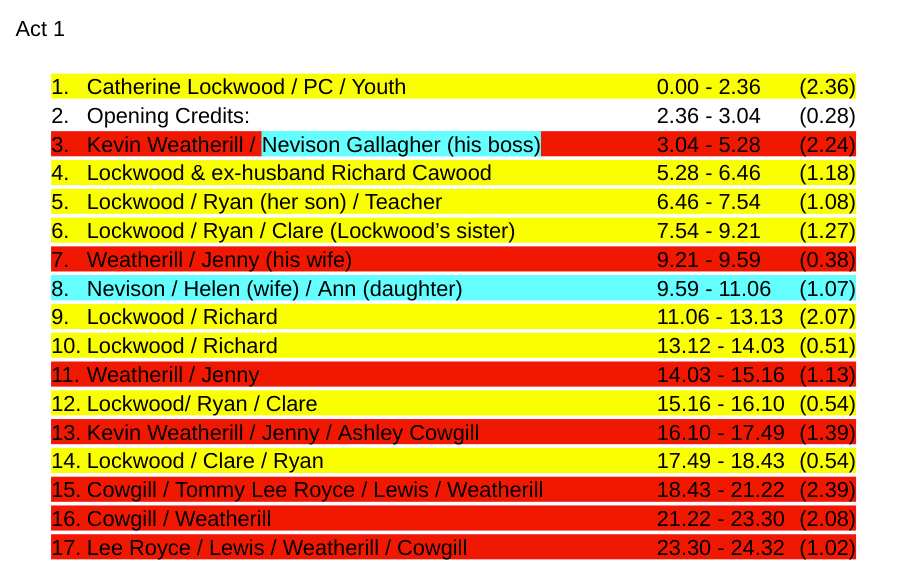
So, what can we notice?
Firstly, there is very little of the victims.
The opening scene we meet the protag, but not in connection with the main case.
After the credits the main case begins.
Immediately we are introduced to this episode’s main antagonist: Kevin Weatherill. NB some may argue that either Tommy Lee Royce or Ashley Cowgill are the main antagonist. However, as the act breaks are all punctuated with Weatherill’s actions (see this post) I believe he is this episode’s main antagonist. He instigated the entire plot. Without him, we wouldn’t have the story.
As you can see, the scenes are quite balanced. After the initial scene with Nevison and Weatherill (scene 3) there are 8 scenes followed by 3 scenes dedicated to the antagonists at the end of the act.
One of the most interesting thing to notice is that the protag and antags have not yet met.
Now let’s look at Act 2 and Act 3.

Act 2 is another well balanced act between protag and antags. Interestingly, at the end of Act 2 we witness the victim with the main antagonist.
Act 3 are 4 scenes dedicated to the protag’s personal life (B story) although in this case the B story cleverly ties in with the main plot, as the child of the protag is also the child of one of the antags (not Weatherill and not related to the main case – this B story will take shape more clearly throughout the rest of the season).
In my opinion the way the writer intertwines the B story with A story is the major strength of the work.
Now, let’s look at Act 4 and Act 5.

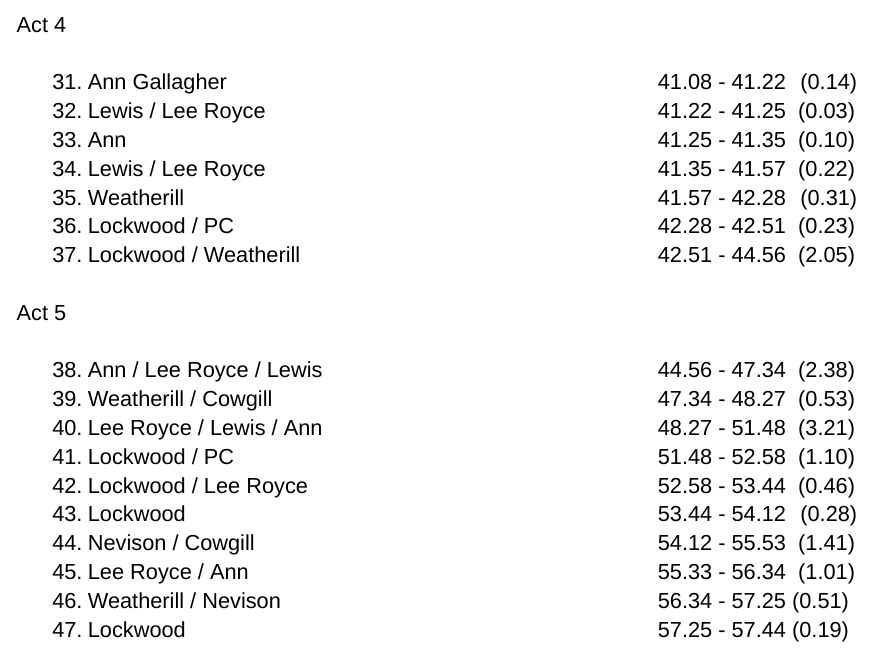
As we can see Act 4 begins with the main victim. This is the first time we spend any time with her. The first 5 scenes of this act are dedicated to the victim meeting the antagonists.
However, what is most important to note is the final scene of Act 4 is where the protag meets the antag for the first time (although in this case the protag has no idea she is meeting the antag.)
Act 5 has the second and third longest scenes in the entire episode (scenes 38 and 40) both dedicated to the major crime – the kidnap.
Scene 42 sees Lockwood see (but not meet) Lee Royce, who will become the season’s main antag.
The final scene is Lockwood discovering a major clue to the case and propels us into the next episode.
The three scenes prior to this final scene have victims and antags together for 3 scenes.
To sum up then, overall, protag and antags are kept apart until Act 4 and Act 5.
Act 5 is a glorious blending together of antags and victim.
The protag, however, is still kept separate. In fact, the only time protag meets antag is scene 37, at the end of Act 4.
What else do you notice?

SPOILER ALERT.
If I had to break this episode down into act breaks, I think I would break it into 5.
Act 1: scenes 1 – 17 (0.00 – 24.32) Act Length: 24.32
End of act: Weatherill proposes Cowgill kidnap Ann Gallagher.
Act 2: scenes 18 – 23 (24.32 – 32.02) Act Length: 5.30
End of Act: Weatherill realises he has made a mistake.
Act 3: scenes 23 – 30 (32.02 – 41.08) Act Length 9.06
End of act: Weatherill tells Cowgill he has made a mistake.
Act 4: scenes 31 – 37 (41.08 – 44.56) Act length 3.48
End of Act: Weatherill attempts to tell Cawood about the plan. (Antag and Protag 1st meet).
Act 5: scenes 38 – 47 (44.56 – 57.44) Act Length 12.48
End of Act: Weatherill learns from Nevison that the plan has been activated and Ann has been kidnapped
The final scene, (47) Catherine alone, is a hook to intrigue the audience to return.
Lockwood runs Weatherill’s number plate and gets his name and address. The protagonist is on to the antagonist.
Below is a breakdown:
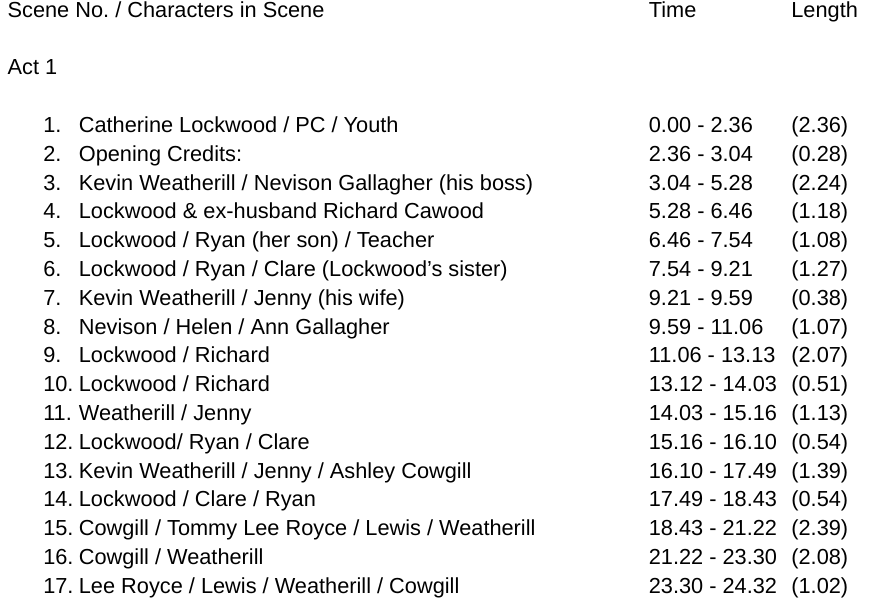
What else can we notice?
We can notice that the set up (Act 1) is much longer than any of the other 4 acts. However, since this is the opening episode of a six part series this is understandable. The 24 minute set up is setting up a 6 hour story.
Interestingly, protagonist LOCKWOOD does not meet any of the 4 male antagonists face to face until she meets WEATHERILL in Act 4, scene 37, almost 10 minutes before the end.
Lockwood’s next close shave with her main antagonist Tommy LEE ROYCE happens in Act 5, scene 42. She doesn’t meet him but almost meets him.
So, at the end of episode 1, Lockwood, the protagonist, has so far met Weatherill, without realising he is an antagonist, and has seen – but not yet met – Tommy Lee Royce, her main antagonist.
What else can you notice about the structure of this episode?

This article is also available to watch on Youtube
We’ve been looking at techniques for responding to questions.
In the last post we looked at two examples from Mammoth Screen’s The Serpent by Richard Warlow. Let’s look at some more examples from the same script. This is episode 1, available from BBC Writers Room.
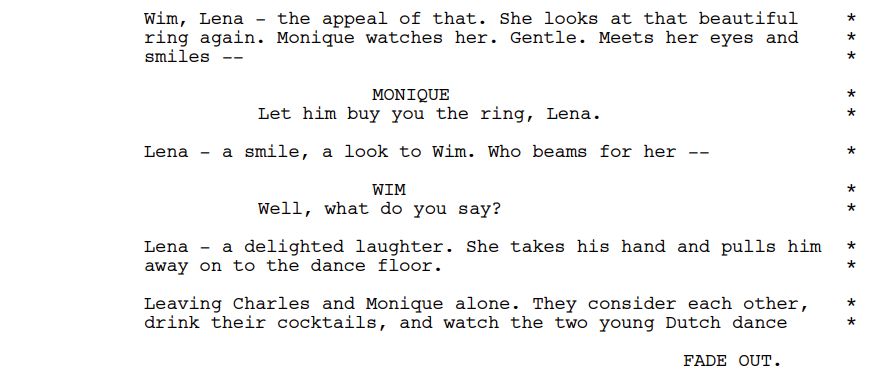
In this scene, Charles and Monique are trying to sell the sapphire / diamond ring to Wim and Lena.

When Monique asks Charles ‘they don’t have to decide now’ it is not a real question. Of course Charles wants them to decide now, but, he’s willing to play the long game. It’s a lot of money.
How does Charles reply? Of course not. But he’s lying. Of course he wants them to decide now. So what technique is this? We might say Charles is responding to Monique’s question by saying what Wim and Lena want to hear.
Let’s look at another question, a bit later in the same scene.
Let’s look at another scenario.
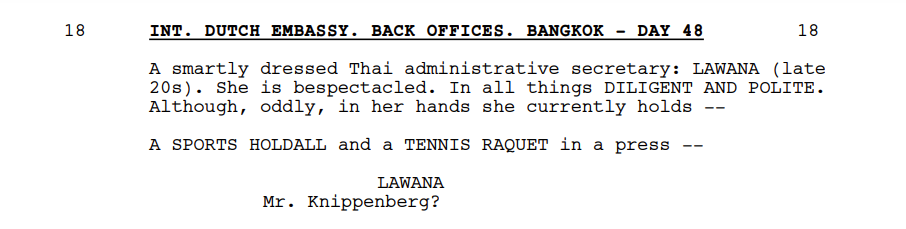

At the Dutch embassy, Lawana, the Thai administrative secretary, asks Herman to clarify that he is who she is expecting: Mr. Kippenberg?
Herman swears in Dutch before responding with a question: how long ago did the others leave?
Lawana – perhaps she doesn’t want to say. So Herman answers his own question.
To conclude, three more techniques writer Robert Marlow uses when responding to questions: