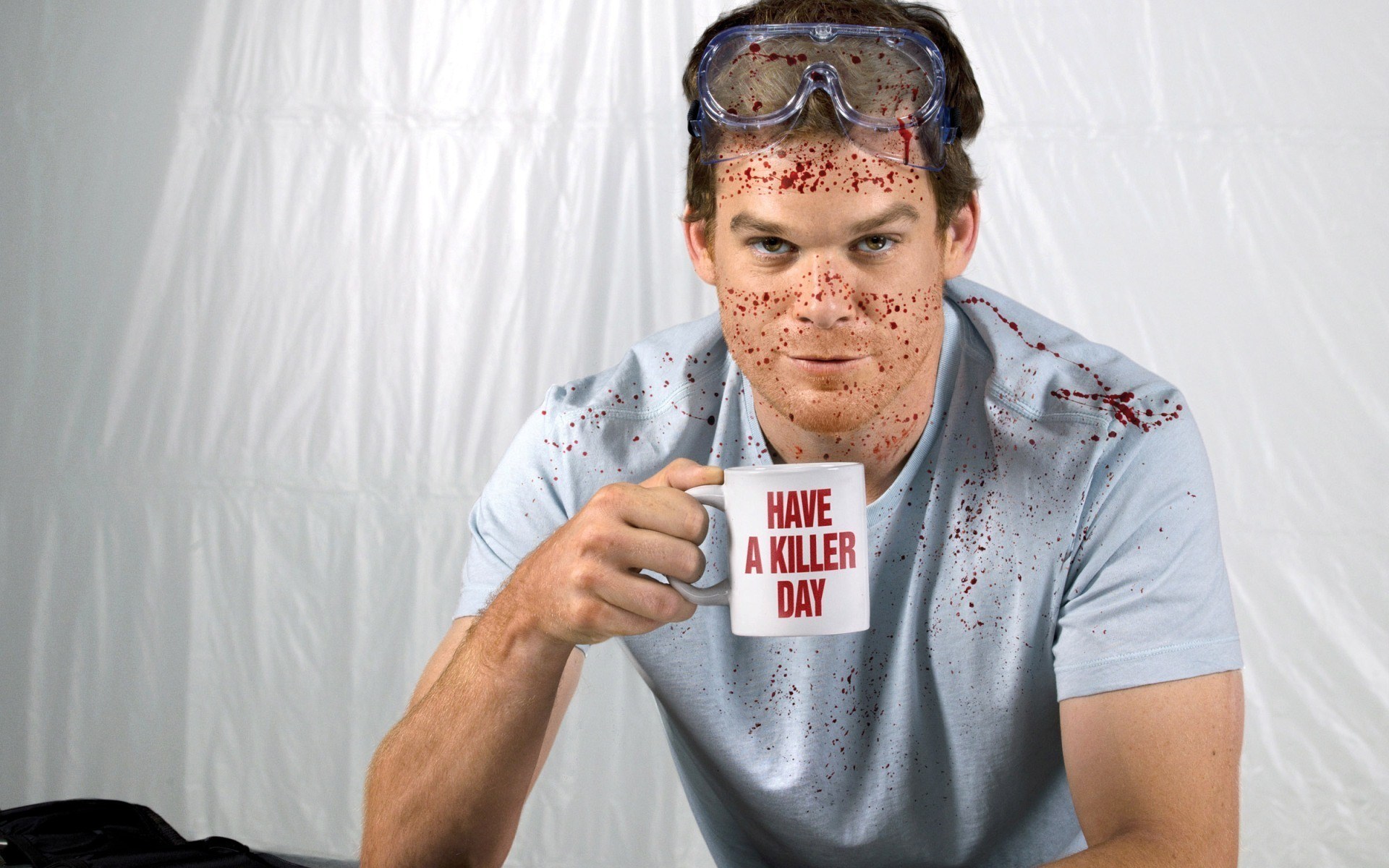
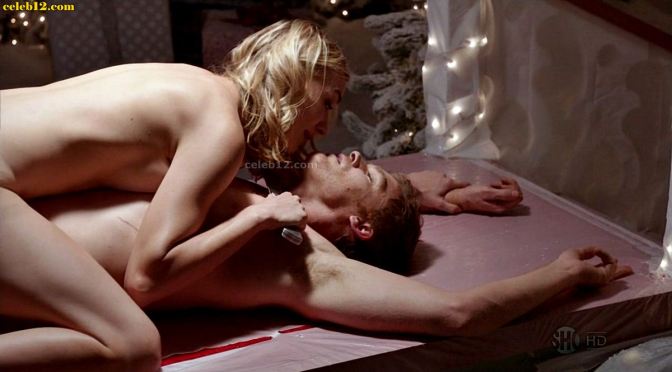
This is the longest scene of the episode (approx. 3 mins) and is the ‘climax’.
First, we see that it breaks into 5 major beats.
We also see a clear ‘to and fro’ of power.
Here’s a summary:
Beat 1.
Dexter enters annoyed at the fact that Hannah’s latest victim died in his apartment. He’s angry with her and asks her how she killed him. Hannah disarms Dexter by answering his question.
We could say the power holder at the start of the beat is Dexter, but at the end of the beat, Hannah.
Beat 2.
Dexter confesses he got rid of some evidence which would have incriminated Hannah. Hannah thanks him.
Power holder:
start of beat – Hannah.
end of beat – Shared.
Beat 3.
Hannah says she could ‘feel’ Dexter watching her when she was being interviewed by the police. She tries to draw him into an awareness of a spiritual, supernatural bond. Dexter refuses to go there.
Power holder:
start of beat – Shared.
end of beat – Dexter.
Beat 4.
Dexter needs to know if the story he heard about Hannah is true. Did she kill her husband because he wanted a family? Hannah again disarms him.
Power holder:
start of beat – Dexter.
end of beat – Hannah.
Beat 5.
Hannah tries again to draw Dexter in to an awareness of their deep, spiritual connection. This time she succeeds. Dexter is overwhelmed by her intoxicating power and the sexual ‘chemistry’ between them reaches its inevitable climax.
Power holder:
start of beat – Hannah
end of beat – Shared.
The shared power at the climax of this scene is echoed in Hannah’s line: ‘We were looking out for each other.’
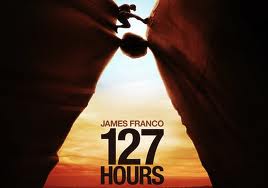
127 Hours runs at 90 minutes and adheres to perfect 3 Act Structure:
Act 1: 15 minutes.
Act 2a : 30 minutes.
Midpoint
Act 2b: 30 minutes.
Act 3: 15 minutes
NB: The Midpoint or Point of No Return happens at 45 minutes – exactly half way through the movie.
Each act break + plot point is not only marked with a Turning Point but is also marked with the end of a musical sequence.
Watch the film carefully paying attention to what happens at these exact times.
So, what happens at each Turning Point?
SPOILER ALERT – watch the movie before you read this analysis!
Act 1 begins by foreshadowing the moral revelation the hero will have in the climax – Aron’s selfishness – as he refuses to answer his mum’s phone calls or tell his work mate where he’s going. Next we’re shown an excited young man off on an adventure. He’s a daredevil. When he spectacularly falls from his mountain bike he simply smiles, snaps a pic of himself and he’s ‘back on the saddle’ foreshadowing his tenacity and resilience displayed in extremis in the Climax.
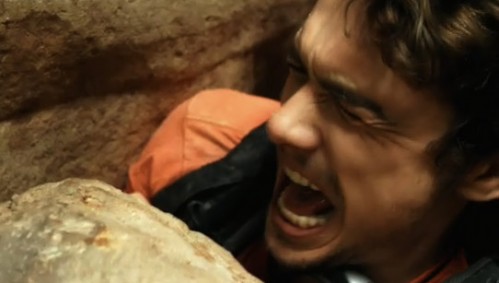
After exactly 15 minutes, Aron falls: the film’s inciting incident. He’s trapped by the rock. Danny Boyle inserts the film’s title 127 Hours here, telling us the movie, the real story, starts now. Like any Act 2 this is the new world, the upset Status quo which must be re-balanced.
So Act 2 begins at 15 minutes.
Then, 15 minutes into Act 2 (30 minutes into the movie) we have Plot Point 1 which points us towards the film’s major Theme.
So what happens here? Well, we see Aron as a small boy sitting on the Grand Canyon in his father’s loving embrace as they both stare out at the rising sun. (Theme: interconnectedness + familial love).
Between 30 minutes and the midpoint at 45 minutes we witness Aron beginning to make his video diary. He addresses his mom and dad – we hear his mother’s voice saying ‘call me – lots of love’ (Theme reinstated: connectedness + familial love).
The Midpoint or Point of No Return comes at exactly 45 minutes: Aron takes his pocket knife and tries to cut his arm – foreshadowing the Climax. Why is this the Point of No Return? Because Aron is considering another option, if all else fails.
And we’re into the second part of Act 2 which we’ll call Act 2b.
Immediately after the Midpoint we’re back with the video camera and treated to the hilarious spoof radio show and Aron’s self-examination. This is a superb blend of comedy and tragedy. He reveals the fact he’s always seen himself as a ‘big fucking hard American superhero’ who can do everything ‘on his own’. This is writing of the highest quality; the hero’s moral / psychological revelation that his ‘supreme selfishness’ – his character flaw – has led him to this place of captivity and isolation, later to become a place of extreme suffering, is delivered with a ‘spoon full of sugar’ as this self-revelation is presented to us by the writers gift-wrapped in brilliant dialogue as Aron attacks his own flaws with scathingly funny self-deprecating humor.
Then, 15 minutes after the Midpoint at Plot Point 2 Aron rams the blade into his arm. Danny Boyle takes us visually inside his arm and we see the blade ‘close to the bone.’ An idiom often used when remarks cut close to the truth. And the truth Aron has just revealed to us? He has been living life selfishly. In fact, he apologizes to his mom and dad into the camera for being ‘unappreciative.’
After another 15 minutes, at around the 75th minute of the movie – leading towards the End of Act 2 Turning Point Aron apologizes to his sister that he won’t be able to play piano at her wedding. Another apology. This dialogue tells us he has accepted his fate and that fate is death. Michael Hague calls this the ‘All is Lost’ moment. Blake Snyder the ‘Visit to Death’.
Then, still at the 75th minute mark, we enter ACT 3 as Aron makes one last ‘do or die’ drive to set himself free, and, as a mirror to the Midpoint – BANG! – he rams the blade back into his arm and drags us, screaming and terrified, feeling every nerve of his tortuous pain, into the bloody, horrific Climax.
The next 15 minutes are the Resolution as Aron is rescued. Here Aron’s learning curve – his character arc – is clear as the ‘big hard fucking superhero’ who can do ‘everything on his own’ screams for help from strangers – a changed man.
127 Hours sticks to perfect 3 Act Structure as taught by Michael Hague and also adheres to John Truby’s teachings on Moral and Psychological Revelations in his book Anatomy of Story.
Having explored most of the major screenwriting books like Story by Robert McKee, Anatomy of Story by John Truby, Screenwriting for Hollywood (audio book) by Michael Hague, The Writer’s Journey by Chris Vogler, Save the Cat by Blake Snyder and The Sequence Approach by Paul Joseph Gulino (among others) I’m still convinced 3 Act structure is the way that feels right, the most organic. What about you? Are you using 3 Act, or finding Truby’s 22 Steps better, or the 8 Sequence approach?
I see the ‘Turning Points’ in 3 Act structure as stepping stones between which we the writer have absolute freedom to create character, scribble scenes, dabble with dialogue, search for subtext etc. while needing to step on these crucial stones so that our heroes can reach their goals. What do you think? Which structure are you using? Or if you’re a novelist do you follow structure at all? Should novels obey the rules of screenplays or should there be more freedom for fiction?