Category Archives: #screenwriting

Introducing characters in The Serpent

Welcome to this series of posts looking at how different writers introduce their lead characters.

Let’s start with episode 1 of The Serpent written by Richard Warlow, produced by Mammoth Screen. The screenplay is available on the BBC Writers’ Room website.

Let’s take a look.

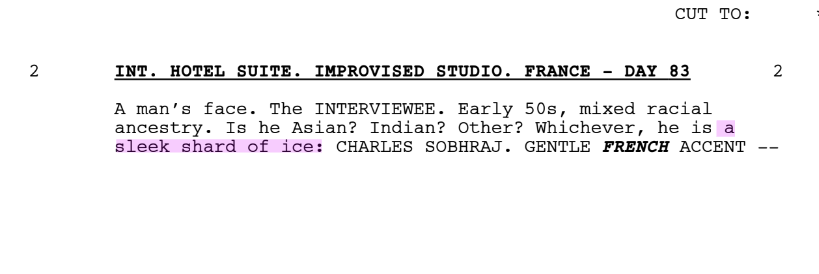
I love this. Charles Sobhraj is a sleek shard of ice. Richard Warlow chooses to describe him with a metaphor. Doesn’t it work well? Doesn’t it tell us everything we need to know about him?

Next, we meet the other protagonist, Monique. Let’s see how Richard Warlow introduces her.

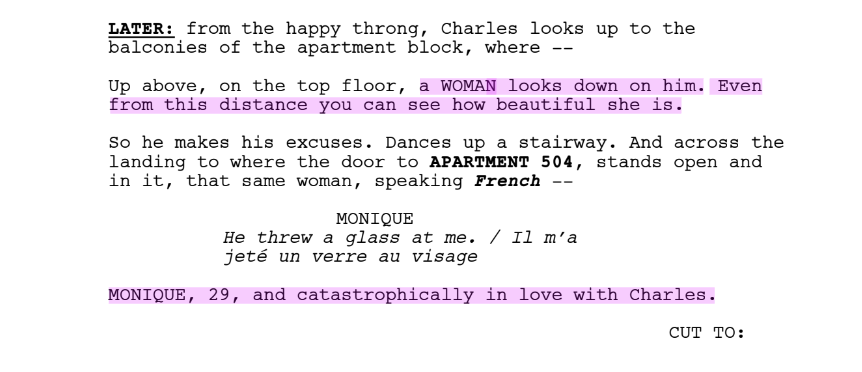
So, first, we simply see a WOMAN looking down on him. Before we know her name, from a distance, we can see how beautiful she is. Then, when Charles enters, and we can hear her as well as see her, the writer describes her as being ‘catastrophically in love with Charles.‘ And that’s all we need to know.

So, all in all, Charles is a sleek shard of ice and Monique is catastrophically in love with him.

And that’s all we need to know.

Dialogue techniques in The Serpent

Let’s consolidate the lessons we learned from looking at dialogue in episode 1 of The Serpent by Richard Warlow, published on the BBC Writers Room website.

Overall, there are three articles:

Article 1

Article 2

Article 3

These articles illuminate 8 separate techniques:

  1. Say what others want to hear.
  2. Respond with action.
  3. Answer your own question.
  4. Choose not to answer
  5. Respond with a question
  6. Avoid the question
  7. Seduce
  8. Euphemize

What other techniques are there for answering questions? Let me know on Twitter @screenwrite.org

Dialogue in The Serpent – responding to questions part 3.

This article is available to watch / listen to on Youtube below.

So, this is the 3rd and final part of looking at questions in The Serpent, and techniques writer Richard Warlow uses when his characters respond to them.

I can see 3 techniques in this section worthy of noting.

SPOILER ALERT.

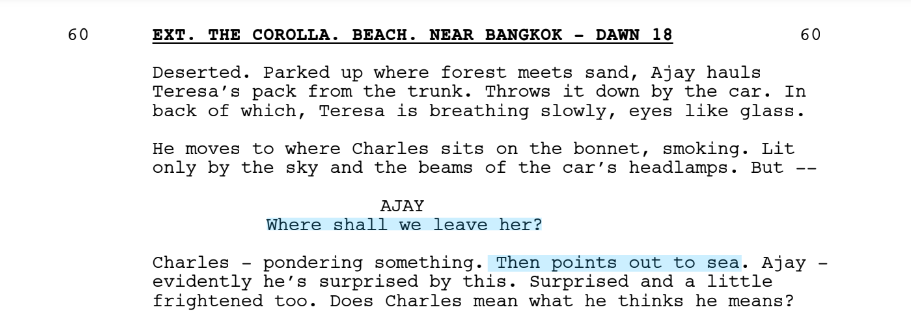
Technique 1: Responding with action: in this section of script, Charles and Ajay have kidnapped a backpacker, Teresa. Ajay isn’t sure of the plan. So he asks Charles. Charles responds with an action – he points out to sea.

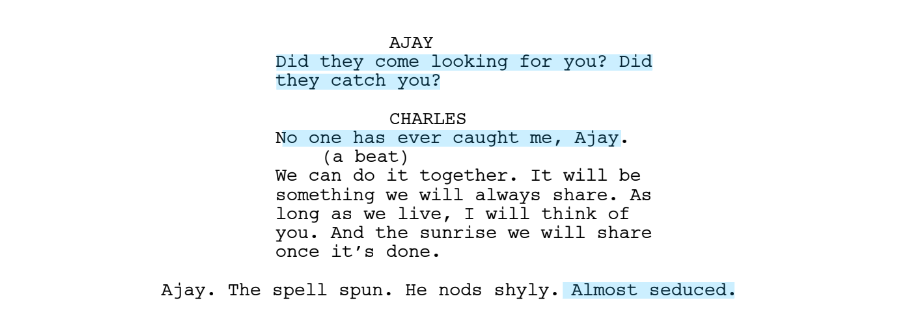
Technique 2. Seduce – in this section Charles is looking for a partner in crime. Charles, having just shared a deep dark secret with Ajay for the purpose of building trust, that he once killed a taxi driver the same way, is asked by Ajay Did they look for you? Did they catch you?
– to which Charles replies No one has ever caught me, Ajay. Which is true. One of the rare occasions where someone answers with the truth. In this post dissecting the dialogue in Dexter we can see that when someone tells the truth it can be when a character relinquishes power in order to draw the person into their trust. In a way, here, Charles is relinquishing power if, indeed, the story he told, the murder confession is true. If not, he is simply deceiving Ajay with lies, which, paradoxically, is probably closer to the truth. If, therefore, Charles has been lying the whole time, with his murder confession, yet pretending to reveal a great truth about himself, it only accentuates his psychopathy, and his powers of manipulation.

Technique 3: Euphemistic

Our final example, then, of techniques used by Richard Warlow when his characters respond to questions in episode 1 of The Serpent, is where Charles uses a euphemism in order to conceal his heinous intentions. Here’s the moment:

No. Better than that actually means No. I’m going to kill you. His better than that softens the blow. If the meaning of euphemism is “the use of a word or phrase to avoid saying another word or phrase that may be unpleasant or offensive” (Cambridge dictionary) then we might say Charles phrase here is euphemistic.

In my opinion this is a fascinating choice by Richard Warlow. He has the choice to have Charles respond to this question in any way he wants. He has Charles give Teresa one last glimpse of false hope before she meets her dreadful fate. Superb.

Don’t forget to follow me on twitter @screenwriteorg or follow this blog for future posts.

Dialogue – responding to questions in The Serpent part 2.

This post is available to watch / listen to here:

In the last post we looked at three techniques writer Richard Warlow uses in episode 1 of The Serpent when his characters respond to questions.

(The script is available on the BBC Writers Room website.)

In this post we’re going to consider three more techniques.

Here goes:

In this scene Celia and Teresa are floating down the river in Bangkok discussing heroin and hash in Kathmandu.

Celia asks Teresa Then where are you going?

Teresa chooses not to answer.

Technique 1. Choose not to answer.

Let’s look at the next section of the script.

Celia’s next question is You sure you don’t want to get high?

Teresa answers a question with a question. Why get high? Standard screenwriting technique, but, how does Celia respond to Teresa’s question?

She doesn’t. Teresa continues her train of thought, enjoying the breathtaking new oriental landscape.

With this 2nd question (and we might say that by responding with two consecutive questions the writer transcends the standard technique of answering a question with a question) Teresa both reveals character and sets personal boundaries – she doesn’t need heroin or hash – she’s naturally high.

Technique 2: respond with two questions, while revealing character.

Finally, in this scene Teresa calls her Grandma (Emma) back in California, who asks:

Teresa responds I just felt I didn’t say goodbye properly.

That’s not true. And we know it’s not true, because by the end of the scene Teresa has admitted to Emma, her grandma, that she has a ‘bad feeling’…

But, initially, Teresa avoids the question, possibly to protect her grandma from the truth.

Technique 3: avoid the question.

So, three more techniques from Richard Warlow

1. Choose not to answer.

2. Respond with two questions while revealing character.

3. Avoid the question to protect the asker from the truth.

Dialogue – responding to questions in The Serpent: part 1

This article is also available to watch on Youtube

We’ve been looking at techniques for responding to questions.

In the last post we looked at two examples from Mammoth Screen’s The Serpent by Richard Warlow. Let’s look at some more examples from the same script. This is episode 1, available from BBC Writers Room.

In this scene, Charles and Monique are trying to sell the sapphire / diamond ring to Wim and Lena.

When Monique asks Charles ‘they don’t have to decide now’ it is not a real question. Of course Charles wants them to decide now, but, he’s willing to play the long game. It’s a lot of money.

How does Charles reply? Of course not. But he’s lying. Of course he wants them to decide now. So what technique is this? We might say Charles is responding to Monique’s question by saying what Wim and Lena want to hear.

Let’s look at another question, a bit later in the same scene.


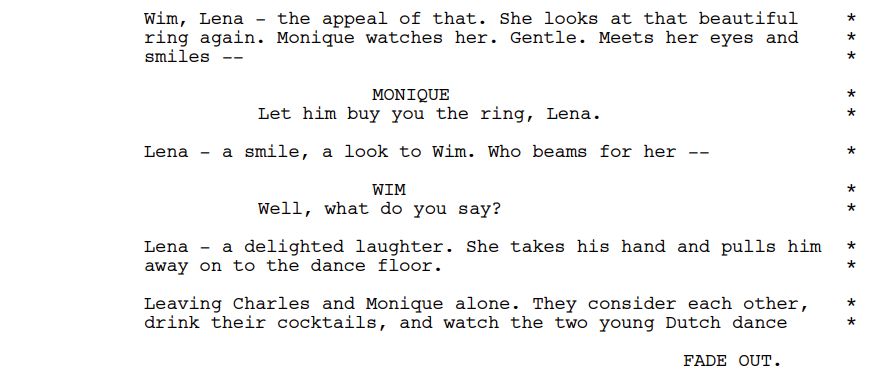
This time Monique pushes for a sale, telling Lena to let Wim buy her the ring. Lena smiles at Wim. Wim ‘beams for her’ and asks Lena: Well, what do you say? Lena responds not with words but with action, laughing and pulling him to the dance floor.

Let’s look at another scenario.

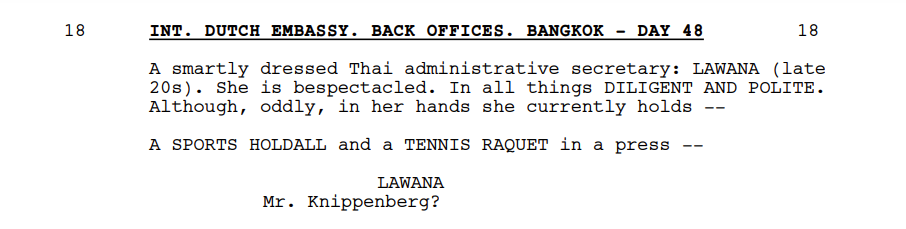
At the Dutch embassy, Lawana, the Thai administrative secretary, asks Herman to clarify that he is who she is expecting: Mr. Kippenberg?

Herman swears in Dutch before responding with a question: how long ago did the others leave?

Lawana – perhaps she doesn’t want to say. So Herman answers his own question.

To conclude, three more techniques writer Robert Marlow uses when responding to questions:

  1. Say what others want to hear.
  2. Respond with action.
  3. Answer your own question.

Dialogue – responding to questions in The Serpent

We’ve been looking at dialogue, and the choices we have when responding to questions.

But how do the experts do it?

This is an excerpt from episode 1 of The Serpent by Richard Warlow available on the BBC Writers Room website.

Herman works for the Dutch consulate in Bangkok. Van Dongen is the ambassador. Herman interrupts him at a pool party, which Richard Warlow describes as:

See the diplomatic classes at play. Plenty of BOOZE. Multiethnic, elite, transactional. Men and women; drink and sex. And Herman – the only man still in his work clothes, nodding
a polite and embarrassed hello here and there —

Van Dongen doesn’t say ‘yes’. And he doesn’t say ‘no’. Not directly. What does he do then?

It seems to me Van Dongen is saying ‘no’ but indirectly. He says ‘no’ without saying ‘no’. He says ‘no’ using other words.

What about this next section, immediately following?

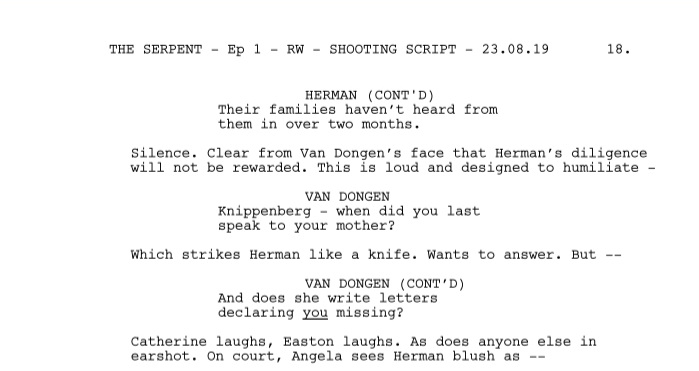
Van Dongen: When did you last speak to your mother?

Which strikes Herman like a knife. Love that. Wants to answer. But —

Van Dongen doesn’t let him. Instead, he twists the knife with sarcasm. And belittles him, in front of others, showing character.

Brilliant.

5 more dialogue techniques for responding to questions

In the last post we looked at 7 ways for a character to respond to questions.

Having read this review of Better Call Saul which mentions Walter White’s ability to misunderstand a question, here are five more techniques for our arsenals:

  1. Misunderstand the question:

ADAM

Are you going to eat the apple?

EVE

Am I going to eat the what?

2. Mishear the question:

ADAM

Are you going to eat the apple?

EVE

Am I going to meet the apple?

3. Misinterpret the question:

ADAM

Are you going to eat the apple?

EVE

Do you want to eat the apple?

4. Respond to the subtext:

ADAM

Are you going to eat the apple?

EVE

You’re too controlling. I’m leaving.

5. Respond with sarcasm:

ADAM

Are you going to eat the apple?

EVE

I’m going to eat all the goddam apples!

Do you have any more to share?

7 Dialogue Techniques for Responding to Questions.

Let’s look at some dialogue techniques which we can apply to our scenes.

Section A: Responding to questions.

  1. Ignore the question.

Whatever is said, have your next character ignore it and reply with something completely unrelated.

ADAM

Are you going to eat the apple?

EVE

Nice figleaf.

2. Respond with the same question.

ADAM

Are you going to eat the apple?

EVE

Are you going to eat the apple?

3. Respond with an action.

ADAM

Are you going to eat the apple?

Eve can’t believe what Adam is wearing. She turns away, so he can’t see her laughing.

4. Respond with a different question:

ADAM

Are you going to eat the apple?

EVE

Are you going to keep asking the same question?

5. Respond to the question.

ADAM

Are you going to eat the apple?

EVE

I might.

6. Respond to the question and ask the same question:

ADAM

Are you going to eat the apple?

EVE

I might. Are you?

7. Respond with an unrelated statement, then respond in the next line.

ADAM

Are you going to eat the apple?

EVE

Nice figleaf.

ADAM

You like my figleaf?

EVE

I was planning to eat the apple.

Just a few techniques to take control of your dialogue.

Do you have any to share?

The X-Files – what a Shocker.

MA Writing for Script & Screen – reflective blog

Over half way through the module, in week 8, and I’m almost ready to submit my X-Files reboot. I’ve got my character bios, my premise, my step outline, my key scenes. And my module tutor this week told me he thought my twist reveal works. Bingo.

Except, one minor problem: one aspect of this X-Files reboot is to include, reinvent or re-imagine a character from the original TV show, for fan service.

Well, I opted for the laziest choice, Section Chief Scott Blevins, played by Charles Cioffi. (BTW Mulder and Scully cannot appear – it has to be new protagonists). Having only watched three episodes of the original season, choosing to analyse in detail the pilot rather than watch the whole season, (our course leader had said to watch one season was enough) I reimagined Chief Blevins with Charles Cioffi who would be the longest serving Director of the FBI in living history at the age of 87.

Problem is, the character died in ’97. (Charles Cioffi is still alive).

Hmmm. That’ll learn me to cut corners on my viewing / research.

My tutor gently and helpfully pointed out that one aspect of the course is the ability to research and write to a brief, noting British soaps as needing this kind of skill from a screenwriter.

But, like any great teacher, my tutor not only pointed out a problem, but he offered me a solution. Two solutions, in fact.

You have enough time, he said, to research etc. You could possibly re-introduce a different character. One that isn’t, er…dead. (Solution No. 1)

Or…make your episode a prequel to Scully and Mulder, when Chief Blevins is still alive. (Solution No. 2.)

Brilliant!

My tutor said there’s nothing in my script that really suggests present day, except emails, mobile phones and a methamphetamine epidemic. All of which are easily substituted. Emails: snail mail. Mobile phones: landlines. Meth: heroin, cigarettes or alcohol. Since we are working to a family friendly brief, maybe the meth-addicted mother would be better on ‘the sauce.’

So, I’m edging towards solution No. 2.

However, I didn’t really want to lose the meth angle. So now I’ considering Mitch Pileggi aka Walter Skinner, who works out perfectly as a 70 year old (Mitch Pileggi was born in 1952) in the race for longest serving director of the FBI with J.Edgar Hoover.

And, having just wiki’d Mitch, I find out he was in Wes Craven’s Shocker, which was the very first film I watched stoned on marijuana, and which frightened the life out of me more than any other film ever.

Perhaps I’ll slip in a cheeky reference in dialogue e.g. You never fail to shock me, special agent.

It’s all starting to make sense.

Problems, problems, problems.

Still, they are only story problems.

My kind of problems!

3 weeks until submission.

Time to think, watch, review and reflect.

I am grateful for superb tutorial feedback. Over all my tutor gave me 7 excellent points to consider with some brilliant ideas on how to improve my work and take my story to the next level. He really went the extra mile.